Tag Archives: Shortwave Radio

Russian Agents Used Shortwave Radio to Receive Coded Messages

Courtroom drawing of the suspects. Source: NY Times

Many of you may have noticed in the news yesterday that shortwave radio was used by the 11 Russian agents who were carrying out espionage within the United States. An article in the New York Times noted that one of the methods they used to communicate with the S.V.R. headquarters in Russia was via shortwave radio. The article mentioned that the agents would send “coded bursts of data” via shortwave transmitter.

The NY Times article failed to mention that the agents no doubt received messages from Russia via shortwave numbers stations.

So why is shortwave radio–a rather “low-tech” communications medium–used in modern espionage? The primary reason is it’s almost impossible to trace, thus messages leave little to no breadcrumbs for one to follow back to the source.

For decades, radio listeners have been trying to figure out from where numbers station broadcasts originate. They’ve had very little success. Indeed, the only breaks we’ve had have been when the broadcasting station makes a mistake. This has happened once with a numbers station message originating from Radio Havana Cuba. Listeners heard the faint sound of an RHC broadcast in the background–they were obviously hearing noise from across the studio hall.

Of course, another reason shortwave radio is used to relay secret messages is because it’s almost impossible to block. I wrote an article called “When shortwave radio is better than the Internet” that describes why this characteristic alone is an important reason to keep shortwave stations on the air around the world. No government or local authority can prevent you from listening to shortwave broadcasts–whether you’re a spy (like this lot) or simply living in a country where the folks in charge like to  control your access to the news and information.

One small shortwave  radio can break through all of that red tape.

UPDATE: For more information on how radio was used by these agents, check out the US Department of Justice’s website. In particular, check out pages 11-12 in this document. (Thanks to David Goren for this tip.)

For more information:

RNZI says shortwave ‘will continue to play major role’ in Pacific

In an age where shortwave listeners feel they only hear negative news from the major broadcasters, it’s refreshing to see that one of our favorite stations understands the value of shortwave radio.

In an interview with the Asia-Pacific Broadcasting Union (ABU),
Chief Executive of Radio New Zealand, Peter Cavanagh, said:

“We currently broadcast to the Pacific using both analogue and digital (DRM) shortwave transmitters.

“Most of our local partner stations are now using our digital transmission to provide a higher quality and more reliable signal for re-broadcast to their own audiences.

“But many individuals and those living on the more remote islands are still very much dependent on analogue receivers – particularly in times of crisis such as the cyclone season – and it’s likely that analogue shortwave will continue to play a major role in the region for many more years to come.”

Read the full article here.

Something he didn’t mention was the importance shortwave radio played in Fiji last year when the government shut down Australia’s ABC’s FM stations. Unlike the internet or FM radio, shortwave radio crosses borders without regard to who is in power.

Shortwave Radio Charity, Ears To Our World, Featured in Wall Street Journal

From the Wall Street Journal Magazine:

Source: ETOW Partner - The Empower Campaign

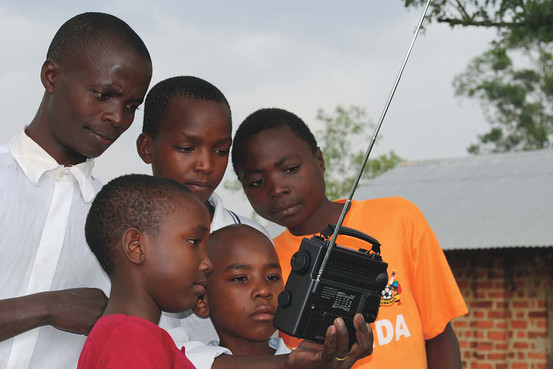
“This is the sound of renewable education!” says Thomas Witherspoon, 37, founder of Ears to Our World, as he picks up a small portable radio and quickly cranks its handle, producing a high-pitched, wobbly whine. Inside, a dynamo charges the radio’s battery. Witherspoon has taken his love of shortwave radio and filtered it through his experience in the corporate world, devising a strategy to help the most people for the least money. ETOW distributes wind-up radios to isolated villages across Africa and into Belize and Romania, providing listeners with vital information. His radios are also proving to be disaster-relief heroes in earthquake-devastated Haiti.

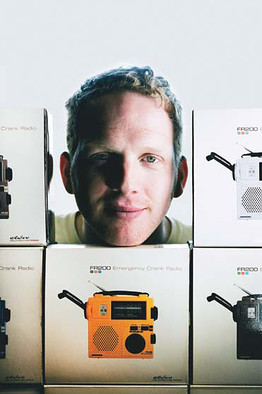
Thomas Witherspoon of Ears To Our World

Thomas Witherspoon of ETOW. Source: WSJ Mag, Randy Harris

“We give them to schools, and teachers use them to enhance the classroom experience,” Witherspoon says. “It’s not dependent on power. It’s not dependent on Internet or any other infrastructures.” Founded in 2008, ETOW has grown quickly, squeezing the most out of minimal funding by collaborating with established educational organizations, and by taking advantage of the one-to-many model inherent in broadcasting. “I’ve heard stories coming back from some of our partners that when someone’s listening to a radio, you can guarantee there’s going to be 10, 20 people listening at the same time,” Witherspoon says.

Read the full article at the Wall Street Journal website and consider expanding your radio hobby by donating to ETOW!

Irish Times Reports On Shortwave Broadcaster Targeting North Korea

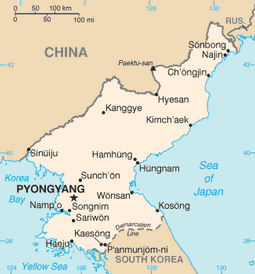
Free North Korea Radio is giving voice to a growing opposition to the dictatorship, writes David McNeill in Seoul.

Building up a new network of stringers took time. Today, 10 freelance journalists provide reports from behind the bamboo curtain on a retainer of about $100 (€73) a month. They include a university professor, a teacher, at least two soldiers and a North Korean security agent…

…FNKR provides them with small digital recorders, which are used to record interviews, and mobile phones with signals that work across the Chinese border – Pyongyang’s fledgling mobile- phone system was bought from Egypt and is incompatible with the South Korean network.

The recordings are smuggled across the Chinese border and transported back to Seoul via a network of spies.

The results detonate on air during Voices of the People , where the raw views of the North’s citizens – electronically distorted – are broadcast back into their own country. Brainwashed automatons in so much reporting, the people heard here emerge as thrillingly human, alive and angry.

Read full article in the Irish Times.

Other reports of Free North Korea Radio:

Radio World: Whatever Happened to Shortwave Radio?

For all its transmission expense and audio problems, analog shortwave radio has one clear advantage over the Internet and domestic radio/TV: It cannot be easily blocked — even when states try to disrupt its signals using jamming transmitters.

This is one of the best articles I’ve read recently about the state of shortwave broadcasting. It features authorities on the subject like Andy Sennitt, Larry Magne and Kim Elliott. Moreover, it highlights the historical appeal and the challenges shortwave broadcasts face in the internet age. Click here to read the full article on Radio World’s website.

forth magazine: Clandestine, not confidential

Jason Walsh, of Ireland’s forth magazine, attempts to separate the news from the propaganda on the international airwaves – and finds it impossible

IMAGINE THERE was a communications medium that spanned virtually the entire globe and was virtually impossible to censor. Now imagine that, unlike the internet, it couldn’t be switched-off by the powers that be and didn’t require expensive equipment or monthly subscription fees to access. That would be a powerful voice for democracy, wouldn’t it?

Read the full article here.