Shortwave listening and everything radio including reviews, broadcasting, ham radio, field operation, DXing, maker kits, travel, emergency gear, events, and more
Whenever I ask myself that question, I can’t help thinking of a couple analogies. Let me explain one. In the mid-80s, there were three contenders for the home computing market: IBM, Apple, and Commodore. There were others, but those were the main ones. It was not uncommon for entrepreneurs to rent out halls and host fairs at which vendors for all three platforms would display the latest peripherals and software. The IBM PC was incompatible with the Apple IIe; each, in turn, was incompatible with the Commodore 64. Most of the software came at premium prices. Why? I was told that developers had to recoup their cost from the existing group of owners of each specific platform. Being the early days of home computing, these groups were relatively small, and consequently, this determined the cost of software. This situation was euphemistically known as the “installed base” ? an existing population of users who owned computers for the targeted software.
Applying this to radio, is there an installed base to warrant more international shortwave broadcasting? From all appearances, there are more shortwave radios being marketed now than I can ever recall. I searched for “shortwave radios” on Amazon, hoping to get a reasonable model count, but soon gave up.
Without getting into the politics of the issue, the Chinese are the dominant player in shortwave use today. They are making most of the shortwave radios and doing most of the shortwave broadcasting. The targeted audience is both domestic and international. The radios they make are marketed around the world, apparently quite successfully. An AI inquiry on the Internet can’t put a number on it, but states that there has been a resurgence of interest in shortwave, particularly since the COVID-19 pandemic and subsequent global conflicts. Isn’t it reasonable to assume there is now a sizeable installed base of potential shortwave listeners?
If I may be allowed one more analogy, in 1950 the physicist Enrico Fermi asked the cosmic question, “But where is everybody?” He was referring to the scope of the universe, the real probability that there are enough other habitable planets such that some others should support life. His paradox is that we have not yet heard from anyone else.
Again, translating this to radio, given the proliferation of shortwave radios and listeners, where are all the broadcasters? Hasn’t the quality, performance, reasonable cost, and availability of shortwave radios been the seed to start the resurgence of shortwave broadcasting?
The well-worn argument is that times have changed. We now have the Internet and cell phones to instantaneously bring us an incomparable mass of information and entertainment, all of this on demand. Why contend with noise, interference and weak signals? Why wait for desired content to be available on a certain day at a certain hour? Further, and just as important, public broadcasting is costly in terms of production and delivery. To put a face on it, shortwave radio does not permit one to fasten a $200 GoPro to the front of his bicycle, video his ride, post it on YouTube, and garner thousands of likes.
All of that is strong poison. On the other hand, radio waves are an immutable form of electromagnetic radiation. The medium is not going away. With a high degree of certainty, it will eventually be repurposed, possibly in digital form or with some method of modulation which is yet unknown. The content may be commercial, military, private, or public. Someone is going to figure out a way to use it.
In the meantime, why can’t we use it just the way it is? One advantage of radio is real-time broadcasting – talk radio, spontaneous news reporting, and emergency information. While this is possible on the Internet, its implementation has been tangential. For example, I can go for a live cab ride with a truck driver, watch trains run around Horseshoe Curve, or listen to a techno-specialist field viewer questions – all live it’s true, but still not quite the same thing. Perhaps it is just a matter of time for the Internet to catch up.
The Internet is better for drawing maps and ordering products for home delivery. Ultimately, however, it fails to engage the imagination. Instead, the world is presented to us in vivid color leaving no detail in question. With radio, the listener’s faculties are permitted much wider freedom. One is allowed to color between the lines, “a fiery horse with the speed of light, a cloud of dust…” Even the fading or hollow aural echo of a distant shortwave signal can stimulate further vision. That is radio’s ace in the hole. It just needs the initiative of one visionary to give the ball a push and start it rolling.
Many thanks to SWLing Post contributor Dan Robinson, who shares the following review:
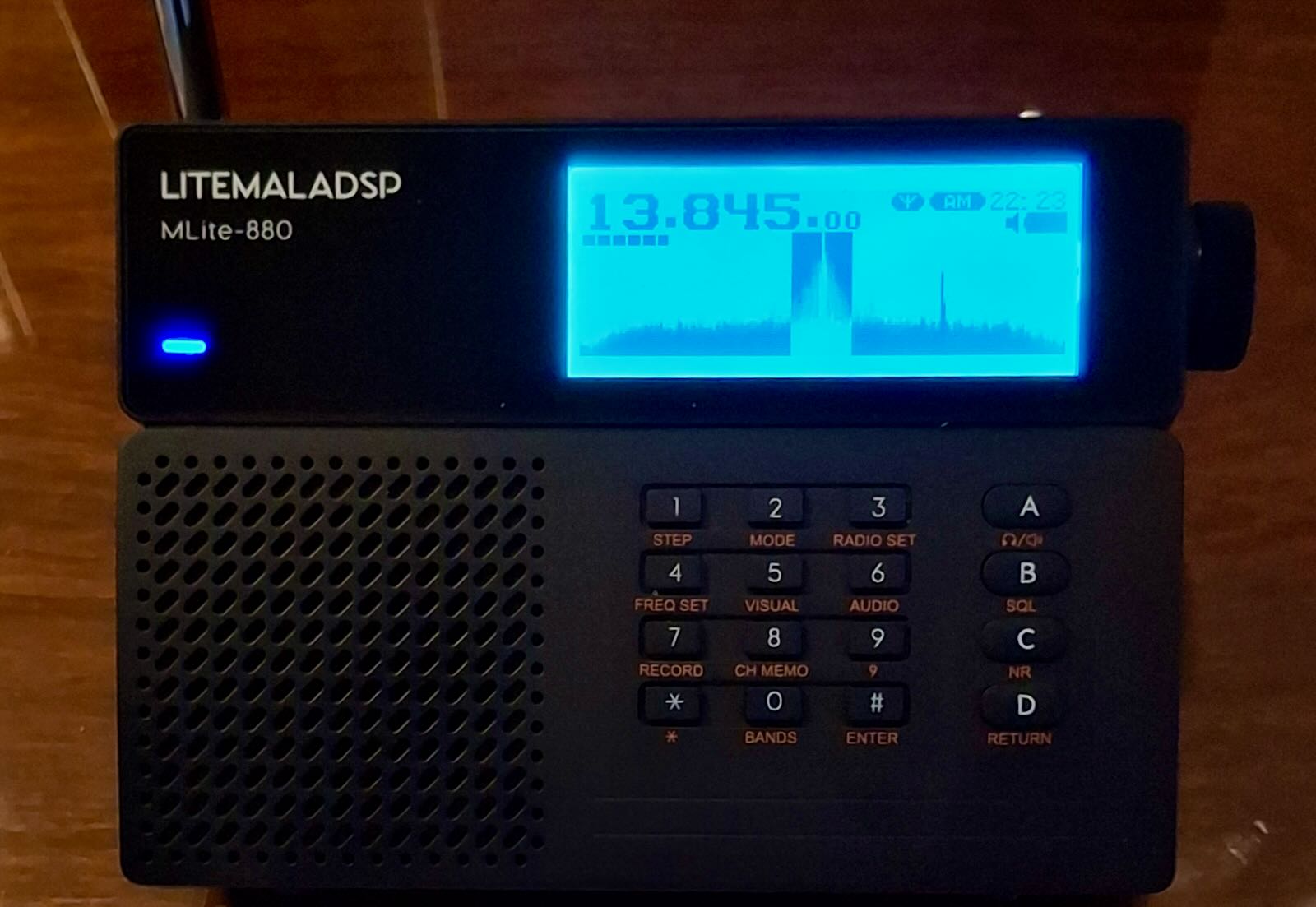
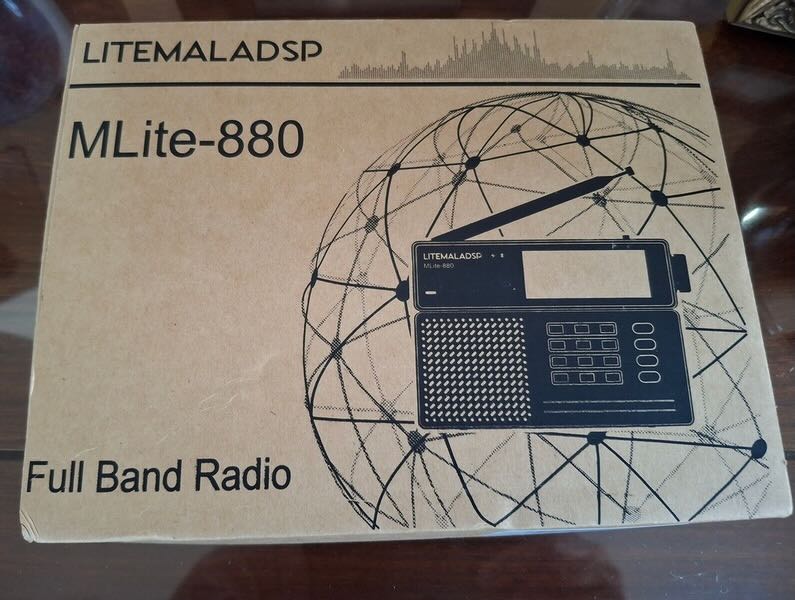
MLite-880 Spectrum Display Portable: Advanced SDR Performance in Traditional Portable Clothes
by Dan Robinson
For years, radio listening hobbyists (as many of us who are still around in 2026) have had numerous choices when it comes to portable receivers. Those of us who got our start as DX’ers/SWLs in the 1960’s (some earlier) or 1970’s have seen a lot of hardware come around the corner.
Some years ago, the Malahit/DSP receivers, firmware, and hardware designed and made in Russia appeared. There was the Belka, amazingly small but a superb receiver that many of us still use. Although shortwave broadcasting has generally been on the decline, we were lucky that companies such as Tecsun, Sangean (reported to have now stopped all production of SW portables), and other China/Taiwan-based companies continued to make impressive portables.
ICOM, Yaesu and Kenwood began putting spectrum scopes in displays a long time ago. ICOM’s IC-R9000 (produced 1989 to 1998) was the first to bring that feature. The more recent Icom 7300, 8600, and 9500 demonstrated far more advanced spectrum displays, as did Kenwood. Ten Tec in its original form put rudimentary spectrum display capability in its RX-350/Jupiter receiver/transceiver.
Today, we’re seeing a number of HT units with some kind of spectrum display. The Radtel 950Pro is one example of this. ICOM’s IC-R30, discontinued but a superb wide band unit, also has a spectrum option though quite limited. Various China-based companies started putting spectrum displays into the ATS series of receivers, and scope displays became standard on transceivers by Xiegu and others.
Malahiteam in Russia licensed firmware out to a range of China-based manufacturers. The China-made “ATS” portables available from AliExpress and Banggood have been through numerous versions, including the ATS25 Pro + AIR desktop, the ATS25 Ultra, ATS25 XF (see https://www.youtube.com/watch?v=LJC-pAu4nUk), and these are increasingly emphasizing the spectrum option on the display. There have been some very interesting front panel designs such as the DP-666 based on the TF6686 chip, and the AMNVOLT ESP138, the first with dual 4732/6686 architecture (see: https://www.youtube.com/watch?v=m1njJskDSUI&pp=ygUMZXNwMTM4IHJHzGlv)
What we had not seen until recently was anyone putting a spectrum display into a “traditional” portable cabinet (some years ago, I had suggested to County Comm/Maratac which has carried a re-badged Tecsun PL-368 that they consider doing so. At one point I received from them a photo of a prototype which looked like a PL-368 with a spectrum display at the top. But to my knowledge nothing was done to advance that to market).
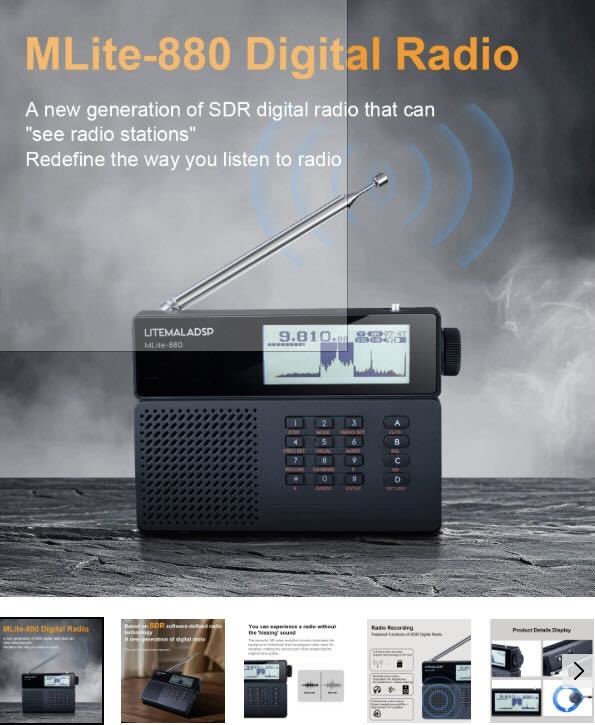
The major feature can be seen at power on. Instead of just a digital/numerical display of frequency we see the frequency AND below, a 40 kHz slice of spectrum. As the advertising description on the Elecevolve.com website states:
“A new generation of SDR digital radio that can “see” radio stations” . . . and “the radio in people’s impressions stays in the last century.”
The message that Malahiteam wants to convey is clear: this is a major step forward from portable design of the past.
The radio is very light, with a back-stand and a fairly robust whip antenna which stands at an angle when the receiver is being used with the back-stand (unfortunately, the antenna base does not allow it to go vertical).
Around the cabinet, there are a minimum of controls: on top, we have a simple power-on/off switch and a microSD slot (more about that later). USB-C and headphone jack are on the right, and an external antenna jack on the left. The frequency display module of the radio looks like just that — it’s on top above the multi-function keypad and ABCD keys. As for mode displays, there are battery and Bluetooth lights below and next to the LITEMALADSP letters. On the back, we find the 21700 battery compartment, and on the back-stand, we find information about the receiver, but no “Made in…” information whatsoever.
From the videos, and certainly from the name of the radio (LITEMALADSP) we have the impression that the MLite-880 is a cost-reduction version of the Russian DSP/2/3 receivers. Neither 4732 nor TEF 6686 chips are used. While one video review states that an MSI-SDR-M1 chip is inside, Georgiy at Malahiteam states that this is not so.
There was obviously a deliberate choice of the 21700 battery rather than 18650 used in Tecsun, Choyong, and other portables. First adopters say that so far, this battery keeps the receiver going for hours, something I can confirm. Anyone unfamiliar with professional type batteries like this should invest in a good standalone charger; if you already own a Tecsun PLxxx or D808 portable you will be familiar with 18650 and similar cells. [UPDATE]: Larger size 21700 battery does not fit — the battery provided with the radio is a EVE INR21700/50E
The inclusion of a backstand is very welcome, since Russian DSPs and China-made SDR portables often lack one. The whip antenna is not thin and flimsy like those found on some China-made small portables. There’s a mini to SMA adapter included in the box.
One reviewer notes that high-speed microSD cards are needed because files are recorded in WAV format. Georgiy at Malahiteam states that 16 and 32 GB cards have worked, BUT one user reports a 256GB card worked. Recording capability is a feature seen on other portables like the Raddy RF919. A good sized speaker is on the left. The tuning knob has a dual push-pull function for volume and frequency change.
And the radio has Bluetooth capability, which worked fine when I first tried it with a Bluetooth speaker.
In menus under “About” we see “Designed in Russia/Made in China.” I recommend that readers view the various videos available online. While I was in the process of writing, I was surprised when the MLite-880 I had ordered from Banggood showed up on my doorstep. So, I’m able to provide initial impressions, and when a second unit arrives here, I’ll do some unit-to-unit comparisons. [NOTE: Testing done using only the onboard whip antenna]
If this is supposed to be a “Lite” version of the Malahit DSP receivers, whether the original Russian-made units or those from China, that would not be apparent to someone using this receiver for the first time. Numerous options are brought over from the Malahiteam DSP. We have synchronous reception (but see below) and the ability to correct calibration variations. Recalibration and BFO fine adjust is something we see on Tecsun portables, and China-made SDRs, and the AFEDRI SDR.
I won’t list everything, but we also see Hi-Z/50 Ohm, BiasT, Attenuation, and options for adjusting display brightness, spectrum average, spectrum fill, and RDS view. That is quite a lot of flexibility and reminds me of what we find on receivers costing thousands of dollars. Under Audio settings, we see Filter Type, Filter Low Freq, Filter High Freq, and variable Noise Reduction. One reviewer asserted that NR “works significantly better than on the Russian-made DSP-3, which costs near $500,” and based on my first tests, I agree. NR runs from 0 to 15 and, once set, can be quickly activated by pressing the C button on the right labeled NR. Overall filtering ranges: 0 to 8 Hz, 0 to 12 Hz, 0 to 15 Hz for the three designated filter positions.
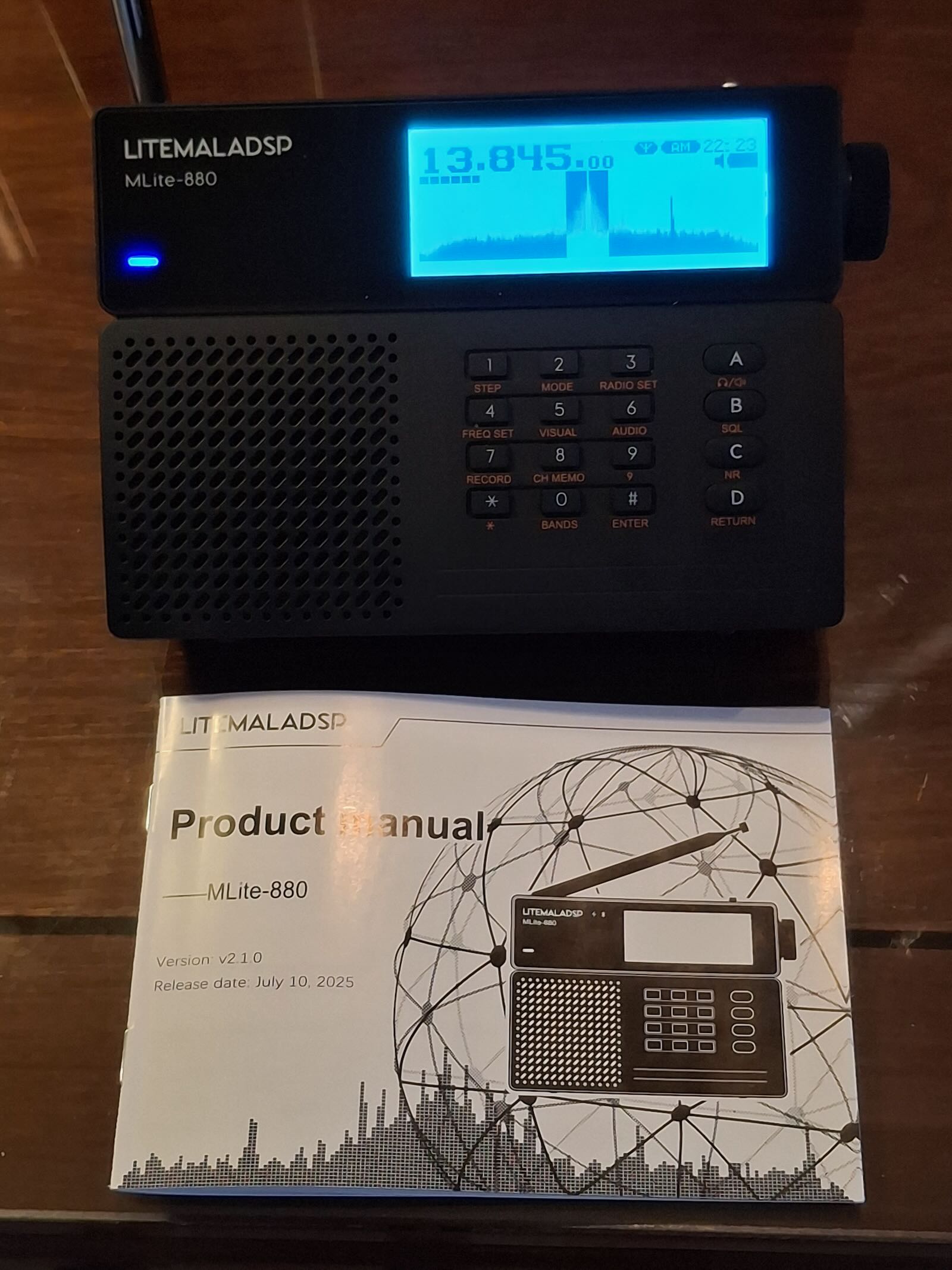
AGC settings include AGC limit, AGC gain, and manual control, all settable in dB. On a third page of options, we find NB Mode, NB Threshold, Equalizer Type, Key Beep Level, and SQUELCH Threshold. Recording is accomplished with a direct access button (NOTE: I had some problems getting record working with a 1GB microSD but switched to a FAT32 8 GB and it worked). A quite nice printed manual shows the modes: USB, LSB, CW, DSB, AM, SAM, NFM, WFM. Steps are listed as: 100 Hz, 500 Hz, 1 kHz, 2.5 kHz, 5 kHz, 6.2 kHz, 8.3 kHz, 9 kHz, and 10 kHz.
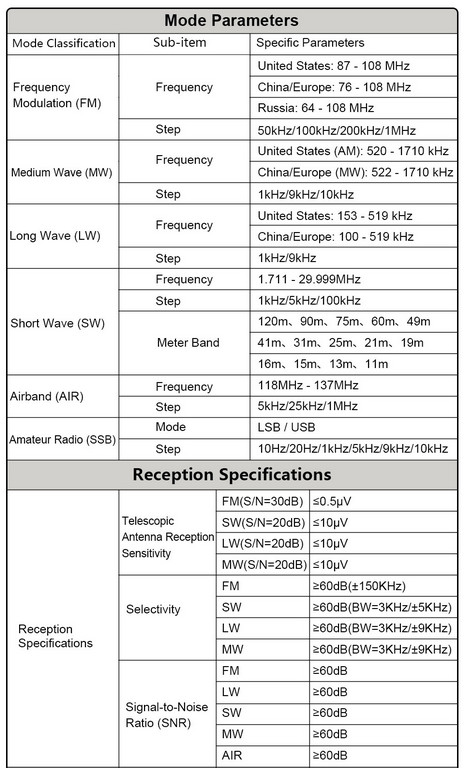
The MLite-880 contains band ranges selected by pressing the appropriate key and then A/B to scroll through those ranges. Coverage is from 100 kHz to 519 kHz, from 520 kHz to 1710 kHz, and up to 29,999khz. But one can directly enter any frequency in this entire range, regardless of the ranges. Under AMATEUR BANDS, we find 135.70 kHz to 137.80 kHz (2200m), 472 kHz to 479 kHz (630m), 1800 kHz to 2000 kHz, 3500 kHz to 3800 kHz, 5351.5 kHz to 5366.5 kHz, 7000 kHz to 7200 kHz, and on up to 29.700 kHz, with 70 mHz to 70.5, and 144 mHz to 148 mHz. Finally, FM/VHF bands include 65.9 mHz to 74 mHz (OIRT), 76 mHz to 108 mHz, and AIR band 118 to 137 mHz.
The spectrum display on the MLite-880 is 40 kHz. For most people, especially those coming from a portable with just a digital numerical readout, I don’t think this is going to be a problem. The 880 obviously has a smaller spectrum display than the full Russian DSP or Chinese-originated portables. Under VISUAL settings, we have choices of: BRIGHTNESS LEVEL, BRIGHTNESS OFF TIME, SPECTRUM AVERAGE, SPECTRUM FILL.
I have not opened my MLite-880, but RADIOCHIEF.RU on YouTube shows the cabinet back removed (around the 29-minute mark). We see extensive shielding with metal covers over key sections. Very impressive, and it finds me wishing that other manufacturers would have done this. How much better the short-lived “Elite Satellit” by Eton might have been with better internal shielding.
What remains to be seen is the extent to which the MLite-880 monochrome display throws off interference, a well-known issue with the original Russia-made Malahit units and China-made portables. See my interview with Georgiy of Malahiteam, who notes that not all noise is gone. “We weren’t able to completely eliminate the noise,” he says, adding that “it still occurs in places, mostly on the long and medium wavelengths. However, significant attention was paid to the screening, and turning off the display completely solves the issue.” The screen shutoff he mentions is accomplished as of now by pressing the “9” key.
We learn from the few available YouTube reviews that the main microcontroller in the MLite-880 is the STM32H743, which one reviewer says is “about the same as the older version in the Malahit DSP-3”. And he adds: “It’s a full-fledged SDR like the DSP-3 that is, unlike all sorts of superhet Tecsuns and DEGENs on chips with all sorts of soft mutes, the Malachite works just as well but significantly better. . .”
Unfortunately, so far we see that firmware updating is accomplished using the STMCube program used by the Russia and China units and the excellent AFEDRI. I find STMCube to be clunky and often frustrating, though it seems straightforward when explained in the ML-880 manual.
RADIOCHIEF.RU on YouTube provides a demonstration of the MLite-880, comparing it with an ICOM IC-R20 and a DSP-3. He notes that while there are flaws in the 880 they appear to be fixable via firmware upgrades. In the downloads section of the elecevolve website we see version 1.2 dated 6 February 2026. The unit delivered here has 1.1 The printed manual shows “v2.1.0 Release date July 10, 2025”. I’m not aware of videos or other online presence of the ML 880 before January 2026.
WHAT’S THE BIG DEAL?
SWLing Post readers, whether SWLs or amateur operators, may be asking what the big deal is with the MLite-880. That’s understandable, but let me explain the significance. Much as the Choyong LC-90 became the first receiver to provide HF and Internet radio in a traditional radio cabinet (though without any spectrum display), the 880 shows that placing such a display in a traditional portable cabinet has been quite possible for some time — it just took someone to go ahead and do it. Continue reading →
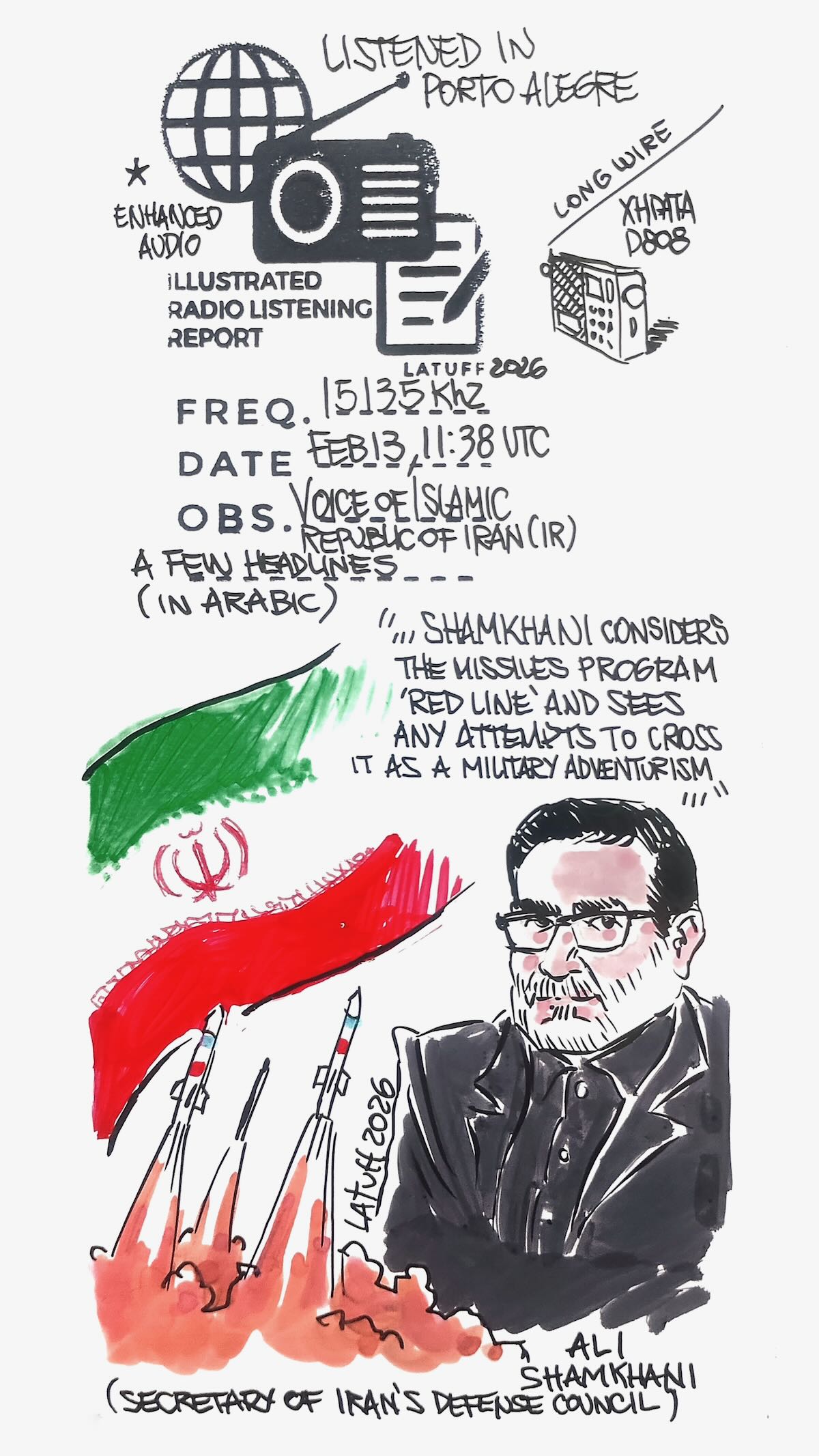
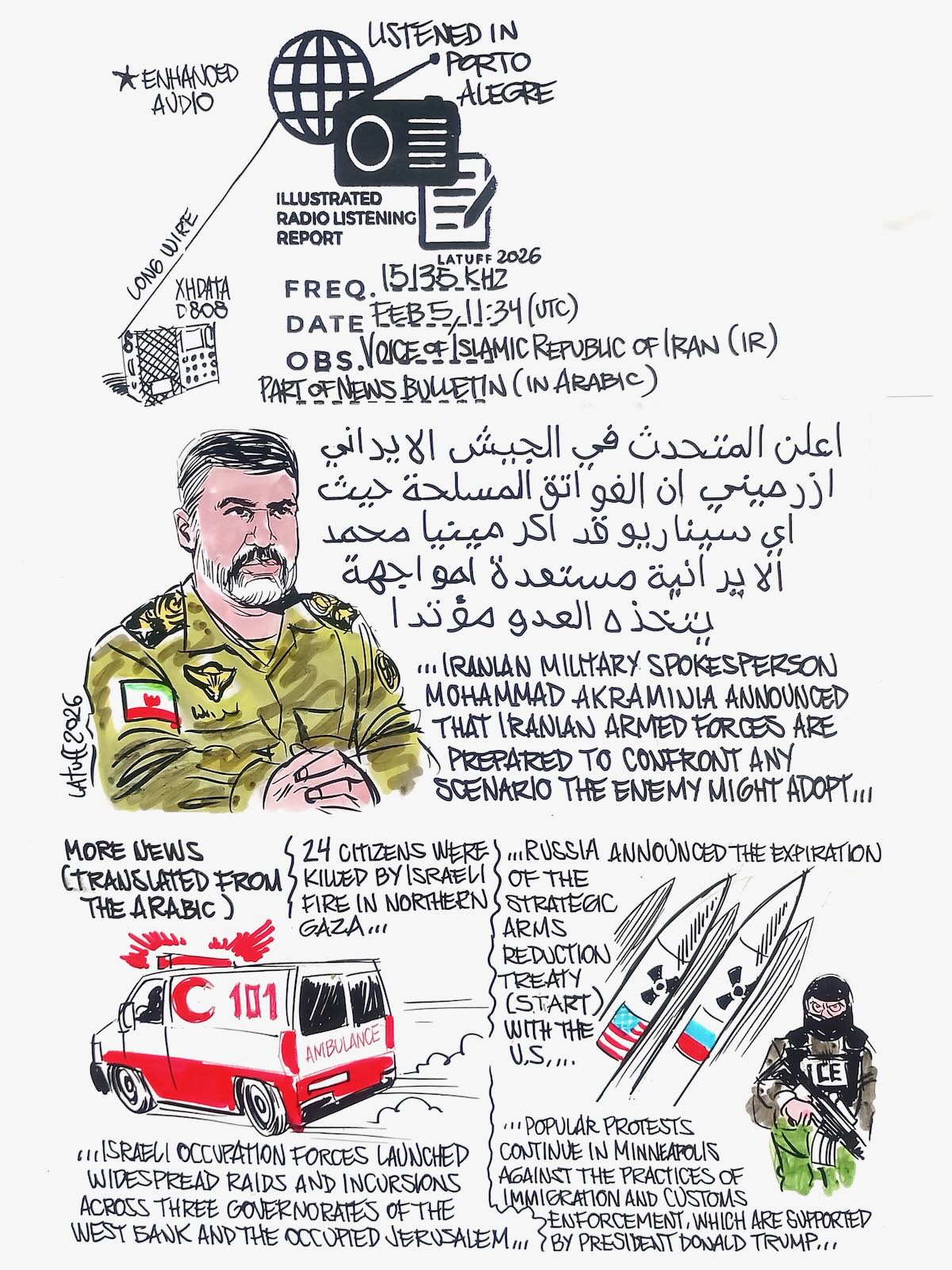
Many thanks to SWLing Post contributor and noted political cartoonist, Carlos Latuff, who shares the following illustrated radio listening report of a recent Voice of Islamic Republic of Iran broadcast.
Carlos notes:
Shamkhani: Our missile capabilities are non-negotiable. Voice of the Islamic Republic of Iran, 15135 kHz
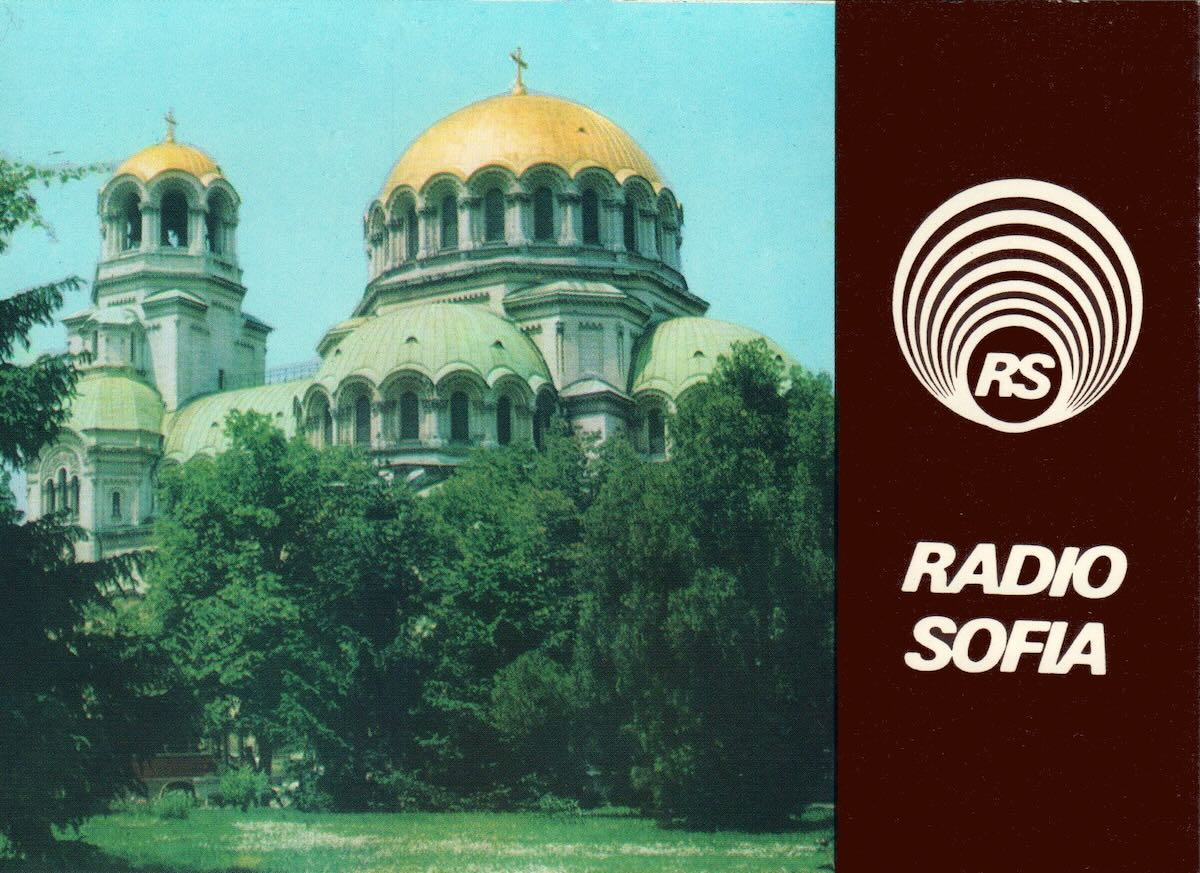
Many thanks to SWLing Post contributor Paul Jamet, who shares the following update and QSL card images related to Bulgarian National Radio (BNR) and Radio Bulgaria.
As Radio Bulgaria looks ahead to its 90th anniversary in 2026, Bulgarian National Radio has announced a new commemorative QSL card series for listeners who submit reception reports. The series will include 12 different QSL cards, each highlighting a key moment from the history of BNR and the Radio Bulgaria service. According to BNR, a new card will be released each month, along with a short publication explaining the historical background behind the featured image.
Paul also points to a broader retrospective titled “BNR at 90 – A Story of Pride and No Prejudice,” which looks back on nine decades of Bulgarian National Radio. The piece reflects on BNR’s history through periods of political change and technological transition, while underscoring the role of public broadcasting in preserving culture and maintaining a connection with international audiences.
Attached at the top and bottom of this post are two QSL cards from Paul’s own collection.
Many thanks again to Paul for sharing both the news and the QSL images!
Many thanks to SWLing Post contributor Don Moore–noted author, traveler, and DXer–who shares the following post:
A Beginner’s Guide to ALE: Part One
By Don Moore
Don’s traveling DX stories can be found in his book Tales of a Vagabond DXer[SWLing Post affiliate link].If you’ve already read his book and enjoyed it, do Don a favor and leave a review on Amazon.
To me, part of the excitement of DXing has always been logging new stations. From the very beginning (over fifty years ago), I went after shortwave broadcast (SWBC), medium wave, and voice utility DX. Up until the mid-90s, I usually averaged logging one new SWBC station per week. Today, it’s hard to add more than one or two each year. There are also far fewer voice utility stations on the air today. At least medium wave is still going strong. Several years ago, my quest for logging new stations on the shortwave frequencies got me involved in DXing digital utility stations. I wrote an article here on monitoring DSC stations: https://swling.com/blog/2022/11/guest-post-monitoring-digital-selective-calling-dcs-with-yadd/).
But DSC is just one of several digital modes that I’ve been playing around with. The one that I’ve found most interesting – and the one that has yielded hundreds of new stations in numerous countries – is ALE.
Now, I am not an expert at monitoring ALE. I’m just an advanced beginner. But I think I know enough to help other beginners get started. And if you are an ALE expert reading this, I welcome your additions, corrections, and even criticisms to the comments section. I still have a lot to learn, too.
What is ALE?
Ever since the early days of radio, one of the most important uses of the shortwave spectrum has been two-way communication. It provides a means for an organization’s far-flung offices or bases to communicate without relying on external infrastructure. That remains true even today because satellites can malfunction and evil powers can cut undersea cables.
But shortwave isn’t consistent. The frequencies that work best between any two points will vary by time of day, time of year, solar conditions, and a host of other factors. In the old days, radio operators had to understand radio propagation to make an educated guess as to the best frequency to use to reach a particular distant station. Sometimes they guessed wrong, and stations would struggle to communicate or maybe not even connect. ALE, or Automatic Link Establishment, was designed to make two-way shortwave communication as simple as making a telephone call. Depending on your point of view, it has taken the guesswork out of frequency selection … or made it so easy that any dummy can be a radio operator.
In an ALE system, each station is assigned a unique identifier and the network has a set of preconfigured frequencies spaced throughout the shortwave spectrum. For example, here’s a partial list of frequencies and stations for the United States Air Force, one of the most active ALE networks.
The key to the system is a piece of software called the ALE controller. At periodic intervals, the ALE controller at a particular station, say PLA, will loop through the frequencies and send a “sounding” out on each one. That’s just a short digital identification burst saying “This is PLA!” Here’s a recording of an ALE sounding.
That’s not the kind of signal that anyone would enjoy listening to all day. Fortunately, no human being has to do that. Instead, all the other controllers in the network are monitoring every frequency and automatically make note of how well PLA is received (or not) on each channel. Now, if someone at Offutt Air Force Base needs to send a message to Lajes, they just go to their ALE controller and enter “PLA.” The system will select the best frequency to use based on the most recent observations. That’s the basic explanation. If you want to understand more, see the links at the bottom.
Monitoring ALE
You can’t DX ALE with your ears. A computer program has to do it for you. There are several hobby programs that do the job, and I’m going to look at two of them. The first one will get you started, and the second one will take your ALE DXing to the top.
I began with Sorcerer, a free program that decodes several dozen digital modes. See the links below for downloading. The program doesn’t need to be installed. Just unzip the file and place the executable in a suitable location. Next, you need an SDR and an SDR application. I prefer SDR-Console for digital work, but any SDR program will work if you can feed the audio into a virtual audio cable. And that’s the other thing you need – a direct audio connection from the audio output of your SDR application to Sorcerer. There are several similar products available, but I recommend VB-Cable. Your first VB-Cable is free, and you only need one to run Sorcerer. If you want to expand, you can buy more VB-Cables later.
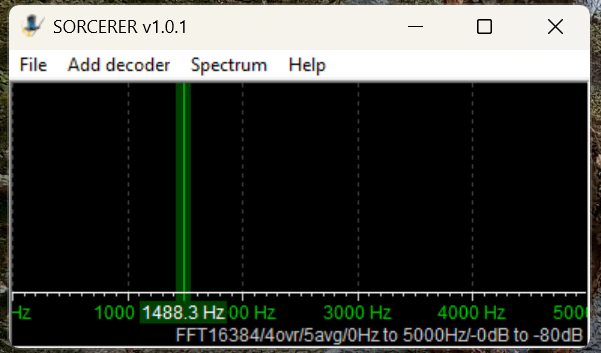
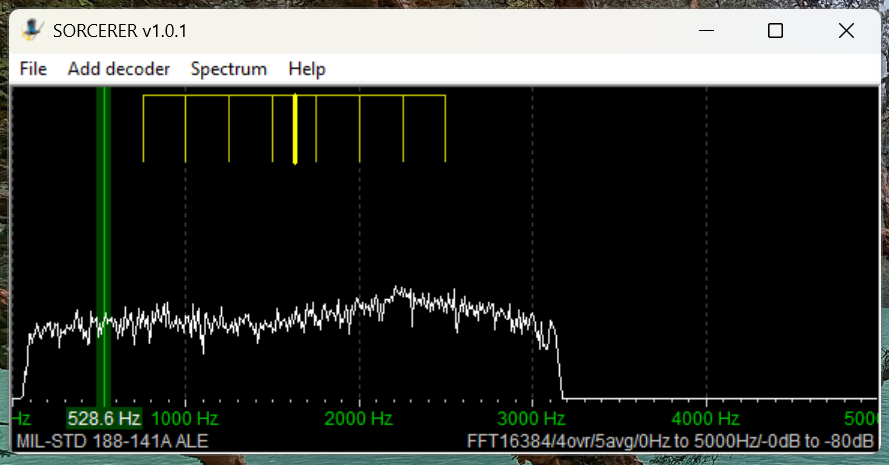
Here’s the main window that opens when you start Sorcerer.
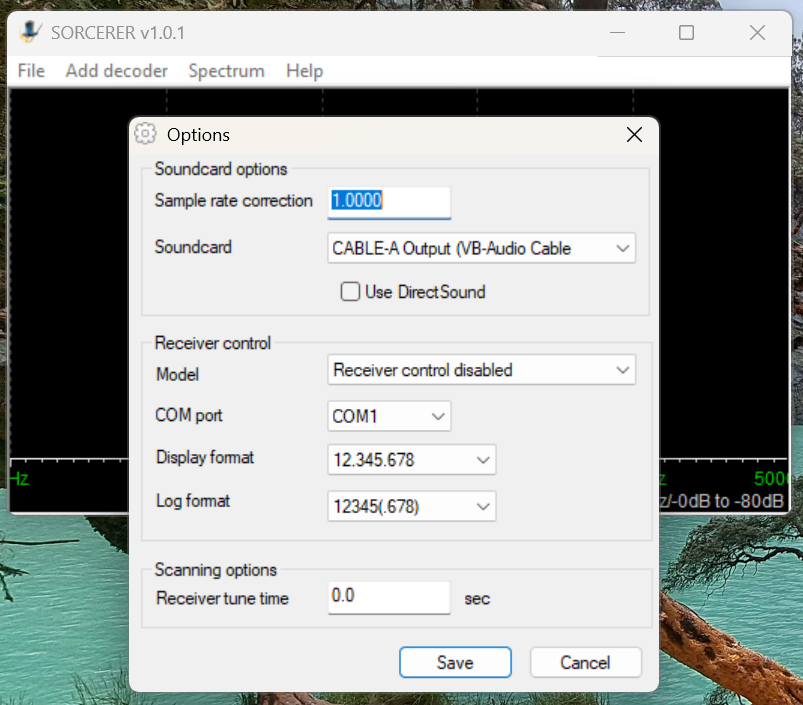
The first time you use Sorcerer you will need to connect it to your VB-Cable. On the menu select File then Options. Find the cable under the Soundcard list and save.
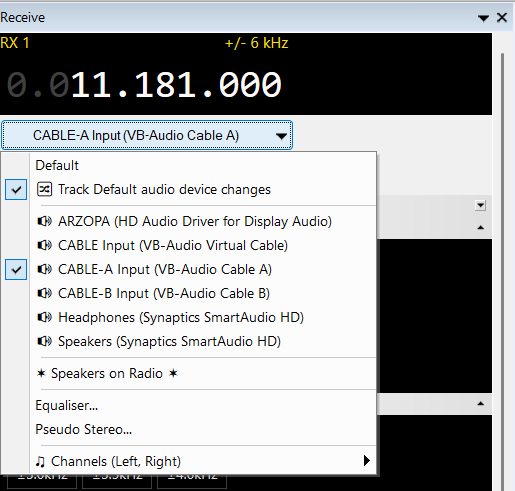
Open your SDR application and tune it to 11181 kHz. Set to USB mode with a filter value of around 2.8 kHz. That is one of the most heavily used frequencies by US Air Force bases around the world. Wherever you are, something should be received. Next, set the audio output of your SDR application to go to VB-Cable. In SDR-Console that’s done by a drop-down box under the current frequency. Next, slide the volume level all the way up.
Now go back to Sorcerer and confirm you are getting audio from the SDR application.
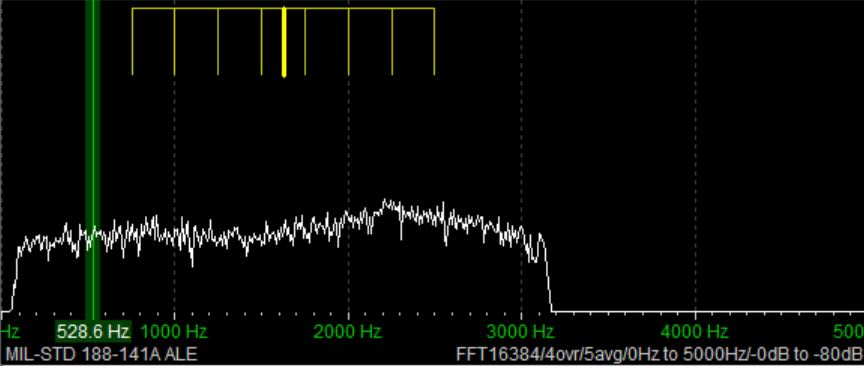
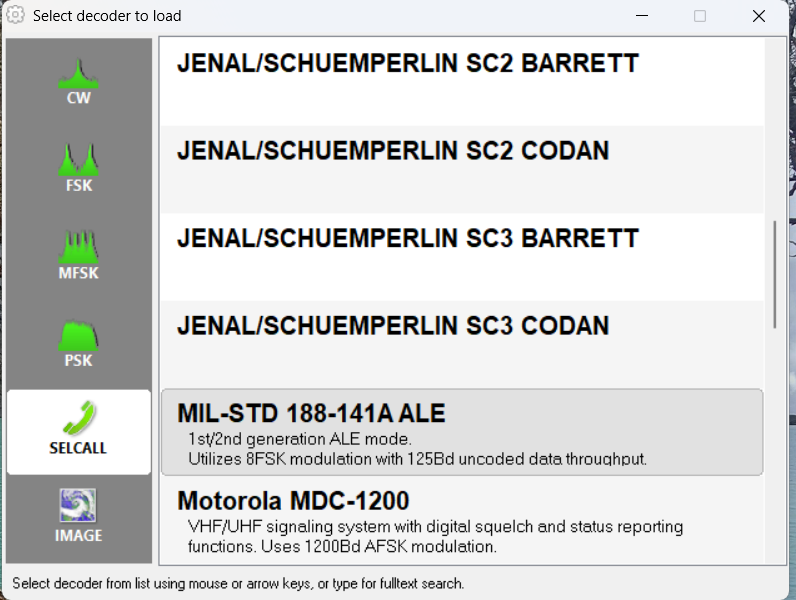
Now select Add Decoder from the top menu in Sorcerer. Then select SELCALL on the left side and scroll down and double-click to select MID-STD 188-141A ALE from the options.
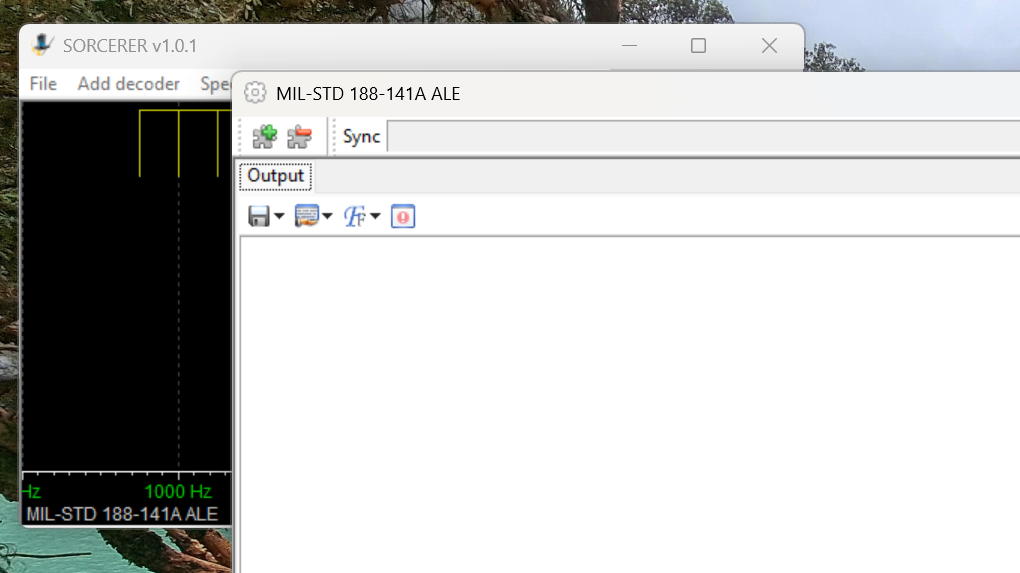
That will open a large decoder window, which you can resize as needed.
Now, go get a cup of coffee and come back in about thirty minutes.
Sample Sorcerer Output
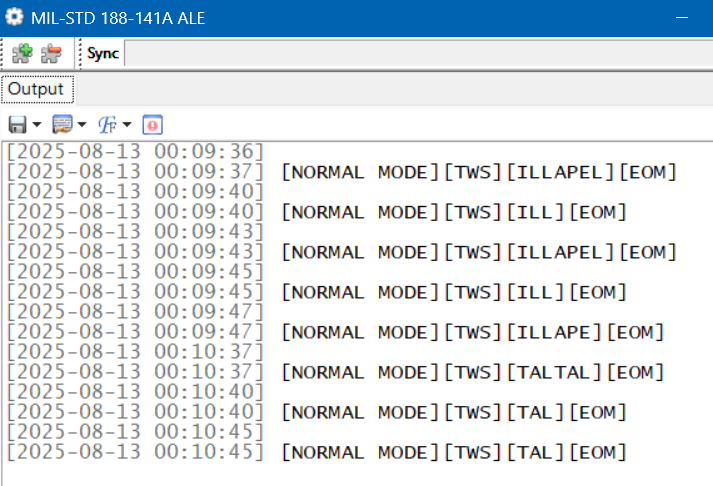
Let’s take a look at some sample output from Sorcerer. These loggings were made on 7915 kHz, a frequency used by the Carabineros (National Police) in Chile. First, Sorcerer shows the time and date the decoding was done per the current time on the laptop. If you are monitoring live, those are the correct date and time of the reception. For the record, I was decoding from SDR spectrum recordings in these examples, so the times and dates are not the real ones. (I got the real ones from the spectrum recordings.) TWS stands for “This Was” and EOM for “End Of Message.” ILLAPEL and TALTAL are the station identifications, which in this case correspond to two Chilean cities. Note that sometimes the end of the ID can be cut off if reception isn’t clear.
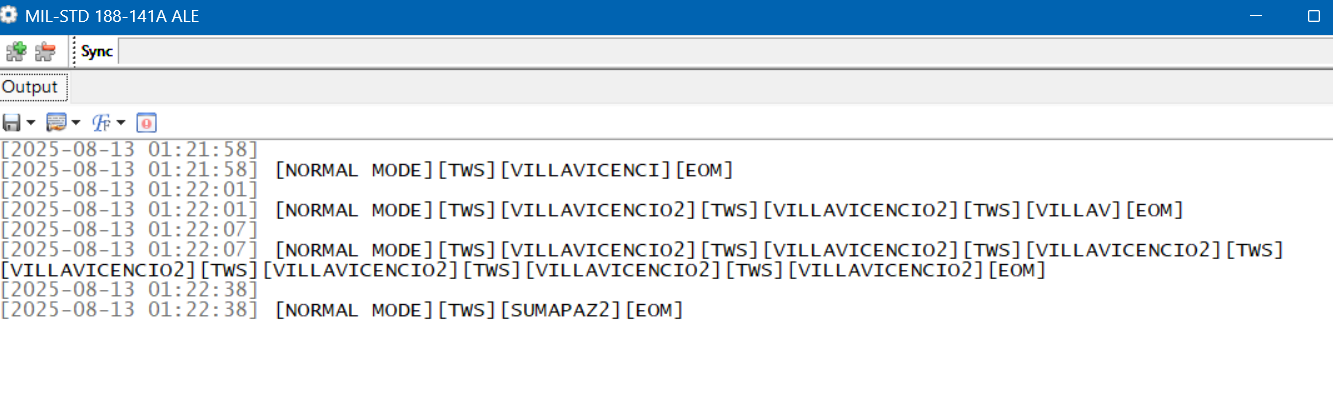
These next loggings are from the national police of Colombia on 7560 kHz. Villavicencio is a city east of the Andes, and Sumapaz is a national park in the remote mountains south of Bogotá.
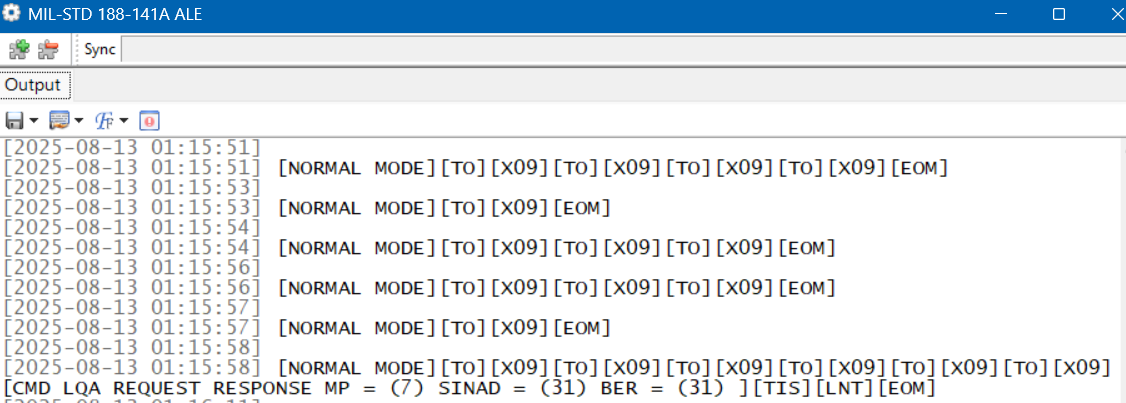
Here is a string of loggings on 7527 kHz, a frequency used by the US Coast Guard and other US government agencies. But here we have a TO, which means someone is trying to call X09. That happens to be a C-27J Spartan, a medium-range surveillance aircraft used by the US Coast Guard. Who’s doing the calling shows up in the final line. TIS (“This Is”) is a variation on TWS. LNT is the identification for CAMSLANT, the big US Coast Guard station in Portsmouth, Virginia.
The Limits of Single Frequency Monitoring
DXing live and monitoring one highly active frequency at a time with Sorcerer makes for a good introduction to ALE. However, if you just stick to monitoring easy frequencies like the USAF ones, you’ll get a lot of logs, but it won’t take long until you feel as if you’ve gotten everything. There are hundreds more ALE frequencies out there, such as the Chilean and Colombian police ones. But those are less active and might only be received at your location when conditions are just right. If you go after those by live monitoring with your SDR parked on a single frequency, you’ll spend a lot of days without getting a single hit.
What is needed is a way to cast a wide net to catch all the activity in a particular band. The idea I came up with was to use the Spectrum Analyzer feature of the SDR-Console program. See my article on this highly useful feature for an understanding of how this works.
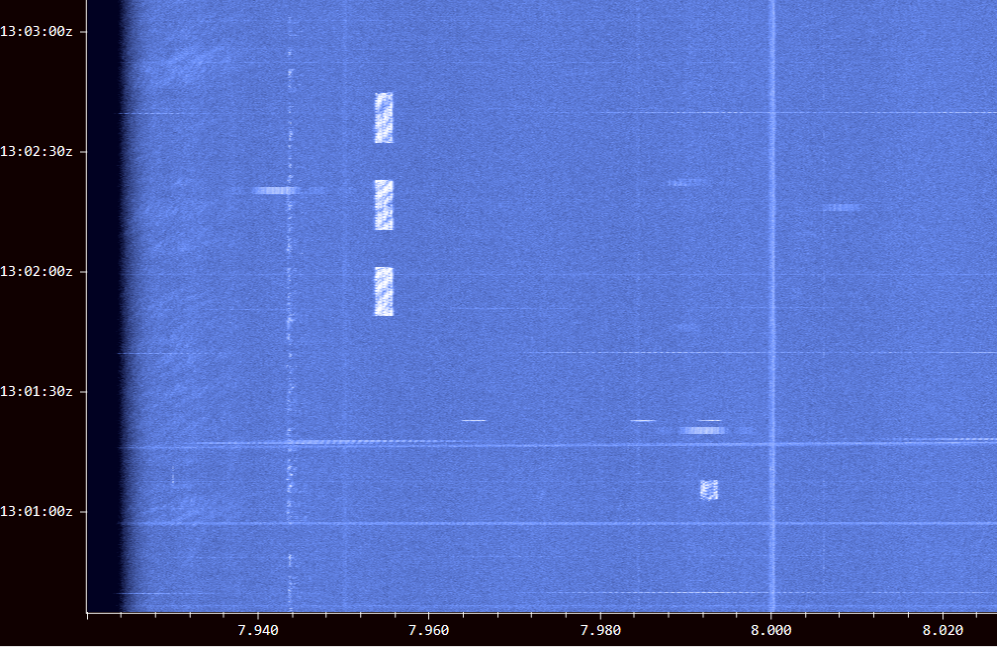
Using an Airspy HF+ Discovery, I would make several hours of spectrum recordings and then use the Spectrum Analyzer to visually find the ALE signals. Here’s a string of three long ALE bursts on 7953 kHz and a single weaker one on 7991 kHz. (Some other digital modes look the same on screen.)
I just had to click on a signal to play it into Sorcerer to get the ID. The process worked really well, and I found a lot of stations this way. But it was also tedious and time-consuming. I wanted something better … something that did the hard work for me. That’s what technology is for, right?
Stay tuned for Part Two …
Links
Sorcerer Download. Be sure to only download from this link and not from one of the many public download sites. Some years ago there were instances of Sorcerer infected with malware on public sites: https://www.kd0cq.com/2013/07/sorcerer-decoder-download/
VB Cable Download. Note, it is also possible to use Sorcerer by feeding the audio output from a traditional receiver into the audio input of a laptop. https://vb-audio.com/Cable/
Many thanks to SWLing Post contributor and noted political cartoonist, Carlos Latuff, who shares the following illustrated radio listening report of a recent Voice of the Islamic Republic of Iran broadcast.
Carlos notes:
Iranian armed forces are ready for any scenario, Voice of Islamic Republic of Iran, 15135 kHz