Tag Archives: World Radio Day

ShortWaveMusic offers one-day music download in honor of World Radio Day

Our friend, Myke, over at the ShortWaveMusic blog has a very special World Radio Day gift:

As the preeminent blog dedicated to preserving and disseminating indigenous sound and music as heard via international radio, ShortWaveMusic is observing World Radio Day with a special, one-day-only offer: a download of the 5-CD retrospective box set, The Clouds Should Know Me By Now: ShortWaveMusic 2005-2010. This box set was compiled in 2011 for release on a prominent independent record label, but has since stalled at the gate for various reasons. As a result, I’ve decided to give it away on the occasion of World Radio Day – perhaps no more fitting time to compel others to enjoy the vast and kaleidoscopic array of music available via shortwave radio.[]

What are you waiting for? Go to ShortWaveMusic and get your free download–bookmark the site, too, as Myke offers some incredible recordings and journals of his audio/radio expeditions. (This is not the first time we’ve mentioned Myke’s work on the SWLing Post.)

Thanks, Myke, and happy World Radio Day!
Today is World Radio Day: Support a Cause via Shortwave Radio

Shortwave Radio Listeners may occasionally feel that their hobby is a passive one–one of simply listening. I’m here to tell you that it is not.

SWLers are among the more enlightened of media hobbyists, and here’s why: 1) they tend to be intensely curious about the world, 2) they tend to cultivate a nostalgic appreciation of the past, of the world’s history and what it teaches, and 3) as a result, they understand the power that radio still holds for much of our world today, especially those the not-so-world-wide internet has forgotten or overlooked, and those that political strife oppresses.

This World Radio Day, you can change that false label of “passive” to active, and create change by contributing to a charity near and dear to my heart–Ears To Our World (ETOW).

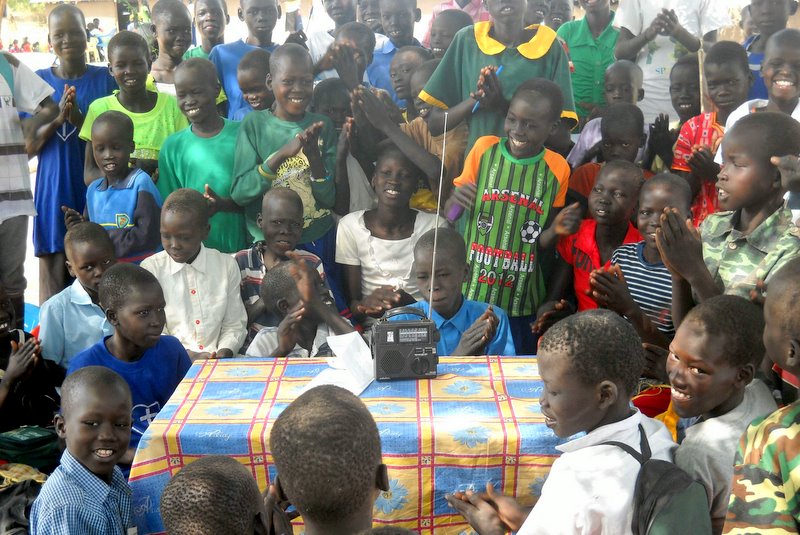
ETOW is a shortwave radio charity that sends self-powered shortwave radios to schools and communities in third world countries.  This is because ETOW believes that access to information is access to education.

In other words, every day is World Radio Day at ETOW.

Children in South Sudan listening to music on their self-powered shortwave radio supplied by Ears To Our World.

Click here to donate to Ears To Our World, and make World Radio Day a lasting reality for needy schools throughout our world.

Happy World Radio Day!  To quote ETOW’s tagline:  Listen and learn.

More power to you, SWLers.

ABC video highlights the Dooen transmitter on World Radio Day

The Dooen tower "hat" (photo: ABC)

(Source: Australian Broadcasting Corporation)

Standing 201-metres tall with a 19-metre wide capacitive ‘top hat’, the 3WV mast in western Victoria stands out in the vast flat landscape that stretches below it.
Celebrating 75th years of service, the occasion of World Radio Day seemed a worthy time to pay tribute to this impressive technological structure.

“It really meant a lot to us. It must’ve been a big undertaking in 1936 to build it because cranes and things that are about today weren’t even heard of,” says long time Horsham resident James Heard.

And while the locals are proud of the trusty Dooen mast, its power reaches far wider than just this wide brown land.

In fact 594 AM has even been heard as far as Canada, Japan and South Africa.

The staggering reach is aided by the distinctive ‘top hat’ and the low frequency of the AM band. While obviously a success, the antenna was the first of its kind in Australia and acted as a prototype for other services.

“It’s the first solid-state 50-kilowatt broadcast transmitter installed for the ABC and it was the test bed for the installations across the rest of the country,” says Tim Hughes, Transmission Coordinator for ABC Victoria.

So whether you’re tuning in from snowy Canada or just down the road, thanks be to the 3WV transmitter.

I’m sure many an ultralight DXer would like to snag this transmitter! Watch the 3+ minute video on the ABC website.

The Guardian on World Radio Day: celebrating an unsung hero

(Source: The Guardian)

Radio is the predominant source of information in areas of the world that are sometimes too remote to get a newspaper delivered, let alone access the internet. This is why Unesco has noted that radio is a “low-cost medium, specifically suited to reach remote communities and vulnerable people”.

Attention given to technology for information communications has recently been captivated by web-based applications, especially “new” or “social media”. But about 65% of the world’s 7 billion people do not use the internet. In addition to those who are offline due to lack of access, there are also those who are unaware, unable or simply do not want to use social media.

People listen to the radio in their cars, on the move and at work. Radios don’t require large amounts of electricity, and wind-up radios don’t need an electrical source at all. Moreover, radio reaches large groups of people, being easily shared among families or listener groups. It is a medium often used as a focal point for community discussion on subjects including politics, elections and service provision. Radio efficiently reaches large audiences in real time. [continue reading…]

This will be filed under our ever-growing category, “Why Radio?

Read the full article at The Guardian.

RNW: radio = free access without app or web

Brilliant article from Radio Netherlands Worldwide.  Hat tip to SWLing Post reader Mike Taniwha!

(Source: RNW)

On World Radio Day, 13 February 2012, UNESCO will remind the world that there is a medium which reaches parts that other media can’t reach.

Radio is still a vital form of communication because a radio station can be set up much faster, and at much lower cost, than a terrestrial or satellite TV station. Radio is especially useful for reaching remote communities and vulnerable people such as the illiterate, the disabled and the poor. It also provides a platform for such groups to take part in the wider public debate.

Radio also plays a vital role in emergency communication and disaster relief, which was illustrated following the tsunami in the Indian Ocean in December 2004. RNW was able to help several partner stations in Indonesia by sending out “radio stations in a box” – self-contained mobile FM stations providing a temporary studio and transmitter ready to be used by broadcasters whose own facilities had been destroyed.[continue reading…]

Thanks, RNW, for reminding us why radio is the the most effective information medium. Read the full article at Radio Netherlands Worldwide.

UNESCO Proclaims World Radio Day – February 13

UNESCO’s Executive Board approved item 13 of its provisional agenda “Proclamation of a World Radio Day” to be celebrated each February 13th.

The Executive’s decision is as follows:

  • Recommends to the [UNESCO] General Conference that it proclaim a World Radio Day and that this Day be celebrated on 13 February, the day the United Nations established the concept of United Nations Radio;
  • Invites all Member States, organizations of the United Nations system and other international and regional organizations, professional associations and broadcasting unions, as well as civil society, including non-governmental organizations and individuals, to duly celebrate the World Radio Day, in the way that each considers most adequate;
  • Requests the Director-General, subject to the final resolution of the General Conference, to bring this resolution to the attention of the Secretary-General of the United Nations so that World Radio Day may be endorsed by the General Assembly.

Read UNESCO’s full World Radio Day proclamation here (PDF).