Yearly Archives: 2011

QRZ visits the American Museum of Radio and Electricity

Fred Lloyd (AA7BQ), publisher of QRZ.com (a very popular ham radio call sign website) has written about a recent visit to the American Museum of Radio and Electricity:


Earlier this week we were treated to a tour of the American Museum of Radio and Electricity, a must-see landmark in the city of Bellingham, Washington. The AMRE is located in the central downtown district of the city and despite it’s rather plain looking exterior, inside is one of the most interesting and engaging museums of its kind anywhere.

[…]The museum includes more than 11 distinct period exhibits that commence with the very discovery of electricity itself, recreating the initial experiments of Ben Franklin, Ohm, Volta, Hertz, Tesla, and others. Here, you’ll find Leyden Jars, static electricity experiments, some of the first batteries ever made, the first electromagnet, the earliest electric motors, and other devices that were truly genius for their time. Sometimes, you just have to stop and wonder how these great pioneers, some more than 400 years ago, had the insight and inspiration to make the discoveries they did.

Read the full story here.

Also, check out the American Museum of Radio and Electricity website.  It’s packed full of information and will certainly give you a much needed dose of nostalgia.

Radio Afghanistan now on shortwave

(Source: Bakhtar News Agency)

Sunday, July 31, 2011 Kabul (BIA) Dr. Sayed Makhdoom Raheen Minister of Information and Culture inaugurated the foreign section of Radio Afghanistan yesterday.

Dr. Sayed Makhdoom Raheen Minister of Information and Culture inaugurated the foreign section of Radio Afghanistan yesterday. This section in the first place will air program in English and Urdu languages each night from 8:00 to 9:00 pm. Opening the section Dr. Raheen said that this section has been revived with the efforts of the director general and employees of the radio and in the first place it will air English and Urdu programs and followed by Arabic and Russian programs and subsequently French and German programs. According to Dr. Raheen revival of this program shall assist in recognition of Afghanistan to its outside friends and will inform them about our country’s events. Abdul Ghani Mudaqaq head of the publications department of Radio Afghanistan said that this program shall cover Asia, Africa and Europe regions. According to officials of the radio ten years delay in the radio programs was inactivity of the short wave in Yakatout. Ghulam Nabi Farahi, Deen Mohammad Mobarez Rashidi deputy ministers of information and culture, Zareen Anzur general director of National Radio-TV and some other officials participated. Radio Afghanistan started its publications in 1304 and after a short lapse restarted its publications in 1320 and now it is 20 hours on the air. An employees of the radio said that Afghanistan was the first country in the region which had radio publication on that time.

Additionally, I just noticed this same story in RNW Media Network’s feed. They had an additional update with frequencies:

Thanks to Mikhail Timofeyev in St Petersburg, Russia who reports English at 1530 UTC on 6100 kHz, followed by Urdu at 1600, so the schedule is confirmed as 1530-1600 English and 1600-1630 Urdu.

BBC strike could affect World Service today

It appears some BBC journalists, as of 23:01 UTC (Sunday), have gone on the strike we mentioned previously.
(Source: BBC News)

Members of the National Union of Journalists (NUJ) began their strike at 00:01 BST. From Tuesday, members will also observe a work to rule.

The NUJ says the BBC is “unwilling to engage in finding reasonable resolutions” for those forced to leave and who face compulsory redundancy.

The BBC says it is unable to agree to demands for no compulsory redundancies.

[…]The NUJ accuses the BBC of “wasting thousands of pounds making skilled and experienced people compulsorily redundant instead of redeploying staff”.

If this strike affects the World Service, and if history is a guide, we will most likely hear pre-recorded content today.

Read full article here.

Guinea imposed temporary ban on Radio France International

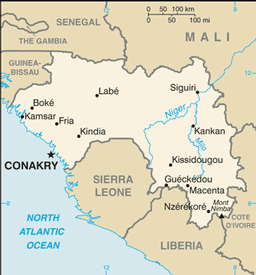
Map of Guinea (Source: CIA World Fact Book)

(Source: Committee to Protect Journalists via RNW Media Network)

On Monday [25 July], Guinea’s state-controlled media regulatory agency imposed a “temporary” ban on media coverage of the July 19 attack on the private residence of President Alpha Conde, silencing private radio and television talk programmes in which critical questions were being raised about the episode.

In such circumstances, Guinean listeners turn to foreign media outlets such as France’s state-funded international broadcaster, Radio France Internationale (RFI), the most popular station in Francophone Africa. With programmes such as “Appels Sur L’actualite”, a daily news call-in show, RFI is considered by millions of African listeners to be an essential source of news and information.

Wednesday’s “Appels Sur L’actualite” began with an ominous statement read by host Juan Gomez. “We had planned this morning to debate the attack last week against the residence of the Guinean president, but yesterday the National Communications Council of Guinea decided to temporarily suspend any programme or article about the attempted assassination against the head of state as well as all call-in programmes.” Gomez told listeners they would have to debate another topic.

Squeezed between the expectations of listeners and the conditions set by governments leasing the local frequencies it needs, RFI found itself in a difficult position. “We are not submitting to a censorship measure; we regret it and we hope that it will be temporary.” RFI deputy director Genevieve Goetzinger told CPJ today [28 July].

RFI has suffered for its critical reporting on current events in Africa. The station has seen its reporters expelled from Chad, Rwanda, and Senegal, its local correspondent jailed in Niger, and another correspondent killed in the Ivory Coast.

RFI has had its broadcasts temporarily banned in a number of countries, most recently in the Democratic Republic of Congo where the government of President Joseph Kabila sought the removal of RFI senior reporter Ghislaine Dupont, the station’s DRC specialist who was expelled from the country in 2006. Nevertheless, RFI management remains adamant the station will continue to report without interference. “Our editorial line is set in Paris, in complete independence from all the governments in the world,” Goetzinger said.

As a follow-up, RNW Media Network noted that the temporary ban was eventually lifted.

As with Fiji, Burma, Zimbabwe and many other countries where the ruling party arbitrarily tries to block free speech, shortwave radio cuts through censorship without regard for national borders.

Ultralight shortwave radios now tagged in the Shortwave Radio Index (SWRI)

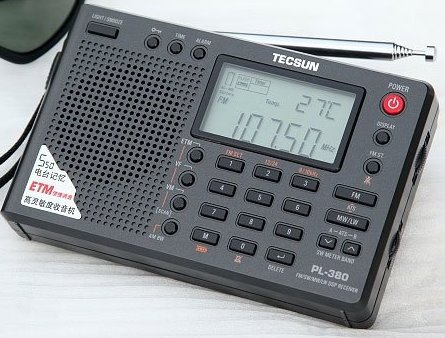
The Tecsun PL-380 is an “ultralight” that has exceptional shortwave sensitivity and selectivity.

I have gone through the SWRI and tagged all portable shortwave radios that are considered “ultralights” by the ultralight “Definitions Committee.” Note that “ultralight dxing” is primarily a Mediumwave hobby, but you will find that many of the best performing ultralights are also capable, if not best-in-class shortwave receivers.

What are the attributes/guidelines for a radio to be considered an “ultralight”? Per the definitions committee:

  1. It is a simple shirt pocket-sized radio of not more than approximately 20 cubic inches.
  2. It is an entertainment-grade radio, as opposed to enthusiast’s radio. As such, it will usually not have AM synchronous detection, SSB clarification or other specialized features.
  3. It is readily available to the hobby in new or used markets at the time of its approval.
  4. It costs no more than $100 retail at the time of approval.
  5. It is primarily a radio. While it may have other features as well (MP3 recorder, etc.), the design and function should have radio reception as its focus.
  6. It is not a “novelty radio” such as Coca Cola Can radio, Mr. Potato Head, etc.
Each radio is individually approved before it is considered an ultralight.

The Tecsun PL-310, PL-380 and C.Crane CCRadio-SWP are three shortwave ultralights that I regularly use and are considered fine examples of ultralights.

Want to know more about ultralight dxing? Check out these resources:

Shortwave Radio: One of 5 popular espionage techniques from former USSR

(Source: Top Secret Writers)

Shortwave radios have been a tool of the espionage trade for many years. Radios can transmit information encoded to be picked up by the receiver and then decoded.

This technique was used throughout World War I, World War II, and the Cold War. Like Steganography, radiograms are still being used today.

[…]The techniques were used by the Soviets during the Cold War many years ago, but it seems that they have remained long-lasting fixtures in Russian Espionage.

We actually reported on this back when news broke about the russian agents who used numbers stations for espionage purposes. Yep, shortwave radio is your friend if you don’t want people tracing where you are and what you’re listening to.

Mind you, when you live in a country that suppresses free speach, you also reach for a shortwave radio.

Read the full article that details four other popular espionage techniques from the former Soviet Union.

Fighting cancer with radio waves

John Kanzius, K3TUP (SK)

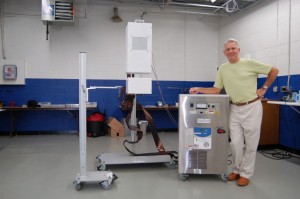
John Kanzius standing next to his Kanzius RF device.

There are few people in the radio world that I admire more than John Kanzius, K3TUP (SK). John took knowledge from his amateur radio hobby and applied it to the medical field–specifically, to fighting cancer.

(Per Wikipedia)

Kanzius RF Therapy is an experimental cancer treatment that employs a combination of either gold or carbon nanoparticles and radio waves to heat and destroy cancer cells without damaging healthy cells.
The specific absorption rate for radio waves by living tissue in the proposed wavelengths and intensity levels is very low. Metals absorb this energy much more efficiently than tissue through dielectric heating; Richard Smalley has suggested that carbon nanotubes could be used to similar purpose. If nanoparticles were to be preferentially bound to cancer sites, cancer cells could be destroyed or induced into apoptosis while leaving healthy tissue relatively unharmed. This preferential targeting represents a major technical challenge. According to a presentation by Dr. Steven Curley, the types of cancer potentially treatable using Kanzius RF therapy include essentially all forms of cancer.

Kanzius built a prototype Kanzius RF device in his home, and formed Therm Med., LLC to test and market his inventions. The device was successfully tested at University of Pittsburgh Medical Center in 2005. As of 2007-04-23, preliminary research using the device at The University of Texas M. D. Anderson Cancer Center and the University of Pittsburgh Medical Center has shown early promise. If federal approval is granted, testing on human patients may follow. An article published in late 2010 illustrates that radiofrequency fields induce intracellular hyperthermia and necrosis in pancreatic tumors without injury to the human pancreatic tissue grafts tested.

Perhaps the reason John has been on my mind today is because, just last week, my wife lost her mother  to a vicious, aggressive form of cancer called carcinosarcoma.  She was only 68, otherwise healthy and in the prime of life, with young grandchildren.  We hold her memorial service today.

Our family supported her as she bravely fought this cancer for more than 4 years, beating the 2 year survival statistics she was quoted by various oncologists. Carcinosarcoma is very resilient to the effects of chemotherapy and spreads so widely through the body that radiation eventually can only be used for palliative purposes. Without the efficacy of chemotherapy and radiation, one does not have other viable treatment options for such an aggressive cancer–at least not currently.

Though we have been learning about cancer and doing research on it for years, there are still so few effective treatments for many patients. Though I’m neither doctor nor researcher and I appreciate the technical complexity of this option, I do believe Kanzius’ research is a step in the right direction because:

  • it uses nano-particles to target specific cancer cells, leaving healthy, normal cells intact
  • the RF radiation used to activate (heat) the nano-particles is absolutely benign to normal, non-infused tissue
  • this therapy could work in lieu of the surgical removal of tumors, which often runs a high risk of harming the patient and further spreading the cancer

Readers may have noted the “SK” after John’s ham radio callsign above. SK stands for “Silent Key.” John passed away on Feb 18, 2009 from pneumonia–a complication brought on by his own battle with cancer. Prior to his death, John established a 501(c)(3) nonprofit, The Kanzius Cancer Research Foundation, to carry on his research and human trials of the Kanzius RF therapy.

Today, my family and our local community will celebrate the life of my mother-in-law, Jean.  Her passion for nature, her knowledge of science, her love of family and her remarkable faith in humanity and Divine power were/are inspiring to everyone she knew.

John Kanzius, I celebrate your life today too, and am happy that your research and vision lives on! May it inspire future cancer treatment.