

Author Archives: Robert Gulley

BBC Predicts Internet-Only Radio in the Future

BBC-logo(The following is part news / part editorial)

According to a report going to Parliament for the BBC’s broadcast charter proposal, the BBC is preparing for an Internet-only world for broadcasting. This has prompted an investigation of other radio broadcasting services by Radio World magazine to get their take on this perspective. Part of the article “Is Broadcast Radio Doomed”  follows:

 Conventional radio and television broadcasting are doomed, eventually. Or so one might reasonably assume from reading “British, Bold, Creative,” the BBC’s broadcast charter proposal for the next decade of its mandate. The BBC’s 10-year broadcast charter is up for renewal in 2016. The proposal is the Beeb’s funding pitch to Parliament.

To be sure, the BBC didn’t use the word doomed, or put a timetable on it. However, over the next 10 years, “We will be moving to an Internet-fit BBC, to be ready for an Internet-only world whenever it comes,” states the BBC proposal. The only limiting factor will be to “move at the pace of our audiences”; ensuring that older subscribers have access to content on radio and TV as long as they need it.

Subsequent to issuing this proposal, the BBC announced that it is reorganizing its internal divisions along content rather than platform lines. For instance, “Each overarching division would have subsidiary divisions such as BBC Youth, a mooted subdivision of BBC Entertainment, which would include the online channel BBC Three, and pop music station Radio 1,” reported The Telegraph newspaper . . . .

In the current transitional environment, it is impossible to see just where broadcast radio will be in 10 and 20 years’ time. The BBC’s prediction of an inevitable “Internet-only world” notwithstanding, there are still many parts of the Third World where one-way radio broadcasts remain the only economical, effective way to reach mass audiences; no matter what advances are being made in 4G-and-beyond smartphones in the First World. Add broadcast radio’s resiliency in the face of natural and man-made disasters — compared to the frequent overloading and failure of cellular telephone networks during such incidents — and the notion of shutting down broadcast lifelines seems unlikely in these regions.

– See the full article at: http://www.radioworld.com/article/is-broadcast-radio-doomed/278577#sthash.YrBAkCfQ.dpuf

The demise of broadcast radio has been predicted many times in the past 50-60 years and yet it remains. Still there is a growing mindset in what I call  the Western culture’s business mindset that the pervasiveness of the Internet is the dominant factor in future media decisions. This is the same justification for various governments reducing or eliminating SW Broadcast budgets. After all “Everybody has the Internet now!”

This is a mistake, and belies a Western-centric view of the world. I cannot claim to know the real numbers, but I have little doubt the numbers representing Internet availability are inflated, partially because of assumptions and partially for selfish business interests.

In an ever-competitive entertainment market broadcasters (and governments) are naturally worried about such things as market share and the like, but this is only looking at things from one side of the coin. Anyone who uses the Internet outside of the home knows data fees can become enormous, and therefore we watch just how much traffic we pass through our wireless devices. (Yes I admit it – any place I go regularly which has “free Internet” gets loaded into my list of networks so as to keep my data charges down.)

How many people are going to listen to radio streams like they do now to radio broadcast stations? Are you going to drive home with your radio on through the Internet? I doubt it. Similarly how many people listen to the radio in places where there would be no coverage of wireless? I believe the market share would decrease rather significantly in these same western cultures where the Internet is indeed plentiful, but not certainly not free.

Having been involved in the early days of the public Internet back in the 90s, I remember meeting with city planners when they were looking to offer free Wi-Fi within the city so everyone could have access. While the idea sounded good, the logistics of equipment, and more importantly the expense of such an ongoing system, quickly laid such plans to rest for most government budgets.

I hope the pendulum swings back over time and business leaders and government officials recognize the value of both shortwave and OTA radio broadcasts. The Internet is a shiny diversion to be sure, but it is not the answer to all of our media needs. And whether folks like to admit it or not, the Internet is a fragile thing. As the old saying goes, a chain is only as strong as its weakest link. How many times a year does your Internet service go out for no apparent reason, much less because of weather or other disasters?

Broadcast radio needs to be supported for many of the same reasons as shortwave radio – there simply is no more reliable way getting information out to the most number of people over the greatest possible coverage area.

Robert Gulley, AK3Q, is the author of this post and a regular contributor to the SWLing Post. Robert also blogs at All Things Radio.
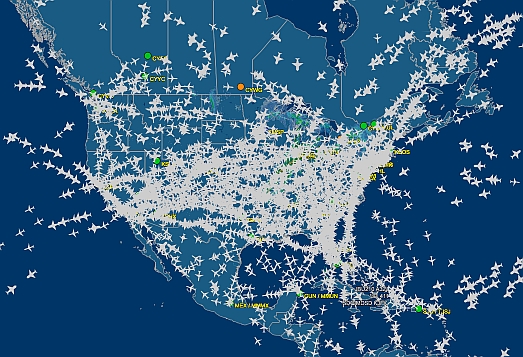
Real-time Flight Status And Radar For All US/Canada Flights

FlightAwareFor those who receive (and send) flight data from ADS-B capable devices such as the RTL-SDR dongles or have Apps for their tablets and phones, FlightAware announced on Wednesday this change to their service:

Hi from FlightAware,

After months of development, we released a large upgrade to our back-end flight tracking engine on Tuesday. Not only did the upgrade include dozens of bug fixes and flight tracking improvements, but we added a massive enhancement for US and Canadian flight tracking — the flight status and radar data is now live with no more five minute delay! Previously, the US/Canada data feed contained a five minute delay in addition to our ~30 second processing time, but now all data is less than a minute delayed from real time. In addition to the general improvement, this yields a lot of additional benefits:

  • More seamless transition between RADAR, ADS-B, and MLAT positions
  • Flights will no longer transition from “Arriving soon” to “Arrived 5 minutes ago”
  • Fewer estimated positions due to delayed RADAR data

Now that the radar data in the US and Canada is real-time, we’ll soon be enabling public MLAT data in the US, which is real-time just like our ADS-B data.

This is a major upgrade in data for folks in North America, and it will make using programs like PlanePlotter even more useful!

For those who might be interested in building their own dedicated ADS-B receiver, information may be found here. Of course FlightAware may be used as an online flight checking service just for tracking the progress of a given flight, which is in itself a lot of fun!

Robert Gulley, AK3Q, is the author of this post and a regular contributor to the SWLing Post. Robert also blogs at All Things Radio.

World Amateur Radio Day April 18th

Picture

This announcement for World Amateur Radio Day was posted on the IARU website along with links for clubs (or individuals) to download flyers and posters to promote the event.

World Amateur Radio Day

Every April 18, radio amateurs worldwide take to the airwaves in celebration of World Amateur Radio Day. It was on that day in 1925 that the International Amateur Radio Union was formed in Paris.

Amateur Radio experimenters were the first to discover that the short wave spectrum — far from being a wasteland — could support worldwide propagation. In the rush to use these shorter wavelengths, Amateur Radio was “in grave danger of being pushed aside,” the IARU’s history has noted. Amateur Radio pioneers met in Paris in 1925 and created the IARU to support Amateur Radio worldwide.

Just two years later, at the International Radiotelegraph Conference, Amateur Radio gained the allocations still recognized today — 160, 80, 40, 20, and 10 meters.  Since its founding, the IARU has worked tirelessly to defend and expand the frequency allocations for Amateur Radio. Thanks to the support of enlightened administrations in every part of the globe, radio amateurs are now able to experiment and communicate in frequency bands strategically located throughout the radio spectrum.  From the 25 countries that formed the IARU in 1925, the IARU has grown to include 160 member-societies in three regions. IARU Region 1 includes Europe, Africa, the Middle East, and Northern Asia. Region 2 covers the Americas, and Region 3 is comprised of Australia, New Zealand, the Pacific island nations, and most of Asia. The International Telecommunication Union (ITU) has recognized the IARU as representing the interests of Amateur Radio.

Today, Amateur Radio is more popular than ever, with over 3,000,000 licensed operators!


The full article and a list of several amateur-radio related activities may be found here.

Robert Gulley, AK3Q, is the author of this post and a regular contributor to the SWLing Post. Robert also blogs at All Things Radio.
Car Shortwave Radio

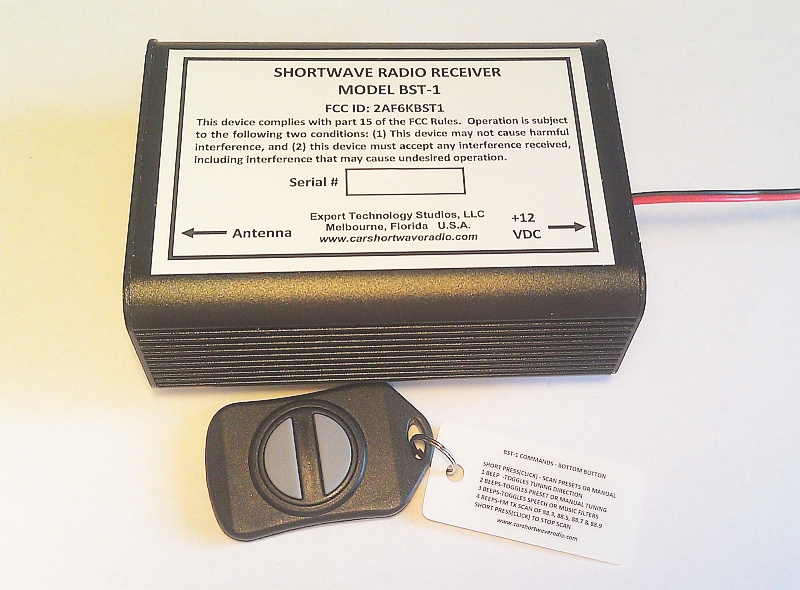
sw_car_audioTonight on Allan Weiner Worldwide (WBCQ  7490 kHz coming in beautifully on my FRG-7) Allan mentioned a shortwave radio converter for car radios. The package uses a small box which plugs into the cigarette lighter socket and can either use an antenna made for the converter or an antenna supplied by the user. The unit can display frequencies through the FM RDS display, and has a key-fob controller for scanning and saving stations into memory.

Here are some of the features listed by the manufacturer:

FEATURES OF THE BST-1
Excellent sensitivity – 0.5 microvolt at the antenna connector will stop the preset scan and provide a very listenable signal.
Automatic Gain Control – Keeps audio levels constant for weak and strong stations.
Full Shortwave band coverage – tune to any 5 kHz spaced AM channel from 2.3 to 26.1 MHz.   The frequency coverage is actually from 150 KHz to 30 MHz but with reduced sensitivity when operating outside of the shortwave bands, especially below 1.8 MHz.  This extended frequency range lets you listen to the 10 and 160 meter ham radio bands as well as CB channels.  If you are close to the transmitting antenna, you can even hear airport beacons in the 200 to 400 KHz radio-location band.
DSP (digital signal processor) selectivity – Sharp 3 kHz for speech or wider bandwidth for Hi-Fi music.
Noise Blanker – A digital noise blanker greatly eliminates any spark plug noise from car engine that can disrupt reception.Built-in crystal controlled FM transmitter –  Has RDS to display 5 digit tuned shortwave frequency and preset channel number/ “S” meter on the vehicle’s FM radio.
Four BST-1 broadcast FM frequencies can be selected by the Key Fob Controller so you always have a clear FM channel to use.  Programmed with 88.3, 88.5, 88.7, and 88.9 MHz – one of these channels will always be clear to listen for the BST-1’s FM transmitter.
If you know Morse code for the numbers 0-9 (very easy to learn), you can use the Key-Fob to activate a Morse code annunciation of tuned frequency.   This aids in operation if your FM receiver doesn’t have RDS display or if you can’t look at the display on the FM radio while driving.

Key-Fob command for instant selection of WWV channels – 5,10,15, and 20 MHz for accurate time and signal propagation checks.

High or Low sensitivity selection by the Key Fob – Optimum performance can always be obtained during conditions of very strong signals.
Rugged construction – Designed for automotive use.
Memory storage of up to 100 preset channels-  After changing channels, the preset channel is shown on the RDS display for 3 seconds and then the display switches to show the “S” meter.
The BST-1 can be manually tuned to any 5 KHz channel in the turning range and if desired, that new frequency stored in preset memory (up to 100 presets).  Note that the BST-1 radio is AM reception only so 5 KHz tuning intervals are optimum since all International Shortwave stations are on 5 KHz channels. A digital AFC (Automatic frequency control) circuit in the BST-1 is used to automatically compensate for stations that are slightly off (+/- 150 ppm) the exact 5 KHz channel.
Pre-programmed- The BST-1 is ready to start listening right away.  Comes with 50 popular U.S. and International shortwave stations as well as WWV at 5,10,15 and 20 MHz.
Easily add or delete preset channels using the Key Fob controller.

For a starting price of $179.50 (as of this writing) plus shipping, this is an intriguing possibility for having shortwave radio in the car. 73, Robert

Robert Gulley, AK3Q, is the author of this post and a regular contributor to the SWLing Post. Robert also blogs at All Things Radio.
Raspberry Pi 3 Available

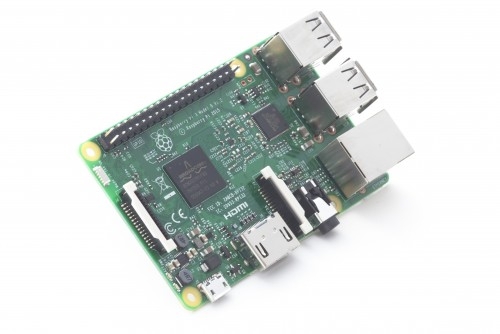
RaspberryPi3“Just when you thought it was safe to go back in the water . . .” From the Raspberrypi.org Blog blog comes news of a new board with greater processing speed and integrated hardware.

“In celebration of our fourth birthday, we thought it would be fun to release something new. Accordingly, Raspberry Pi 3 is now on sale for $35 (the same price as the existing Raspberry Pi 2), featuring:

  • A 1.2GHz 64-bit quad-core ARM Cortex-A53 CPU (~10x the performance of Raspberry Pi 1)
  • Integrated 802.11n wireless LAN and Bluetooth 4.1
  • Complete compatibility with Raspberry Pi 1 and 2

“The 900MHz 32-bit quad-core ARM Cortex-A7 CPU complex has been replaced by a custom-hardened 1.2GHz 64-bit quad-core ARM Cortex-A53. Combining a 33% increase in clock speed with various architectural enhancements, this provides a 50-60% increase in performance in 32-bit mode versus Raspberry Pi 2, or roughly a factor of ten over the original Raspberry Pi.

“Raspberry Pi 3 is available to buy today from our partners element14 and RS Components, and other resellers. You’ll need a recent NOOBS or Raspbian image from our downloads page. At launch, we are using the same 32-bit Raspbian userland that we use on other Raspberry Pi devices; over the next few months we will investigate whether there is value in moving to 64-bit mode.”

At $35 these computers are a steal, and now with Bluetooth and Wireless built in, they are even more affordable. I have a Raspberry Pi 2 already, but I have a feeling one of these will end up in my shack before too long!

Robert Gulley, AK3Q, is the author of this post and a regular contributor to the SWLing Post. Robert also blogs at All Things Radio.
Radio Öömrang

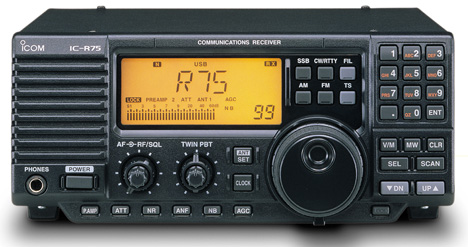
Icom-R-75This once-a-year broadcast could be an interesting challenge for folks on Sunday:

Radio Öömrang will broadcast on Feb.21, 2016 from 1600 to 1700 UTC on 15215 kHz in German, English and Frisian.

*(Caroline Mesnier via EuroRadio)*

Radio Oomrang broadcasts once in a year on shortwave in lower German language via facilities of Media Broadcast in Germany. Radio Oomrang announces as “The Free Voice of Frisian People from Amrum island in Germany”.

Station ID is in english.

About Oomrang :
http://en.wikipedia.org/wiki/%C3%96%C3%B6mrang

— Posted by Alokesh Gupta, New Delhi in the Cumbre DX Yahoo Group

While I have not heard them before, I will definitely be trying to catch the broadcast this weekend, and I will have my recording gear ready! Let us know if you have a successful reception report to share!

Edit: I mistakenly listed Saturday at the top but the correct date is the one in the post, Sunday. Sorry!!

For verification card, contact [email protected]

Robert Gulley, AK3Q, is the author of this post and a regular contributor to the SWLing Post. Robert also blogs at All Things Radio.

World Radio Day

WRDThis was posted on the European broadcasting Union page:

To mark World Radio Day (13 February), the European Broadcasting Union (EBU) is organizing a ‘Musical Caravan’ from east to west in partnership with other broadcasting unions across the globe.

Listeners will be taken around the world in a little over two hours.

This special compilation submitted by EBU Members, Associates and its sister unions (ABU, ASBU and CBU*) and coordinated by the EBU Music Unit in Geneva consists of songs representing the musical heritage of 34 countries.

The broad list of contributions include a Richard Strauss lied recorded by Bavarian Radio, an Indonesian song for peace and friendship, a folk tune from India and carnival music from the Caribbean.

The EBU will also share key facts about radio listening compiled by the organization’s Media Intelligence Unit in the week leading up to World Radio Day 2016 on its Facebook page and Twitter account.

Another highlight of the EBU’s contribution to World Radio Day 2016 will be a special performance of Beethoven’s Ninth Symphony by the NHK Symphony Orchestra of Tokyo and the Kunitachi College of Music Chorus. An interview with conductor Paavo Järvi can be found here.

EBU Head of Radio Graham Dixon said: “Radio plays a very significant part in all our lives. On average, we will listen to nine years of radio in a lifetime – more than any activity except breathing and sleeping!  Radio provides a convenient way to encounter new ideas, new music and new ways of thinking, and also provides valuable company to counter isolation and loss.  Nine years of an average lifetime is indeed an impressive figure, but the real personal impact of radio cannot be quantified. World Radio Day provides a great opportunity to reflect on the power of radio.“

– See more at: http://www3.ebu.ch/news/2016/02/ebu-takes-listeners-on-a-global

Robert Gulley, AK3Q, is the author of this post and a regular contributor to the SWLing Post. Robert also blogs at All Things Radio.