
Author Archives: Robert Gulley

A Good Friend Who’s Always There

cas-pro-relaxThis summer has been a tough one for me in many ways, not the least of which is the minimal amount of time I have been able to spend playing radio. I have several commitments involving radio each week/month, but I do not consider that “playing” radio. To me, playing radio is where we get to sit down in front of a radio of any kind and do something with it just for the pure joy of it. The good thing about this hobby is it is always there whenever you are ready. It is like a good friend who is always there. Radio is, in fact, a bit like my dog.

For those who enjoy dogs like I do, one of the most rewarding things is to come home and find your dog waiting for you, tail wagging, and excited to see you. It does not matter how long you have been gone — a short trip elicits the same excitement upon your return as you would get being gone all day. Good dogs require very little maintenance to be happy, and they are ready for love and attention whenever you are available to give these to them.

My radios do not wag their antennas when I walk into the room, but they are there ready to go when I am, and they provide a world of enjoyment when called upon. As I sit here looking at the radios in front of me (only a small portion of the radios I have around the house overall), each one means something special and calls to mind enjoyable times. My 220 rig gets very little use overall, but it always reminds me of an amateur radio friend who was an Elmer to me in the hobby.

As I am typing this my 2-meter APRS channel has come alive with signals from the digipeater in the International Space Station (ARISS) and I am hoping for a contact or two. This past week I made a contact with AF4B in Texas, which was his first ISS contact! What an honor that is for me — whenever I have the privilege of being someone’s first contact in any manner of radio I am thrilled!! It always brings to mind my “firsts” and how exciting were those moments!

As I look at my Uniden Bearcat BC898T I remember going to my first Dayton Hamvention and buying this beautiful analog scanner. One of the fellows there tried to talk me out of it because it was only analog, and some of the local departments had moved to digital. Fortunately there are still many analog signals to catch in my area, and I am interested in more than just Public Service transmissions. I like Marine, Aviation, Railroads, Coast Guard, and a dozen other things which can be picked up by analog scanners. The 898T was my entrance back into the scanning hobby after many, many years away from it. There was a great deal to learn, but this was my re-introduction to scanning.

I have previously talked about my Yaesu-Musen FRG-7, in some ways the ultimate in shortwave radios for nostalgia, quality workmanship, and manual control of a radio. 40+ years old and still a gem!! Oh yes, and then there is my Swan 350, another marvel of a radio from the past. Never known as a top-of-the-line rig by any means, I treasure its heft, its vacuum tube warmth, and its mechanical tuning which turns like tire compared to the optical tuning wheels on modern rigs. In fact, its a lot like me — slow to get going and needs some time to warm up, but gets the job done eventually. (Why does it seem getting up out of bed and getting started each day gets harder and harder . . . I can’t be that old, can I??)

Fall and winter are coming, definitely great times of the year to play radio, and I hope to do just that. A little work on my antennas should get me back up to  speed in terms of capabilities, and my hope is life will slow down enough to let me have some fun. I know whenever I have the time my old friends will be there ready and waiting! I hope the coming months are filled with radio fun for each of you! 73, Robert

Robert Gulley, AK3Q, is the author of this post and a regular contributor to the SWLing Post. Robert also blogs at All Things Radio.


A Great Pirate QSL Card!

XFM927

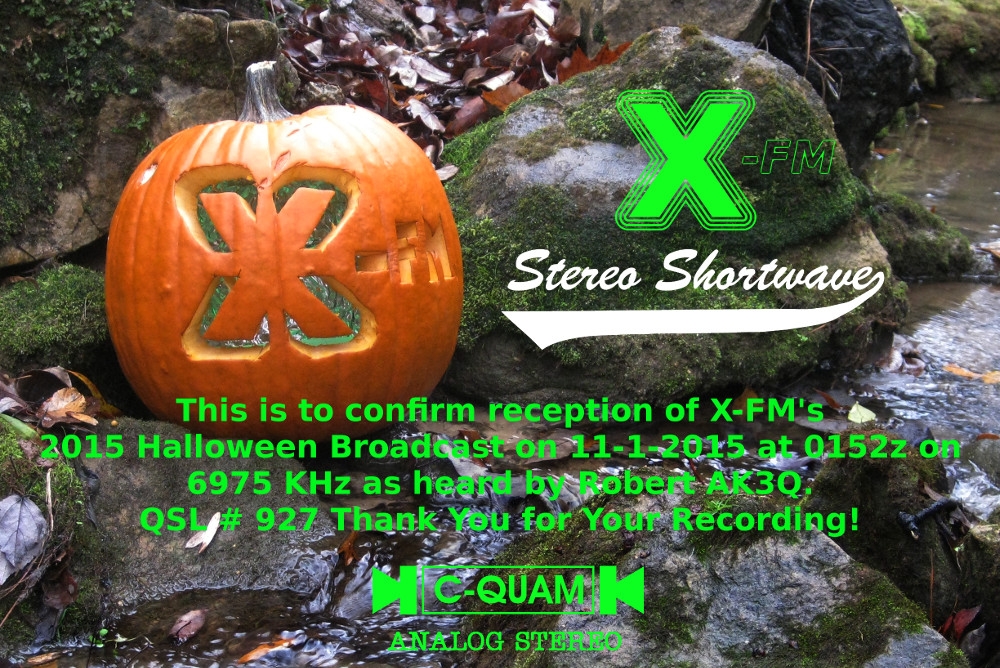
Here’s a great example of a QSL report from Pirate Station X-FM Stereo Shortwave monitored Halloween 2015. Not only is it a beautiful card, Redhat (the Deejay) also included the playlist as a .txt attachment.

As I recall he also made live announcements of who had left reception reports/comments on the HF Underground forum as well as for those who sent him emails directly.

I sent a short recording as part of my reception report, and it was an added bonus to see that mentioned in his QSL card.

I am quite impressed with all the effort made to turn out a quality QSL card, but a Pirate transmitting in stereo obviously appreciates quality!!

Pirate Radio receptions are memorable events on their own, but the QSL cards really make them special! Happy Pirate hunting!

Robert Gulley, AK3Q, is the author of this post and a regular contributor to the SWLing Post. Robert also blogs at All Things Radio.
13 Colonies Special Event

13-colonies

13 Colonies operating event runs from 1300Z July 1 – 0400Z July 7

Once again, the 13 Colonies Special Event will take place between 1300z, July 1st and 0400z July 7th. The certificate is printed on heavy card stock. Stations working one state or, as many as all 15, will be eligible for the certificate. A “Clean Sweep” indicator will be affixed, for those lucky enough to “Q” all 15.

A special endorsement will be attached for stations contacting their sister operation, WM3PEN, in Philadelphia, PA, where independence was declared. New since 2015, the 13 Colonies have added a second sister event station GB13COL will operate from Durham, England. The 13 Colonies certificate will have a Liberty Bell added for a contact with WM3PEN. They will also offer a special QSL card printed just for this event.

There should be at least two stations from each on the 13 colonies on the air, as well as Super contest stations, multi-operator Club stations and OM and XYL teams. The thirteen orginal U.S. colonies are CT-DE- GA-MA-MD-NC-NH-NJ-NY-PA-RI-SC-VA. Special events stations mentioned are: K2A (NY), K2B (VA), K2C (RI), K2D (CT), K2E (DE), K2F (MD), K2G (GA), K2H (MA), K2I (NJ), K2J (NC), K2K (NH), K2L (SC), and K2M (PA).

All HF bands will be in play, including the WARC bands, with the exception of 60 meters. 2 meters and 6 meter simplex are encouraged. All modes of operation should be represented – SSB, CW, RTTY, Digital, and the Satellites. The mode of operation is up to the individual colony state station. For more details on the stations, suggested frequencies, QSL info and on how to obtain the special certificate, see: http://www.13colonies.info

Thanks to the Southgate Amateur radio News for this information


This is one of my favorite events each year – and it also represents some of the best of the traditions of amateur operation. I have always found the operators to be kind and helpful and patient, and they really seem to enjoy the event. Why not give it a go  this year?!

Robert Gulley, AK3Q, is the author of this post and a regular contributor to the SWLing Post. Robert also blogs at All Things Radio.

Sangean ATS-909X on eBay

Sangean-909xSangean ATS-909x on eBay

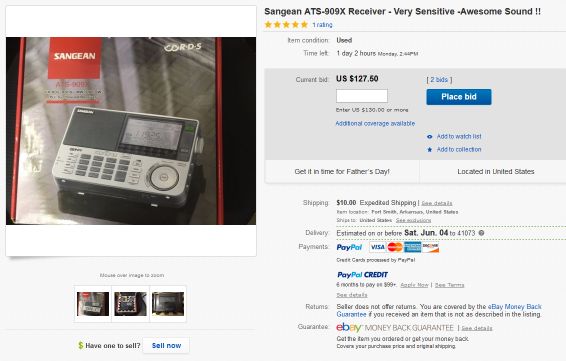
For those who might be interested there is a black version of the 909X on eBay with an auction end day of Monday early afternoon. The condition looks good from the pics (of course buyer beware!) and current bid is $127.50 with two bidders. I have one of the white series which bought several years ago from another ham right at this price, so needless to say I was happy (and lucky!)

Item # 172219284531

Seller information

100% Positive feedback


(No connection to seller – just included for search purposes!)

Robert Gulley, AK3Q, is the author of this post and a regular contributor to the SWLing Post. Robert also blogs at All Things Radio.
European hams announce NEW RADIO – a dual-band, multi-mode radio to support DMR, D-STAR and C4FM

NEW RADIO, DMR, D-STAR, C4FM, System Fusion, mobile, radio, ham radio, amateur radio, VA3XPR, dual-band, multi-mode, FM, chassis

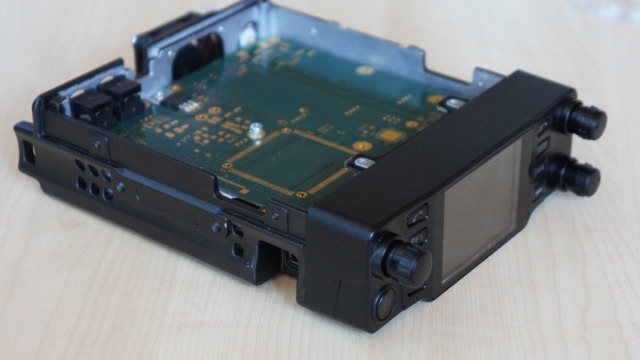
An announcement has been made by Kurt, OE1KBC and reported by concerning a multi-mode radio combining various digital modes. The radio/computer is called simply NEW RADIO and is a joint initiative of the ÖVSV, DARC and IARU R1. As stated in Don’s article:

the “NEW RADIO” that will operate on the 2m & 70cm bands and support the most common ham digital modes, including DMR, D-STAR and C4FM (System Fusion), plus analog FM. As reported in the article, the NEW RADIO has been created by hams for the ham radio community will feature a colour touch screen display, 50W of power output, a 1.8 GHz processor, a Linux operating system, plus dual AMBE+ vocoders, allowing for full-duplex, cross-band operation. Also, one of the biggest features of the NEW RADIO is that it will include a built-in LTE wireless modem and SIM card allowing it to be Internet connected while on the go. Apparently, with it being Internet connected, the NEW RADIO will be able to automatically download frequencies, offsets, contacts and other configuration information on the go, allowing for instant updates for users. (The full article may be found here.)

I certainly hope this radio really is “ready for Prime Time” soon as it might very well fill a big need by allowing use of multiple systems without the need to carry around a radio for each digital mode. I suspect many hams have hesitated to jump on the digital bandwagon simply because of not knowing which standard would have dominance. Nobody wants to relieve the VHS/Beta experience! (Yes, I am dating myself here!)

If anyone gets a look at this radio at Dayton I hope you will share with us your impressions!

Robert Gulley, AK3Q, is the author of this post and a regular contributor to the SWLing Post. Robert also blogs at All Things Radio.
 

New Shortwave Station in South Sudan

Radio-TamazujThere’s a new shortwave station in South Sudan!
Kudos to Eye Media for their Shortwave Radio efforts in South Sudan to complement and extend their reach beyond local FM radio. And I must add, kudos to the United States for their part in helping to fund the venture. While I am quick to criticize my country for their cutbacks in SW funding, I have to be fair and say “well done” when something like this comes along. Here is the news report as posted April 26 (yesterday) on Radio Tamazuj and which was reported by Alokesh Gupta New Delhi on the Cumbre-DX  Yahoo Group:

Eye Media, the parent organization of Eye Radio, has announced that it has launched a new shortwave broadcast service to complement its existing FM broadcasts in South Sudan.

The broadcasts starting today will bring listeners news and information in Arabic, as well as Dinka, Nuer, Shilluk, Bari, Zande and Lutoho.

According to a press release today from Eye Media, “the Eye Radio Shortwave will cover the whole of South Sudan including remote areas in which communities are not able to access FM radio stations.”

Eye Radio is one of the fastest expanding media houses in South Sudan after launching FM repeaters in several state capitals last year, expanding the station’s reach beyond Juba where it is based.

In its press release, the station noted that the funding for this initiative came from USAID, the international development agency of the US government.

Shortwave radio is used for long distance communication by means of reflecting or refracting radio waves back to Earth from the ionosphere, allowing communication around the curve of the Earth. It was a popular means of long-distance news sharing before the advent of the Worldwide Web, and it is still used for reaching remote areas.

Only two other media houses broadcast on shortwave with content specifically for South Sudan: Radio Tamazuj, which operates two hours daily on the shortwave, and Voice of America, which produces the 30 minute program South Sudan in Focus.

Radio Tamazuj broadcasts from 6:30 to 7:30 each morning on 11650 kHz on the 25 meter band and 9600 kHz on the 31 meter band, and 15150 kHz and 15550 kHz on the 19 meter band each evening from 17:30 to 18:30.

Eye Radio’s new broadcasts will run from 7:00 to 8:00 each morning on 11730 kHz on the 25 meter band and 17730 kHz on the 17 meter band from 19:00 to 20:00.


Robert Gulley, AK3Q, is the author of this post and a regular contributor to the SWLing Post. Robert also blogs at All Things Radio.

BBC Predicts Internet-Only Radio in the Future

BBC-logo(The following is part news / part editorial)

According to a report going to Parliament for the BBC’s broadcast charter proposal, the BBC is preparing for an Internet-only world for broadcasting. This has prompted an investigation of other radio broadcasting services by Radio World magazine to get their take on this perspective. Part of the article “Is Broadcast Radio Doomed”  follows:

 Conventional radio and television broadcasting are doomed, eventually. Or so one might reasonably assume from reading “British, Bold, Creative,” the BBC’s broadcast charter proposal for the next decade of its mandate. The BBC’s 10-year broadcast charter is up for renewal in 2016. The proposal is the Beeb’s funding pitch to Parliament.

To be sure, the BBC didn’t use the word doomed, or put a timetable on it. However, over the next 10 years, “We will be moving to an Internet-fit BBC, to be ready for an Internet-only world whenever it comes,” states the BBC proposal. The only limiting factor will be to “move at the pace of our audiences”; ensuring that older subscribers have access to content on radio and TV as long as they need it.

Subsequent to issuing this proposal, the BBC announced that it is reorganizing its internal divisions along content rather than platform lines. For instance, “Each overarching division would have subsidiary divisions such as BBC Youth, a mooted subdivision of BBC Entertainment, which would include the online channel BBC Three, and pop music station Radio 1,” reported The Telegraph newspaper . . . .

In the current transitional environment, it is impossible to see just where broadcast radio will be in 10 and 20 years’ time. The BBC’s prediction of an inevitable “Internet-only world” notwithstanding, there are still many parts of the Third World where one-way radio broadcasts remain the only economical, effective way to reach mass audiences; no matter what advances are being made in 4G-and-beyond smartphones in the First World. Add broadcast radio’s resiliency in the face of natural and man-made disasters — compared to the frequent overloading and failure of cellular telephone networks during such incidents — and the notion of shutting down broadcast lifelines seems unlikely in these regions.

– See the full article at: http://www.radioworld.com/article/is-broadcast-radio-doomed/278577#sthash.YrBAkCfQ.dpuf

The demise of broadcast radio has been predicted many times in the past 50-60 years and yet it remains. Still there is a growing mindset in what I call  the Western culture’s business mindset that the pervasiveness of the Internet is the dominant factor in future media decisions. This is the same justification for various governments reducing or eliminating SW Broadcast budgets. After all “Everybody has the Internet now!”

This is a mistake, and belies a Western-centric view of the world. I cannot claim to know the real numbers, but I have little doubt the numbers representing Internet availability are inflated, partially because of assumptions and partially for selfish business interests.

In an ever-competitive entertainment market broadcasters (and governments) are naturally worried about such things as market share and the like, but this is only looking at things from one side of the coin. Anyone who uses the Internet outside of the home knows data fees can become enormous, and therefore we watch just how much traffic we pass through our wireless devices. (Yes I admit it – any place I go regularly which has “free Internet” gets loaded into my list of networks so as to keep my data charges down.)

How many people are going to listen to radio streams like they do now to radio broadcast stations? Are you going to drive home with your radio on through the Internet? I doubt it. Similarly how many people listen to the radio in places where there would be no coverage of wireless? I believe the market share would decrease rather significantly in these same western cultures where the Internet is indeed plentiful, but not certainly not free.

Having been involved in the early days of the public Internet back in the 90s, I remember meeting with city planners when they were looking to offer free Wi-Fi within the city so everyone could have access. While the idea sounded good, the logistics of equipment, and more importantly the expense of such an ongoing system, quickly laid such plans to rest for most government budgets.

I hope the pendulum swings back over time and business leaders and government officials recognize the value of both shortwave and OTA radio broadcasts. The Internet is a shiny diversion to be sure, but it is not the answer to all of our media needs. And whether folks like to admit it or not, the Internet is a fragile thing. As the old saying goes, a chain is only as strong as its weakest link. How many times a year does your Internet service go out for no apparent reason, much less because of weather or other disasters?

Broadcast radio needs to be supported for many of the same reasons as shortwave radio – there simply is no more reliable way getting information out to the most number of people over the greatest possible coverage area.

Robert Gulley, AK3Q, is the author of this post and a regular contributor to the SWLing Post. Robert also blogs at All Things Radio.