Author Archives: Thomas

VOA adds shortwave frequencies for US election coverage

(Photo source: VOA)

(Source: VOA via Kim Andrew Elliott)

Special election programming on the Voice of America

0200-0600 UTC, November 7:

Africa
0200-0300 UTC  909, 1530, 4930, 6080, 9885, 15580
0300-0600 UTC  Existing broadcasts

Middle East
0200-0400 UTC   9480, 12005, 15255
0400-0600 UTC   9480, 15255

Asia

a. South and Central Asia
0200-0400 UTC  13810, 15155, 15255, 15590
0400-0600 UTC   13570, 13810, 15155, 15255, 15590, 15640, 17525

b. East Asia
0200-0300 UTC  13810, 15230, 17525, 17615
0300-0400 UTC   13810, 15230, 17615
0400-0600 UTC   13810, 15230, 15405, 15640, 17615

c. Southeast Asia
0200-0300 UTC   11705, 15155, 17525
0300-0400 UTC   15155, 17525, 17615
0400-0600 UTC   15155, 15640, 17525, 17615
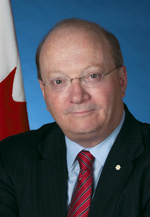
Media Network Plus interviews RCI shortwave supporter, Senator Hugh Segal

Senator Hugh Segal

PCJ’s Media Network Plus interviewed Senator Hugh Segal last week.  As we mentioned previously, Senator Segal made a motion that the CBC be made accountable for the unfair proportion of cuts imposed on Radio Canada International earlier this year.

I found Segal’s thoughts regarding the future of Radio Canada International articulate and accurate. If you’ve been following the RCI Sackville story, you will appreciate this interview as well.

You can listen to the interview on PCJ Media’s website, or by downloading the mp3 by clicking here.

Again, if you haven’t signed our petition to save Radio Canada International’s Sackville transmission site, please consider adding your voice and sharing this with your friends! Click here to sign the petition!

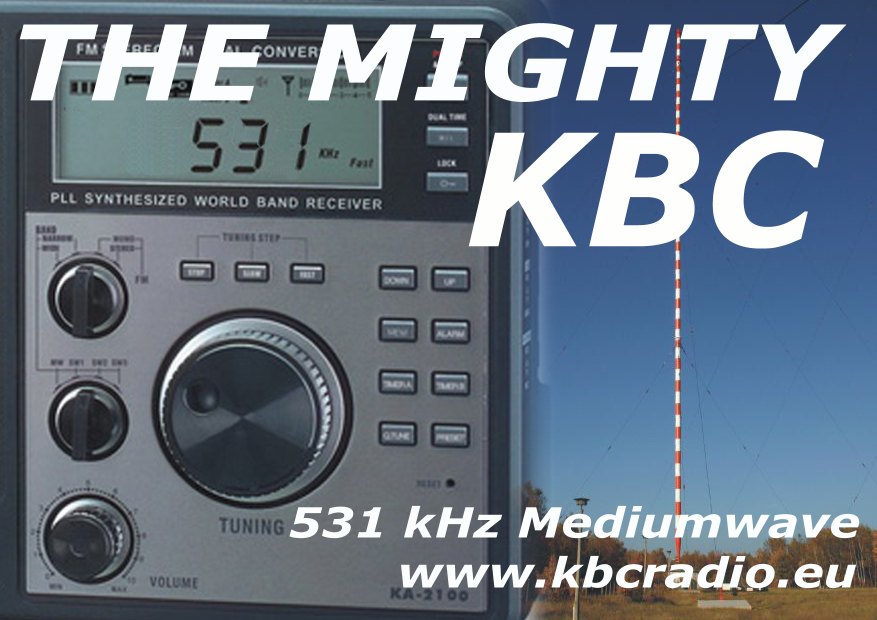
Shortwave Radio Recordings: The Mighty KBC on 9,500 kHz

Once again, The Mighty KBC broadcast a two hour mix of music to the world on 9,500 kHz. Fortunately, I was able to record the entire broadcast–you can listen below.

The KBC signal and audio out of their transmitter in Bulgaria were both excellent. There was very noticeable interference from the clandestine station, Radio Republica, who broadcasts at the same time (00:00-01:57 UTC) on 9,490 kHz.  According to my spectrum display, Republica’s signal had a bandwidth of 20 kHz!  At times, I had to narrow my receiver filter to about 6.6 kHz and use a USB sync mode  to keep KBC’s broadcast clear.  Still, you can certainly hear some of the noise from Radio Republica in the recording.

Though somewhat difficult to see since this is a snapshot, Radio Republica’s signal covered a 20 kHz wide swatch of the spectrum. The KBC broadcast is shaded and centered on 9.500 MHz.

Since Radio Republica is broadcast from the US, I’m curious if listeners in other parts of the world (or other parts of North America) had the same problem. If so, please comment!  I’ll pass this along to KBC.

You can download the entire broadcast as an mp3 by clicking here, or simply listen in the embedded player below:

Guardian: BBC World Service asking for voluntary redundancies

(Photo source: NY Times)

(Source: The Guardian)

Corporation’s global arm to close 73 editorial posts, but hopes to avoid compulsory layoffs as part of £42m budget cuts

The BBC World Service has urged all its network news journalists to consider voluntary redundancy as it aims to avoid compulsory layoffs as part of £42m budget cuts.

The BBC’s global arm is closing 73 editorial posts following its cut in funding by the government in 2010.

Post closures include 16 in network news, which includes domestic journalists based around the UK, 14 in World Service news, and two in newsgathering for world and business.

Stephen Mitchell, the BBC’s deputy director of news, urged staff to consider voluntary redundancy in an email on Thursday morning.

He said: “We are committed to avoiding compulsory redundancies where possible, and have previously been very successful in achieving this. We hope to continue our good record, and therefore are asking all network news staff once again whether they wish to be considered for voluntary redundancy.”

[…]Compulsory redundancies at the World Service led to two walkouts by staff last year.

[…]The National Union of Journalists has criticised the World Service cuts. General secretary Michelle Stanistreet said the job losses “fly in the face” of the corporation’s commitment to quality programming, and urged director general George Entwistle to push for a renegotiation of the licence fee settlement.

“The World Service is a source of information for people across the world, described by former UN secretary general Kofi Annan as ‘perhaps Britain’s greatest gift to the world’,” Stanistreet added.

[…]”These cuts will severely impair the BBC’s scope and services at a time when they are needed more than ever. The BBC needs to stop and rethink its approach to the World Service before it does irreparable damage.”

Read the full article at The Guardian website.

North Korea updates transmitters and jamming ability

(Source: Daily NK)

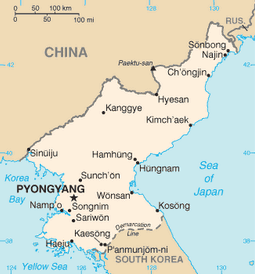
The North Korean authorities are in the process of replacing their existing shortwave radio transmitters, Daily NK has learned. The measure appears designed to both allow better broadcasts targeting South Korea and stop outside shortwave broadcasts entering.

According to the Northeast Asian Broadcasting Institute (NABI), the authorities made their first move in March this year, replacing the shortwave transmission equipment at Kanggye Transmission Station in Jagang Province with modern equipment made by Beijing BBEF Electronics Group Co. Kanggye Transmission Station is one of three high output shortwave transmission facilities in North Korea, with the other two being at Pyongyang and in Gujang County, North Pyongan Province. […]

North Korea has two shortwave broadcasters; Chosun Central 1st Broadcast and Pyongyang Broadcast. The first is for the domestic and international audience while the latter serves the international audience only, leading to the assumption that North Korea is replacing its existing transmitters in order to improve its broadcasts targeting South Korea. With the sort of modern equipment arriving from BBEF, North Korean broadcasts will be receivable anywhere in South Korea, no matter where in the North they are broadcast from.

According to NABI, North Korea’s shortwave broadcasting capacity was previously very weak due to worn out and broken equipment. Signal strength was particularly weak, meaning that listeners tended to receive a different channel even when tuned directly to the intended broadcast frequency. According to one defector from Pyongyang who arrived in South Korea in June 2011, the signal strength of Chosun Central 1st Broadcast was so weak at times that it was even unlistenable in most regions of North Korea.

However, the quality has recently improved dramatically, as Park Sung Moon of NABI explained to Daily NK, saying, “Recent analysis of North Korea’s shortwave Chosun Central 1st Broadcast and Pyongyang Broadcast reveal that they are being broadcast clearly and consistently, without interference or signal shifting.”[…]

The other side of the coin is that improved shortwave transmission strength stops incoming signals from reaching listeners.

According to one defector who used to be a part of the Party Propaganda and Agitation Department, “They know that when the Chosun Central 1st Broadcast signal strength is weak, it regularly arrives with outside broadcasts mixed in. I think they want to stop this happening.”

Sackville still broadcasting CBC North Quebec Service on 9,625 kHz…for now

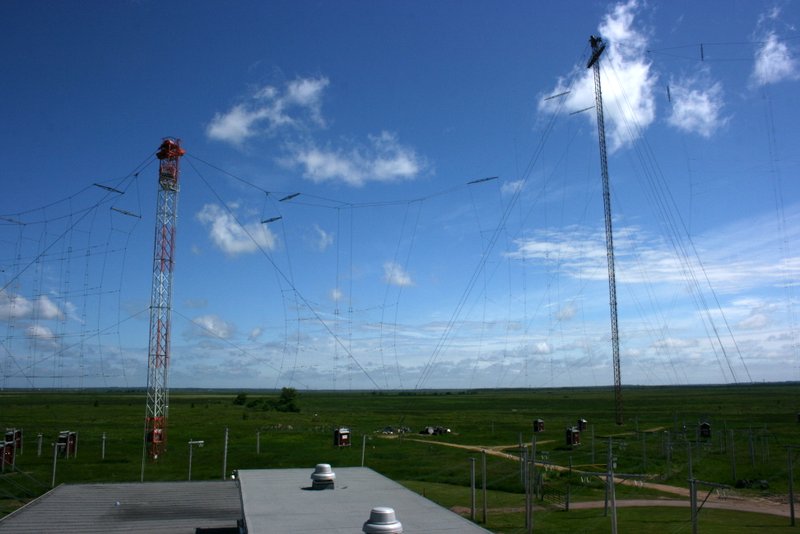
The remaining curtain antenna faithfully broadcasting the CBC North Quebec relay

I just received confirmation that the Sackville, NB transmission site of Radio Canada International will continue broadcasting the CBC North Quebec service on 9,625 kHz until all of the FM relays in North Quebec have been tested and placed into service.

To be clear, contrary to the implication of the recent CRTC ruling, the Sackville site may continue broadcasting for a few more days or weeks, depending on progress with the FM relays’ implementation.

The remaining staff at Sackville have converted the site to run two transmitters and two antennas (for redundancy) for the North Quebec Service on 9,625 kHz via remote operation. Nothing else is being broadcast our of the Sackville site.

Have you singed our petition to save Sackville from being dismantled? Now would be the perfect time:


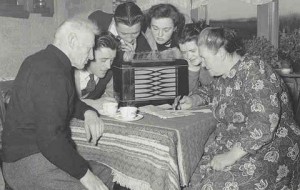
“Tuning In” Radio 4 documentary on the history of early radio in Britain

Tuning In, a history of early radio in Britain, will be broadcast November 3rd on BBC Radio 4. If you don’t live in the UK, you can listen live on the Radio 4 website where they will also post an archive of the show. (Note that some archived shows are only available for a limited time.)

(Source: Radio 4)

The press fulminated, the enthusiasts were frustrated, and the radio manufacturers fumed. Despite the fact that Marconi had invented radio before Queen Victoria had celebrated her Diamond Jubilee in 1897, radio in Britain took another 25 years to begin an official service to listeners. But when, on November 14th 1922 the British Broadcasting Company’s station at Marconi House radiated to an awaiting nation “This is 2LO calling” for the first time under the company’s name, it marked the start of the first and most distinguished public-service radio station in the world.

As part of the celebrations to mark nine decades of the BBC, historian Dominic Sandbrook explores the long and involved pre-BBC history of radio in Britain, how Britain’s broadcaster got going and developed into an institution dedicated to entertainment, education and information, discovers why Australian diva Dame Nellie Melba was involved, and how the improbably-named Captain Plugge made his first British commercial broadcast from the roof of Selfridges department store in London. From Marconi to Savoy Hill via an old army hut in Essex, the story of the early radio in Britain.