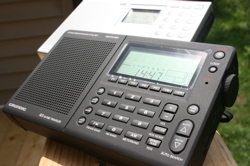
The Grundig G3 with Sony ICF-SW7600GR in background.
The Grundig G3 arrived this week and I’ve had a few moments to gather some first impressions.
I’ve received a lot of inquiries regarding the G3, so I thought I’d post a preliminary review.
There are a handful of G3 reviews on the net (not many, as of the date of this post) and I find that my experience with the G3 is quite different than that of other reviewers.
A quick disclaimer: This review is limited, as I have not had enough time to complete my tests of the G3. All tests thus far were performed with built-in whip antennas and a fresh set of internal batteries. I used the Sony ICF-SW7600GR and the Grundig G5 for benchmarking.
Looks a Lot Like the G5…
The well-known predecessor to the G3 is Grundig’s G5 (Eton E5). The G5 has been out for several years and is an excellent portable. Along with Sony’s ICF-SW7600GR, it has been one of the radios I have recommended most to newcomers and SWLers who seek a powerful yet portable radio. I happen to have one handy for review, so naturally I tested the G3 against its older sibling.
The G5 and G3 are very similar in appearance. Right out of the box, I could see that the G3 shares the same body and keyboard configuration. To my surprise, there are no additional keys on the G3, but the key functions have been shuffled a bit. For example, the former SSB button now switches between upper side-band (USB) and lower side-band (LSB) and toggles RDS. The EDIT button now turns on the sync detector and toggles USB and LSB sync modes. The functions of the four vertically aligned buttons on the left side of the keyboard have all been shuffled as well.
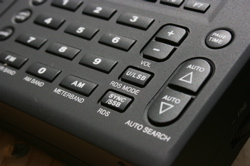 Though I had been familiar with the keyboard functions of the G5, I easily found my way around the G3. Grundig (and Eton) products tend to be ergonomic and easy to use. The G3 is no exception: for example, to change frequency to 10,000 kHz, you simply type 10000 on the keypad and then press the AM button. To go to 89.7 MHZ, simply type 897 and press the FM button. This is a formula that Grundig has used since at least the days of the YB400, and I wished more portable radios would adopt this as a standard for direct frequency entry.
Perhaps the most noticeable change, though, is the G3’s display. The clock on the G5 has been moved to the lower part of the display screen and the panel which contains the signal strength meter, battery indicator, etc. has been shrunk to make room for the new RDS alpha numeric display at the top of the screen.
Performance
I have done some initial testing of the G3 against the Sony ICF-SW7600GR and the Grundig G5 on all bands and modes (except FM aircraft, which the Sony and both G5 lack). I feel that people who are looking for a portable in this price range will naturally have to decide between the G3 and the Sony 7600GR as they both have many of the same features. Here are my notes:
- Audio – The G3 shares the same audio characteristics with the G5 (no surprise here), thus I prefer the audio from its built-in speaker as compared with that of the Sony. The Grundig audio has a surprising amount of dynamic range for such a small radio, the Sony’s audio has more mid-range and lacks the bass heard in the G3.
- AM Broadcast (MW) band – I found that the G3 performed as well as the Sony and G5. I expected this as the G5 was on par with the Sony in this respect. I can’t comment on LW performance, as I live in North America.
- FM – I live in a rural, mountainous area where it is a challenge for FM stations to reach listeners. In my limited testing, I found that FM sensitivity was excellent–again, at least as good as the G5 and the Sony. I can pull in two NPR transponders that are very difficult to receive on a typical radio without an external antenna.
- Shortwave – Again, the G3 and G5 are almost identical with respect to shortwave sensitivity–I could not tell the difference between the two. When paired against the Sony, though, I find that the G3 is slightly more sensitive and selective. Historically, this has always been a factor that kept the G5 in competition with the Sony 7600GR.
What about Synchronous Detection?
One of the biggest features that separates the G3 from the G5 is synchronous detection. For those of you unfamiliar with this feature, it basically addresses the issue of selective fading and co-channel interference on shortwave. Too technical? Well, in a sense, it locks onto and “evens out” a signal. Essentially, it helps to separate a signal you want to hear from those you don’t. For a good primer on sync detection and how it works, read this ARRL document (PDF).
It’s still early days, but it doesn’t seem that the G3’s sync detection function is as good as Sony’s. The G3 has difficulty locking onto a weak signal with sync detection enabled. This is a bit disappointing since sync detection should help with weak signals. The Sony, on the other hand, locks onto signals whether they are strong or weak. Mind you, I think Sony has the best sync detection available under $300-400. The Eton E1’s sync detector surpasses the Sony’s, but is a much bigger, more expensive radio.
With that said–and here is where I depart from other reviewers who have been upset with the G3’s sync detection–I find that the G3 still performs better than the Sony on the shortwave bands. Especially while listening to broadcasts in AM mode, that is–I have not yet thoroughly compared them side-by-side in SSB.
I have tested both radios with weak and strong signals and have found that if I had to chose a radio for any of those broadcasts, the G3 would have won each time. For example, the morning of this post, I compared both radios side-by-side while listening to the relatively strong signal out of WRMI, Miami, Florida. The G3’s audio was clear–punchy, even–without sync detection turned on. The Sony, on the other hand, also received the signal clearly, but the noise floor was higher (background static was higher–some of which could have been local). When I turned on the Sony’s sync detection, it didn’t help bring the audio and signal to the level the G3 had achieved without sync detection. It would have been nice if the G3’s sync detection worked on the WRMI signal, though–but it did not.
A Souped-Up G5
I look at the Grundig G3 as a G5 with more bells and whistles. It performs as well as the G5 in every respect (possibly better; time will tell) and comes with RDS, FM Aircraft band, and synchronous detection. RDS alone makes this a great portable for travel as you can quickly identify FM stations on the G3’s alpha numeric display. Also, the Grundigs have tuning knobs that work very well for cruising the bands–the Sony lacks this feature, herein lies my main gripe about the Sony.
I Confess: I’m a Fan of Both
I’ve always loved the Sony ICF-SW7600GR–it’s a great radio, performs very well and is built like a tank. I also loved the Grundig G5–it has a similar price point and similar features, lacking only sync detection. Both, in my mind, have been competitive with each other for these very reasons. I suspect the Grundig G3 will be even more competitive than its predecessor. I do sincerely wish the sync detection was better–I may actually replace this radio just to make sure it’s not a flaw with this particular unit.
Overall, I’m impressed with the G3 and it looks like it’ll be a keeper. I assumed when I bought the G3 that I would either sell my Sony, or sell the G3–now I’m not so sure I can part with either.
Keep in mind that my tests so far have not been in depth; I will come to more concrete conclusions in due time. Eventually, I will post a full update review–but in the meantime, I will add comments to this post as I discover more about the G3. Please subscribe for updates.

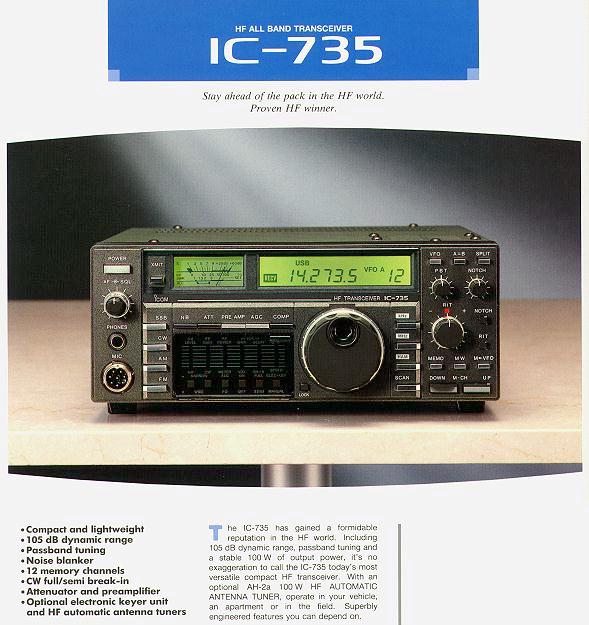
 Though the IC-735 is primarily a ham radio transceiver, it has general coverage and makes for an exceptional shortwave broadcast receiver as well. In fact, I have an IC-735 in my shack and use it primarily for SWLing. This unit was produced by Icom in the 1980’s; many are available now in the used market for around $325-450US. A great value for the money, especially if you also happen to be a ham.