Author Archives: Thomas

Radio Waves: New Massive Over-The-Horizon Radar, Evolution of Receivers, Tour of Eisenhower’s Air Force One, and ABC on Cricket in 1930s

Radio Waves:  Stories Making Waves in the World of Radio

Welcome to the SWLing Post’s Radio Waves, a collection of links to interesting stories making waves in the world of radio. Enjoy!


US Begins Installing ‘Mighty’ Over-The-Horizon Radar In Palau That Can Detect Objects Thousands of KMs Away! (The EurAsian Times)

The United States has begun work on the deployment of a new long-range over-the-horizon radar system for the United States Air Force, which will be placed on the Pacific island of Palau.

The sensor station, known as the Tactical Mobile Over-the-Horizon Radar, or TACMOR, will be set up on the highly strategic island of Palau. The sensor station intends to improve the situational awareness of US and allied forces operating in the region in the air and maritime domain.

The Department of Defense announced on December 28 that it had granted Gilbane’s Federal business a $118.4 million contract to develop the structural foundation of a new US Air Force radar station to be built in the Republic of Palau.

Gilbane Federal will build reinforced concrete pads and other foundational components as part of the firm-fixed-price contract to set up the Tactical Mobile Over-the-Horizon Radar system, the Department of Defense said.

The Naval Facilities Engineering Systems Command Pacific acts as the contracting activity for what is known as the TACMOR infrastructure project. The work is anticipated to be finished by June 2026. [Continue reading…]

The Evolution of Radio Receivers (Euro Scientist)

Radio receiver is one such gadget that people have been using for many generations. After the invention of radio communication by Guglielmo Marconi in 1895, the first radio receiver was also invented by Marconi. A radio receiver is an electronic device that can only receive radio signals and can convert the radio signals to audio and sound. A radio receiver can receive radio signals of various frequencies by tuning to a particular frequency. These frequencies are of two types – Amplitude Modulation (AM) and Frequency Modulation (FM). A radio receiver capable of receiving any analog audio on AM/FM frequency is called analog radio receiver and for many years people were using analog radio receivers.

Since the invention of analog radio by Marconi in 1895, many companies started manufacturing radio receivers. First came the De Forest RJ6 in 1916, and later many analog radio receivers like Sony TR-63 (1957), and H.H. Scott 350 (1961) came in the market, and they were the first analog radio receivers of that kind. After the emergence of digital electronics and digital radio transmission, digital radio receivers started to capture the market – receivers capable of receiving Digital Audio Broadcasting (DAB) – digital radio transmission. In 2003, Pure launched the PocketDAB 1000 and It was the world’s first pocket digital radio capable of playing DAB radio stations. However, radio receivers became diversifying when internet technology was implemented in them, which made it possible for the companies to introduce internet radio receivers. An internet radio receiver can be either an app of a computer or can be a standalone receiver, connected to the internet to receive internet radio stations. Kerbango internet radio receiver from 3com was the first standalone internet radio receiver of 21th century. This change in the technology of radio receivers even went beyond internet radio – after the arrival of Software Defined Radio (SDR).

Continue reading

Carlos’ Shortwave Art and recording of NHK World Japan (January 2, 2023)

Many thanks to SWLing Post contributor and noted political cartoonist, Carlos Latuff, who shares his radio log art of NHK World Japan on January 2, 2023.

Carlos’ goal is to vividly illustrate the broadcaster’s message in his own unique artistic style and is not a reflection of his own beliefs or those of the SWLing Post. His objective is for his artwork to add historical context and put a visual with the news, reporting, and broadcast content:


Carlos notes:

South Korea versus North Korea.
Part of news bulletin in French broadcasted by NHK World Japan radio via shortwave to West Africa and listened in Rio de Janeiro, Brazil.

Click here to view on YouTube.

Jeff’s recordings of HAARP’s Asteroid Sweep Signals

Many thanks to SWLing Post contributor, Jeff Cooper (KJ7LTU), who writes:

Hello Thomas!

First thank you for continuing to update your blog and website. It is such a great resource for those of us still tuning in to those distant waves.

I was doing some listening this morning [December 27, 2022] and checked your blog only to find out the HAARP experiment was underway. I quickly tuned to 9600 kHz and managed to pick up the signal twice in Southern Idaho. I made recordings of the capture and posted them on YouTube:

Please note: To be very clear, these are recordings of the transmitted sweep signals from HAARP. These are not recordings of the actual bounced signal from the asteroid. HAARP and NASA would need an extraordinarily high-gain antennas and radio astronomy-grade low noise receivers to detect a signal at this distance.

1732 UTC:

1752 – 1810 UTC:

-Jeff Cooper (KJ7LTU)

Thank you so much for sharing these recordings with us. I think HAARP is going to get reports from across the globe. Seems these sweep signals were widely received. I’m very curious if HAARP met any success hearing one of the signals bounced back to earth from the target asteroid. Hopefully, we’ll soon learn!

BBC Radio 4 – Lights Out: Call Signs


My dear friend and SWLing Post community member, Volodymyr Gurtovy (US7IGN), has been featured in another brilliant documentary on BBC Radio 4 called Call Signs.

This documentary was produced by the talented Cicely Fell with Falling Tree productions for BBC Radio 4. Note that Cicely also produced a BBC Radio 4 Short Cuts earlier this year featuring Vlad as well. Enjoy:

BBC Radio 4 Lights Out: Call Signs

A man, a Mouse and a morse key: the story of a radio amateur in Kyiv as the Russian invasion unfolds.

When his wife and two children flee Kyiv to escape the war, Volodymyr Gurtovy (call sign US7IGN) stays behind in their apartment with only his radios and the family hamster, Mouse, for company.

Before the war, he used to go deep into the pine forests, spinning intricate webs of treetop antennas using a fishing rod, catching signals from radio amateurs in distant countries.

Prohibited by martial law from sending messages, he becomes a listener, intercepting conversations of Russian pilots and warning his neighbours to hide in shelters well before the sirens sound. After three months of silence, he begins transmitting again. Switching his lawyer’s suit for a soldering iron, he runs a radio surgery for his friends and neighbours, dusting off old shortwave receivers and bringing them back to life.

During air raids, he hides behind the thickest wall in his apartment, close to his radios, their flickering amber lights opening a window to another world. A story of sending and receiving signals from within the darkness of the Kyiv blackout.

Music: Ollie Chubb (8ctavius)
Producer: Cicely Fell
A Falling Tree production for BBC Radio 4

Listen to Call Signs on BBC Sounds by clicking here, or via the embedded player below:

Today: HAARP to bounce signal off asteroid; SWLs/Hams asked to listen and record results

Many thanks to a number of SWLing Post readers who share the following announcement–also previously noted by Robert–from the University of Alaska Fairbanks (followed by an announcement from the ARRL):
HAARP to bounce signal off asteroid in NASA experiment (UAF News)

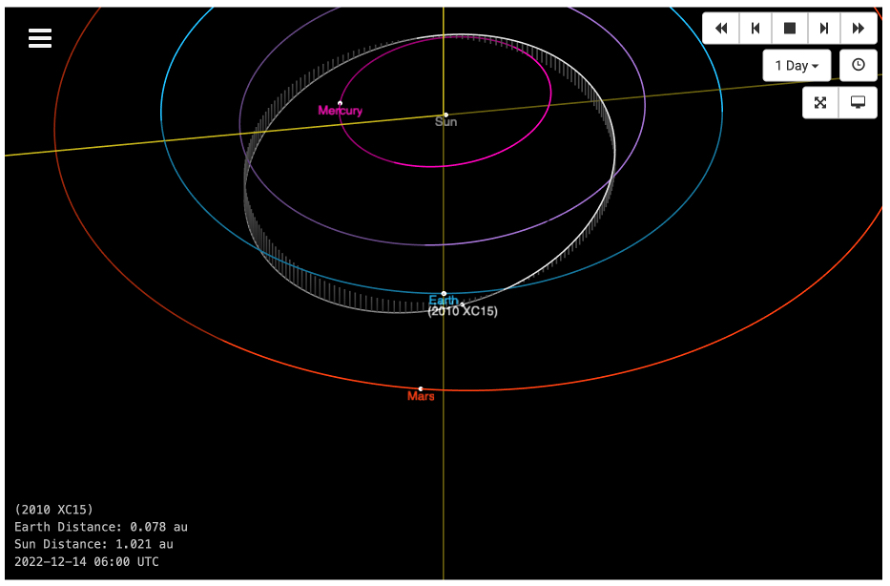
An experiment to bounce a radio signal off an asteroid on Dec. 27 will serve as a test for probing a larger asteroid that in 2029 will pass closer to Earth than the many geostationary satellites that orbit our planet.

The High-frequency Active Auroral Research Program research site in Gakona will transmit radio signals to asteroid 2010 XC15, which could be about 500 feet across. The University of New Mexico Long Wavelength Array near Socorro, New Mexico, and the Owens Valley Radio Observatory Long Wavelength Array near Bishop, California, will receive the signal.

This will be the first use of HAARP to probe an asteroid.

“What’s new and what we are trying to do is probe asteroid interiors with long wavelength radars and radio telescopes from the ground,” said Mark Haynes, lead investigator on the project and a radar systems engineer at NASA’s Jet Propulsion Laboratory in Southern California. “Longer wavelengths can penetrate the interior of an object much better than the radio wavelengths used for communication.”

Knowing more about an asteroid’s interior, especially of an asteroid large enough to cause major damage on Earth, is important for determining how to defend against it.

“If you know the distribution of mass, you can make an impactor more effective, because you’ll know where to hit the asteroid a little better,” Haynes said.

Many programs exist to quickly detect asteroids, determine their orbit and shape and image their surface, either with optical telescopes or the planetary radar of the Deep Space Network, NASA’s network of large and highly sensitive radio antennas in California, Spain and Australia.

Those radar-imaging programs use signals of short wavelengths, which bounce off the surface and provide high-quality external images but don’t penetrate an object.

HAARP will transmit a continually chirping signal to asteroid 2010 XC15 at slightly above and below 9.6 megahertz (9.6 million times per second). The chirp will repeat at two-second intervals. Distance will be a challenge, Haynes said, because the asteroid will be twice as far from Earth as the moon is. [Continue reading…]

The ARRL provides the following specific information about how SWLs and Hams can participate:

Amateur Radio Operators Invited to participate in Asteroid Bounce Experiment (ARRL News)

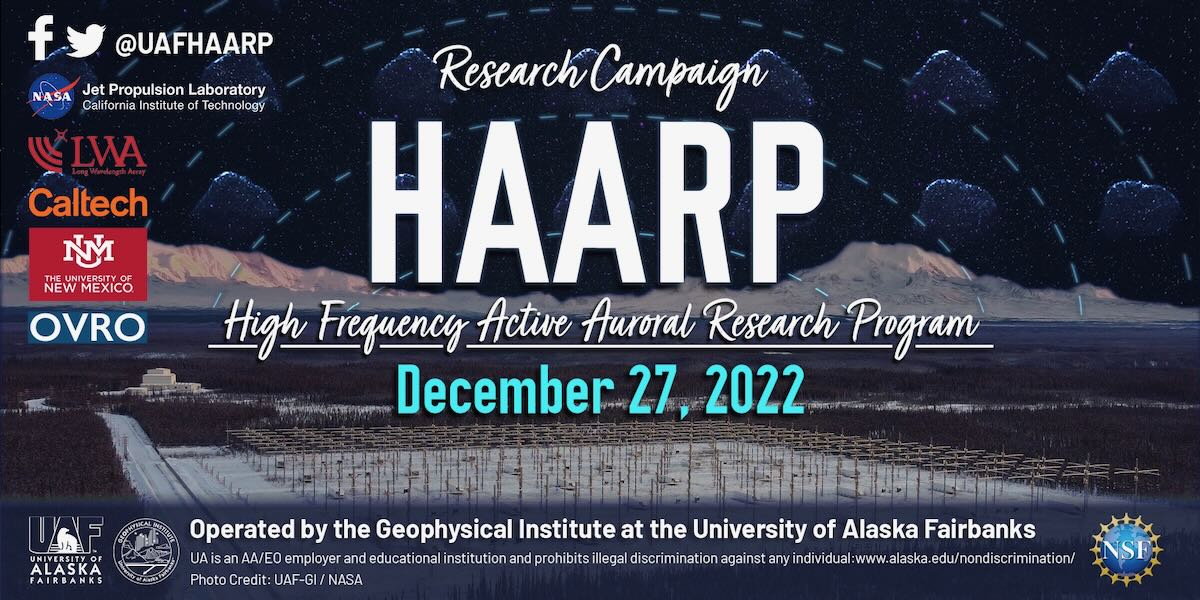
The High-frequency Active Auroral Research Program (HAARP) will be conducting a research campaign/experiment on December 27, 2022, with transmissions between 1100 – 2300 UTC (0200 – 1400 AKST).

[…]Actual transmit times are highly variable based on real-time ionospheric conditions and all information is subject to change. Currently, the Asteroid Bounce (2010 XC15) experiment will take place Dec. 27, 2022, from 1100 UTC to 2300 UTC; 9.6 MHz, LFM (linear FM), 0.5 Hz WRF (waveform repetition frequency), 30 kHz bandwidth. Reports recording echo are encouraged; demodulated recordings in .wav or .mp3 are recommended.

For real-time ionospheric conditions in Gakona, please consult ionograms from the HAARP Diagnostic Suite at https://haarp.gi.alaska.edu/diagnostic-suite.

Amateur radio and radio astronomy enthusiasts are invited to listen to the transmissions/echoes and submit reception reports to the HAARP facility at [email protected] and request a QSL card by mailing a report to:

HAARP
P.O. Box 271
Gakona AK 99586
USA

Click here to read this announcement on the ARRL News website.