Author Archives: Thomas

Guest Post: Dan’s letter concerning the new Elite Satellit

Many thanks to SWLing Post contributor, Dan Robinson, who publishes the following guest post:


Letter to Eton:  Cutting Corners on Elite Satellit Won’t Succeed

by Dan Robinson

As SWLing.com readers will recall, weeks before Eton shipped the first group of Elite Satellit receivers I published a commentary that asked a key question:  would Eton be able to meet the higher standards of the listening community in 2022 when it comes to new advanced portables?

Unfortunately, we all see what the answer to that question was.  Eton was forced to recall Elite Satellit radios that had been shipped to major resellers such as Universal Radio, Ham Radio Outlet, and others as defects became all too apparent.

A radio that had been on its way to me for review was among those recalled.  But I recently was able to examine a unit that a friend in the Washington, DC area purchased.  What I found I am putting in this commentary as a letter to Eton.

If the company takes these points seriously, I think there is still hope that the Elite Satellit can join the ranks of respectable multi-band portables – after Eton has gone back to the drawing board so to speak.  However, if Eton continues to cut corners with this receiver, its future is not bright:

Letter to Eton on the Elite Satellit

Dear Eton,

MUTING WHILE TUNING

As many who purchased or tested the Elite Satellit have remarked, the fact that you decided to release a radio with this issue is beyond comprehension.  Tuning on the Elite Satellit is, tragically, an uncomfortable and frustrating experience.  This needs to be corrected/fixed – you only need to take a look at Tecsun receivers such as the H-501 or PL-990x to know what needs to be done.

POORLY-IMPLEMENTED PASSBAND TUNING

Perhaps even more puzzling than muting, the Elite Satellit I tested had an even more mind-boggling issue.  Passband tuning should function to adjust the signal pitch without changing the audio frequency.  On the radio I tested, PBT was actually TUNING and changing the frequency.  Using PBT on this radio was virtually no different from tuning in SSB, with injected tones heard, until a zero beat was achieved.  All you had to do was take a look at a E1 receiver, or any other receiver with well-implemented PBT to understand how real PBT is supposed to function.

Continue reading

Andy hears Morse Code in B52s concert

Many thanks to SWLing Post contributor, Andy, who writes:

Thomas,

I was just listening  to an old B52’s music gig on YouTube when it got
to 51:57 mins in.

You can clearly hear NAWS DE CFH and some other stuff.

How did that get there–?

73 de Andy

Thanks for sharing, Andy!

Ah yes, Planet Claire! I actually heard the eB52s play this one live at a concert in the early 90s.

The “CHF” that you hear is the callsign of the Canadian Forces Station Mill Cove. This is a partial recording of a CHF broadcast listing frequencies for RTTY transmissions. The B52s have been known to incorporate radio feedback and snippets in their work. You can hear CW more clearly in this video:

In fact, when I saw the B52s live, Fred Schneider used a walkie talkie Morse Code button (the type that you could find on kids’ walkie talkies) for audio feedback in at least Planet Claire and Rock Lobster

I bet there are some other B52s fans out there who will have even more insight! Thanks again, Andy!

Video: Nick’s initial review of the Eton Elite Satellit

Many thanks to SWLing Post contributor, Nick Booras, who writes:

I bought [an Eton Elite Satellit] on Amazon and received it today. Here is a link to my YouTube review.

I have made several radio videos on YouTube recently and your audience may enjoy them.

Click here to view on YouTube.

Many thanks for sharing your initial review, Nick! I look forward to seeing any comparison videos you might produce as well!

The new Alinco DJ-X100 wideband receiver

It appears that Alinco will soon introduce a new wideband handheld receiver covering 30 to 470MHz. I first learned about this during Ham Fair 2022 in Tokyo via HamLife.jp’s Twitter account.  That Twitter account lead me to the HamLife.jp website where I translated the details into English via Google Translate:

On August 20, 2022, Alinco Co., Ltd. released the DJ-X100 handheld wideband receiver that supports WFM/FM/AM in analog mode and C4FM/D-STAR/DCR/NXDN/DMR in digital mode. , Announced at the company’s booth (B-17) at Ham Fair 2022. The reception frequency range is 30 to 470MHz (some frequencies are excluded), the external dimensions are 58W x 110H x 32.5mm, and the weight including the antenna and battery pack is about 260g. The price is undecided and it is scheduled to be released in early spring 2023.

This isn’t an HF receiver, but it will be interesting to those who enjoy monitoring many of the digital voice modes in those frequencies. It’s one of the few receivers I’ve seen that can decode both DMR and D-Star among others modes. 

Check out HamLife.jp for more details (in Japanese).

One last call for SDRplay RSP1A metal cases!

Many thanks to SWLing Post contributor Dave (N9EWO) who writes:

Thomas, FYI

RTL-SDR.com decided to make one LAST production run of the RSP1A metal cases. These are now available on Amazon for $34.95 until stocks run out.

73
Dave Zantow N9EWO.

Click here to view on Amazon (affiliate link).

Thank you so much for the tip, Dave!

Can you help Rob identify two mystery signals on the 20 meter band?

I received the following message from my buddy Rob (NC0B) who is trying to identify a couple of signals on the 20 meter band. Rob kindly gave me permission to post his email here on the SWLing Post with the idea that someone may be able to help him solve this:

The following is a description of two odd digital signals observed on 20 meters with transmission modes I do not understand. They may not amateur transmissions, but I have no way to decode them. They stick out like a sore thumb on 20m in the Extra portion of the phone band. The time of day on August 20th was between 11:50 AM and 12:00 PM MDT.

Two weeks ago I was in QSO on 14,170 kHz and occasionally there was the same 10 kHz wide digital signal but centered on 14,171 kHz. It sounded like the old Russian jammers buzz saw modulation. Those signals from decades ago were much wider, and or course we didn’t have high resolution spectrum scopes back then. Today the same transmissions occurred several times, and more than once a minute for about 5 seconds each. In total the transmissions may have occurred on and off for about 10 minutes.

Then after a few 10 kHz transmissions a different signal came on the air a few times with what looked like a digital modulated carrier plus digital sidebands on each side of the middle signal.

Look at the attached JPG file and I’ll try to make sense out of it:

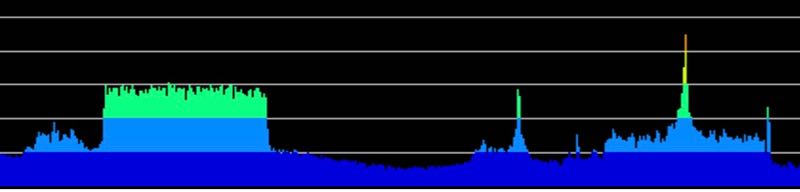
The waterfall image lasts about 50 seconds on the Icom IC-7610 set on slow. There are two different signals to differentiate in this image. The signal I observed two weeks ago and today is 10 kHz wide and today spans from 14,178 to 14,188. It shows up in green on the band scope, and just under it in blue on the water fall for about 3 seconds of the approximate 5 second transmission. You can also see at the bottom of the waterfall the previous transmission that has about 4 seconds worth saved on the waterfall running off the bottom. The horizontal span of the scope was set to 5 kHz per division.

Once the 10 kHz wide signal started, I went to Dual Watch so I could listen for KL7QOW on 14,170 kHz for a sked, and hear the buzzing signal on 14,183 kHz in SSB mode. That frequency placed the carrier position of the SSB 2.8 kHz bandwidth in the center of the 10 kHz wide signal.

Soon after I started observing the relatively flat spectrum of the 10 kHz signal, a new digital signal appeared about 3 kHz lower in frequency. At first it had a much stronger center modulated carrier about 2 kHz wide and then two symmetrical digital signals on each side within about a 6 kHz total bandwidth. I wasn’t able to capture the best picture of the 2nd signal as it appeared to be tuning up. The amplitude difference between the central signal and the separate sidebands initially was about 15 dB. Vertical divisions are 10 dB.

On the waterfall you can see the second type of signal is centered on about 14,180 kHz. The modulation depth of the outer pairs of signals were not constant, possibly due to selective facing. QSB was quite significant at this time at least to Alaska. You can see there was a short break of a few seconds in the 6 kHz wide signal. Every time I have seen the 10 kHz wide signal its amplitude across the transmission bandwidth has been fairly constant, always of short duration, and repeating several times within 10 minutes before terminating.

Does anyone have any idea what either of these transmissions are? I have heard of email digipeaters, but I would not think their bandwidth would be this wide.

Rob, NC0B

SWLing Post community: Please comment if you can help Rob ID these signals!