Author Archives: Thomas

Guest Post: Peter discovers the first FM-capable CB radio for the US market

Many thanks to SWLing Post contributor, Peter Laws, who shares the following guest post:


Thomas is Famous!

by Peter Laws

A few weeks ago, a summary of the recent change to Title 47 of the Code of Federal Regulations, Part 95, Subpart D — better known as the rules for the CB Radio Service — was published here.  That change, following a successful petition for reconsideration of a previous petition allowed FM as an additional mode in the CB Radio Service.  The original petition was the one that caused the FCC to do away with the nearly-impossible-to-enforce “DX Rule” that prohibited communications of more than 250 km.  For one, the ionosphere had a long history of ignoring the rule entirely, at least for part of the Sun’s eleven-year cycle.

In that article, the author speculated that it may not be too long before manufacturers brought radios that were capable of FM to market, since they already existed in other markets, namely countries that were members of CEPT.

That author has been watching the FCC OET site to see who will be the first out of the gate to get an FM CB approved.  The Office of Engineering and Technology is the FCC’s line office that handles, among other things, Equipment Authorization.  They also handle Experimental Licensing, i.e., “Part 5”, like the recent 630- and 2200-m band projects that resulted in new Amateur Radio allocations and the ongoing 8-m band experiments under WL2XUP (see that license’s details at https://apps.fcc.gov/oetcf/els/reports/CallsignSearch.cfm).

OET also provides a public database of equipment authorizations.  If you know a radio device’s “FCC ID” (usually an alpha-numeric string found on the label of a device or in the device’s documentation), you can look up the details in the database.  A manufacturer’s ID — the first 3 to 5 characters of a product’s ID — will show all the devices that have been authorized.  Fortunately, you can limit the search by date as by frequency range.   https://apps.fcc.gov/oetcf/eas/reports/GenericSearch.cfm Authorizations available online go back into the 1990s but the further back the results go, the less detailed they become.

So who won the race to bring the first FM-capable CB radio to the US market or at least to get a product authorized?  Our benefactor, Mr Witherspoon, will be thrilled to hear that the first radio to gain FCC authorization is the President Thomas FCC!

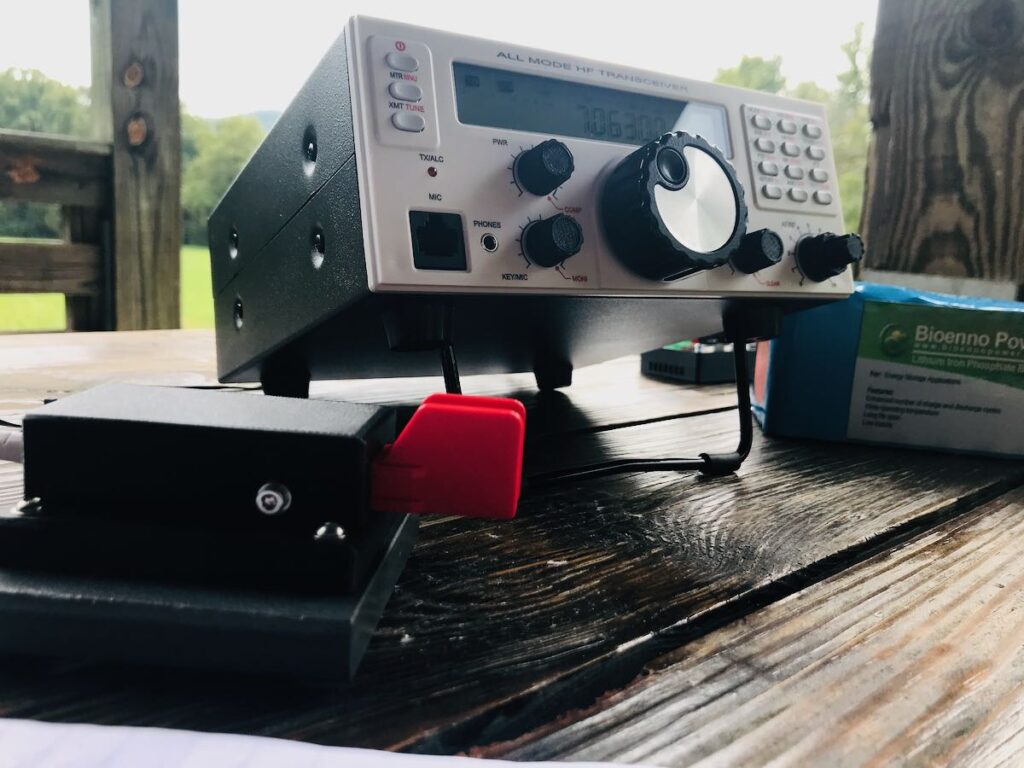
The President Thomas ASC model in Europe.

As soon as President Electronics can get stock to distributors, the radio should be available.  This writer has no information about when that may happen.

The President Thomas FCC is an older design (c.2013), meaning that whatever R&D costs President Electronics had for the bulk of the design will have been amortized years ago.  As noted in the previous article, changes for conformity with the FCC Part 95 rules are expected to be minimal and likely have to do with locking out the “multi-norm” ability in the new model’s European counterpart.  Following FCC rules, this is an AM radio that has FM as well.  The new Part 95 regulations require AM in every radio with FM as a possible option.

Several websites have details on the existing President Thomas ASC (ASC is automatic squelch control). [See photos above.]   It’s a multi-norm radio as is common in the European market and offers CEPT channels, UK channels, and Polish channels among others.  CEPT channels are identical to the FCC allocations, UK channels are completely different though still between 27 and 28 MHz, and Polish channels are exactly like the FCC channels except that they are all 5 kHz lower (i.e., our Channel 19 is 27.185 while their Channel 19 is 27.180).  Here is an example of a site with data on the European version: http://www.cbradio.nl/president/thomas.htm

FCC authorization was long ago turned over to contract labs.  Here is the Equipment Authorization for the President Thomas FCC:

https://apps.fcc.gov/oetcf/tcb/reports/Tcb731GrantForm.cfm?mode=COPY&RequestTimeout=500&tcb_code=&application_id=AgTi5CpzImyrjI5Oicfj2A%3D%3D&fcc_id=2AEOCPC208

Peter Laws

With your help, Bill would like to take a deep dive into Mailbags!

Original image by Sigmund via UnsplashMany thanks to SWLing Post contributor, Bill Meara, from the excellent Soldersmoke Podcast, who writes:

Thomas:

A recent comment on the SS blog about the roots of our podcast got me thinking about one of our favorite segments: the Mailbag.

I know that in coming up with this segment — and its name — I was influenced by the shortwave broadcast stations I listened to as a kid.

Today I did a bit of Googling to find out which ones had Mailbags.

Turns out that the practice and the term almost certainly originated at Radio Moscow. You will find this interesting:

https://rijmenants.blogspot.com/2020/05/radio-moscow-and-cold-war.html

HCJB had DX-Party Line, but I don’t know if they had a segment called Mailbag. It may have been just one big mailbag!

Radio Romania still has one (I think). As does Radio Havana Cuba.

I saw one reference to a Canadian “Maple Leaf Mailbag” but I don’t recall ever hearing this.

Any other Mailbags out there?

73 Bill

I, too, have a lot of nostalgia for Mailbag shows. As you note, there are still quite a few on the air. Radio Romania International always comes to mind and also the many reader notes Jeff White addresses in Wavescan on WRMI. I was called out on the Maple Leaf Mailbag a number of times, but that was more than a decade ago now (wow–next year, RCI will have been off the air for a decade! Let that sink in!).

I’m sure there are many more.

SWLing Post readers: Can you please comment with any active Mailbag shows you know of currently on the shortwaves? Perhaps mention the broadcaster and program name and any of your favorites. Thank you in advance!

While you’re at it, check out the Solder Smoke podcast!

Jerome makes an aluminum back stand for the PL-880

Many thanks to SWLing Post contributor, Jerome van der Linden, who writes:

Hello Thomas,
I have managed to break three of these flimsy PL-880 back stands, and thought, “how hard can it be to make one out of metal?”

These two photos are the result from a piece of aluminium that I had in the shed (yes I know you guys call it aluminum) . Here’s hoping it lasts longer!

I love it, Jerome.  I’m willing to bet your backs tand will outlast the PL-880 now!

Thanks for sharing. I love this simple aluminium (remember, I lived in Europe–ha ha) solution! 🙂

HanRongDa HRD-700 English manual

Many thanks to SWLing Post contributor, Frank, who shares the following:

Hello Thomas,

HanRongDa has built a new mini portbale called HRD-700. Information of it is still rare, and of course it is not a professional radio. But it is interesting as it is a special analogue tuner with digital background.

I have bought one and i am really estonished about its reception quality and features. Very small, so good for camping…

Actually nowhere a manual can be found on the internet, but I have got an English document and I scanned it to share here. Perhaps it is interesting for some readers?

Click here to download PDF.

Friendly regards

Frank from Germany

What an interesting radio design! We hope you report on the performance and share your thoughts soon, Frank!  Thank you for the English manual!

Patricia hears a mystery signal on 7075 kHz

Many thanks to SWLing Post contributor, Patricia, who writes with the following inquiry:

I wonder if anyone has heard and identified the station or signal I heard on 7075 kHz at 0745 October 30, 2021 on my C. Crane Skywave, and I live in southern California. I would like to know where this signal originates, sounding something like a numbers station, no voice, but a whooshing sound. I have heard it may be a ham frequency or a signal from space. Any ideas?

Thanks,

Patricia G.

Thank you for your question, Patricia.

I believe what you’re hearing is the ham radio digital mode called FT8.

FT8 is a weak signal digital mode that is extremely popular in the ham radio world these days. The mode isn’t designed around relaying lengthy messages, rather it’s designed for short, very formulaic exchanges.

Each message of up to 13 characters takes 13 seconds to send. For FT8 operators to be successful, they try to keep very accurate timing on their computing device controlling the transceiver. When the whole group is coordinated well, you’ll hear groups of signal tones singing all at once in 13 second intervals with a couple seconds of space between messages.

Here’s what FT8 sounds like in SSB mode:

It’s possible it sounded quite different, however, if you were listening in AM mode.

If this doesn’t sound like what you heard, perhaps you can check the comments for any other possibilities, but my guess is it’s FT8 as it’s a pretty strong chorus of tones!

Great question, Patricia!

Radio Waves: Broadcast v Ham Radio, Marjorie Stetson’s Secret Wartime Work, Czech Republic MW Switch-Off, and PV RFI

Radio Waves:  Stories Making Waves in the World of Radio

Because I keep my ear to the waves, as well as receive many tips from others who do the same, I find myself privy to radio-related stories that might interest SWLing Post readers.  To that end: Welcome to the SWLing Post’s Radio Waves, a collection of links to interesting stories making waves in the world of radio. Enjoy!


Alike, but Not Alike: Broadcast vs. Ham Radio (Radio World)

Experience in amateur radio can be a boon to the radio engineer

Starting in the 1920s and through the ’60s, almost every broadcast engineer was a licensed amateur radio operator. That has changed a bit, but the importance of being a ham has not.

Both environments involve getting an RF signal from Point A to Point B. But it is interesting to note that radio broadcast and amateur radio are similar and yet so different.

For those who don’t know much about ham radio, I’ll tell you that communicating locally or internationally, via licensed amateur radio, can be a fascinating and challenging hobby. There are about 700,000 hams in the U.S. and an equal number worldwide.

Physics

Broadcast and amateur radio operate under the same laws of science. Transmitters, transmission lines, antennas and receivers make up an RF path to convey a message.

Broadcast engineers know that signal propagation on AM and FM bands is dramatically different. It is because our FM band is roughly 100 times the frequency and 1/100th the RF wavelength of that on the AM band. Engineers also know that 950 MHz STL signals are line-of-sight and roughly a 10-times jump in frequency from FM broadcast frequencies. Each band has its own challenges in getting a useable signal through. [Continue reading…]

A Canadian opens up about her secret wartime work — eavesdropping on Japan (CBC)

Retired sergeant remembers what it was like on the ‘front line of the radio war’

At age 97, Marjorie Stetson has never told anyone her secret code number — until now.

That’s the identity code — 225 — that she typed on every page of her highly classified work for the Canadian Armed Forces during the Second World War.

The retired sergeant’s wartime work was so covert, she said, she had to sign 15 separate copies of Canada’s Official Secrets Act.

“Nobody knew where I worked,” Stetson told CBC News from her home in Massachusetts ahead of Remembrance Day. “Nobody knew what we did. Even my parents never knew what I did in the service.”

Her husband, an American sailor she met at a celebration marking the end of the war, passed away a decade ago. She never told him what she really did during the war.

Today, Stetson herself is only now learning about the true scope of her role and the significance of all those sheets of white paper she filled with encrypted messages from Japan. [Continue reading…]

Czech Republic: MW Switch-Off by 2021 (Radio Reporter)

Czech public radio ‘?eský Rozhlas‘ is stepping up its information campaign for listeners receiving mediumwave programmes, ahead of the planned switch-off of transmitters by the end of 2021. Since 1 November, more announcements have been broadcast to warn users and a call centre has been set up to explain the possible listening alternatives (from FM to DAB). In the run-up to Christmas, public radio will launch an intensive advertising campaign in the print media and online magazines on 22 November to promote the purchase of digital DAB receivers to replace analogue radio. [Continue reading…]

The impact of photovoltaics (Southgate ARC)

Seamus Ei8EP reports on the IARU Region 1 website that the 358 page Final Report on the Study on the evaluation of the Electromagnetic Compatibility Directive has now been published.

It is publicly available, free of charge, from the Publications Office of the European Union. The Political Relations Committee of the IARU Region 1 responded recently to a European Commission Roadmap on the environmental impact of photovoltaics.

The radio spectrum is an important finite natural resource which must be protected. While PV technology of itself is to be welcomed, the IARU submission pointed out the inherent problems of non-compliant installations, particularly the installation or retro-fitting of optimisers which can produce significant spectrum pollution for very limited efficiency increase.


Do you enjoy the SWLing Post?

Please consider supporting us via Patreon or our Coffee Fund!

Your support makes articles like this one possible. Thank you!

Travel radio decisions: Jack seeks your input!


Many thanks to SWLing Post contributor, Jack Kratoville, for the following guest post:


Important travel decisions…

For the first time, (in a very long time), I’ll be traveling outside the country. This will be my first visit to Germany, and while I’ve already put Thomas’ packing skills to the test domestically with moderate success and confidence, I thought I would ask for assistance on what radio to bring.

The following is what I have, along with my current personal pros and cons regarding each one for this specific trip. I’m traveling with my wife, daughter & mother-in-law and staying with her family. This probably excludes a lot of alone time dedicated specifically to radio listening and DXing.

Now, from what I’ve been reading, MW and LW have been eliminated in favor of digital signals. This changes the equation a bit. Lack of SSB is NOT a deal-breaker. The amount of time I spend listening is miniscule. Here’s the receivers:

CC Skywave

The CC Skywave

This has been on every domestic trip I’ve taken since its purchase in 2015. Perfect size (even with the hard case) and excellent performance. Two quality AA batteries will last for 2 weeks easily. However, my favorite feature, WX, is useless there. Best MW reception in an ultralight, but does that matter in the land of DAB? Assuming there’s no LW to listen to either, the Skywave’s lack of it shouldn’t factor in. I like the Skywave’s super-fast scanning, but I think I’ll wish I had the ETM feature of other radios. I’ve used the Air Band, but I won’t be staying anywhere near an airport and I doubt I’ll be sitting in an airport with an extended antenna anytime soon. Non-digital audio control gives me exact control to go “unnoticed” if others are sleeping. The lack of ETM may keep this unit home.

Tecsun PL-360

Another favorite travel companion that does feature ETM, this radio is small and compact – and my unit still works like new. I can recharge the batteries with a computer cable, not that it’s ever shown high power consumption. I had thought this was a front runner, but tinny audio and that extra antenna to lose is giving me second thoughts. It’s physical build lends to more hand-held than bedside table use and that is definitely a factor worth considering. Analog audio control, but it has gotten noisy.

Digitech AR1780

The Digitech AR1780

Has it all: LW/MW/Air/FM(RDS)/SSB and fantastic audio. For positives, it checks all the boxes. It is a slow scanner – and that is a persistent downside. Further considerations, I’m committed to carry-on travel only (European dimensions!) and this receiver will command more real estate in the bag. Now if I didn’t need to pack socks for a couple of weeks… I may also be shoving a radio in my pocket for those “here’s-what-we-have-planned” moments and I don’t want to look like I’m obviously addicted to my hobby. With that non-existent charging cord, four replacement double-A’s might also be an issue if I do use it for any reasonable amount of time. I had considered this a shoe-in when we first talked Germany prior to pandemic, but it seems more unsuitable every time I weigh the pros and cons.

Tecsun PL-310ET

The PL-310ET

A radio gifted to me that was immediately assigned to basic alarm clock duty bedside – now surprisingly is part of the discussion. Not enough sizzle to replace my favorites domestically, but it may have the right combo for a few weeks in Germany. Quick scanning, ETM, multiple tuning modes, a decent speaker. Unlike the PL-360, you can’t “fast-tune” with the knob, but you can direct-input frequencies. I would miss RDS on FM, but I’ve scanned most of my life without it. Now, I’ve had a few other Tecsuns (along with the Grundig G8) and they all eventually fail with tuning and volume knobs (the PL-360 is the honorable exception). Since I haven’t used this unit much, I’m confident it’s well before its failure phase, if it ever does. I am not a fan of digital volume knobs, but this one seems to be better balanced than most. Not sure how it does on 3 AA consumption, but I’m testing rigorously. I would have never guessed, but this is the front-runner at the moment.

Eton Traveler III

The Eton Traveler III

While I’ve enjoyed RCS and the adjustable lighted dial at the beach, I’m not impressed. Sounds and looks nice, but lack of user-friendly functionality has kept this unit from any serious travel. Not to mention a battery hog with 4 AAs!

What do you think?

While I might fantasize about making room for the Eton Executive Satellit or putting batteries back in my G5, I’m limiting choices to the above! I appreciate all input and any thoughts on radio listening in Germany. Please comment!

Any SW frequencies I should direct input? We’ll be staying just outside of Kiel, which could include a day trip to Denmark.

Now it’s off to Hodinkee for GMT watch suggestions.