Author Archives: Thomas

Source files for Tom Lackamp’s NewLog logging application?

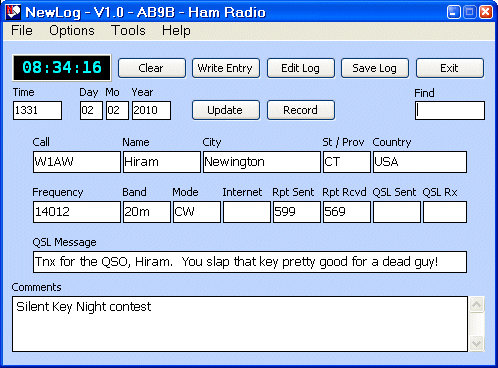
NewLog Entry Screen

I recently received an inquiry from SWLing Post contributor, Geroge (NJ3H), who is a big fan of the simple logging application NewLog.

NewLog was written by Tom Lackamp (formerly AB9B) who was very well regarded in the community. Several years ago, however, he seemed to disappear: his callsign was reassigned and his email no longer works. Many assume, of course, that he could be SK.

UPDATE: Many thanks to the SWLing Post readers who shared the sad news that Tom Lackamp passed away on 12/26/2017 at age 70.

George has attempted to track Tom down because there are a few minor modifications he’d like to make to NewLog.

I’m told Tom openly encouraged his users to modify NewLog’s source files that we believe to have been written in Delphi.

If you happen to have the source files for NewLog–or know of a way to locate them–can you please comment on this post? Perhaps NewLog can be given a second life in the hands of the right programmer. Of course, please comment if you know how to contact Tom Lackamp or if you know what might have happened to him.

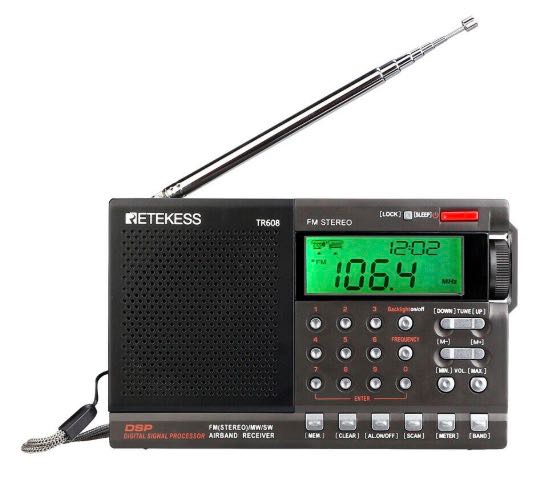
Mike reviews the Retekess TR608 AM/FM/AIR/SW receiver

Many thanks to SWLing Post contributor, Mike S, who shares his assessment of the Retekess TR608. Mike writes:

For this model, the company marketing electronics under the Retekess brand seems to be using a different supplier compared to the previous digital-radio-plus-memory—card-player products. The result is a more traditionally styled multiband DSP radio which runs on (gasp) traditional AA batteries. Its feature set takes inspiration from the Radiwow R108 and original CCrane Skywave, but with mixed results (albeit at a fraction of the price). It delivers decent performance for its price class but more serious listeners would be advised to spend a little more on a more established model.

Pros

    • Usual set of features: sleep timer, alarm, scanning, auto memory fill.
    • Uses replaceable alkaline or NiMH “AA” cells.
    • Decent sensitivity across the board.
    • Full shortwave coverage.
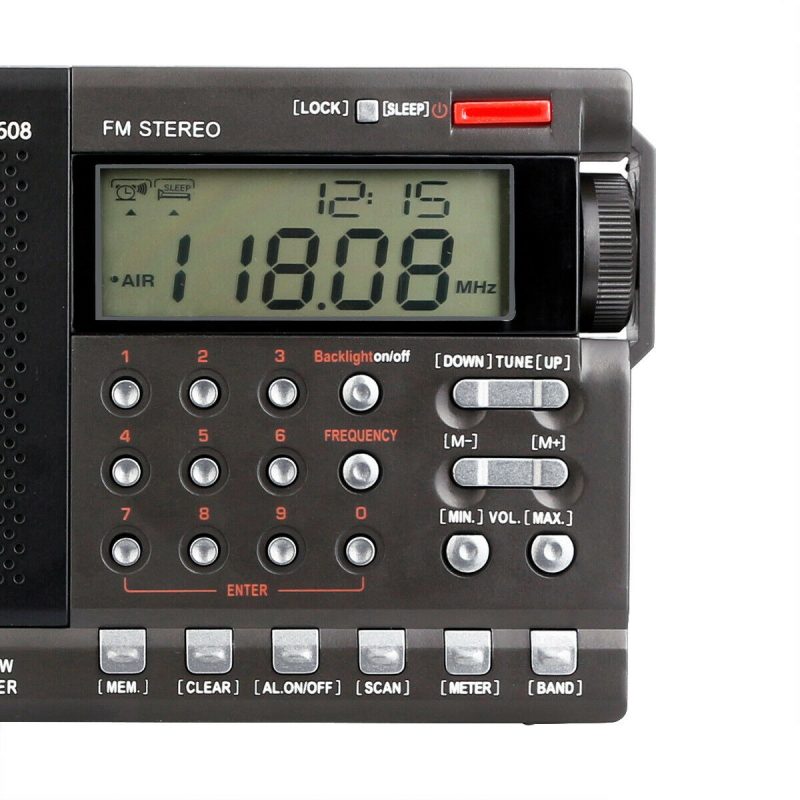
    • Frequency display is large and contrasty.
    • Dial light is effective and can be disabled. Display is readable without it, even in dim light.
    • No annoying keypad “beep”, so no mad rush to discover how it can be disabled.
    • Speaker can play reasonably loud without distortion.
    • FM reception is solid with good frequency response and stereo reception through headphones; this also activates a display indicator.
    • MW/SW reception is NOT plagued by digital hash bleeding through from the processor as with most other models in this price range!

Cons

    • Significantly larger than expected.
    • Unfortunately the added cabinet space is not utilized for a more wide-range speaker; audio is tinny.
    • Clumsy mounting of one spring in the battery compartment on my sample makes it almost impossible to insert the third AA battery without risking damage.
    • Many keypad buttons are so tiny and almost flush with the cabinet, that they are difficult to press.
    • Lens over LCD display is molded and unpolished with moiré distortion at some viewing angles.
    • Air band reception marred by birdies, bleed-through from other bands, and lack of squelch.
    • Volume control defaults back to level “10” under some circumstances (the manual warns about this).
    • Confusing 2-level LOCK function requires close attention to almost microscopic indicator on LCD.
    • No battery level indicator.
    • Although the manual advises that batteries can be charged using the 4.5V coaxial socket, no charging indicator is obvious.
    • Rotary knob, used for both tuning and volume adjustments, has no detents and so can easily spin off target.
    • Assigned function (no indication) depends on whether the tuning or volume buttons on the keypad were the last to be used.
    • No fine tuning outside of pre-programmed increments.
    • MW selectivity is a bit too wide for congested night reception.
    • MW reception occasionally exhibits weird artifacts; ghost images, sputtering audio on marginal signals, and “processed” sounding voice audio. Don’t know if these are DSP or AGC related, or a mixture of both. I have observed the same thing with the Eton Mini and other inexpensive portables using marginal DSP implementations.

SHOWSTOPPER ALERT: MW band channel assignments marred by 9kHz-centric firmware bug. Even after changing to 10kHz channel spacing (undocumented), the CPU still “thinks” in 9kHz assignments for direct input. Entering FREQ-1-0-1-0-FREQ should get you to 1010 kHz; but it actually lands on 1018 kHz because that is the nearest channel in the 9kHz band plan. You are now stuck in frequency step hell, as the up-down frequency keys still operate in 10KHz mode but do not know they are now off bandplan. UP/DOWN yield 1028/1008, not 1020/1000. The only way to recover is to enter a MW frequency that is the same in both bandplans, or to power off and double-reset the step rate resulting in all memories being lost.

Thank you so much for the review, Mike.  It sounds like this little receiver isn’t ready for prime time yet. The issues with frequency steps on the mediumwave band is certainly a show-stopper for anyone in North America. Indeed, it sounds like mediumwave reception, in general, is mediocre at best. At least the receiver isn’t plagued with internal noises.

With pricing around $29.99-$39.99 it’s certainly a bargain radio. But I’m sure you’re thinking what I’m thinking: you pay for what you get.

The Retekess TR608 can be purchased on eBay or Amazon.com (affiliate link).

KiwiSDR update brings integrated DRM reception!

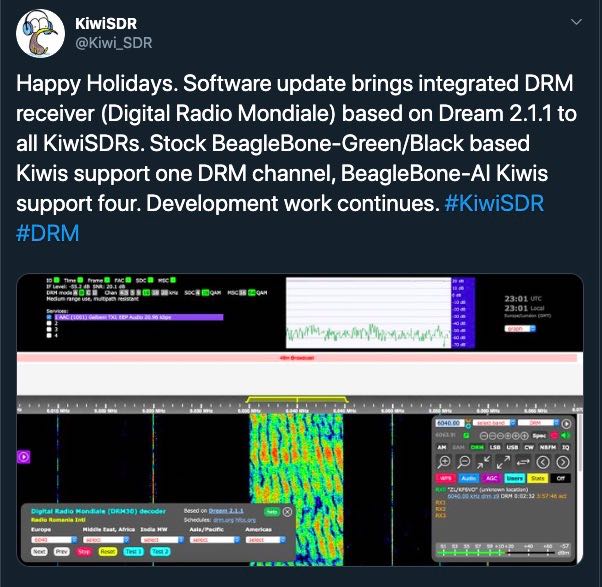
Many thanks to SWLing Post contributor, Mark Fahey, who shares the following tweet from KiwiSDR:

“Happy Holidays. Software update brings integrated DRM receiver (Digital Radio Mondiale) based on Dream 2.1.1 to all KiwiSDRs. Stock BeagleBone-Green/Black based Kiwis support one DRM channel, BeagleBone-AI Kiwis support four. Development work continues.”

Ironically, I had only recently published a post asking if anyone had ever attempted to decode DRM using a KiwiSDR. Turns out, several readers had by porting the IQ audio output into the DREAM application. Now that KiwiSDR will have a native DRM mode, this will no longer be necessary.

Many thanks, Mark, for sharing this tip! As you say, this is “mega news!”

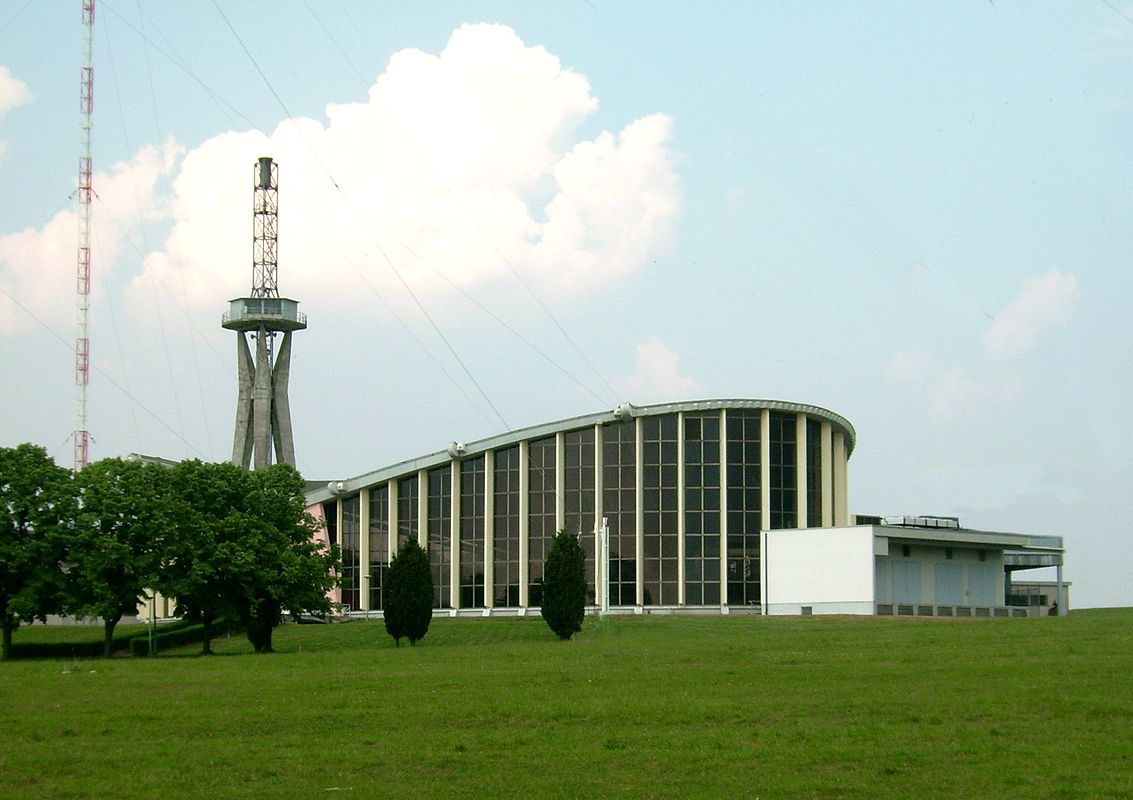
Europe 1 to close 183 kHz longwave service December 31, 2019

Transmitter building of Europe 1 with one of the radio masts in the background (Source: Wikimedia Commons)

Many thanks to SWLing Post contributor, Gaétan Teyssonneau, who notes that Europe 1 has announced that they will close their 183 kHz longwave service on December 31, 2019 at midnight. Gaétan shared the following message, in French, from Europe 1:

Cher Monsieur.
Les habitudes d’écoute étant en train d’évoluer et l’utilisation des supports numérique se multipliant, Europe 1 n’émettra plus en grandes ondes à partir du 31 décembre 2019 minuit.

Un choix assumé par la station qui a toujours fait preuve d’innovation dans sa manière de penser et concevoir l’écoute de ses programmes. l’approche environnementale a également motivé cette décision. Quitter les grandes ondes c’est aussi protéger l’environnement.

Bonnes fêtes à vous .

Constance BENQUÉ

Directrice Générale Lagardère News (Europe 1/ Paris Match / JDD)

CEO ELLE International

Thanks again for sharing this news, Gaétan.

Holiday Memories: A simple transistor radio…

Have you ever received a gift that had a major positive impact on your life?

One year, I received a gift that really opened the world of radio listening and, eventually, amateur radio.

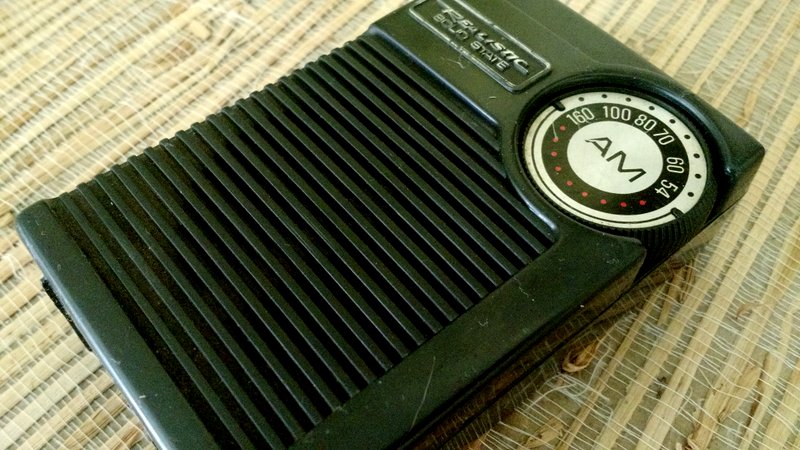
It was a Realistic Model 23-464 portable AM transistor radio. It was the very first radio that, as a kid, was completely my own–!

The Realistic Model 23-464.

Although it had a super simple dial and was incredibly basic, I absolutely loved it. It was through this radio that I discovered the world of night time mediumwave propagation. I remember plugging in the single earpiece in the side of the radio, laying in bed at night, and tuning in distant signals. Although selectivity left something to be desired, sensitivity was excellent.

I can’t remember if I eventually gave this little radio away or simply lost it in one of the dozens of moves I made early in my career. Three years ago, I purchased another one on eBay for no other reason than the warm memories.

Have you ever received a radio as a holiday gift and is it tied to any special memories? Of course, we’re talking about any holiday–Christmas, Chanukah, Kwanzaa, Ramadan, Easter, or any other religious or secular holiday.

Please comment and share your memories!

Here’s wishing everyone Happy Holidays!  


Do you enjoy the SWLing Post?

Please consider supporting us via Patreon or our Coffee Fund!

Your support makes articles like this one possible. Thank you!

WI2XLQ: Brian Justin’s annual longwave broadcast

Canadian Reginald Aubrey Fessenden in his lab believed circa 1906 (Source: Radio Canada International)

(Source: ARRL News via Harald Kuhl)

The Canadian inventor, experimenter, and entrepreneur Reginald Fessenden has been credited as the inventor of radiotelephony. Fessenden claimed to have made his first voice — and music — broadcast on Christmas Eve in 1906 from Brant Rock, Massachusetts, although his account is disputed. As he has done each December for the past few years, Brian Justin, WA1ZMS, of Forest, Virginia, will transmit a program on 486 kHz, under authority of his FCC Part 5 Experimental License WI2XLQ ito commemorate Fessenden’s accomplishments.

Justin will transmit for at least 24 hours starting at around 2000 UTC on December 24, with a repeat transmission on New Year’s Eve likely, “keeping in step with what Fessenden was reported to have done on both nights in 1906,” Justin explained.Fessenden’s transmitter was most likely a high-speed “dynamo” or alternator — a predecessor to the later Alexanderson alternator — modulated by placing a carbon microphone in series with the antenna feed line to create an amplitude modulated signal. Fessenden a few years earlier had limited success making voice transmissions using a rotary spark gap transmitter. Fessenden fed his signal into a substantial antenna system erected in Brant Rock for his experiments. Accounts say on Christmas Eve 1906, he transmitted recordings of two pieces of music and read a verse from the bible.

Justin will use somewhat more modern equipment — a home-brew master oscillator, power amplifier (MOPA) transmitter based on a classic design from the early 1920s. It uses a UV-201 oscillator tube driving a VT-25 tube — a modern equivalent to a UV-202 — to generate “a few watts” on 486 kHz. His modulator consists of another VT-25, which uses a large inductor in the RF amplifier’s plate supply to serve as a Heising modulator. The audio program comes from a laptop computer.

“Heising modulation was used in World War I as an easy way to achieve AM in rigs such as those used in aircraft,” Justin said. “My particular Heising modulator can deliver only around 60% modulation, so an audio processor is used to help boost the average volume level ahead of the modulator tube.”

Justin uses far more modern technology to boost “the few watts” of modulated RF to drive a modified Hafler 9505 solid-state 500-W audio amplifier. “The idea for the amp came from W1TAG and W1VD,” he said, “and information on using such an amp on the 630 and 2200-meter ham bands can be found on the web.” After a multi-pole low-pass filter, the carrier output is 150 W.

Justin’s antenna is a Marconi T, crafted from a 160-meter dipole some 60 feet above ground and fed with open-wire line, which is shorted at the transmitter end. A homebrew variometer — constructed from 14-gauge wire wound on a piece of 4-inch diameter PVC pipe — is placed in series to resonate the antenna, which is fed against an extensive ground system. “Most of the RF is lost due to the ohmic losses of the ground system, but at least 15 W ERP is possible, depending on the dampness of the soil. Damp soil helps lower the ground losses,” Justin said.

Click here to read the full article on the ARRL News.

Listener reports may be sent to Brian Justin, WA1ZMS, at his QRZ.com address.

If you would like more information about Brian Justin and WI2XLQ, check out our interview with him in 2013. Indeed, I successfully heard the 2013 WG2XFG broadcast and posted this audio clip on the Shortwave Radio Audio Archive.

Additionally, SWLing Post reader, George Stein has a very personal connection with radio pioneer, Reginald Fessenden: click here to read his story.