Author Archives: Thomas

Carlos seeks help identifying signals

Many thanks to SWLing Post contributor, Carlos Latuff, who writes:

Attached are two different recordings.
Both made in South Brazil.

– Florianópolis, 26/11/2019, 19h13 (Brasilia time) 12015 kHz

– Porto Alegre, 12/12/2019, 20h11 (Brasilia time) 7455 kHz

Searching on the Web I found these two frequencies related to US Navy NATO RTTY station STANAG 4481:

Are you able to confirm this?

Thanks for your inquiry, Carlos! Unfortunately, I cannot confirm this. If your radio had been in SSB mode, it would have made the RTTY pop out and we could have perhaps confirmed at least the RTTY mode with FLDIGI. I’m hoping a savvy SWLing Post reader can help you ID these transmissions. Please comment!

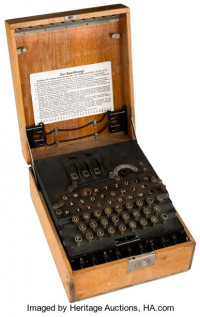
An Enigma machine just fetched over $106K at auction

(Source: Bloomberg.com)

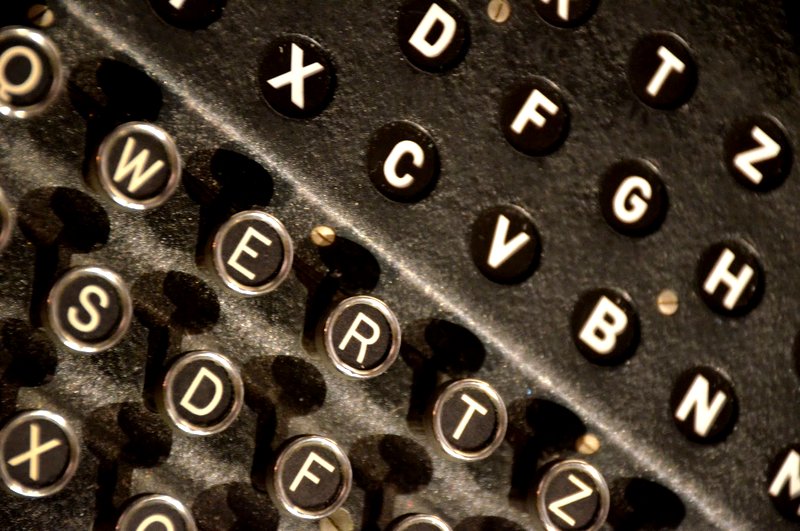
A rare “Enigma” machine, used by Nazi Germany to create military communications code thought to be unbreakable, sold at auction for more than $106,000.

The 28.5-pound cipher machine went to an internet buyer on Saturday, according to Heritage Auctions. It comes with operating instructions, a case with an engraved Third Reich emblem — and a rich lore including how British scientist Alan Turing helped crack the code.

One of the unit’s 26 light bulbs is broken, according to the description.

It’s not the first time a Nazi code creator has traded hands for such a sum. In May, an Irish private collector swiped up a different encryption machine, known as the “Hitler mill” because of its hand crank, for 98,000 euros ($109,000) from a Munich auctioneer, according to the Telegraph.[…]

Click here to continue reading the full article at Bloomberg.com.

Click here to view the auction page.

SWLing Post contributor and friend, Dan Robinson, and I once visited the National Cryptological Museum at Fort Meade and got to try our hand at using an Enigma machine. It’s an absolutely brilliant bit of mechanical engineering, of course. I highly recommend this museum to anyone interested in radio, computers or cryptography.

If you’d like to learn about another fascinating bit of over-the-air WWII technology–the SIGSALY network–I strongly encourage you to check out this post from our archives.

Ninth Edition of The Worldwide Listening Guide

Many thanks to SWLing Post contributor, Dan (KB0RTQ), who writes:

Hi Thomas!
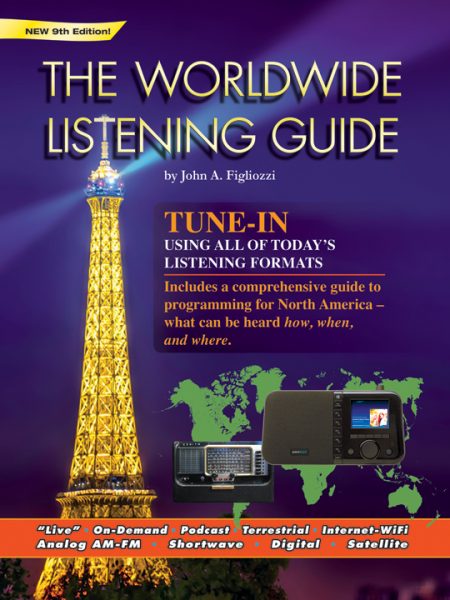
Apologies if you have covered this and I missed it – the 9th edition of John Figliozzi’s Worldwide Listening guide is available on Amazon (apparently, it has been since 11/15/19).

Click here to view on Amazon (affiliate link supports the SWLing Post).

Just thought I’d pass it along.

Thank you very much for passing this along, Dan! I see that Universal Radio also has the new guide in their inventory (click here to check it out).

The publisher is sending me a review copy of the ninth edition, so I’ll be posting my overview soon!

“My father paid four times his weekly wage for the greatest gift of my life”

Photo by Markus Spiske

(Source: The Guardian)

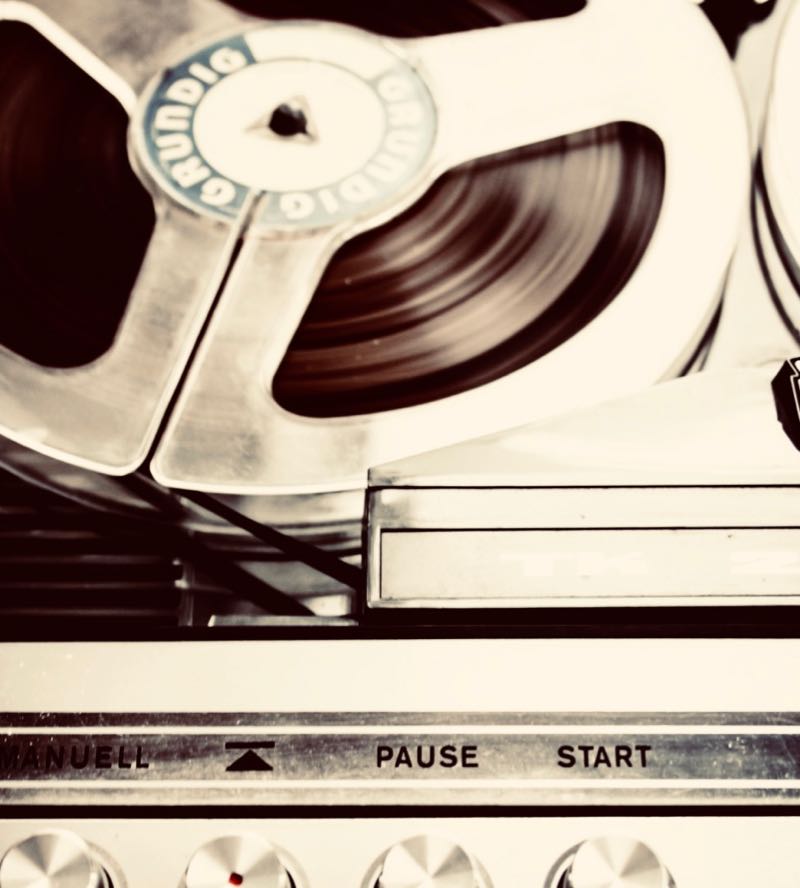
He bought me and my brother – both of us blind – a tape recorder that dominated Christmas Day and the remainder of the holidays, and led to a long and happy career

It’s eight o’clock on Christmas morning, and Uncle Tom wants to hear the news. My 11-year-old self is wondering why on earth grownups want to hear the news on Christmas Day when there are vital things to be done, such as handing out presents. And then, while I am only half-listening, something weird happens: the Greenwich time pips start. Surely we have already heard those. And then the boring man with the plummy voice begins going on about a Christmas message to the world from the Vatican. Surely that’s been on already, too.

It’s my older brother, Colin, who gets it! “Pete, Pete, it’s a tape recorder, you idiot! We’ve got our tape recorder.”

The penny drops: Uncle Tom and my dad have recorded the headlines, and are playing them back.

I think it’s often quite rare to experience real excitement over a present: in my experience, children are as good as adults at knowing what is expected of them and simulating joyful surprise, even when they don’t feel it. But for me this was one of those rare moments when my insides gave an involuntary lurch and the world did a little somersault.

Colin and I had both been blind from birth, and at this point were spending most of our time at a special boarding school, Worcester College for the Blind (now called New College Worcester). In the late 1950s, Britain had just reached the point when exciting consumer goods were coming within reach of the not-really-rich, and at Worcester reel-to-reel tape recorders were definitely the consumer gizmos of choice. For blind kids, they would trump cameras every time, especially at this moment when rock’n’roll was more of a religion than a pastime. For us, you could spot the better-off kids not by the clothes they wore, or the holidays they boasted about, but by the tape recorders they owned. So in our class, Iain Hopkin was marked out as something of a plutocrat by his Brenell recorder. Fortunately for us, Hoppy was a generous soul, and gave us all access to his recordings of Tony Hancock and Peter Sellers.

Still, a recorder of your own was the height of aspiration, and Colin – better informed and more realistic about family finances than me – had no real expectations.

I realised, much later, that at this time my dad, a very good joiner and carpenter, was probably earning about £8 a week. The tape recorder my parents had bought us, although nowhere near at the top of the range, would have cost more than four times his weekly wage. My parents could only afford it by borrowing the money from Uncle Tom, who had a thriving grocery business. Family or not, I know my mum and dad would have thought long and hard before incurring the debt.

The new toy, mains-powered and the size of a small suitcase, dominated the rest of Christmas Day and the remainder of the holidays. Once we had mastered the controls (Colin was the technical one, but was surprisingly patient in sharing his discoveries with me), we recorded everything in sight: each other, our parents, the milkman, the dog … And we very quickly learned the fun to be had at catching people unawares.[…]

Click here to continue reading at The Guardian.

Icom IC-705 price and availability

Note: We will update this post as pricing information is confirmed by retailers.

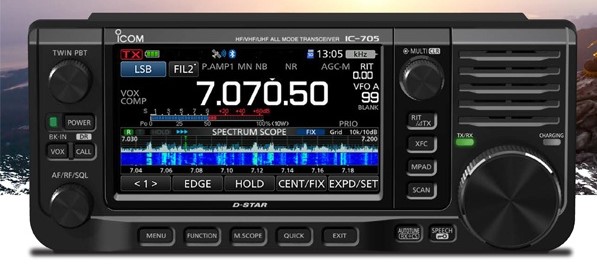
Many thanks to several SWLing Post readers who have been carefully tracking the price of the Icom IC-705 transceiver which is expected to start shipping around the second quarter of 2020.

Pricing in Japan: 124,800 yen

Paul Evans notes that the price in Japan, according to this Icom Japan press release [PDF], is 124,800 yen + tax. That’s roughly $1150-1200 USD.

Pricing in UK: £1200.

In addition, ML&S have recently posted updated details from Icom UK and have noted that they “anticipate a price of around £1200 (£1000.00 excluding VAT).” To put that in perspective, the IC-7300 is currently being offered for the same price and it’s been on the market a while now.

This could mean that after the IC-705 has been on the market for a while, discounts could place it well below that of the IC-7300. Of course, if history is an indicator, early adopters will likely pay the top price.

Pricing in US: [TBD]

No confirmation yet from US retailers, but at this point, I would bet we could see pricing around $999 USD. That would be a competitive starting point. Of course, once we have confirmation from retailers we’ll update this with actual figures.

Other regional pricing

We will update this post with pricing and availability once we confirm details. Please comment with any tips!


Do you enjoy the SWLing Post?

Please consider supporting us via Patreon or our Coffee Fund!

Your support makes articles like this one possible. Thank you!

TX Factor Episode 25

Many thanks to SWLing Post contributor, Eric (WD8RIF), who notes that the 25th episode of TX Factor was recently released. Here’s the show summary:

A post-election special – well, not really! Just a look at some more new and innovative AR products from this year’s Hamfest, including a potted history of the ever-popular and much revered range of transceivers and kits from Electraft with co-founder Eric Swartz WA6HHQ. There’s our free-to-enter draw with some excellent prizes from ML&S and RSGB to be won.

In this modern era of connectivity, we take the ever-present Internet for granted; it’s always there and continues to deliver our data from A to B without issue. But what would happen if that vital link failed? We visit Southampton and Portsmouth on the UK’s south coast to see how two city councils, assisted by a group of dedicated amateurs, plan to maintain their communications infrastructure via radio links alone, should the Internet go down.

Click here to view on YouTube or on the TX Factor website.

Phil recommends The Radio Historian website

Many thanks to SWLing Post contributor, Phill (W9IXX), who writes:

Thought might be interested in this if you haven’t already mentioned this site:

http://www.theradiohistorian.org/pubs.html

Check out his calendars!

Thanks for the tip, Phil! I know we’ve linked to article on this site before, but thanks for mentioning it again. This is truly a treasure trove for those of us who love vintage radio.  I especially like the articles page which has a number of fascinating reports. Of course there are a load of photographs and recordings as well.

Click here to check out The Radio Historian website.