Category Archives: Antennas

Guest Post: ZIPWALL10 poles as antenna supports

Many thanks to SWLing Post contributor, Mario Filippi (N2HUN), who shares the following guest post:


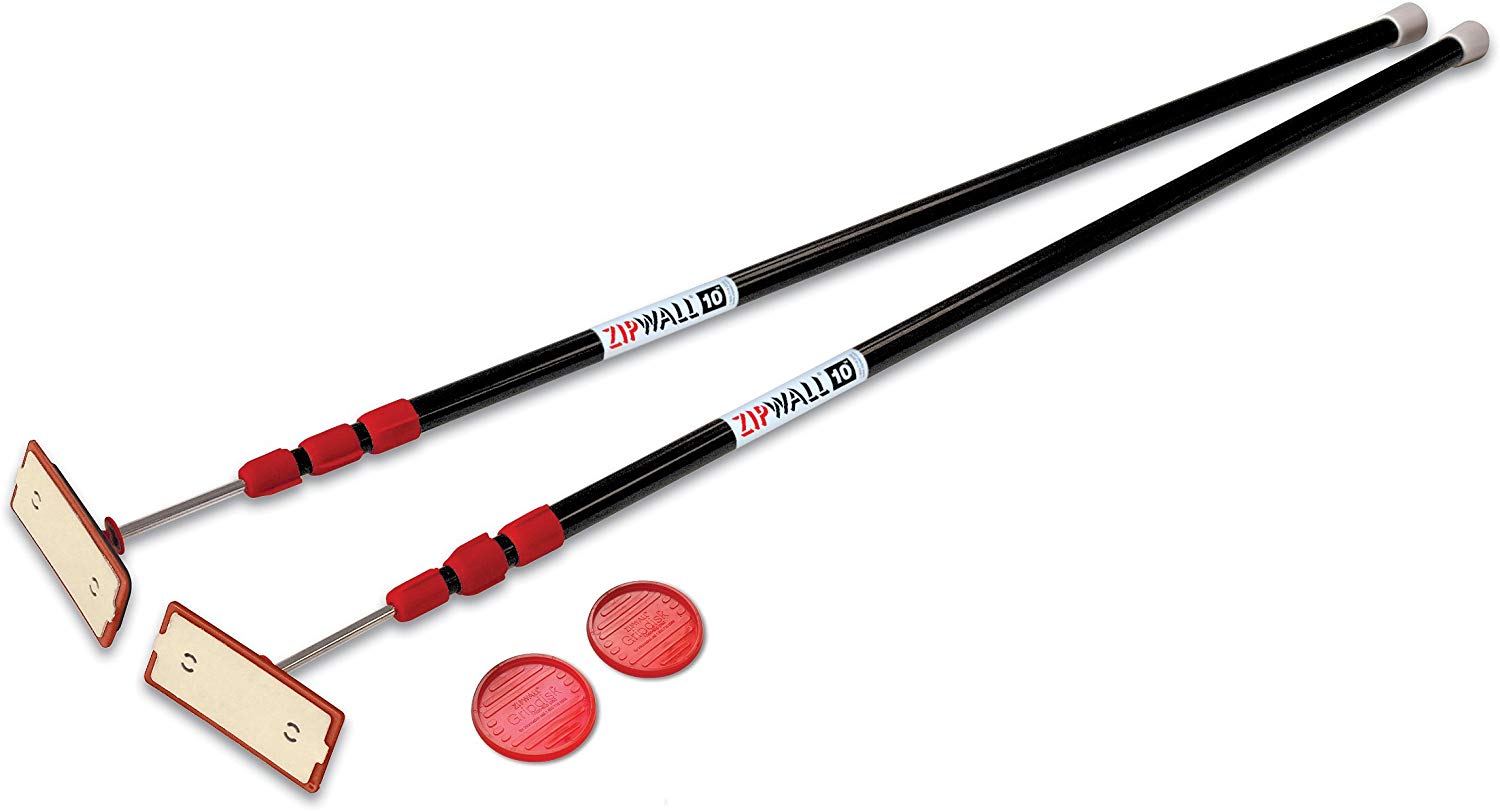
ZIPWALL10 poles

Recently we had a remodeling job performed at the home QTH and the workers used telescoping poles to form a dust barrier.  When the job ended, they said I could have the telescoping poles, a product called ZIPWALL10, which when collapsed are four feet long but extend to ten feet.  This got me pondering about how handy these could be in the radio shack, especially for indoor impromptu antennas.
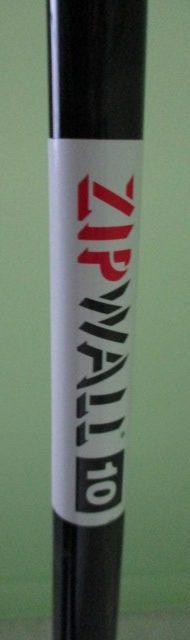
Close up of the ZIPWALL telescopic pole.

Indoor antennas, especially wire antennas usually have to be secured to a wall somehow, and should be as high as possible in the room.  That requires using adhesive tape to attach the wire and a ladder (most ceilings are eight feet), but using the ZIPWALL10 poles it’s easier and safer.  Below is a temporary random wire antenna in my shack using 26 gauge insulated wire strung between the two poles.
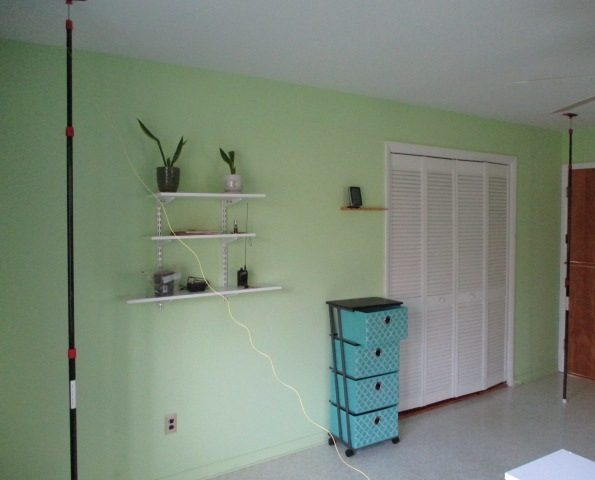
Random wire in shack room is a bit hard to see but it is strung between the two poles.

What’s nice about these poles is they have rubber feet to grip the floor and plastic pads on top to avoid damage to the ceiling. The top section is spring loaded to assure a tight fit.  The ZIPWALL10 model extends to ten feet in three telescopic sections. No tools are needed to set these up, and they conveniently collapse for storage.
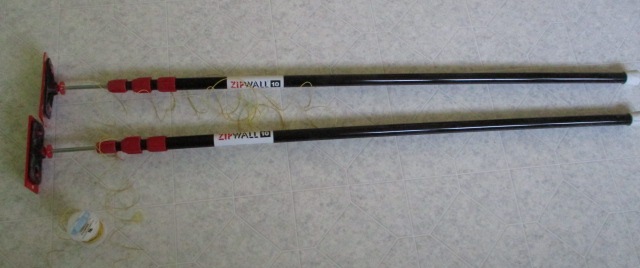
ZIPWALL10 pair along with roll of 26 gauge wire for temporary indoor antenna installation.

These poles just happened my way due to a remodeling job, but surely other types are available on the market for those wanting to experiment with indoor antennas.  The price for a ZIPWALL10 pair on Amazon is around eighty dollars. Thanks for reading.


What a great use for ZipWall poles, Mario! I’ve spent the past few days at an ocean front condo and could have used two of those supports to suspend a small, lightweight passive loop antenna safely on the balcony. That’s fantastic your contractors simply gave you those poles! 

Thanks for the tip!

As you mention, Amazon sells a full line of ZipWall options (links below support the SWLing Post) but these can also be found at most home improvement stores. 
Rick compares the Bonito ML200, Cross Country Wireless, MLA-30 and Wellbrook 1530LN

Many thanks to SWLing Post contributor, Mike Ladd, who shares the following video by Rick King who compares four mag loop antennas: the MLA-30, Cross Country Wireless, Bonito ML200, and the Wellbrook 1530LN.

Click here to view on YouTube.

Excellent comparison, Rick!

Although we’ve previously posted reviews and comments about the MLA30, I’m quite impressed that it gave the venerable Wellbrook a run for its money. I’m not surprised the Bonito ML200 was the winner here–Bonito quality is second to none.

Loop links:

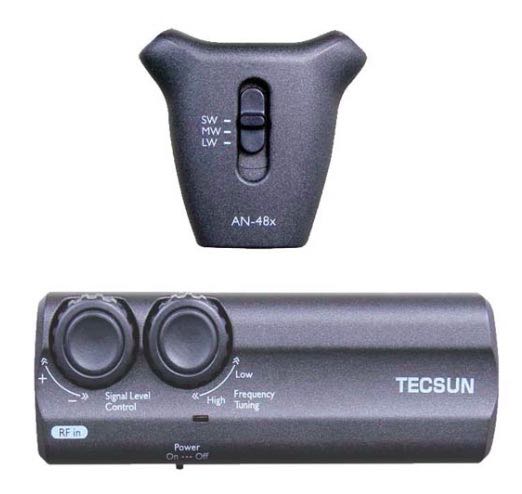
The new Tecsun AN-48x Active Loop Antenna

Many thanks to SWLing Post contributor, Troy Riedel, who shares a link to the new Tecsun AN-48x Active Loop Antenna at Anon-Co. Here’s the description from Anon-Co:

TECSUN AN-48x is an active loop antenna for enhancing shortwave (SW), medium wave (MW/AM) and longwave (LW) reception.

Unlike previous models (DE31MS, A38-LMS) available on anon-co.com, the AN-48x is supplied with adapters to connect the antenna to BNC and RCA sockets. This greatly simplifies hooking up the antenna to TECSUN receivers like S-2000 and S-8800, while it is just as easy to use with H-501, PL-990, PL-880 and the rest of the “PL”-family.

AN-48x also works with portable radios that do not have an external antenna jack!

Effective Frequency Range

Longwave: 120 ~ 400 kHz

Medium Wave (AM): 520 ~ 1700 kHz

Shortwave: 3500 ~ 20,000 kHz

[…]

Click here to view at Anon-Co.

Anon-Co notes that they expect to launch this product in December 2019. If you happen to grab one, consider sharing your review here on the SWLing Post!

Jack’s Mediumwave Lazy Susan Mag Loop System

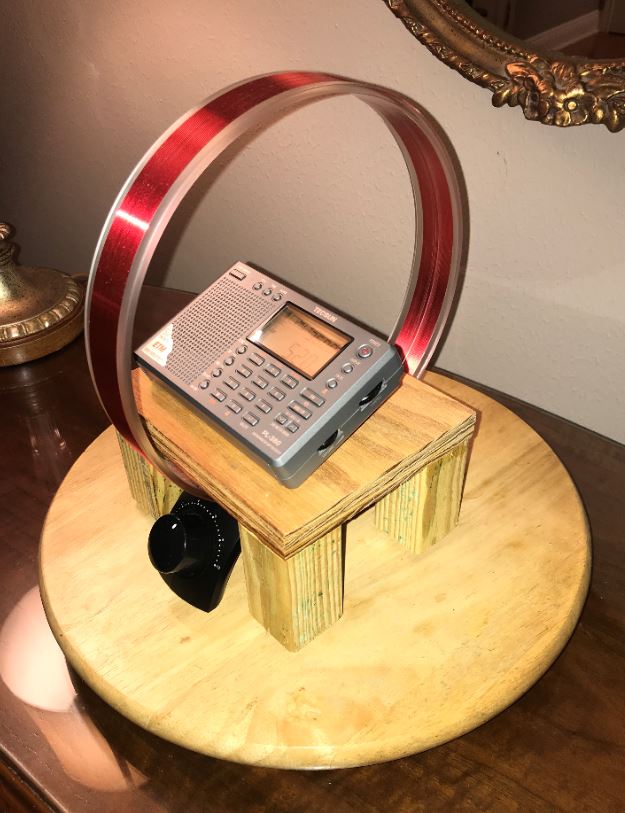
Many thanks to SWLing Post contributor, Jack Blanke (WB5LVP), who writes:

I stole this idea from another SWLing Post contributor and I hope he won’t mind.

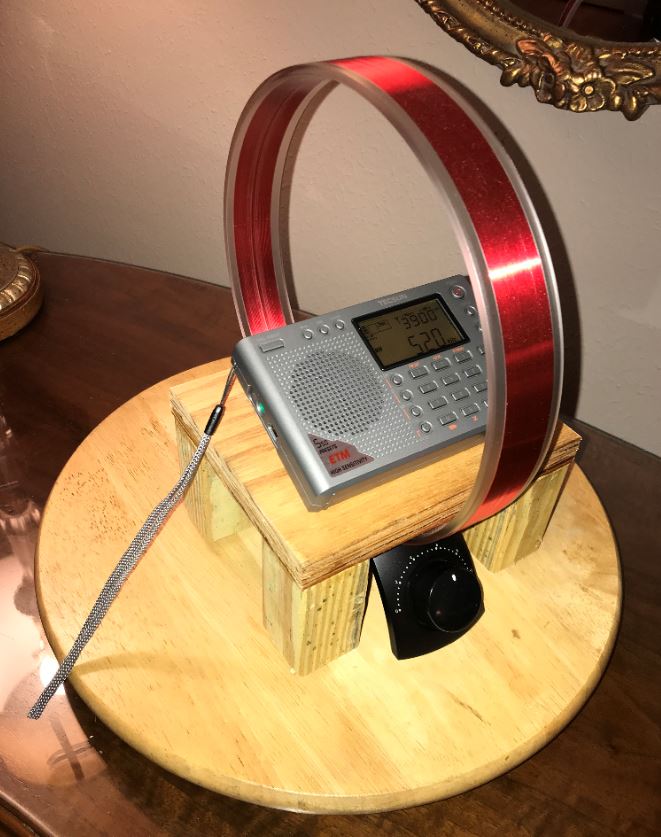
However, placing the Ferrite Antenna near the center of the loop does enhance its performance and the Lazy Susan was something I had been using long ago to quickly re-orient the radio azmuth to accommodate the signal source. But, like my mentor, minor improvements like this can really enhance performance of smaller portables on medium wave. He used cardboard and I used scrap wood from the work shop. Either way, not much money was involved in this minor enhancement.

These inexpensive additions to the listening post really make the PL380 and the AN200 combo provide hours of enjoyment from medium wave DXing. Now,if only I can find the gent’s name who came up with this little gizmo, I’d love to thank him!!

73’s!

Thanks for sharing your setup, Jack! I can assure you that Rich Stahl (WR3V) will be happy you “stole” his idea. That’s what it’s all about–helping each other! I love the little table/stand you built for the portable and how it perfectly accommodates the loop. Great job!


Do you enjoy the SWLing Post?

Please consider supporting us via Patreon or our Coffee Fund!

Your support makes articles like this one possible. Thank you!

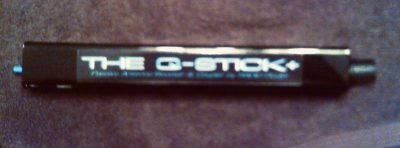
Ron’s thoughts on RFL200 and Q-Stick longwave antennas

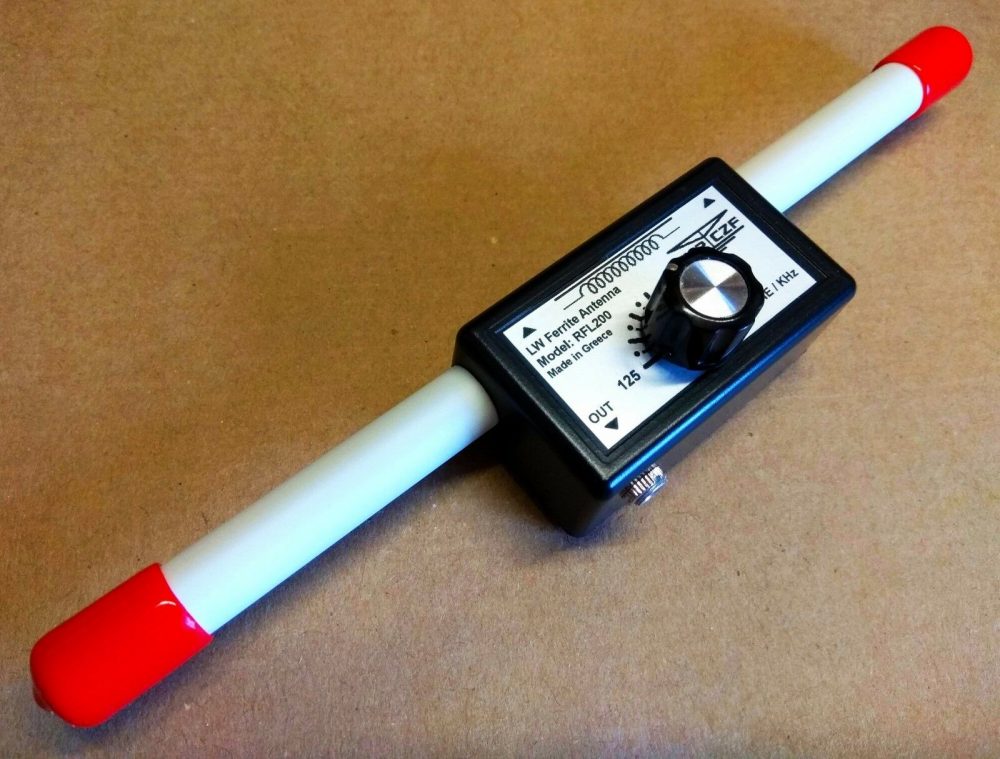
Many thanks to SWLing Post contributor, Ron, who shares his thoughts on comparing two portable longwave antennas:

To begin, for reference, check out this post where The Professor reviews the RFA200. Also, check out the following video from the replies of that post:

Both the RFL-200 and the Q-Stick came in today.

Performance of both was very nearly identical but for now the Q-Stick wins on price ($67.50 vs. $75.78 delivered) and the Q-Stick does both LW and MW.

But Gerry says he’s going to close RadioPlus early next year so-presumably-
that will leave just the RFL-200 and its REA-200 sibling.

The “200” no doubt comes from the length, 200mm or 8 inches…the Q-stick
uses a 7-3/4 inch ferrite bar which is probably why the similar performance.

There is one thing: the small tuning knob is not hard to turn on the RFL-200
as it was on the REA-200 tested earlier but a bigger knob would be nice.

But the tuning cap uses a 1/8th inch shaft so finding a larger knob is too
much bother, most are for 1/4 inch shafts.

By comparison the Q-Stick has a nice big knob and is quite easy to tune.

So for now the Q-Stick would be the better buy, but don’t tarry.

[One more note,] if you want the most bang for your buck, forget both of these, get
a PK Loop
for $90.60 delivered (be sure to specify the 155-500 kHz model).

Thanks for sharing your thoughts, Ron!

Click here to check out the RFL200 longwave antenna on eBay.

(Click here to view the RFA200 mediumwave version.)

Click here to check out the Q-Stick antenna at Radio Plus. 


Do you enjoy the SWLing Post?

Please consider supporting us via Patreon or our Coffee Fund!

Your support makes articles like this one possible. Thank you!

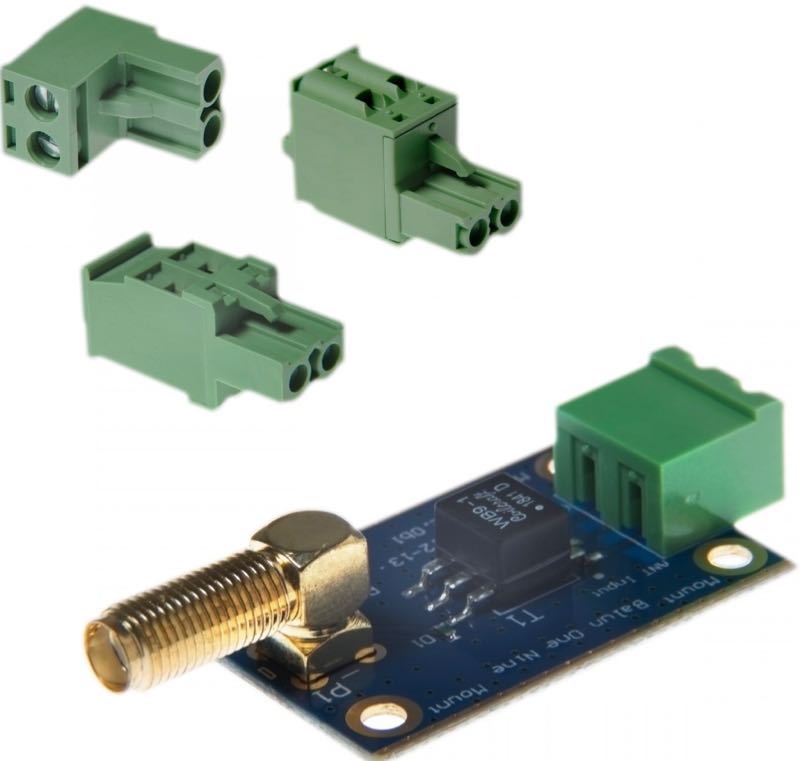
The NooElec Balun 1:9 v2

Many thanks to SWLing Post contributor, Grayhat, who writes:

Hi Thomas, was about to write you about some infos related to the NooElec balun when found that they now offer a v2 model:

https://www.nooelec.com/store/balun-one-nine-v2-barebones.html

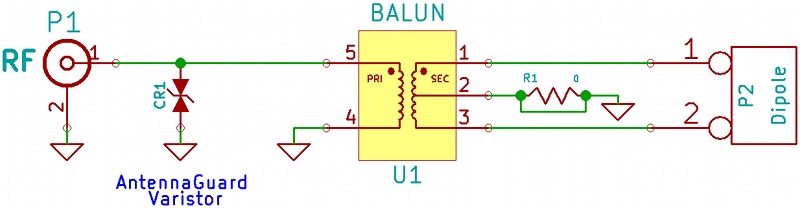
The new balun has the same schematic as the previous one:

But it is slightly bigger, has a better connector for the antenna wires and (according to NooElec) uses a transformer which allows the tiny balun to work more efficiently from 0 to around 70 MHz (check out the charts found in the downloads section of this link).

The transformer used, judging from the pics, is a CoilCraft WB9-1, whose data can be found here:

https://www.coilcraft.com/wb_th.cfm

As I wrote the reason for this was the fact that a friend of mine reported that he used the (v1) balun with a Loop On Ground (LoG) Antenna !

If you look at the schematic (above) you’ll notice that there’s a “jumper” labeled R1 (zero Ohm resistor). That tiny detail is important, see, leaving the balun as is, it will work fine with a longwire, one just connects contact #1 to the antenna and #2 to a counterpoise or ground system and there he goes, BUT there’s another way to use the balun, that is, CUT the “jumper” (ok, resistor) labeled “R1”. If you cut it, the balun will become a 9:1 isolation transformer and with such a modification will work just fine with the KK5JY “LoG”
antenna: http://www.kk5jy.net/LoG/

According to what my friend reported, the balun works just fine, and although probably the ferrite core used in the V1 isn’t up to par with the original one used by KK5JY, the difference isn’t so huge.

Oh, and I also suspect that the modified balun may work fine with the KK5JY simpler passive loop http://www.kk5jy.net/rx-loop/ which may be a nice antenna for restricted spaces!

I think it may be of interest to people not knowing/willing to wind their own baluns, at that point one may just need an enclosure to protect the balun and putting up a receive antenna will be as easy as 1-2-3.

Thank you for sharing this! Readers: Grayhat has been encouraging me to deploy a LoG antenna at my home and I do plan to do so in the coming months. Please comment if you use a LoG similar to the KK5JY model and what your results have been.

Thank you again for the tip, Grayhat!

Rolf experiments with MW antenna coupling

Many thanks to SWLing Post contributor, Rolf, who writes:

I made a great discovery tuning using a second passive analog radio.

When I tune to Radio Caroline, for example, on my portable I can receive the signal okay. When I put the receiving radio on minimum then place it next to and couple it with the second radio, it is receiving a lot better!

Even stations I could hardly hear, now i can hear them!

Check out my short demonstration video:

Click here to view on YouTube.

That is fascinating, Rolf. Thank you for sharing. Indeed, this is one of the reasons why I try to maintain a good distance between radios when comparing them in reviews. In this case, though, you’re using coupling to your advantage!