Category Archives: Broadcasters

Radio Afghanistan now on shortwave

(Source: Bakhtar News Agency)

Sunday, July 31, 2011 Kabul (BIA) Dr. Sayed Makhdoom Raheen Minister of Information and Culture inaugurated the foreign section of Radio Afghanistan yesterday.

Dr. Sayed Makhdoom Raheen Minister of Information and Culture inaugurated the foreign section of Radio Afghanistan yesterday. This section in the first place will air program in English and Urdu languages each night from 8:00 to 9:00 pm. Opening the section Dr. Raheen said that this section has been revived with the efforts of the director general and employees of the radio and in the first place it will air English and Urdu programs and followed by Arabic and Russian programs and subsequently French and German programs. According to Dr. Raheen revival of this program shall assist in recognition of Afghanistan to its outside friends and will inform them about our country’s events. Abdul Ghani Mudaqaq head of the publications department of Radio Afghanistan said that this program shall cover Asia, Africa and Europe regions. According to officials of the radio ten years delay in the radio programs was inactivity of the short wave in Yakatout. Ghulam Nabi Farahi, Deen Mohammad Mobarez Rashidi deputy ministers of information and culture, Zareen Anzur general director of National Radio-TV and some other officials participated. Radio Afghanistan started its publications in 1304 and after a short lapse restarted its publications in 1320 and now it is 20 hours on the air. An employees of the radio said that Afghanistan was the first country in the region which had radio publication on that time.

Additionally, I just noticed this same story in RNW Media Network’s feed. They had an additional update with frequencies:

Thanks to Mikhail Timofeyev in St Petersburg, Russia who reports English at 1530 UTC on 6100 kHz, followed by Urdu at 1600, so the schedule is confirmed as 1530-1600 English and 1600-1630 Urdu.

Guinea imposed temporary ban on Radio France International

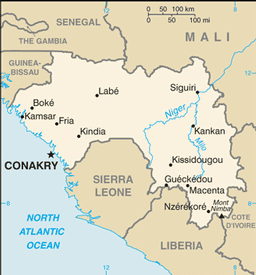
Map of Guinea (Source: CIA World Fact Book)

(Source: Committee to Protect Journalists via RNW Media Network)

On Monday [25 July], Guinea’s state-controlled media regulatory agency imposed a “temporary” ban on media coverage of the July 19 attack on the private residence of President Alpha Conde, silencing private radio and television talk programmes in which critical questions were being raised about the episode.

In such circumstances, Guinean listeners turn to foreign media outlets such as France’s state-funded international broadcaster, Radio France Internationale (RFI), the most popular station in Francophone Africa. With programmes such as “Appels Sur L’actualite”, a daily news call-in show, RFI is considered by millions of African listeners to be an essential source of news and information.

Wednesday’s “Appels Sur L’actualite” began with an ominous statement read by host Juan Gomez. “We had planned this morning to debate the attack last week against the residence of the Guinean president, but yesterday the National Communications Council of Guinea decided to temporarily suspend any programme or article about the attempted assassination against the head of state as well as all call-in programmes.” Gomez told listeners they would have to debate another topic.

Squeezed between the expectations of listeners and the conditions set by governments leasing the local frequencies it needs, RFI found itself in a difficult position. “We are not submitting to a censorship measure; we regret it and we hope that it will be temporary.” RFI deputy director Genevieve Goetzinger told CPJ today [28 July].

RFI has suffered for its critical reporting on current events in Africa. The station has seen its reporters expelled from Chad, Rwanda, and Senegal, its local correspondent jailed in Niger, and another correspondent killed in the Ivory Coast.

RFI has had its broadcasts temporarily banned in a number of countries, most recently in the Democratic Republic of Congo where the government of President Joseph Kabila sought the removal of RFI senior reporter Ghislaine Dupont, the station’s DRC specialist who was expelled from the country in 2006. Nevertheless, RFI management remains adamant the station will continue to report without interference. “Our editorial line is set in Paris, in complete independence from all the governments in the world,” Goetzinger said.

As a follow-up, RNW Media Network noted that the temporary ban was eventually lifted.

As with Fiji, Burma, Zimbabwe and many other countries where the ruling party arbitrarily tries to block free speech, shortwave radio cuts through censorship without regard for national borders.

Public Diplomacy Magazine features array of articles on the state of international broadcasting

It is a rare occurrence when so much attention is given to the topic of international broadcasting. Financial hardship combined with a rapidly changing media landscape set a stage where broadcasters are being forced to a precipice of change. How well they quickly evaluate restructuring their message and the medium they use to deliver it could very well determine the future of broadcasting on the shortwaves.
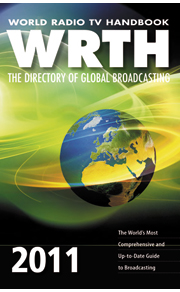
This issue of Public Diplomacy Magazine covers the scope.

(From: RNW Media Network)

PD Magazine, Summer 2011 of the University of Southern California Center on Public Diplomacy, is devoted to international broadcasting. Its contents include:

Also available is the pdf version.

Thanks to RNW Media Network, Kim Andrew Elliot and Richard Cuff for the tip.

Jonathan Marks re-publishes “The Hitch-Hikers Guide to DXing”

Jonathan Marks has re-released The Hitch-Hikers Guide to DXing. In his own words:

It is thirty years ago since I wrote a rather silly parody on both international radio broadcasting based on my favorite radio series at the time, the Hitch-Hikers Guide to the Galaxy. There seemed to be so much to make fun of at the time…the boring propaganda at the height of the Cold War, jamming, the waste of energy shouting from one country to another, and the variable quality of reaction from listeners. I don’t think it was the listeners’s fault that most of the feedback was very technical, to do with signal strength and QSL cards rather than comments on the programme. May be people were being too polite.

[…]There wasn’t much time to write radio drama on the second floor of the Radio Netherlands building. And there was no budget to hire actors. So I just rattled it off on a typewriter and asked colleagues to come and read their parts in a lunchtime recording session. This was all two track material, sliced together with a chinagraph pencil and a razor blade. In total we made 5 in 1981 to fit the 5th Thursday in the month, and then one more in 1982 as a Christmas special.

To listen to all five episodes, simply cruise to the Media Network Vintage Vault and start with Episode 1. It’s well worth a listen and a nice little piece of 1981 RNW ingenuity.

BBC World Service audience dwindling in transition to internet-based media

A lesson here is when you pull out of shortwave radio broadcasts you lose very large swatches of listeners–especially when many in your audience lack access to the internet.

(Source: Journalism.co.uk)

The BBC World Service’s global audience has dropped by 14 million in the past year, according to the broadcaster.

Overall audience for the year has been estimated at 166 million, down from 180 million last year.

However, it claims online the World Service’s audience has risen by 40 per cent in the past 12 months.

In the BBC World Service annual report, published today, the broadcaster blamed the overall fall on the numerous service closures and changes which were implemented following cuts to its funding.

Read full article at Journalism.co.uk.

Shortwave plays vital roll in Somalia

I found this BBC profile on Somalia quite indicative of many countries in Africa. In light of cuts that the BBC World Service has been facing, this short article, about Somalia’s fragmented media landscape, admits that shortwave plays a vital roll in domestic news.

The TV and press sectors are weak and radio is the dominant medium. There are around 20 radio stations, but no national, domestic broadcaster. Many listeners tune to Somali-language media based abroad, in particular the BBC Somali service. The latter is available on shortwave, and via FM relays in Mogadishu (91.1), the Somaliland capital Hargeisa (89.0), and elsewhere.

They go on to say:

The Somali diaspora – in the West, the Gulf states and elsewhere – sustains a rich internet presence. But domestic web access is hampered by practicalities such as limited access to mains electricity. There were 102,000 internet users by September 2009 (Internetworldstats). In secessionist Somaliland and Puntland the authorities maintain a tight hold on broadcasting.

Shortwave listeners in Somalia, one should note, also listen to the likes of the Voice of America, Radio Netherlands Worldwide, Radio France International and many others. Most of whom are facing cuts right now as national budgets are being tightened in the economic recession. To those living in Somalia, where the media is fragmented and untrustworthy, shortwave radio represents a lifeline of information.

As we mentioned in this previous post, please consider speaking up on behalf of those without a voice. Let international broadcasters and their governing bodies know how crucial shortwave services are into impoverished regions of the world.