Category Archives: Broadcasters

All India Radio on DRM track

As we’ve mentioned before, it appears AIR (All India Radio) may soon be a leader in digital radio in all forms, including shortwave. This, from the Deccan Herald:

The government plans to launch a 24-hour news broadcast channel of All India Radio (AIR) as part of its sweeping modernisation programme in the next five years.

AIR will also witness a complete digitisation of its studios, transmissions and connectivity across the country by 2017 according to plans by Ministry of Information and Broadcasting. With a view to improving efficiency and broadcast quality, the government will replace old and obsolete equipment besides enhancing AIR’s infrastructure by refurbishing its studios.

[…]While the reach of the national channel is proposed to be extended to the whole of the country, the external services of the AIR will also be strengthened through digitalisation of shortwave transmitters.

Read the full article at the Deccan Herald. Thanks to @kaedotcom (Kim Elliot) for the tip!


BBC strike next week

BBC journalists have announced that they will strike next week in protest of the mandatory lay-offs/redundancies which will greatly reduce the BBC World Service staff.

(Source: Journalism.co.uk)

Journalists at the BBC have announced they will take strike action next week in a dispute over compulsory redundancies.

Members of the National Union of Journalists voted in favour of strike action earlier this week, with 72 per cent of those who voted saying they would be prepared to strike.

According to the NUJ, more than 100 people are at risk of compulsory redundancy at the BBC World Service.

Union members are also said to be at risk in divisions including BBC Monitoring, BBC Scotland and potentially at BBC Wales, BBC 4, BBC Sport and TV Current Affairs.

Today the union confirmed a one-day walk out will take place on 15 July.

Read full article at Journalism.co.uk.

Archived BBC 4 documentary on Lincolnshire Poacher

A friend recently sent me this archive site of a BBC documentary from 2005 that tracks the Lincolnshire Poacher and other numbers stations.

If you’re unfamiliar with numbers stations check out our previous post on the subject–and be sure to listen to David Goren’s production, “Seis Siete Tres Siete Cero“.

Along with pirate radio stations, I think numbers stations are one of the most sonically interesting catches we find while cruising the ether.  When I happen upon one, no matter what language, I end up listening to them for way too long. Indeed, I do the same with WWV, but that’s a different story.

Want to hear the Lincolnshire Poacher live? It can be a bit tricky, but learn where they broadcast by visiting this page and set the memories on your radio to scan those frequencies.

Happy hunting!

Between Broadcasts-Exploring Interval Signals

Lately, I’ve been listening to a plethora of shortwave broadcasts as I’m about to review several new radios. I’ve noted so many great interval signals that are still in use. The following is a reprise of a previous post–from over two years ago–about interval signals. If you’ve never heard of interval signals, this post offers an introduction. 

What are interval or tuning signals? Often the most recognized sounds in the shortwave bands are the repetitive tones and musical interludes heard between broadcasts, known as interval signals. These are simply characteristic  musical phrases that broadcasters play between programs.  In fact, for me, nothing is more nostalgic than to hear the interval signals of some of my favorite broadcasters from my youth. Here are a few classic examples of interval signals:Analog Radio Dial
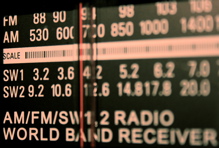
Interval signals usually include station and program identification, and are often in multiple languages. Not only do they help identify the station, but in the days of crowded international broadcast bands, interval signals helped listeners tune in and adjust their radios prior to program commencement.

Broadcasters have been using interval signals since the 1920s, but there has been a decline with the advent of digitally tuned radios which, unlike analog tuners, take the guesswork out of tuning into a specific frequency.

So, in this digital age, are interval signals still around? Sure. Many broadcasters believe an interval signal is still the best way to announce station and program identification; one might say their interval signals have become audio “logos.”

Here is an audio clip I recorded on April 23, 2009, of the interval signal for the new Happy Station Show: [Click here to listen]

For comparison, listen to this audio clip of the Happy Station Show from Jan 20, 1980, when it was a part of Radio Netherlands: [Click here to listen]

Listening for Signals

Where can you hear interval signals today?  Fortunately, they can be heard all over the shortwave broadcast spectrum. The best times to hear interval signals are on the top of the hour and sometimes at the half or quarter hour.

Another great place to hear interval signals are on the web. There are several interval signal databases where you can listen to a wide variety of interval signals. One of my favorites is the Interval Signal Database. This site is in German and English and is well categorized and searchable. In fact, Bernhard, the webmaster of the Interval Signal Database, gave me permission to publish several of his audio clips above. [Danke, Bernhard!]

Here is a list of interval signal websites:

Since he’s somewhat of an interval signal guru, I asked Bernhard for his favorite interval signal recording. He pointed out this one from the Cold War era:  it is a recording of a special low-power (1kW) training station of the Austrian military. Bernhard informed me that in times of crisis, this station was to serve as a back-up for the Austrian Radio ORF.

Leave a comment:  What is your favorite interval signal, and why?

• • • • • • • • • • • • • • • • • • • • • •

On a side note–Bernhard also pointed out one of his favorite non-interval signal recordings.  In this recording, the news reader started the German language news by reading the frequencies, then noticed that the studio door was open.  You can clearly hear her getting up to close the door in the recording.

CNN reports on new Voice of Russia studios in DC

Many long-time shortwave listeners may find it ironic that the likes of Voice of Russia now broadcasts from a studio in downtown Washington DC. I just read this news article posted on CNN about VOR’s new presence:

Jordan Hostetter doesn’t know it, but he’s a target. He’s a young professional living in Washington, curious about international events and listens to the radio while driving to work — just the kind of person Voice of Russia radio is trying to reach.

Changing American hearts and minds about Russia has been Voice of Russia’s mission since it first went on the air in 1929, broadcasting from Moscow via short-wave radio. It still does use short wave but with the Internet, Facebook and Twitter, that seems like a blast from the past.

It goes on to mention how, long-time rival, Voice of America has gone totally digital. Not totally true, in fact, but VOA is putting a major effort into moving off of the shortwave bands. As we mentioned previously, in their shortwave sunset plans, the BBG plans to keep shortwave alive in parts of the world where free speech is suppressed and where shortwave is the only option. They will, most likely, rent broadcasting time from other providers and shut down VOA-run facilities.

What was notable in this CNN article was a tidbit about a VOA attempt to do what their Russian counterpart is doing:

VOA says it tried to get a license to […] broadcast on local Russian radio in Russian to Russians. But Elez Biberaj, VOA’s Eurasia division director, says it was prevented from affiliating with Russian radio and television stations “because of threats and because of the pressure that the government brings on license holders.”

So, I guess, VOA will take on this objective with a web presence?

No doubt, our international broadcasting field is changing. I believe we’ll see more broadcasters following VOR and CRI’s local vector. Perhaps, in fact, this is just what our AM band needs.

RNW cuts are a go

Unfortunately, it appears the RNW budget cuts will take place–details will emerge in October.

From RNW:

The Dutch parliament has voted against two motions which might have blunted the effect of the budget cuts facing Radio Netherlands Worldwide.

One motion called for a separate debate devoted to the future of RNW. Previous debates tackled the cutbacks facing all public broadcasting. The other criticised the decision-making as hasty and called for a postponement.

Effectively, this vote means that the cabinet’s plans to move RNW from the education, media and culture ministry to the foreign ministry and cut the budget from 46.3 million euros to 14 million will definitely go ahead.

RNW’s management will now draw up a redundancy plan, which is expected to be completed in October.

Again, it’s still not too late to voice your opinion. As with the BBC WS cuts, perhaps there is still some hope.