Category Archives: Broadcasters

WRTH 2020: A look inside

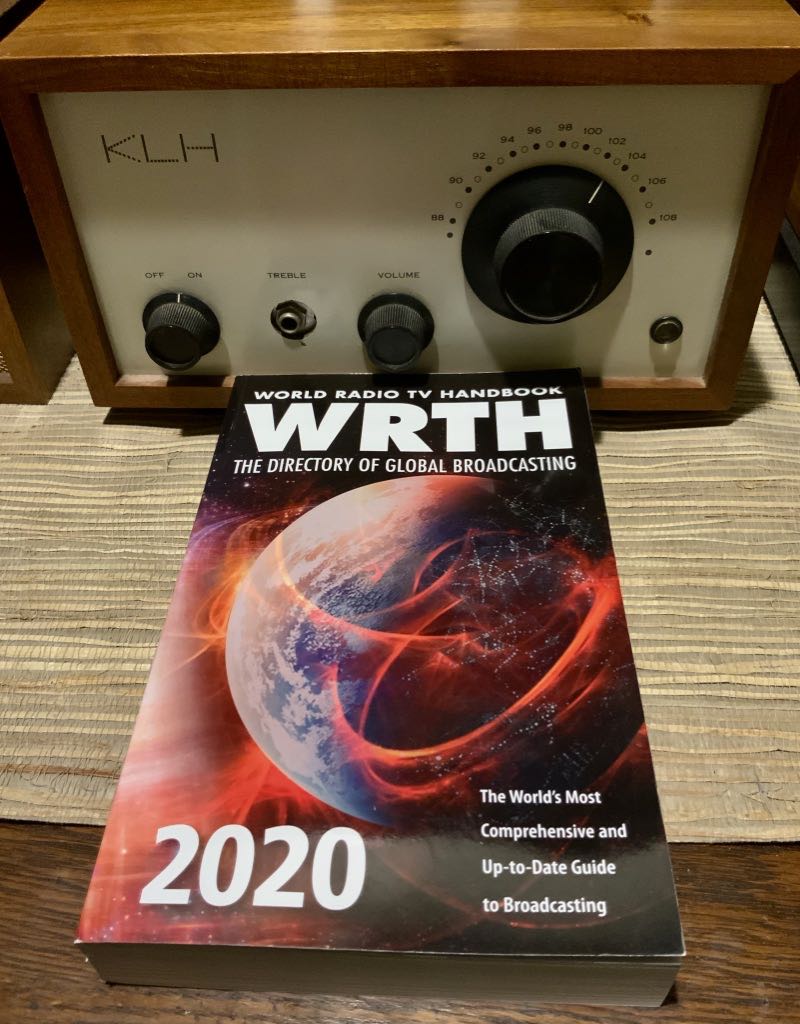
I received my review copy of the 2020 World Radio and TV Handbook (WRTH) shortly after returning from holiday travels last week. I always look forward to receiving this excellent staple radio reference guide–and this is their 74th edition! The WRTH has never disappointed, so my expectations are always quite high.

Once again, the WRTH lived up to my expectations.

WRTH’s team of noted DXers from around the world curate frequencies and broadcaster information by region; while I’m not sure how they orchestrate all of this, the end result is truly a symphony of radio information. In addition to broadcaster listings, WRTH’s radio reviews, feature articles, and annual HF report make for excellent reading.

But the WRTH isn’t just a frequency guide: the publication always devotes the first sixty or so pages to articles relating to various aspects of the radio hobby. Following, I offer a quick overview of these.

The first article always features a WRTH contributor:  this year, they feature Luis Cavalho who is their contributor for Portugal, the Azores and Madeira. His path to becoming a WRTH contributor began in his childhood snagging mediumwave DX with an array of portable radios. His love of radio lead him to the world of shortwave radio, WRTH and eventually his own radio website to serve Portuguese listeners.

WRTH Reviews

The second set of articles is always my favorite: WRTH receiver reviews.

This year, WRTH begins with an in-depth review of the excellent ELAD FDM-DUOr tabletop SDR receiver.  Next they build on their 2019 review of the SDRplay RSPduo by exploring its unique diversity reception capabilities. They also review the AirSpy HF+ Discovery and were so impressed they awarded it the 2020 Best Value SDR.
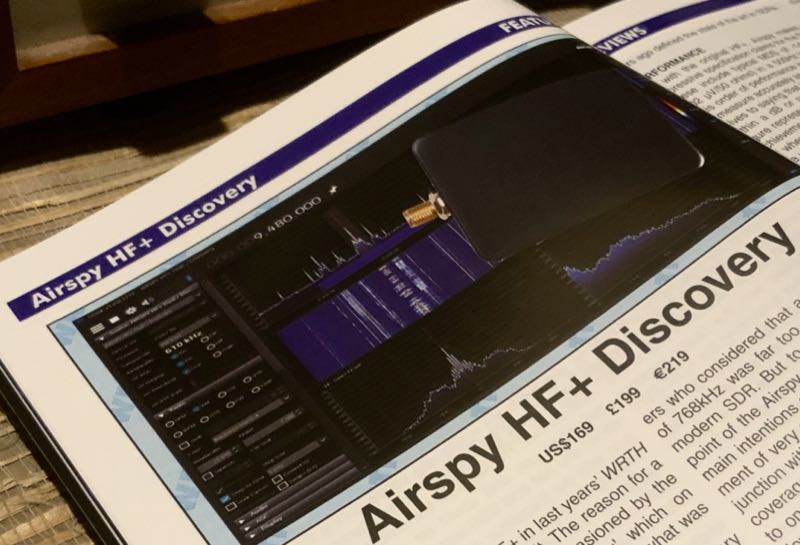
This year, WRTH also reviewed two portable radios by Pure: the Pure Elan E3 DAB, DAB+, FM receiver and the Pure Elan IR5 WifI radio.

The final two reviews are of affordable products that offer incredible value for the radio listener: the venerable Tecsun PL-310ET ultralight radio and the Tecsun AN-200 MW Loop Antenna. I enjoyed reading a fresh review of each of these products as I’ve personally used both for nearly a decade.

WRTH Features

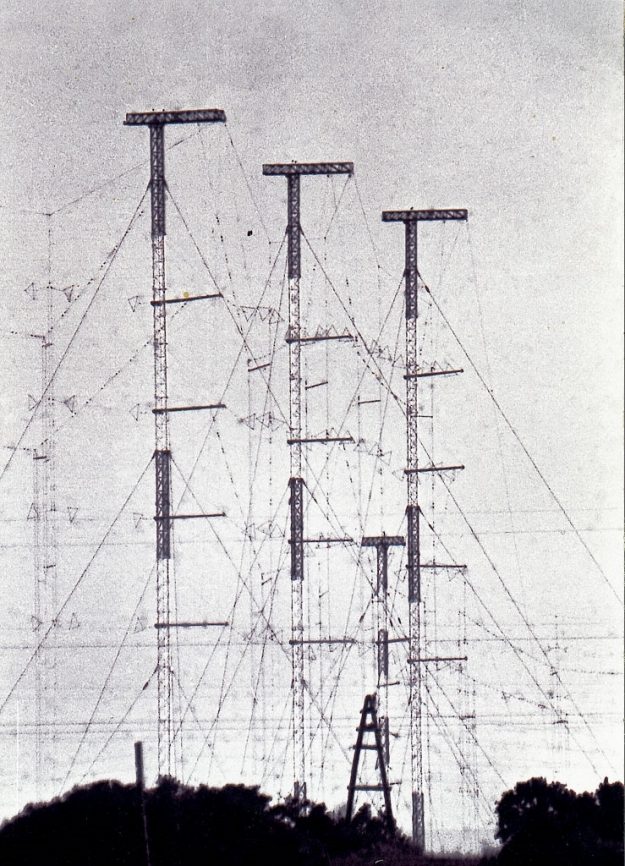
The first feature article, written by none other than Dave Porter, focuses on the development of HF broadcast antennas. His article serves as an excellent primer on the topic, covering Rhombic Antennas, Corner Quadrant Antennas, Log-Periodic Arrays and ALLISS /Rigid Curtain Arrays. A must-read for those who want to know more about the “business side” of a broadcast signal!

Hans Johnson’s feature, Sea Breeze and Wind from Japan, explores the story behind the broadcasts to Japanese citizens abducted by North Korea. Truly, an inspiring story of a determined and mission-dedicated broadcasters.

The following feature article was written by WRTH contributor and chief editor of the New Zealand DX Times, Stu Forsyth, who outlines the history of broadcasting from New Caledonia in the Pacific.

The next feature article focuses on the “finer points” of mediumwave propagation. I thought this was an informative and and timely article as so many shortwave DXers (including yours truly) spend time on the mediumwave bands especially during winter and times of rough HF propagation. A must-read!
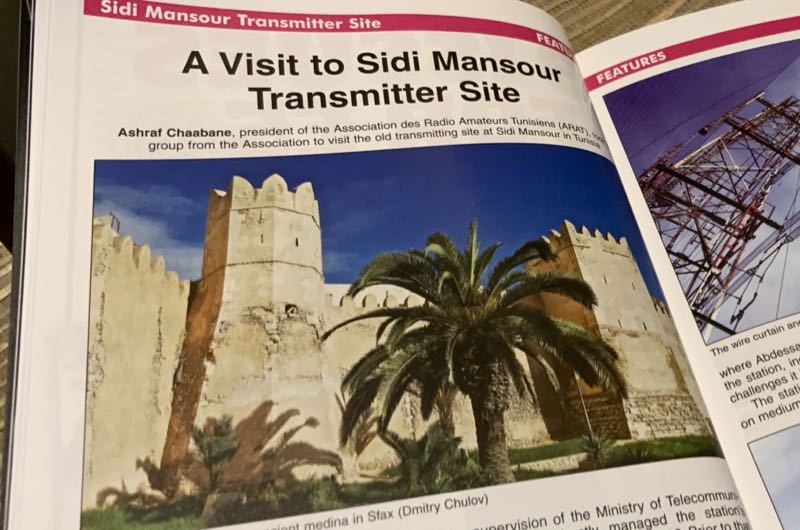
Ashraf Chaaban, president of the Association des Radio Amateurs Tunisiens, takes WRTH readers with him on a visit to the Sidi Manson Transmitter Site in Tunisia in the final feature article. Having an affinity for broadcast sites, I sincerely enjoyed the focus on Sidi Manson which fell silent on shortwave in 2014.

Next, WRTH spotlight the annual Digital Update which summarizes the dynamic state of digital broadcasting. I’ve found this feature to be incredibly informative as we see how digital broadcasting is penetrating both domestic and international services.

The final article–a tradition–is the WRTH  HF propagation report/forecast by Ulf-Peter Hoppe. Always an informative read especially as we work our way out of a log-term solar slump.

The 74th is another fantastic edition of the World Radio TV Handbook. As I say every year, I’ve never been disappointed with WRTH. Their publishing standards are such that the quality of their reviews, their writing, and (most importantly) their broadcast listings are simply unparalleled.

At the heart of any WRTH is an uncompromising and unparalleled amount of information regarding regional and international broadcasting.

For DXers who collect QSL cards, you’ll find that broadcaster contact information in WRTH is often more up-to-date than a broadcaster’s own website. When readers contact me asking for QSL information from an obscure broadcaster, the first place I search is the current WRTH. Remember: their information is based on volunteer contributors who specialize in specific regions of the world–the most knowledgeable regional DXers keep this publication accurate.
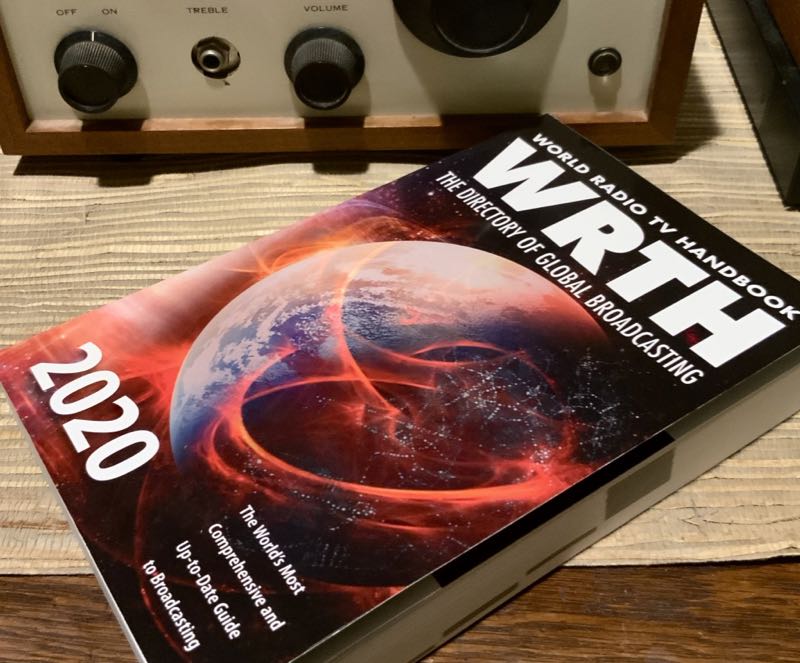
Purchase your copy of WRTH 2020 directly from WRTH’s publishers, or from a distributor like Universal Radio (US) , Amazon.com (US),  or the Book Depository (international).

RRI’s Personality of the Year 2019

Many thanks to SWLing Post contributor, David Iurescia (LW4DAF), who shares the following announcement from Radio Romania International:

Dear friends, RRI continues its traditional polling of listeners on short wave, the Internet and social media, with a new challenge that, we hope, you will find interesting.

We would like to ask you which person you think left their imprint on the world in a positive way in 2019. We are preparing to designate, based on your options, “The Personality of the Year 2019 on RRI”. Will this person be a politician, an opinion leader, a businessman, an athlete, an artist, a scientist, or even a regular person with a special story? It’s up to you! We would also want to ask you why you picked that particular person.

You can send your answers, as usual, by commenting on our website, at rri.ro, by e-mail at [email protected], on our Facebook, Google+, Twitter and LinkedIn profiles, on WhatsApp at +40744312650, by fax at 00.40.21.319.05.62, or by post, at 60-64, General Berthelot Street, sector 1, Bucharest, area code 010165 (PO Box 111), Romania.

We recall that:

The “Personality of the year 2018 on RRI” was the German Chancellor Angela Merkel.

The “Personality of the year 2017 on RRI” was the Romanian tennis player Simona Halep, former no.1 in the WTA rankings and the “Personality of the year 2016 on RRI” was the American president Donald Trump.

The Personality of the year 2019 on RRI will be announced on January 1st, 2020.

Click here to read at the RRI website.

Autumn 2019 issue of the BBC Monitoring magazine now available

(Source: Southgate ARC)

The Autumn 2019 edition of the BBC Monitoring’s magazine Monitor is now available on the web

BBC Monitoring provides news and information from freely available media sources around the world. Our round-the-clock monitoring of TV, radio, press, internet and news agencies is provided to the BBC and a range of customers – commercial clients, including media organizations, foreign governments, NGOs and universities, and the UK government.

BBC Monitoring is funded by the licence fee and is part of the BBC World Service Group.

You can read copies of Monitor magazine at
https://issuu.com/bbcmonitoring

BBC Monitoring
https://monitoring.bbc.co.uk/

Click here to view this post at the Southgate ARC website.

Short film about RIAS (Rundfunk im amerikanischen Sektor)

Many thanks to SWLing Post contributor, Gerhart, who shares links to this short 1994 film, produced by Deutsche Welle TV, about the West Berlin radio station, RIAS:

Part 1:

Part 2:

I’m curious if any SWLing Post readers ever listened to or logged RIAS while living or travelling in West/East Berlin during the Cold War years. Please comment!

New Zealand gov’t might replace RNZ & TVNZ with new public broadcaster

(Source: Radio New Zealand)

The fate of RNZ and TVNZ may soon be in the hands of Cabinet ministers, with a proposal to disestablish both broadcasters and create an entirely new public media entity.

The coalition government has been grappling with what to do with public broadcasting in New Zealand, and now there’s a greater sense of urgency with the media industry under real financial threat.

Labour campaigned on RNZ+ with annual funding of $38 million in 2017, but that was canned after the resignation of Clare Curran as Broadcasting Minister.

The portfolio was handed to Kris Faafoi, who has signalled a different approach to public broadcasting.

An advisory group, with representatives from both media companies and a range of public service agencies, was set up to look at future funding options.

RNZ understands there were three options: merge the RNZ and TVNZ newsrooms, put more money into New Zealand On Air, or the third, preferred option now heading for Cabinet – most likely in early December.

The advisory group concluded the status quo was “unsustainable” and “collectively recommended the government agree to disestablish TVNZ and RNZ and to establish a new public media entity”.[…]

Click here to read the full article at Radio New Zealand.

EU vehicle digital radio legislation

Photo by Philipp Katzenberger

Many thanks to SWLing Post contributor, Mangosman, who shares the following:

The European Union as asking its member states to legislate the following, which Germany has just done today.

EU Vehicle Directive

This directive requires all new car radios sold in the European Union to be capable of receiving digital terrestrial radio, in addition to any FM or AM functionality which manufacturers may want to include. The code also grants EU member states the power to introduce rules requiring consumer radios to include digital capability.

Following its adoption by the European Council, the directive was published in the Official Journal of the European Union (OJEU) and came into force on Dec 20 last year. For the automotive industry, the key section of the European Electronic Communications Code is Article 113, XI:

“Any car radio receiver integrated in a new vehicle of category M which is made available on the market for sale or rent in the Union from … [two years after the date of entry into force of this Directive] shall comprise a receiver capable of receiving and reproducing at least radio services provided via digital terrestrial radio broadcasting. Receivers which are in accordance with harmonized standards the references of which have been published in the Official Journal of the European Union or with parts thereof shall be considered to comply with that requirement covered by those standards or parts thereof.”

The policy commences 21st December 2020 and applies to any vehicle with 4 or more wheels. It does not apply to amateur radio equipment. The radio must be able to display the broadcasters’ name.

Note the way the type of receiver is phrased is digital terrestrial radio, it does not specify what type. It obviously applies to DAB+ because there are many DAB+ transmitters in Europe, but could also apply to DRM. With the advent of Software defined receivers, it is easy to have both standards. This would then open they way for high frequency (short wave) DRM in most vehicle radios. Remember that there are now 1.5 million factory installed DRM car radios in India which has been achieved in 18 months.

This decision will open the way for all new radios to include DAB+/DRM in all markets except the USA/Mexico.

Thank you for sharing this!

Australia: “Whispering to the Asia-Pacific”

(Source: Australian Strategic Policy Institute via William Lee)

Australia gropes and stutters towards a renewed embrace of international broadcasting—the vital need to ‘speak for ourselves’ in the Asia–Pacific.

The latest lurch towards fresh understanding is the silent release of the review of Australia’s media reach in the Asia–Pacific. Note the irony that a report on broadcasting is soundless on arrival.

Behold a classic orphan inquiry, not wanted by either the government or the Australian Broadcasting Corporation, nor particularly desired by the public service. The orphan was created as part of the price to win a Senate vote, and is dumped on the public doorstep without a word of welcome.

The review was completed last December but only released (published on the Department of Communications website) on 17 October. No announcement. No government decisions.

The inquiry matters because it nods towards significant policy failure and the absent-minded trashing of Oz international broadcasting.[…]

Click here to continue reading the full article.