Category Archives: Broadcasters

Radio Caroline to broadcast on 648 kHz mediumwave

(Source: Southgate ARC and Mike Terry)

Caroline to be on 648 kHz with 1 kW ERP

We can now announce that our AM frequency will be 648 kHz with a power of 1000 watts. This is ERP or simply the power radiated by the aerial.

A transmitter was imported from the Continent a few days ago and is now being modified to suit the frequency. There are further hurdles, but as you can see progress is being made.
http://www.radiocaroline.co.uk/#home.html

It’s taken Radio Caroline 53 years to get an AM licence and it was perceived as a threat to the BBC for many years.

Ironically 648 kHz was best known for transmitting the BBC World Service in English around the clock on 648 kHz from September 1982 until March 2011 from the Orfordness transmitting station on the Suffolk coast.

Update on the future of Radio Bulgaria’s online broadcasts

Many thanks to SWLing Post contributor, David Iurescia (LW4DAF), who provides the following update regarding the closure of several Radio Bulgaria language services:

http://bnr.bg/en/post/100837500/to-terminate-radio-bulgaria-or-not-the-jury-is-still-out

The Bulgarian National Radio`s Horizont Channel aired an interview, live, with BNR Director General Alexander Velev and the chair of Radio Bulgaria`s editorial staff panel Daniela Konstantinova on the plans by the BNR management to close down Radio Bulgaria.

Alexander Velev stated there was a little interest in the content offered by Radio Bulgaria, adding there was need to vacate posts for new appointments at the BNR. Daniela Konstantinova on her part expressed concerns that by closing down Radio Bulgaria, the BNR will be deprived of the unique advantage it now has as an institution of presenting a balanced picture of the country abroad.

She added she disagreed there was little interest in Radio Bulgaria, adducing examples of Radio Bulgaria content being extensively republished by other websites, where it generates a great many views, and shared in the social media. Asked whether he was inclined to reconsider the intention of terminating Radio Bulgaria, the BNR Director General stated that you cannot go against reality. Konstantinova said she expected the president, parliament and other institutions, addressed by the Radio Bulgaria staff in connection with the planned closure, to take note of their arguments. In conclusion, the Horizont radio host Tanya Velichkova stated she expected the debate to remain open.

The Open letter by the Radio Bulgaria editorial staff panel is available online on the website of the Union of Bulgarian Journalists.

Radio Bulgaria to stop online broadcasts

Many thanks to SWLing Post contributor, David Iurescia (LW4DAF), who writes:

Today the listeners of the Spanish service of Radio Bulgaria found a sad new in the website:

http://bnr.bg/es/post/100837204

After the cessation of Radio Bulgaria short-wave broadcasts in 2012, the time has come when our programs will no longer be heard on the web. As of June 1, 2017, by decision of the Bulgarian National Radio Directive, of which Radio Bulgaria is part, the voice of this station will be extinguished. However, they will be able to continue reading our articles and to know the news about the happening in this country in our web site during a couple of months more.

For us journalists from Radio Bulgaria, programs abroad have meant much more than conventional notions about radio journalism, since it has been our mission, our link with the world, our relationship with foreigners eager to know more about the History, culture and traditions of Bulgaria.

Thank you for having been with us for all these years.

Please try to write to the radio and authorities for supporting to RB.
Yours from Argentina

Many thanks for passing along this news, David.

This reminds me of the final broadcast of Radio Bulgaria which I recorded over five years ago. Hard to believe it was that long ago:

Final Transmission of Radio Bulgaria

“Shifting away from shortwave”: Significant reductions for BBG under FY 2018 budget

Edward R. Murrow Transmission Site near Greenville, North Carolina

(Source: BBG Press Release via Dan Robinson)

FY 2018 budget request reflects key BBG priorities amid spending constraints

WASHINGTON, D.C. — The Broadcasting Board of Governors today released the FY 2018 budget request to support key U.S. foreign policy goals by providing news and information around the world while accommodating the current tight fiscal climate.

“As is true throughout the federal government, the budgetary environment requires that we prioritize our resources while emphasizing impact and maintaining the level of excellence our audiences have come to expect,” said CEO John F. Lansing. “Despite reductions in spending, we are committed to our mission, impacting the lives of hundreds of millions of people around the world by providing accurate, unbiased, and uncensored news and information.”

The tight fiscal environment necessitates BBG to improve operational efficiencies and make difficult resource trade-offs to effectively meet performance goals and support U.S. foreign policy priorities.

The $685.1 million budget request includes transmission, program and staffing reductions across all BBG networks—the Voice of America, Radio Free Europe/Radio Liberty, the Office of Cuba Broadcasting, Radio Free Asia, and the Middle East Broadcasting Networks—and the International Broadcasting Bureau, including the Office of Technology, Services and Innovation. This includes reducing, and in some cases, eliminating certain language service capacities; shifting away from shortwave transmissions where they have the least impact; and optimizing information technology.

Although the funding request represents a 12.9 percent reduction from the FY 2017 enacted budget, it prioritizes funding for U.S. foreign policy goals, including combatting violent extremism, countering Russian disinformation, and enhancing programming for North Korean audiences. It also capitalizes on the momentum gained from the streamlining of operations in 2016 and the aggressive shift to digital already underway at each of the five networks.

The request includes $680.4 million for International Broadcasting Operations, including Federal and non-Federal networks, as well as $4.7 million for Broadcasting Capital Improvements.

The FY 2018 budget request contains proposals to continue the agency’s responsive shift to the most effective media platforms, respond readily to crises, keep pace with shifts in audience demographics and interests, and sharpen strategy and results measurement to drive performance.

BBG’s extensive network of seasoned, professional and well-connected journalists is particularly strong in regions where ISIS, Russia, Iran, China and other global actors that do not share American values are attempting to make further inroads.

“Should Congress enact this budget, there is no doubt that staff reductions would be difficult,” Lansing said. “We will do everything possible to minimize the effect on our employees by emphasizing attrition, early retirement opportunities, and agency buyouts for federal employees wherever possible. Our staff and journalists are the core of what drives our impact around the world. We will do everything we can to safeguard our greatest asset.”


RAE Argentina to the World now in more languages via WRMI

Many thanks to SWLing Post contributor, Adrian Korol, of RAE Argentina to the World, who shares the following news:

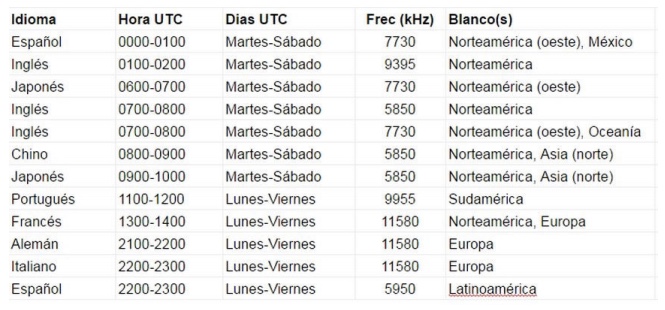
We are happy to announce that RAE Argentina to the World will broadcast on shortwaves in its 8 languages starting May 22nd.

Click here for PDF Schedule (in Spanish today)

Thanks for your attention.

Regards

Adrian Korol

Many thanks, Adrian. It’s been great to hear RAE on the shortwaves again! Thanks for keeping us updated!

ACMA report on radio listening in remote Western Australia

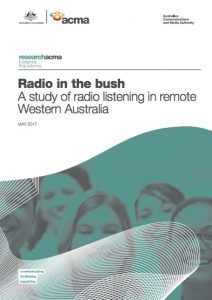
Image: ACMA

Many thanks to SWLing Post contributor, Phil Brennan (VK8VWA), who shares the following:

I spotted this bit of research from the Australian Communications and Media Authority regarding radio listening habits of people living in remote Western Australia.

Click here to download report (PDF).

It shows that radio very much remains a big part of people’s lives in the bush, particularly AM radio. I’m sure these findings would be replicated in the Northern Territory where I live, but as you are only too aware, we’ve had our remote SW radio service axed by the ABC. Anyway, it may be of interest to you and your readers.

Thank you for the tip, Phil.  This is a pretty fascinating report. As you mention, the use of AM radio is quite heavy–no doubt due to the vast broadcast footprint. It’s this sort of report that should have been done prior to any decision about axing ABC’s NT shortwave service.