Category Archives: Ham Radio

Universal Radio is moving

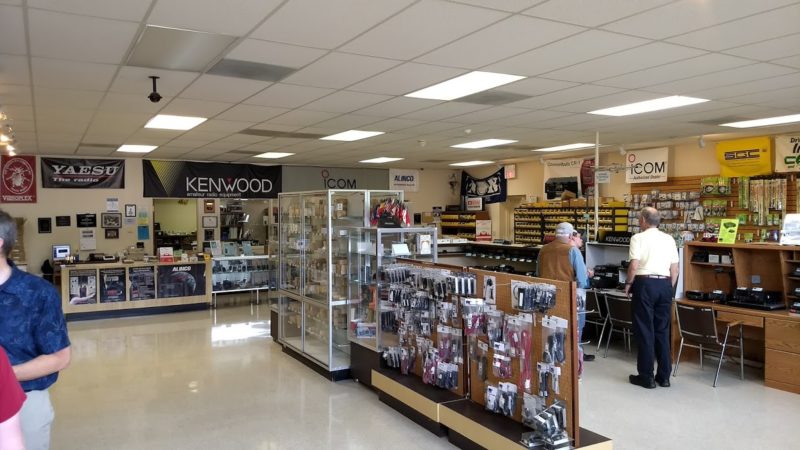
Universal Radio’s showroom at the current Reynoldsburg location.

(Source: Universal Radio via Dave Zantow)

Universal Radio Is Moving

In the coming months Universal Radio will move its operations to a more efficient location here in the Columbus, Ohio area where we can continue to serve our loyal customers.

This will be the fourth location change since Universal was founded in 1942.

We look forward to many more years of serving the amateur and short wave communities which Universal Radio has done for 75 years.

The new location (below) is a 30 minute drive from the current location.

Universal Radio Inc.
651-B Lakeview Plaza Blvd.
Worthington, OH 43085

Moving date: Mid-October, 2017

EclipseMob’s August 21 experiment

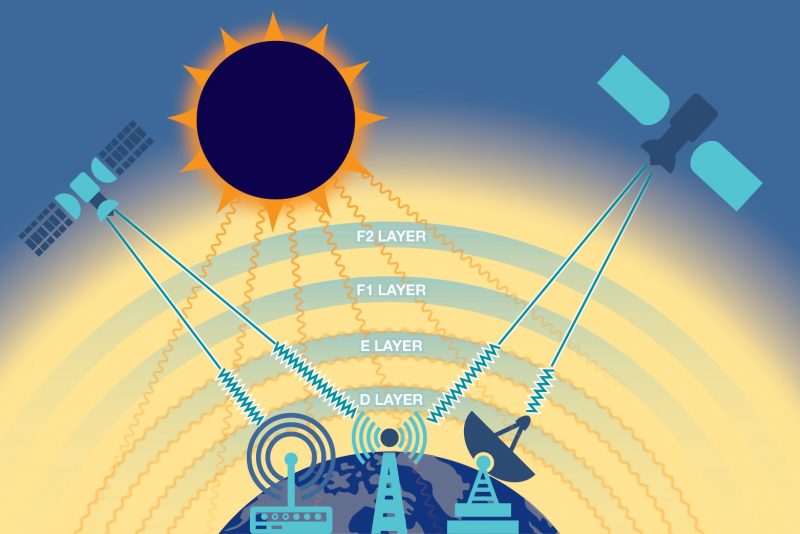
(Image: EclipseMob)

(Source: The Washington Post)

On Aug. 21, as the moon passes in front of the sun and casts a shadow across the United States, millions are expected to gaze at the totality. Meanwhile, a smaller crowd will be glued to 150 custom-made radio receivers set up across the country.

The project, called EclipseMob, is the largest experiment of its kind in history. By recording changes in the radio signal, these citizen scientists will collect data on the ionosphere — the region of the atmosphere where, miles above Earth’s surface, cosmic and solar radiation bumps electrons free from atoms and molecules. It plays a crucial role in some forms of long-distance communication: Like rocks skipped across a pond, radio waves can bounce along the top of the ionosphere to travel farther around the globe. But signals passing through the ionosphere sometimes behave in unpredictable ways, and scientists still have a lot of questions about its properties and behavior.

“Any solar eclipse is a good opportunity to study the ionosphere,” said Jill K. Nelson, an expert in signal processing at George Mason University in Virginia. The level of ions in the ionosphere fluctuates from day to night, decreasing in the absence of sunlight. But this change happens gradually during normal sunrises and sunsets. The sudden light-to-dark switch as it occurs during the eclipse, then, is an opportune moment to observe this layer of the atmosphere.

Continue reading at The Washington Post…

Many thanks for the tip, Ed!

Solar Eclipse 2017: In the path of totality

A portion of the PARI campus

Tomorrow, we will be experiencing a total solar eclipse here in the mountains of western North Carolina.

Instead of enjoying the eclipse at home, I will be volunteering as a docent at the Pisgah Astronomical Research Institute in Rosman, North Carolina. Post readers might recall PARI as it was the location of our 2015 PARI DXpedition.
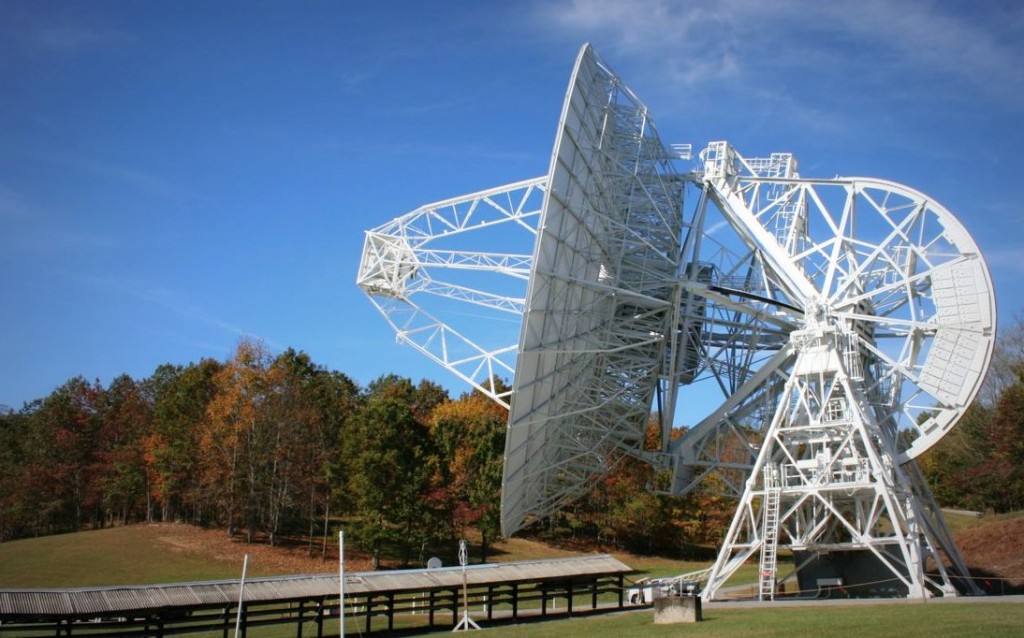
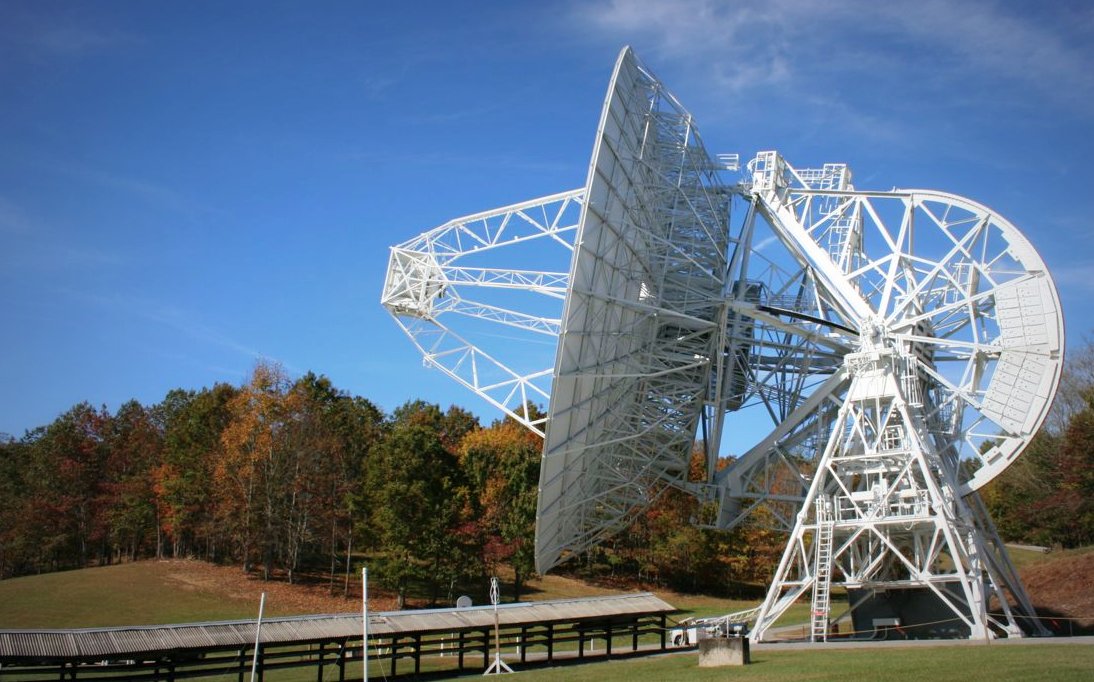
One of PARI’s 26 meter radio telescopes.

PARI is expecting at least 1,000 visitors tomorrow, from a number of countries. Many are scientists, astronomers, and guests who want to be in the path of totality.

On the PARI campus, we will be in totality for about 1 minutes, 47 seconds.

What makes the event truly special for PARI is that this is the first time in history a world-class radio astronomy observatory has been in the path of totality. To say the PARI astronomers are excited is simply an understatement. All four of PARI’s telescopes will be trained on our local star and gathering copious amounts of data.

If you don’t live in the path of the Eclipse, I invite you to check out PARI’s YouTube channel where they will host a live stream:

Click here to watch on YouTube.

Gathering spectrum
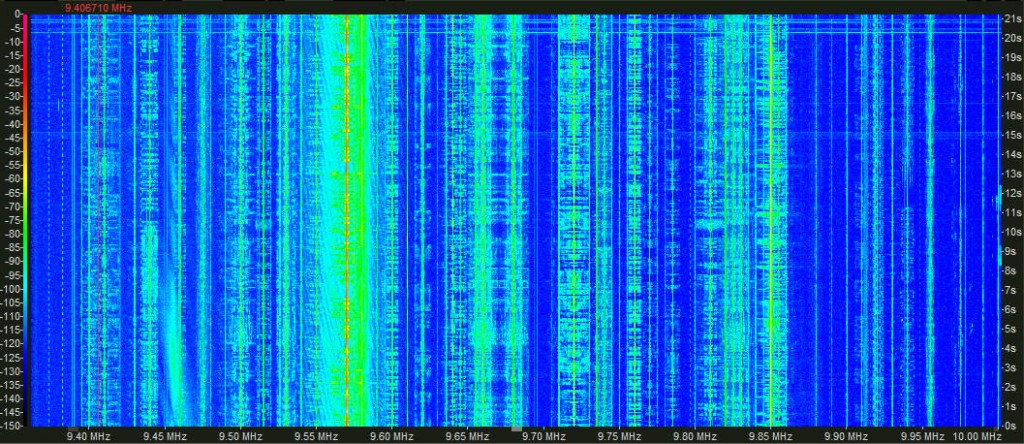
I will also be gathering data of my own during the event.

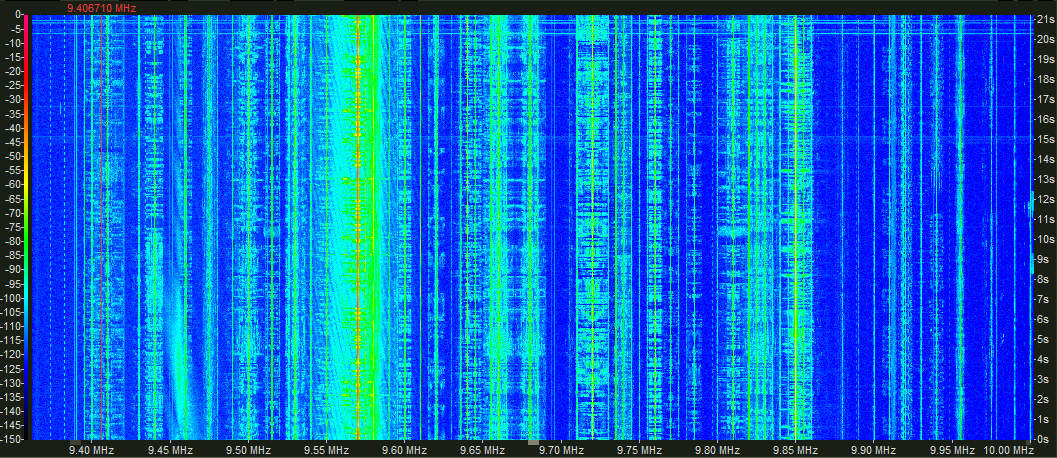
I will remotely record the entire mediumwave (AM broadcast) band several hours before, during and after the eclipse. I will also set up a separate SDR to record either the 31/30 meter bands and my buddy, Vlado (N3CZ) is kindly using his SDRplay RSP1 to record from 6 MHz – 8 MHz.

What do I expect to see/hear in the spectrum recordings? Certainly a drop in noise. If I’m lucky, I also hope to hear some DX anomalies–hopefully a signal or two that I wouldn’t normally here in the middle of a summer day.

I don’t expect any dramatic results (though I would love to be proven otherwise!) since the ionosphere takes time to change states. My buddy Mike (K8RAT) likens it to an oven: it takes time for it to heat up to the desired temperature, and it takes time for it to cool down as well. I’m not so sure the shadow of the moon, which moves at a good clip, will be persistent enough to change the state of the ionosphere in any meaningful way.

If it does, I’ll be there to record it!

There are many other radio related experiments happening during the solar eclipse. A notable one that you can even help with is the 2017 Ham Radio Eclipse Experiment.

SWLing Post contributor, Dan Srebnick also suggests a few stations you might try catching on the AM broadcast band. Dan notes:

Something to do during the solar eclipse on Monday. There are 13 clear channel AM stations along the path of totality. Give a listen for them:
[LIST OF AM CLEAR CHANNEL STATIONS]
kHz CALL Location Eclipse UTC
—— ——- —————- ————–
650 WSM Nashville, TN 18:28
670 KBOI Boise, ID 17:27
750 WSB Atlanta, GA 18:36
840 WHAS Louisville, KY 18:27
880 KRVN Lexington, NE 17:57
1030 KTWO Casper, WY 17:43
1040 WHO DesMoines, IA 18:08
1110 KFAB Omaha, NE 18:04
1110 WBT Charlotte, NC 18:41
1120 KPNW Eugene, OR 17:17
1120 KMOX St. Louis, MO 18:18
1190 KEX Portland, OR 17:19
1510 WLAC Nashville, TN 18:28

Kudos to Bob WB4APR (of APRS fame) for producing this list.

Post readers: Will you be in the path of totality or do you plan to enjoy a partial eclipse? Have you ever experienced a total solar eclipse?  What are your plans if any? Please comment!

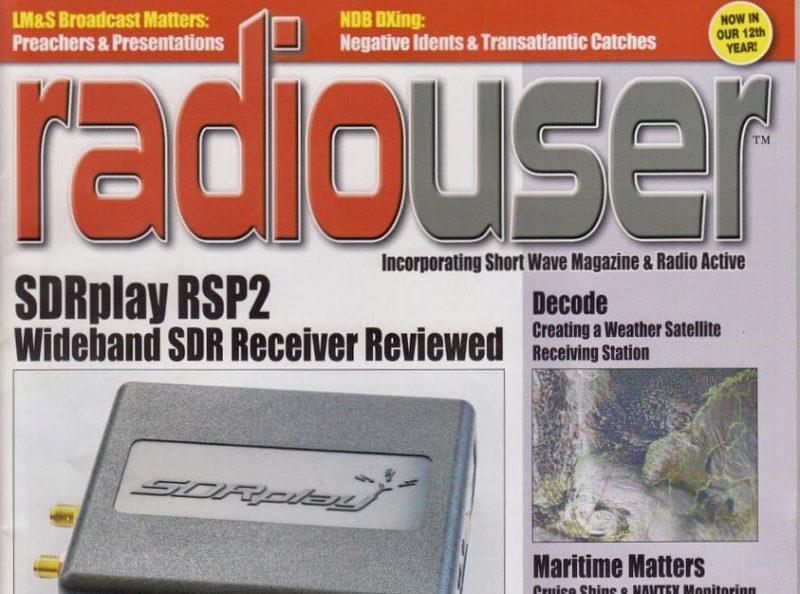
Practical Wireless and RadioUser magazines have new owner

(Source: Southgate ARC)

New owner for Practical Wireless and RadioUser magazines

Roger Hall & Steve Hunt have made the following announcement on the PW Publishing website:

We are very pleased to announce that Practical Wireless and RadioUsermagazines have been bought by Warners Group Publications, a Lincolnshire-based multi-million-pound turnover publishing company that specialises in producing magazines, websites and events for niche hobbies. 

They believe that both Practical Wireless and RadioUser are an ideal fit with their business and have assured us they plan to use their publishing expertise and size to help develop both titles, giving them an assured long-term future.

Both Steve and I are aware that we were only the most recent custodians of two historic titles, Practical Wireless dating from 1932 and the RadioUser with its roots in Short Wave Magazine from 1937.
That’s why, when we decided to retire after being in publishing for almost 40 years, first with IPC and then with PW Publishing, 
we felt it was important to find a reputable company with the expertise and resources to make sure they will continue to be published for many years to come. In Warners, we believe we have found just such a company and both PW and RU will continue to be the country’s best-selling radio magazines

Over the next few weeks we will be handing over all aspect of our business to Warners and they will be publishing both titles from the October issues onwards.

The new Publisher will be Rob McDonnell ([email protected]) and the new Group Advertising Manager will be Claire Ingram ([email protected])

Our existing Editors, Don Field and Georg Wiessala, will remain with their respective magazines. In addition, I will be staying on in a consultancy role to help with the transition and to assist Warners going forwards.

We’d both like to thank all of you for the support you’ve given us and the magazines in the past; it’s been an interesting few decades.

For the next three months, Webscribe will continue to administer subscriptions, to assure a seamless handover, and new contact details will be forthcoming in due course.

Roger Hall & Steve Hunt
PW Publishing Limited
http://www.pwpublishing.ltd.uk

Reminder: 2017 Eclipse Experiment

A map of the United States showing the path of totality for the August 21, 2017 total solar eclipse. (Source: NASA)

The 2017 eclipse is quickly approaching (August 21)–!!

If you would like to participate in a fascinating radio experiment coinciding with the event, check out this undertaking outlined on the website HamSCI. Note that you do not need to be in the path of totality in order to participate.

Here’s the summary:

On 21 August 2017, a total solar eclipse will traverse the continental United States from Oregon to South Carolina in a period of just over 90 minutes.

Previous research shows that the shadow of the eclipse will impact the ionospheric state, but has not adequately characterized or explained the temporal and spatial extent of the resulting ionospheric effects.

HamSCI is inviting the amateur radio community to contribute to a large scale experiment by participating in an Eclipse QSO party and further developing automatic observation networks such as the Reverse Beacon Network.

Data resulting from these activities will be combined with observations from existing ionospheric monitoring networks in an effort to characterize and understand the ionospheric temporal and spatial effects caused by a total solar eclipse.

Click here to read the full detailed experiment at HamSCI online.

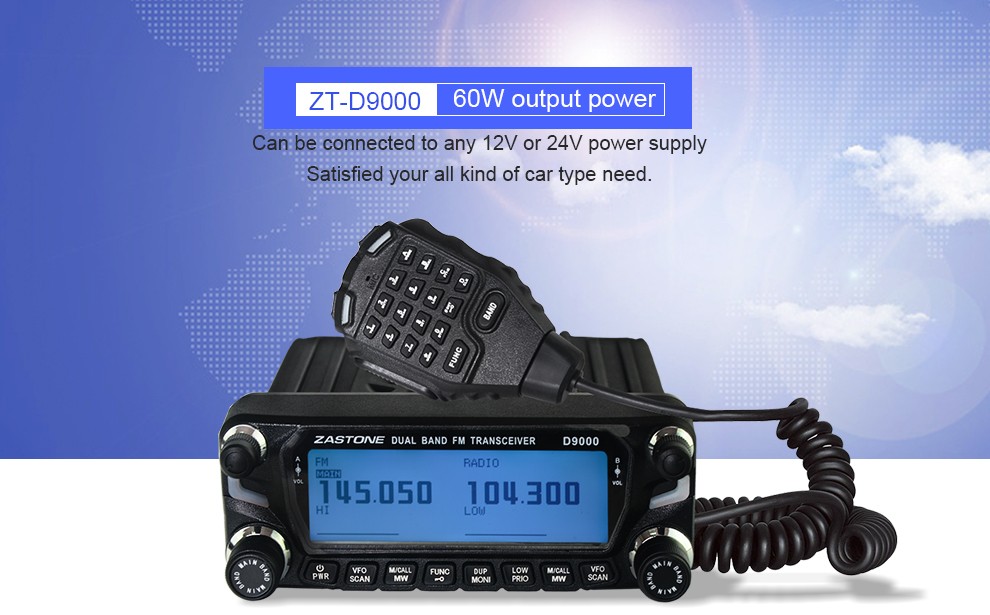
The Zastone ZT-D9000 dual band mobile includes HF and LW coverage

Many thanks to SWLing Post contributor, Cap Tux, who writes:

The Zastone ZT-D9000 radio has actually been out for a while and is a Dual Band Mobile (Triband with option), nothing fancy there and bears a striking resemblance to the Icom IC-2820H (clone?). Options include GPS, Bluetooth, 220Mhz and LW (The latter is really weird!).

What caught my eye is the 2.3-30 MHz Shortwave coverage, a quick search on YouTube turns up a video showing Shortwave working!

Yes, probably as wide as a barn door with no filtering except the 12kHz default but an extremely useful feature if you did need a dual band mobile in your jeep/car.

Two other noteworthy features are a dedicated RX BNC antenna socket and a built in FM Transmitter so you can listen to it on the FM Radio in your car/jeep, very cool. A bit like a pimped IC-2820H. Also has all the bells and whistles a Dual Bander should have,

This is the OEM site:
http://zastonetech.com/2-7-mobile-transceiver/291931

This site has the spec:
http://radioaficion.com/cms/zastone-d9000/

YouTube video showing Shortwave in use:

Click here to view on YouTube.

Click here for eBay UK.

Click here for eBay US.

Some Specs:

A/B Band RX:
136-174MHz
200-260MHz (OPTION)
400-470MHz
470-520MHz

B Band RX:
153-279kHz (AM) (OPTION)
0.5MHz-1.8MHz (AM)
2.3-30MHz (AM)
64-108MHz (WFM)
113-137MHz (Airband – AM)

TX:
136MHz-174MHz
222-225MHz (Type USA 200-260MHz) (OPTION)
400-520MHz

Channel Steps: 1.5, 6, 6.25, 10, 12.5, 15, 20, 25, 50, 100kHz
Frequency Stability: +-2.5ppm
Repeater Shift: +-600kHz(144MHz), +-5MHz (430MHz)
Emission Type: F1D, F2D, F3E
Antenna Impedance: 50 ohms
Supply Voltage: Nominal: 13.8VDC, Neg Gnd, Operating: 12-24V Neg Gnd
Operating Temp: -40F to +-1400F(-20C to +-60C)
RF power Output: UHF: 40W/25W/5W VHF:50W/25W/5W
Case Size: (WxHxD) 6″ x 2.3″ x 1.3″ (Panel w/o knobs and connectors)
6″x6″x 1.8″ (Rear chassis w/o connectors)
Weight: 3.7 lbs

Transmitter:
RF Power Output: UHF: 40W/25W/5W, VHF: 50W/25W/5W
Modulation Type: Variable Reactance F1 D, F2D, F3E
Maximum Deviation: +- 5KHz
Spurious Emission: at least 60 dB below
Microphone Impedance: 2 k ohms

Receiver:
Sensitivity Radio Band:
B Band:
5uV TYP for 10db SN (153-279 KHz, AM)
5UV TYP for 10 db SN (0.5-1.7 MHz, AM)
2uV TYP for 10db SN (203-30 MHz, AM)
2Uv TYP for 12db SINAD (64-108 MHz, WFM)
0.8 uV TYP for 10 db SN 9113-134 MHz, AM)

A&B Band:
0.2 uV for 12db SINAD (136-174 MHz, FM)
0.2 uV TYP for 12db SINAD (200-260 MHz, FM)
0.2 uV for 12 db SINAD (400-470 MHz, FM)
0.2 uV TYP for 12 db SINAD (470-520 MHz, FM)
Squelch Sensitivity: 0.16 uV (144/430 MHz Band)
Selectivity: NFM, AM 12 KHz/30KHz(-6dB/-60dB)

AF Output:
6W@4 ohm for 10% THD (@13.8V) EXP SP
3W@ 8 ohm for 10% THD (@13.8V) Normal EXP SP/CH
AF Output Impedance: 4-16 ohm
3 Speakers

Included in Purchase:
– Radio
– Microphone
– Power Cables
– Remote Install Kit
– Software CD
– Programming Cable
– All Mounting Hardware
– 1 Year Warranty

Options:
– Bluetooth
– GPS
– Barometric altimeter and thermometer
– 220MHz
– LW Band

Very interesting, Cap! Thank you for sharing.  Honestly, I have a very difficult time keeping up with the radio equipment being produced and sold out of China.

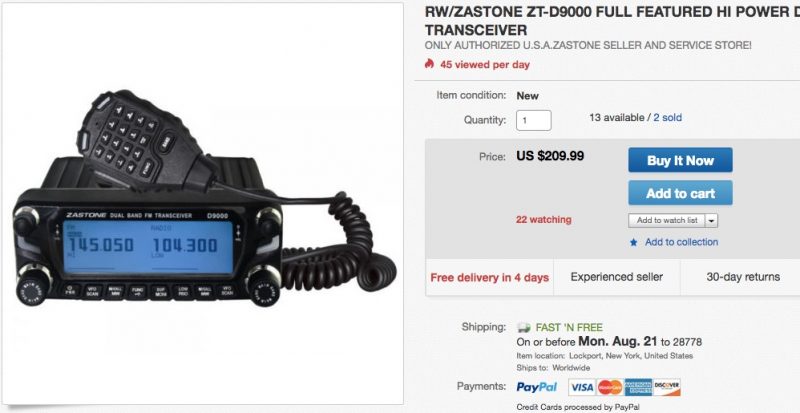
And you’re right: what a surprise to find HF coverage on a dual-band mobile radio and especially longwave coverage! Like you, I wouldn’t anticipate stellar performance. The price is certainly “bargain basement” at $210 US shipped.

SWLing Post readers: Has anyone purchased and tested the ZT-D9000?  Please comment!

Dan demonstrates the Cubic R-2411 receiver

Many thanks to SWLing Post contributor, Dan Robinson, who shares the following video where he demonstrate a recently-acquired Cubic R-2411V3/U commercial rack-mounted receiver:

Click here to view on YouTube.

Wow–and you found this beauty at a hamfest, Dan? What an incredible catch! Thanks for sharing.