Shortwave listening and everything radio including reviews, broadcasting, ham radio, field operation, DXing, maker kits, travel, emergency gear, events, and more
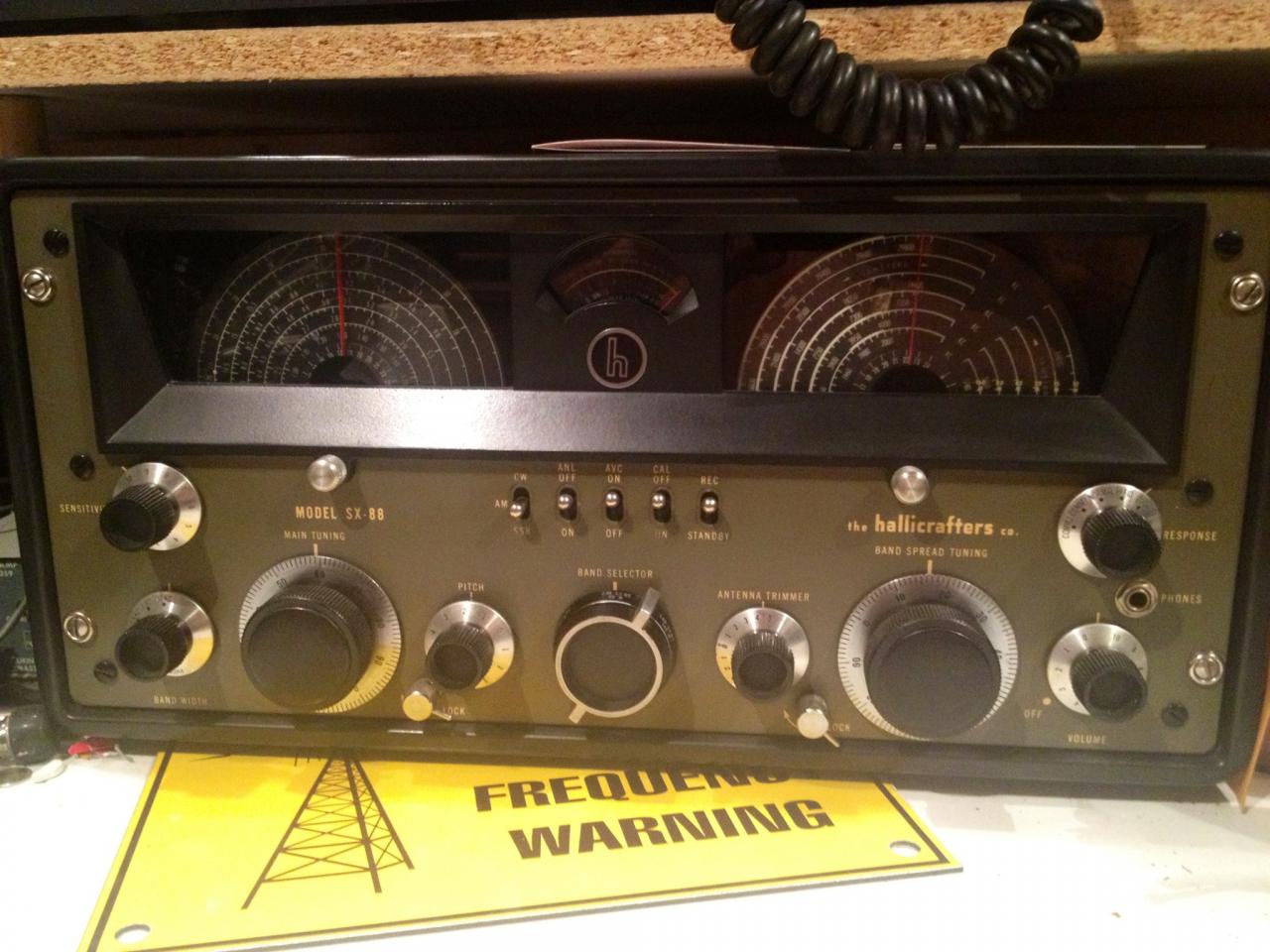
Hi [t]here, I have one SX88 in minty shape and is one of a handful that came in military green on [the] front panel for evaluation by the military. This is an exceptional radio in amazing condition. I can provide pics for someone who is seriously interested. I am open to a fair offer on radio. Please, no low-ballers. We all know what [it’s] worth…
“We all know what it’s worth“–?
Well, it just so happened that my good friend (and Elmer, or ham radio guru) Mike Hansgen (K8RAT) had recently provided me with a little history lesson on the subject of the SX-88, so I did know what this rig is worth: a great deal of money.
But curiosity got the best of me, so I contacted Jeremy (a nice fellow, by the way) and asked what he was expecting to receive in exchange for his Hallicrafters SX-88? Jeremy’s reply:
“…$5,500 USD will take it. It is a very rare unit; it was… only one of about 6 [painted green]…for presentation to the military for evaluation.
That price is firm. [I] will not negotiate downward, and shipping [from Ontario, Canada] is extra.”
Osterman’s wonderfully comprehensive guide mentions that the SX-88 is a “highly regarded, rare and collectible model.” As for the rarity of the SX-88, he describes it thus: “Extremely Scarce.” The used price range he gives is from $3,500-7,000 US.
After thanking Jeremy for his response, he replied:
“It’s a lot of money for a receiver for certain, but it is a fantastic shortwave receiver as the audio that comes out of it is amazing.
It has 10 watts of audio and into a big speaker–it is second to none. The fidelity is amazing and it is the king of its kind. [For those who like] tube rigs, it is the best of its kind.
For ham purposes on AM it is amazing, and on CW I find it incredible to use.
[W]hen they built this thing they intended to pull all [the] stops out and build the best radio they could for the day with the military in mind. It was an engineering marvel for the day.
Anyway, I have played with it for years now and need to thin out the herd.”
Impressive. And while I just don’t have that kind of money to fork out for a receiver, I did ask myself the question: “If I had $5,500 to blow, would I get that Hallicrafters SX-88?”
And my answer? Yes. In fact, I would personally drive to Jeremy’s home in Ontario and bring it back; no way I’d trust it to a parcel carrier or the post office…
Click to enlarge (Source: AntiqueRadio.org)
Come on, you may say. For a guy who rarely pays over $50 for a vintage receiver, how could you possibly justify that kind of financial and time commitment–?
Well, let’s think of it this way. I remember when when I paid well over two thousand for my first laptop in college. How much is it worth now? Maybe twenty dollars–?
Many people have retirement funds in investments, some of which are in a variety of innovative companies that they actually patronize–for example, Apple or Microsoft. But how often can you find an investment that you can actually play with? One which you can turn on, tune in, work the controls, and enjoy?
Yes, I’m sure this is just the sort of justification voiced by many a vintage car collector…So, why not for a museum-worthy radio? After all, they’re not making these anymore.
I expect this Halli will not only hold its value, but will probably increase in value over time.
Ah, well; fun to ponder. My question to you: Would you buy a $5,500 vintage receiver if you had it to spare?
If your answer is yes, and you do have the money, then you might want to contact Jeremy.
I’m very curious if there are any SX-88 owners among our readership? If so, please comment with your thoughts about the ’88!
And for the rest of us, just so we can revel in the vicarious pleasure of ownership, I’ve included some additional information about the Hallicrafters SX-88 below, including two videos.
[Update: Please note that this survey has been closed, but the audio samples–labeled Radio A and Radio B–will remain to allow others the opportunity to make an evaluation prior to reading the PL-680 review.]
The results from the PL-680/PL-660 reader surveys (here and here) have been pouring in! As of this posting, well over 200 readers have participated by listening to and evaluating the two receiver comparison surveys. Thank you!
Yesterday evening, I spent time comparing the Tecsun PL-660 and PL-680 with medium wave reception in mind. I recorded dozens of samples and picked four broadcast recordings I felt best represented receiver performance. Note that this will be my final survey before I post the PL-680 review later this week.
To participate in this survey, start by simply listening, then fill out the form that follows with your choice of “Best Radio” for each broadcast. All of these medium wave samples were recorded in the evening hours, which I believe is more indicative of receiver sensitivity, selectivity and AGC. Notice that I indicate distance to target station (as the crow flies).
Audio Samples
750 AM – WSB Atlanta, Georgia, USA (171 mi/275 km)
Below you’ll find a short video of my 1945 Scott Marine Radio Model SLR-M playing Tommy Dorsey and his Orchestra’s jazz-infused version of “March of the Toys” from Victor Herbert’s holiday classic “Babes in Toyland.”
It’s a little holiday time-travel I cooked up for you on this great vintage rig. I’m actually playing the song via an SStran Model AMT3000 AM transmitter I built from a kit (more on that in a future post). The transmitter has been set to 1410 kHz, to which the SLR-M is tuned.
Though the microphone on my Flip Video camera makes the sound in this little recording tinny (you’ll have to trust me that, live, it’s remarkably warm and rich), it does feel a bit like radio time-travel to hear a 1940s-era song played on a 1940s era-radio. This is just how WWII servicemen might have heard this music.
Check out this charming article about rediscovering radio by Anthony M. Castelletti in The Buffalo News:
“As a child in the 1960s, I enjoyed listening to distant radio stations, I suppose initially for no reason other than because they came from far away. It was a young boy’s hobby based on the accidental discovery of 1050 CHUM in Toronto. Remember, this was quite a feat for a one-transistor, pocket AM radio without an antenna that was the product of 1950s technology. I soon discovered that if I took that little radio outside, even more distant stations were right there on that dial.
Along with my beloved hometown Buffalo Bisons, I also became a fan of the Fort Wayne Komets hockey team, not due to any connection to Indiana, but rather due to my ability to listen to their games on WOWO-AM. This was soon followed by CKLW from Windsor, Ont., a rock ’n’ roll station as powerful as my hometown favorite KB 1520.
It took a couple of years of playing with that little radio for me to figure out that if I snuck outside and listened to the in-dash radio in my father’s Chevy, without starting the car and giving myself away of course, broadcasts from faraway places like New York City, Chicago and on rare occasions Florida, Georgia, Tennessee and other places I had never visited, were right there at my finger tips.
It also didn’t take long for my father to find out why the battery in his car had suddenly died. This was followed by a calmly delivered, yet lengthy and technically detailed lecture from my father, an electrician, on the effects of using a car battery without doing anything to charge said battery.”
I received my copy of the 2015 World Radio and TV Handbook (WRTH) directly from the publisher last week. As many SWLing Post readers know, I always look forward to receiving this staple radio reference guide each year. While other reference guides have dropped out of the scene, WRTH has remained strong and the publication’s quality has been wonderfully consistent. In fact, I noticed in the Editorial that this is 69th edition of WRTH: obviously, a publication with longevity.
WRTH’s team of noted DXers from around the world curate frequencies and broadcaster information by region; while I’m not sure how they orchestrate all of this, the end result is truly a symphony of radio information. In addition to broadcaster listings, WRTH’s radio reviews, feature articles, and annual HF report make for excellent reading.
But the WRTH isn’t just a frequency guide: the publication always devotes the first sixty or so pages to articles relating to various aspects of the radio hobby. Following, I offer a quick overview of these.
The first article always features a WRTH contributor (indeed, it’s this very network of contributors that make WRTH and its listings such a success): this year, Mauno Ritola tells us how he got interested in the hobby and what being a contributor means to him. Many of you will recognize Mauno’s name–he’s quite a prominent Finish SW and MW DXer (and a very nice fellow, as well).
The second set of articles is always my favorite: WRTH receiver reviews.
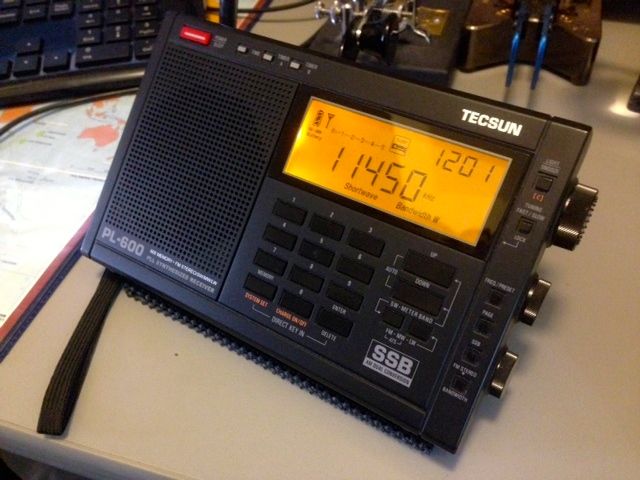
This year, WRTH reviewed the CommRadio CR-1a (un update of their very positive CR-1 review last year). They also review the Tecsun PL-600(above), the SDRplay software defined radio, the MFJ-1046 Preselector, and the Apache ANAN-10. The 2015 WRTH also has a special review section that features two HF noise and loop antennas: the AOR LA400 indoor loop and the Wellbrook ALA 1530S+ Imperium Loop (which wins the WRTH Award for Best Antenna). As I’ve come to expect from this publication, these are all great comprehensive reviews.
The SDRplay
The following article is “Wooferton: 70 Years on the Air,” written by Dave Porter, one time Senior Transmitter Engineer at the site. In a few pages, you’ll gather the technological history of the site, dating back to a rather bumpy start in WWII.
Following this, noted DXer and WRTH contributor, Max van Arhem, speaks to The Future of DXing. He proposes that with the decline of international broadcasting on the shortwaves, there is still much challenge in the hobby–especially by broadening DXing in the FM and medium wave bands. [Indeed, I’ve certainly seen an increase of questions about medium wave DXing here on the SWLing Post. I hope to cover more of these topics in 2015.]
Lord Howe Island
WRTH often features a snapshot of the radio scene in various parts of the world. This year, WRTH Contributor, David Foster, writes about his recent trip to remote Lord Howe Island and what he discovered about the radio landscape there. As a keen traveler myself, I found his article fascinating (Lord Howe Island is now on my travel list!).
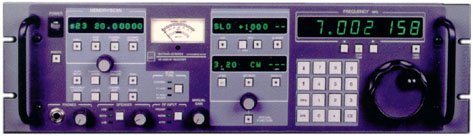
As a bonus, WRTH includes a feature/review of the benchmark Watkins-Johnson 8711A receiver. Not only does the article speak to the mechanics and virtues of the 8711A, but it also places this particular model within the context of the Watkins-Johnson legacy.
The final sections of articles are dedicated to the WRTH Digital Update and HF propagation report/forecast.
As expected, this is another great edition of the World Radio TV Handbook. As I’ve said many times, though I use online frequency databases fairly regularly, there is just no replacement for a good printed frequency guide–especially for all of my off-grid DXing.
For DXers who collect QSL cards, you’ll find that broadcaster contact information in WRTH is often more up-to-date than a broadcaster’s own website.
Not only does WRTH contain more in-depth information on broadcasters and schedules, but it makes for quick reference, and doesn’t require a computer or Internet connection–much like, well, your shortwave radio.
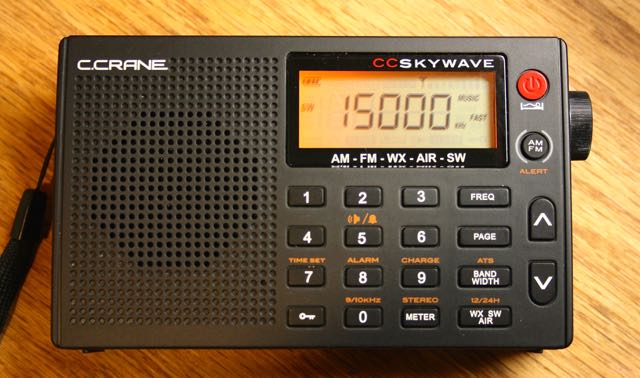
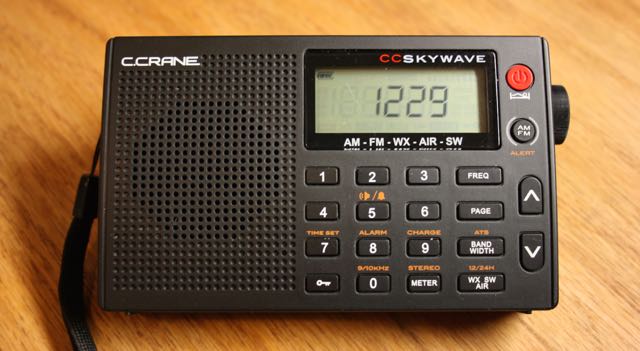
While electronics manufacturer C. Crane offers a number of unique AM/FM radios, including some of the best portable medium wave receivers on the market, they’ve traditionally only had two models of shortwave radio––namely, the CCRadio-SW, and the CCRadio-SWP. Earlier this year, however, C.Crane announced a new portable that would join their product line: the CC Skywave.
Admittedly, I was eager to give this little radio a go: C. Crane touts the Skywave as an exceptional travel radio, for which I’m always on the hunt. Last week, I had my opportunity when C. Crane sent me the new CC Skywave sample for review. I instantly got to work scrutinizing their newest offering…and here’s what I’ve discovered.
First impressions
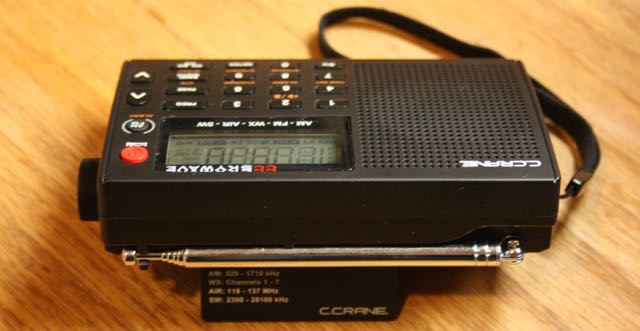
The form factor of the Skywave is very similar to C.Crane’s CCRadio-SWP pocket radio; in fact, its smooth plastic body even feels the same. While this radio doesn’t have the rubberized coating that have become popular on radio exteriors in recent years, supposedly to provide an easy-to-grip surface, I’m pleased that C.Crane does not use this, as these coatings can eventually deteriorate over time and with heat exposure, becoming somewhat tacky or sticky to the touch.
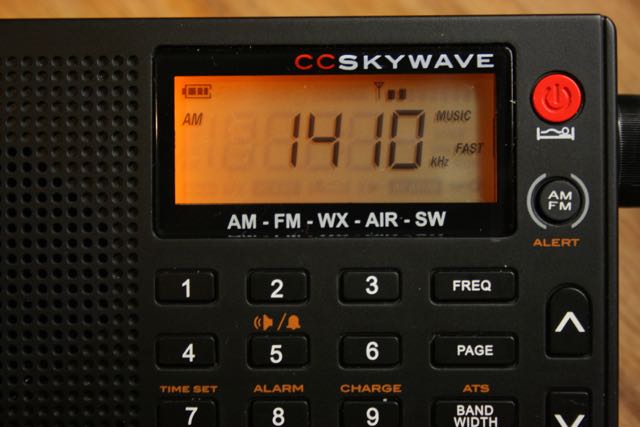
The Skywave’s backlit LCD display is small, but readily viewable from several angles. All of the buttons on the front of the Skywave have a tactile response, again, similar to the CCRadio-SWP. The buttons require slightly more pressure to activate than Tecsun and Degen models; I prefer this, especially for a travel radio: should I forget to activate the key lock, it’s much less likely that the radio will accidentally turn on during transit.
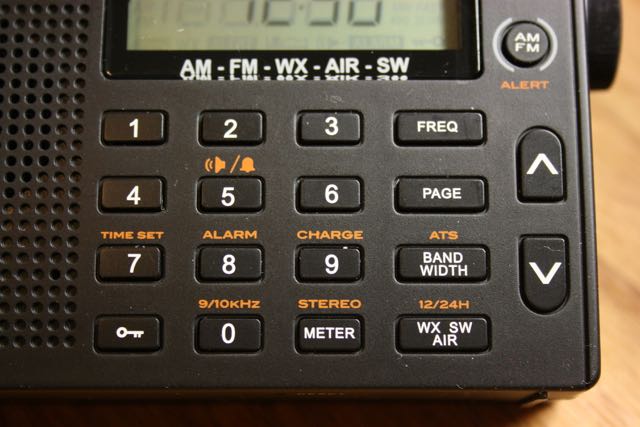
As always, I attempted first to see how many radio features and functions I could uncover without first consulting the owner’s manual. In the past, C.Crane products have been some of the most intuitive on the market. Fortunately, the Skywave did not disappoint: first, I was able to set both the clock and alarm within moments; both essential in a travel radio.
Once the radio is on, it will display either the time or frequency on the main display. While the Skywave defaults to a time display, I discovered that the lock button toggles the display between time and frequency for ten seconds. (Note: After reading through the manual later, I learned that you can actually change the default display mode to either time or frequency–very nice touch!)
I then turned on the radio and found the memory allocation to be very straightforward: tune to the desired station, then press and hold a number button two seconds to save. Press a button quickly to recall. Memory remembers bandwidth, stereo, or mono (if FM), and any voice or music audio filters utilized–very handy!
Speaking of bandwidth, the Skywave has five on shortwave, medium wave, and air bands: 6, 4, 3, 2, and 1 kHz. By pressing the bandwidth button, you can cycle through these from widest to narrowest. The bandwidth defaults to 3 kHz, but the default can be changed by holding down the bandwidth button for five seconds (with radio powered off).
To enter a frequency in AM/FM/SW, you simply press the FREQ button, then key in frequency. To scan through the band, simply press and hold one of the up/down arrow buttons. Worth noting: the Skywave’s scan function is one of the fastest I’ve seen in a portable.
On the topic of scanning, and since this is a travel radio, I would have liked C.Crane to include an ETM function like that found in the Tecsun PL-310ET and PL-380. It’s quite a handy function for auto-populating temporary memories from a simple band scan. I assume this is not an option on the DSP chip powering the Skywave.
Owner’s manual
Once I had my fun trying to discover as many functions on the Skywave without the manual’s aid, I finally opened it and discovered a few more functions.
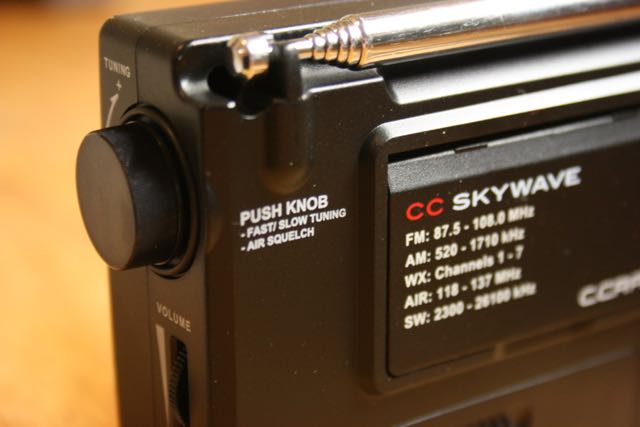
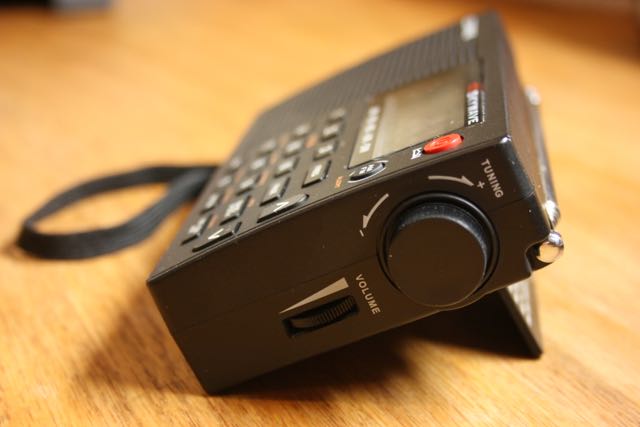
One feature I’ve already come to love in the Skywave: the ability to change the tuning speed, and thus frequency step-spacing on the tuning knob (option of 5 or 1 kHz steps), just by pressing the knob itself. I much prefer this to using a front-panel tuning step button because it’s so easy to operate in low-light settings (lounging in bed, for example).
Another unique feature of the Skywave is a switchable audio filter for voice or music. With the filter set to “voice,” the audio is enhanced for human voice intelligibility. When set to “music,” it widens the audio filter, thus optimizing audio fidelity. Toggling the audio filter settings between voice and music is very easy, but not intuitive; indeed, it’s almost a hidden feature you can discover via the owner’s manual. Simply press the “1” and “2” simultaneously while listening to a broadcast to toggle the filter.
I should note that the C.Crane owner’s manual is one of the most straightforward and simple I’ve seen in ages. You can tell that, at least in the English version that came with mine, this manual was written by a native English speaker. It made for simple, clear instruction without head-scratching over obscure terms. Even the least technically-inclined user will understand these instructions, no problem.
AM – Medium Wave
After asking SWLing Post readers what they would like me to include in this review, a number of you responded that you wanted me to give the AM broadcast band reception a proper review.
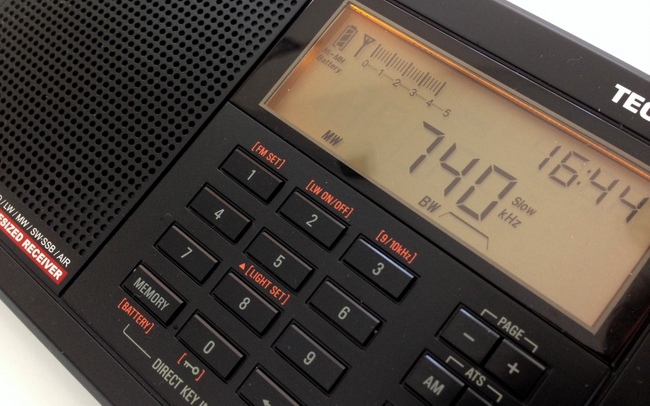
My foray into medium wave listening with the Skywave started off on the right foot. The very first night with the Skywave, I tuned it to 740 kHz, my favorite, albeit challenging to reach, AM station here in the North America–CFZM “Zoomer Radio” While those living in the midwestern and northeastern US can receive Zoomer radio easily enough at night, it is often a tough catch here in the southeast in the evening hours. After nightfall it competes with clear channel stations that also occupy 740 kHz. With a portable radio, the lock on Zoomer is never terribly strong and is very prone to fading.
But after tuning the Skywave to Zoomer, I received CFZM so well it sounded like a local station–in fact, I couldn’t believe it until a station ID confirmed that I was receiving it. Even more surprising was that I received it away from home, in an area plagued with RFI noise where I typically have to carefully turn a radio to null out the noise in an effort to enhance the desired broadcast. But the Skywave somehow mitigated this noise better than my other portables. Even when I turned the radio in the direction of the offending electrical noise, it wasn’t as bad as on other portables. Truly, the reception was remarkable.
With Zoomer firmly locked in, I hopped into bed, turned the volume to a comfortable level, and listened for at least half an hour before falling asleep. I was pleasantly surprised the following morning, some eight hours later, when I woke to the Skywave playing CFZM at the same level. Phenomenal! Perhaps conditions were exceptionally favorable that night; nonetheless, the Skywave couldn’t have impressed me more.
A side note–on the previous day, I’d inserted two generic alkaline AA batteries in the Skywave; after a total of ten hours playing at medium volume, the battery indicator still showed full capacity.
Medium wave audio samples
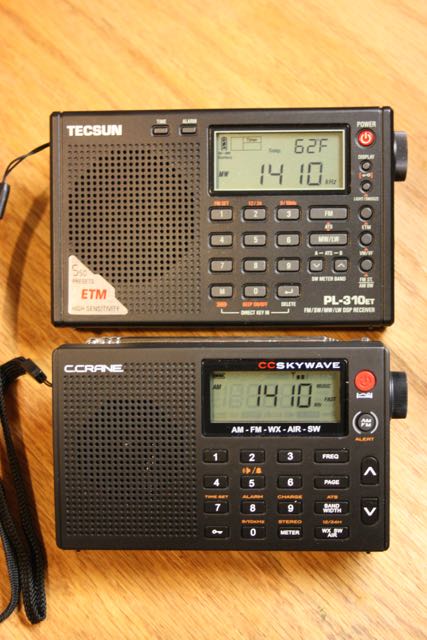
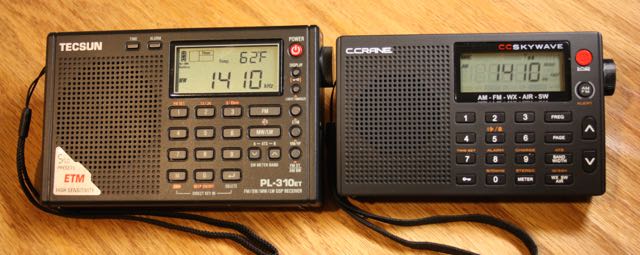
While time won’t allow a full audio sampling of the medium wave band for comparison, I did record the following comparison between the Skywave and the Tecsun PL-310ET (which I regard as one of the more capable sub-$100 ultra-compact portables on the market).
Since SWLing Post readers specifically asked to hear how the Skywave handles choppy nighttime medium wave DX conditions, I tuned to two frequencies with overlapping broadcasts, one of which was slightly dominant: 950 kHz and 990 kHz. I set the AM bandwidth to 3 kHz on both radios and made the recordings within one minute of each other. The CC Skywave’s audio filter was set to “voice.”
In the following recordings, listen for Radio Reloj (Cuba)–it’s buried deep in the noise. You might detect the ticking and “R” “R” in Morse code. These recordings were taken within one minute of each other.
To my ear, the Skywave was clearer and the commentator’s voice seemed to pop out of the noise better.
I’ve spent a great deal of time listening to the Skywave on the medium wave band this week and I feel comfortable recommending it for the medium wave DXer.
FM
While I’ve spent comparatively less time (thus far) evaluating the Skywave’s FM band, I can say that the Skywave receives my “benchmark” FM stations with ease. Sensitivity also seems to be on par with my other DSP based portables (meaning, excellent sensitivity).
Shortwave
Of course, being a shortwave enthusiast, I’ve spent the bulk of my listening time since receiving the Skywave on the shortwave bands. And during this time, alas, shortwave radio band conditions have been challenging for any radio. Yet I’m happy to note that this little radio does not disappoint: it has excellent sensitivity and selectivity for a radio of its size. When I compared the Skywave with the Tecsun PL-310ET, in almost every situation, they are nearly equal in performance.
Shortwave audio samples
Below I’ve included audio samples of the Skywave on 9580 kHz (Radio Australia). Under normal conditions, Radio Australia would be a blowtorch signal here in North America, but this particular morning, propagation was quite poor. In the audio, you’ll hear both radios attempting to cope with pronounced fading, with their AGC circuits reacting to the quick rise and fall of signal strength. Both radios were set to a 3kHz bandwidth and the Skywave’s audio filter set to “voice” to help mitigate noise.
Note that Radio Australia was broadcasting music, which can be more difficult to evaluate, but the vocals were prominent enough I felt it made for a good comparison.
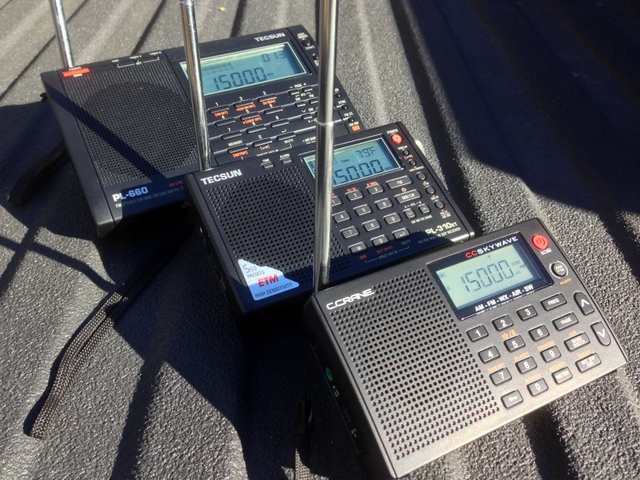
This morning, I also recorded WWV on 15 MHz. Again, propagation conditions were poor across the bands, so even WWV (normally very stable) was affected by quick fading (QSB). For kicks, I decided to add the benchmark Tecsun PL-660 to this comparison. If you recall, it received some of the highest marks for sensitivity in our weak signal shoot out. The Tecsun PL-310ET and CC Skywave were set to 3 kHz bandwidth and the Tecsun PL-660 to it’s narrow bandwidth (which I felt was most equivalent).
The good news is that the Skywave is certainly a sensitive and selective portable. While evaluating shortwave performance over the past week, I’ve been pleasantly surprised by how well this little radio receives.
NOAA Weather radio
Those of us living or traveling in North America will appreciate the Skywave’s built-in NOAA weather radio functionality. Since I have at least a dozen self-powered radios and desktops that have built-in NOAA weather reception, I typically don’t give the band much thought. I figured NOAA reception would be a mediocre add-on with the Skyview. I was wrong.
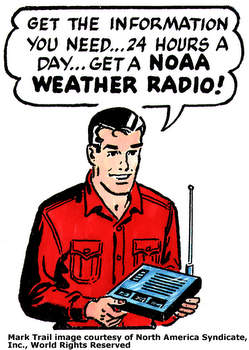
Not only does the Skywave have NOAA weather radio, but it also has weather alerts. What’s so great about that? Imagine that you’re travelling to a rural area and weather is looking ominous; in this case, you can simply set the Skywave to the strongest NOAA channel and activate the weather alert (choose options for 4, 8, or 16 hours). If severe weather is reported for your geographic area, the Skywave will alert you.
I’m very pleased with the NOAA weather radio reception, as well. The Skywave receives NOAA stations even better than one of my dedicated weather radios.
AIR band
C.Crane included the Air band for travelers, as a means to listen to air traffic control while in an airport or awaiting a flight’s arrival. I have several portables with the AIR band, but most lack an autoscan ability (Grundig G3, G6), and performance on these tends to be mediocre at best.
I’ve traveled to three different cities over the past week and used the Skywave to tune to the local air-traffic control tower. After a bit of scanning, it eventually found the frequency, and reception was quite good. I have not yet used the AIR band in an airport (notorious for RFI) nor in a large metro area, so I can’t comment about performance under those conditions.
What really separates the Skywave apart from my other shortwave portable with the AIR band is that it actually has an adjustable squelch mode. Nice touch!
CC Buds Earphones
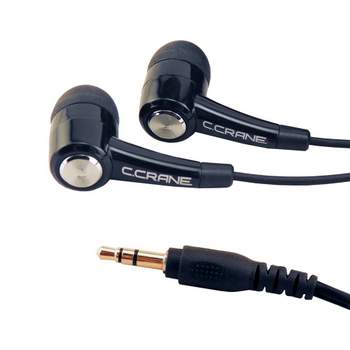
Unlike Tecsun portables which typically ship with batteries, an external antenna wire, chargers, travel cases, and the like, the CC Skywave comes with very few included accessories––just a carry case, an owner’s manual, and earphones.
Most of the headphones/earphones that accompany a shortwave radio package are of the cheapest quality. I’m happy to note that the Skywave’s included earphones are the best I’ve ever received as an included accessory with a shortwave radio.
The CC Buds Earphones are in-ear style (which I prefer, for sound isolation) with soft silicone earpieces. They are tuned to a frequency response which favors voice, an enhanced mid-range. For SWLing and MW DXing, I believe they’re nearly ideal. Indeed, I’m planning to use these with my Elecraft KX3 next time I’m operating QRP––I’m sure that SSB will sound great.
Since these are tuned for the spoken word, however, I wouldn’t necessarily favor the CC Buds Earphones over my Sony in-ear buds for music listening.
Summary
Every radio has pros and cons, and I jot down my reactions as I evaluate a new radio so as not to forget any details. The following is my list:
Pros:
Overall great sensitivity and selectivity for a portable in this price class
Considerate design, well-tailored for the traveler:
Compact size
Air band
NOAA weather radio
Easy to set clock and alarm
Simple controls
Lightweight
Operates on 2 AA batteries
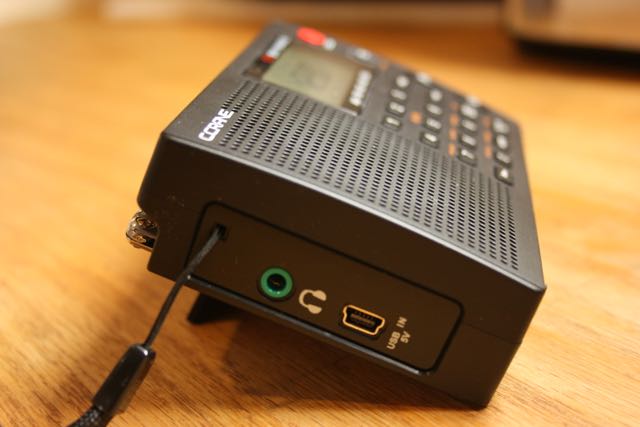
Charges from Mini USB (see con)
Wide HF frequency range (2.3 up to 26.1 MHz) compared to the PL-380/PL-310 (2.3 up to 21.95 MHz)
AIR band is truly functional: includes both scanning and squelch
NOAA Weather radio reception excellent
Includes soft silicone earphones (in-ear type) actually worthy of AM/SW listening
Auto scanning with the up/down buttons is very rapid
Integrated charging circuit
Uses common micro USB port for power/charging
Tuning speed easily changed by pressing tuning knob
Volume control is fully variable (free wheel, analog style), not in pre-determined digital steps
Selectable audio filters for music and voice
Cons:
Internal speaker audio is somewhat tinny (use of the voice audio filter helps)
No external antenna jack
No SSB mode (in this price class of $90 US, SSB is an included mode on some models)
Only one clock; no provision for dual local/UTC time
Mutes between frequency changes
Whip antenna is short––only 16” fully extended. While the Skywave seems to perform brilliantly with this short antenna (see pro), I can’t help but wonder if more length might boost some bands.
While no inconvenience to me, the Skywave does not come with an adaptor or USB cord for powering/charging. (Should you need it, C.Crane sells a proper noise-free regulated power supply separately ($15 US); however, most buyers will already have these cords and any USB port on your PC or USB-based phone charger will suffice. Also note that listening to virtually any radio while charging will inject noise into the receiver, resulting in sub-par reception.)
Can overload on shortwave and AIR bands if located near a strong radio station (see this comment)
Conclusion
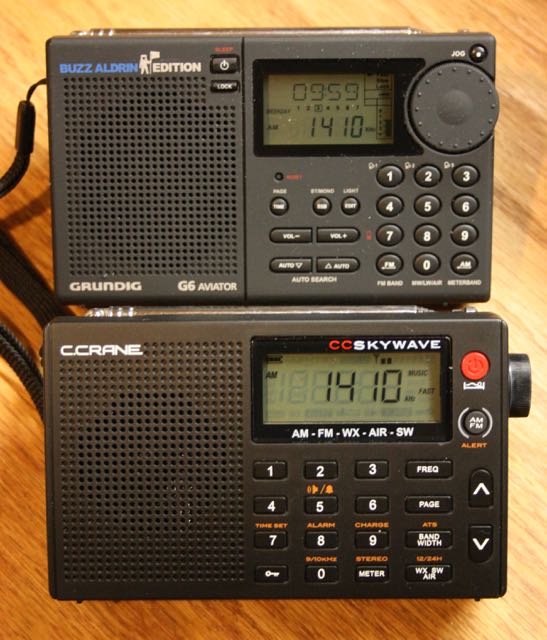
The CC Skywave is nearly identical in size to the late and great Grundig G6.
C. Crane has few shortwave radios in their product line, and all perform rather well for their price point; I know, as I have owned all of them and even purchased as gifts in the past.
Fortunately, it’s clear that C. Crane noticed the shortcomings of the AR1733 and has modified the Skywave’s design and firmware accordingly, which may account for the delayed roll-out of the CC Skywave. Obviously, the Skywave’s ACG circuit has been tweaked to cope with medium wave and shortwave listening, since a poor ACG circuit is one of the shortcomings of the AR1733. But, if so, wow…what a tweak.
Because all in all, the CC Skywave is a excellent little radio. Indeed, in terms of the ultra-compact portable market (models like I included in a recent shoot-out), I think it’s one of the best surprise performers I’ve seen in the past couple of years.
After just one week with it, I’ve already decided to take the CC Skywave along on my travels to see how it performs over time. It will replace my PL-310ET and PL-380 for my one bag domestic and international travelling. The CC Skywave is also especially well-suited for the “go”-bags and “bug-out” bags used in evacuations and other emergencies. Indeed, with AM/FM/SW/AIR plus functional NOAA radio, this little radio packs a lot––in short, the Skywave packs enough to get packed in my bag.
In this general feeling of gloom surrounding the medium and shortwave bands I thought that I would send you some news that bucks the trend. There are a couple of brand new commercial stations, just a few months old, broadcasting on medium wave and can be heard all over Europe.

 “We all know what it’s worth“–?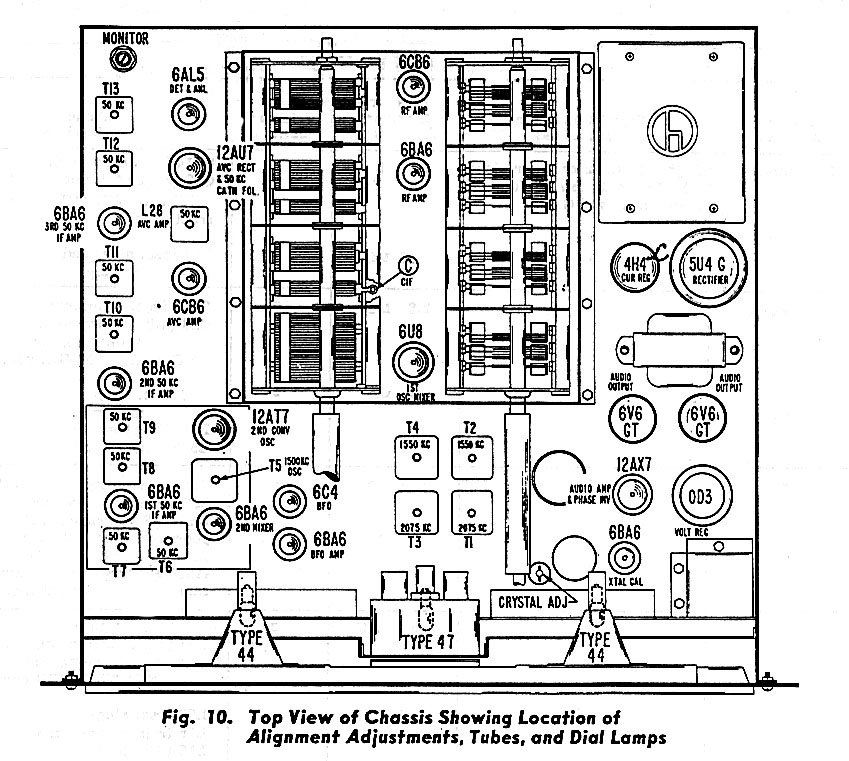










 After just one week with it, I’ve already decided to take the CC Skywave along on my travels to see how it performs over time. It will replace my PL-310ET and PL-380 for my