 The HFCC has posted the preliminary A14 schedule on their website. Click here to download.
This schedule is subject to change since the season does not start until April 1, 2014 and at least one broadcaster (VOR) will be pulling out.

The HFCC has posted the preliminary A14 schedule on their website. Click here to download.
This schedule is subject to change since the season does not start until April 1, 2014 and at least one broadcaster (VOR) will be pulling out.
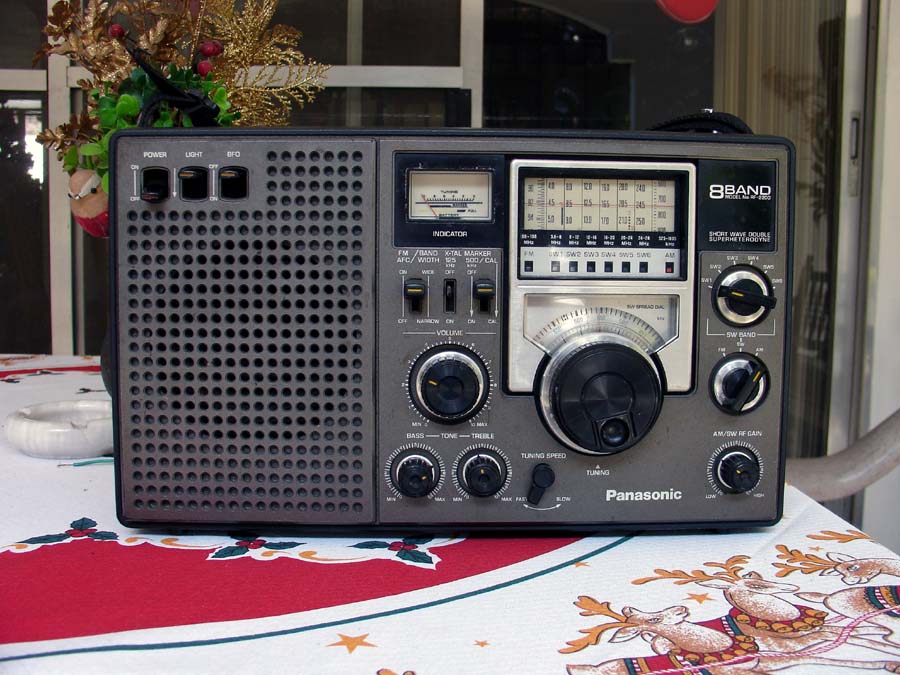
While looking through a number of photos Flickr user vency1 posted, I noticed an interesting story behind his trusty Panasonic RF-2200. He describes his radio thus:
“A very good performing receiver. I’ve had great listening adventures with this on AM and shortwave. This once served as an RDF (radio direction finder) on a speedboat to find our way home in heavy rainstorm in the middle of the sea with zero visibility. A station located in the hometown was tuned in and we steered the boat in the direction of the strongest signal. The RF gain was set so that the slightest signal fluctuation would show on the meter. At home, the sound on FM is very good when connected to a high-fidelity speaker system.”
What better user review of a radio could one give? I mean, it guided him home during a storm at sea? Brilliant! Too bad they no longer make the RF-2200. Fortunately they do show up on eBay regularly–click here to search.
A question for my buddy, Jeff, over at the Herculodge: Does a radio get more manly than this?
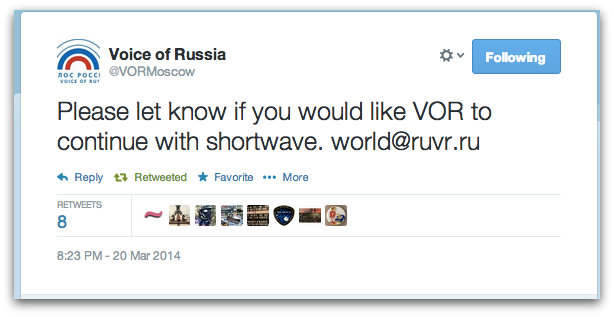
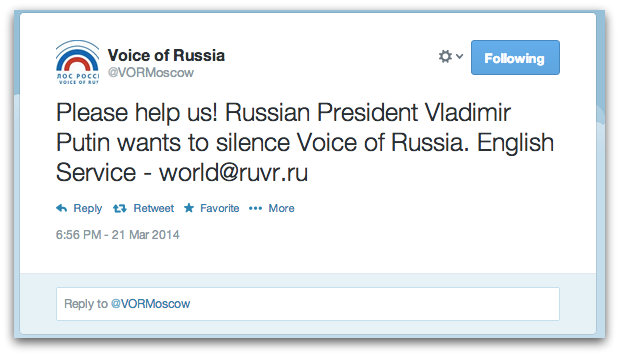
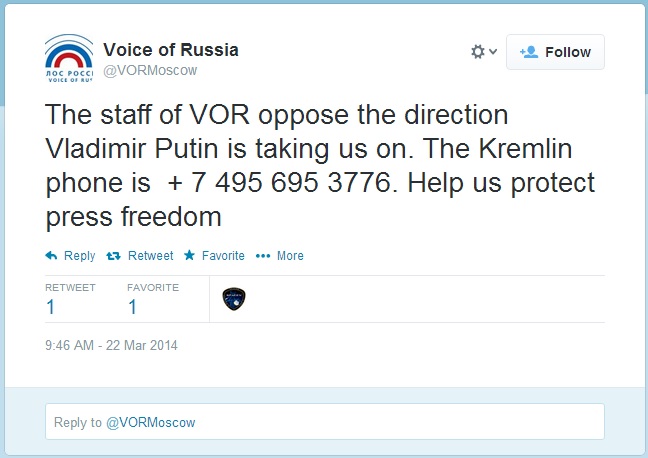
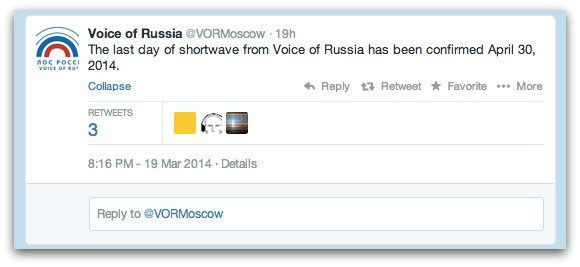
UPDATE: I seriously question this VOR twitter account’s authenticity. @VORMoscow looks to be very new, starting on March 19, 2014–the same day VOR announced an end to its shortwave service–obviously not an official VOR account. Either this is a disgruntled VOR staffer posing as VOR English, or (most likely) a VOR listener. By 5:30 UTC on March 22, 2014 @VORMoscow was removed from Twitter:
Two days ago we learn that the Voice of Russia plans to end all shortwave and medium wave broadcasts as of April 1, 2014.
Yesterday, SWLing Post reader Juan Kulichevsky, noticed this tweet from the new Twitter account @VORMoscow:
Then, about ten hours ago, I notice this tweet among other VOR news items from @VORMoscow:
By 5:30 UTC on March 22, 2014, @VORMoscow posted this final tweet before the account was removed from Twitter:
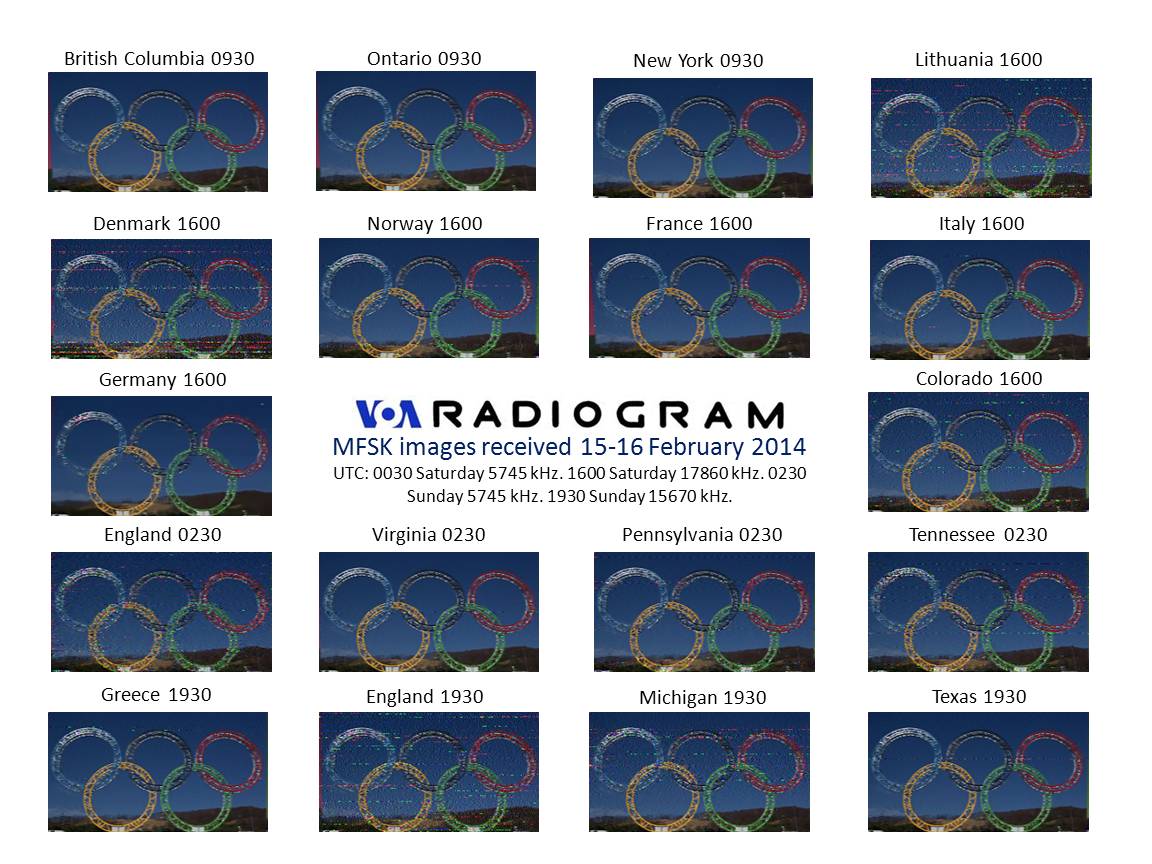 Many thanks to my friends, Bennett Kobb (AK4AV) and Christopher Rumbaugh (K6FIB) who wrote a letter to the BBG regarding the relevancy of shortwave radio. They make a strong point as this article in Radio World puts it: “Hey, don’t forget about Radiogram!”
I also made a case for the VOA Radiogram in my letter to the BBG, but I think Benn and Chris sum it up better. Click here to download their letter to the BBG as a PDF document–I’ve also pasted it below:
Response to BBG Shortwave Committee Request for Comment
March 14, 2014
The BBG has spearheaded ‘Radiogram’ (voaradiogram.net), an entirely novel form of international high-frequency broadcasting. Radiogram is soundly premised on modern digital techniques and mitigates longstanding impediments to HF transmission. Users around the world have documented reception of fifty VOA Radiogram programs in more than a thousand YouTube videos.
BBG must not allow its own pioneering developments to wither, but should advance them toward operational status.
Radiogram should not be confused with Digital Radio Mondiale (DRM), which employs digital modulation for sound broadcasting. Radiogram broadcasts web content via robust, interference-resistant, error-detecting/correcting AM tone modulation, using standardized formats widely practiced in the Amateur Radio Service.
The user’s ordinary shortwave receiver, tuned to a Radiogram transmission, feeds its audio to a user device. These could include mobile phones, tablets, laptop and desktop computers and the new ARM-based miniature computers and embedded devices. The user device decodes the tones and displays text and imagery despite propagation impairments and intentional interference — and without Internet connection.
Placing the radio near the phone or computer is normally sufficient. No hardwire connection is required. By adding a simple audio cable between receiver and user device, however, reception can be silent and covert. No specialized hardware is needed, and the software platform for decoding is long in the public domain.
A more advanced, yet still inexpensive setup would use existing “dongle” technology that places a software-defined radio (SDR) inside a small USB enclosure. Such units are available today for a few tens of dollars and widely used by experimenters. The operating system and decoding software could also be incorporated into the device, which could boot the computer, eliminating the need to install any PC software.
The user need not be present at the time of transmission to receive content. He essentially receives a web magazine updated at will and always ready for use. The user can redistribute it by printing, USB storage, SMS, E-mail etc.
Naturally, the audio tone transmission can be recorded for later playback. Even when buried well under music or noise, the nearly inaudible recorded broadcast can nevertheless deliver 100% copy upon decode.
Radiogram’s transmission methods provide text at 120 WPM (near to the speed of spoken English) along with images. Additional languages have been proven, including non-Roman alphabets.
Sent over regular broadcast transmitters (no modifications needed), this approach effectively extends the reach of the transmitter. In other words, the digital text mode will decode in locations where the audible speech over the same transmitter would be too low for aural intelligibility. The audio recorded or captured could be replayed over another transmitter to even further extend the reach of the broadcast.
Recommendations
BBG should:
1. Capitalize on Radiogram as a circumvention tool, readily consumable by mobile devices. It should integrate Radiogram into its media strategy and networks.
2. Retain, but reconfigure as necessary its HF facilities in view of the potentially lower costs and greater efficiency of Radiogram when compared to conventional sound broadcasting.
3. Support the development and wide distribution of simple, usable, open-source Radiogram decoding applications for popular mobile devices and platforms (Android, iOS, Windows, Mac, Linux), derived from the free Fldigi software used worldwide.
About the Respondents
Bennett Z. Kobb, M.S., SMIEEE, is the communications director for an Arlington, Virginia trade association.
Christopher Rumbaugh, MLS, is a library manager and web publisher in Salem, Oregon.
The views expressed herein are the authors’ own.
Again, many thanks to Benn and Chris for submitting such an articulate letter to the BBG and for sharing with SWLing Post readers.
If you would like to decode a VOA Radiogram yourself, simply visit VOAradiogram.net for details on broadcasts targeting your part of the world.
 It appears that after all of the rumors from last year, and after the cuts to shortwave broadcasts earlier this year, the Voice of Russia has decided to stop broadcasting on shortwave entirely.
This morning, Alokesh Gupta shared the following message from Elena Osipova at the Voice of Russia World Service Letters Department:
“This is just a short message to thank you for your letter and let you know that the Voice of Russia is closing shortwave broadcasts as of April 1st. Our programs will be available online at http://voiceofrussia.com/play/
We hope you will stay with the Voice of Russia and hope to hear from you soon again.”
2nd Update: Shortly after publishing this original post, SWLing Post reader Stephen Cooper, noticed a VOR twitter account announcing the final date as April 30, 2014–I now believe this account to be fake:
Update 2 (10:00 UTC on March 21, 2014): I just received the following message from Elena Osipova at the Voice of Russia World Service Letters Department:
Dear Mr Witherspoon,
This is to thank you for your message and confirm the information about the upcoming cancellation of the Voice of Russia’s short- and medium wave transmissions as of April 1, 2014.
Best regards,
Elena Osipova
Letters Department
World Service
Voice of Russia
I remember when the Voice of Russia and Radio Moscow absolutely dominated the shortwaves, especially in my early years as a radio listener. Times have changed for this broadcaster who has been the mouthpiece for Russia and the Soviet Union.
On a side note, if you have the ability to record the Voice of Russia in its final days on the air, please consider submitting and sharing your recordings on the Shortwave Radio Audio Archive. Please contact me if you have any questions.
Many thanks!
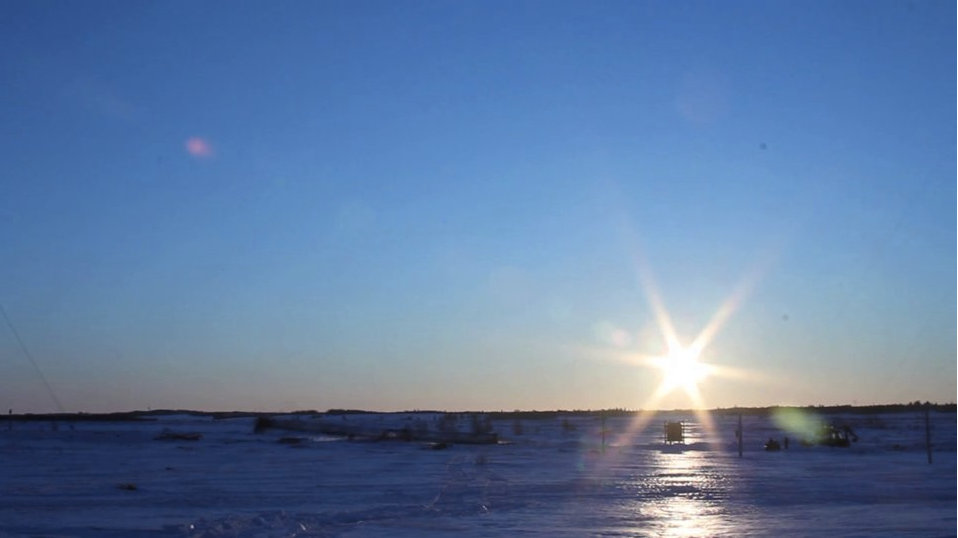
Documentary filmmaker, Amanda Dawn Christie, has been gathering footage to create Spectres of Shortwave: a 90 minute documentary film focusing on the Radio Canada International Sackville transmitting site. Little did Christie know when she started shooting the film several years ago that the site would not only be be shut down but dismantled.
Christie recently shared back-up footage of the towers falling. She describes her videos on Vimeo:
“In the spirit of the founding principles of the CBC and public access to information, i am sharing the back up videos i shot this week of the RCI shortwave towers falling. I retain the copyright to these images, but i do want to share them with anyone who would like to watch them sooner rather than later (given that my film will still be a few month in post production before release). i would also like to thank the CBC for giving me permission to film, and all of the workers on site for being so cooperative and supportive.”
Click here to continue reading and to watch Christie’s footage on Vimeo.
It’s with a heavy heart that I watch these majestic towers fall. After all, I’ve been pretty vocal about how foolish I think Canada is for destroying Sackville. Still, I’m glad someone is documenting it properly. Click here to follow Spectres of Shortwave on Facebook, set to be released later this year (2014). I’ll certainly post updates about the film here.
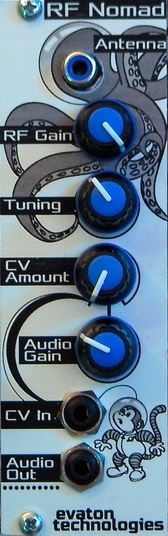 For electronic musicians who love the sonic texture of shortwave radio, check out the RF Nomad, under development by Evaton Technologies.
Evaton describes the RF Nomad module:
“RF. Radio Frequency. The stuff that Marconi made famous. Or maybe it made Marconi famous. Either way, it’s not just for listening to hockey games anymore.
The RF Nomad voltage-controlled sideband shortwave receiver Eurorack module is currently in final stages of prototype evaluation.
The RF Nomad adds the squealy, squelchy, noisy, unpredictable vintage sounds of shortwave radio to your modular. But this is no ordinary shortwave; it’s been designed to be extra noisy, extra squealy, extra gritty, and just downright nasty. No built-in output filtering means that a rich spectrum of harmonic content is available on the audio output jack. Audio levels can be driven to distortion. CV control lets you add your own creative spin on sound design.
Hissy interstation audio. Squealy heterodynes. Fading stations. Atmospheric noises. Faint voices in foreign languages from distant broadcast stations. Fire and brimstone. It’s all in there, just like your granddad’s old tabletop shortwave.
But, the RF Nomad adds a twist: The tuning is voltage controlled. Sure, when you were a kid, you discovered you could make spacy noises on Papa’s shortwave by slowly turning the tuning dial. But just how fast could you twist that dial? Faster than an audio-rate LFO? Hardly. Voltage controlled tuning means that the RF Nomad will let you explore sounds you never imagined you could get out of a shortwave receiver.”
Check out this demonstration video:
Many thanks to Mitsuhiko Kagawa for the tip!