Category Archives: News

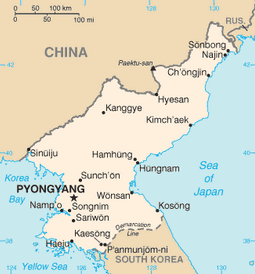
North Korea: Jamming shortwave radio 18 hours a day

(Source: Times Union)

[…]Martyn Williams, who writes the blog NorthKoreaTech.org, said that the government’s intense use of its scant resources and electricity to jam foreign news broadcasts reflected its concern about the impact of outside media.

North Korea targets between 10 and 15 frequencies used by international short-wave broadcasters, such as U.S.-funded Radio Free Asia and stations operated by South Korea’s government, for up to 18 hours a day, and on major occasions like the April centennial, it jams radio signals around the clock, Williams said.

The North appears to have recently installed more sophisticated transmitters acquired from a Chinese company, although jamming operations have been up and down this year, likely because of technical problems or power shortages, he said.

Read the full article, the bulk of which deals with social media and mobile phones, on the Times Union website. Obviously, North Korea feels that shortwave radio is a threat to those in power. They should be afraid–shortwave radio signals easily cross their fortified borders. This article will be filed under why shortwave radio.

The Link talks about the politics of saving RCI

On Friday’s edition of The Link, Mark Montgomery spoke with Amanda Pfeffer about how international radio is being cut around the world and, more specifically, Canada. They discuss how this happened, who is aware of it and if there is any way to save the service.

It’s an informative segment (though see my correction below).

Since this is one of several features in the show, I’ve recorded this specific segment and posted it for listening below.

You can also listen to the segment by downloading the mp3 here.

Please note that Amanda is a little mis-leading about the bureaucratic structure of US international broadcasting. It is rather confusing.

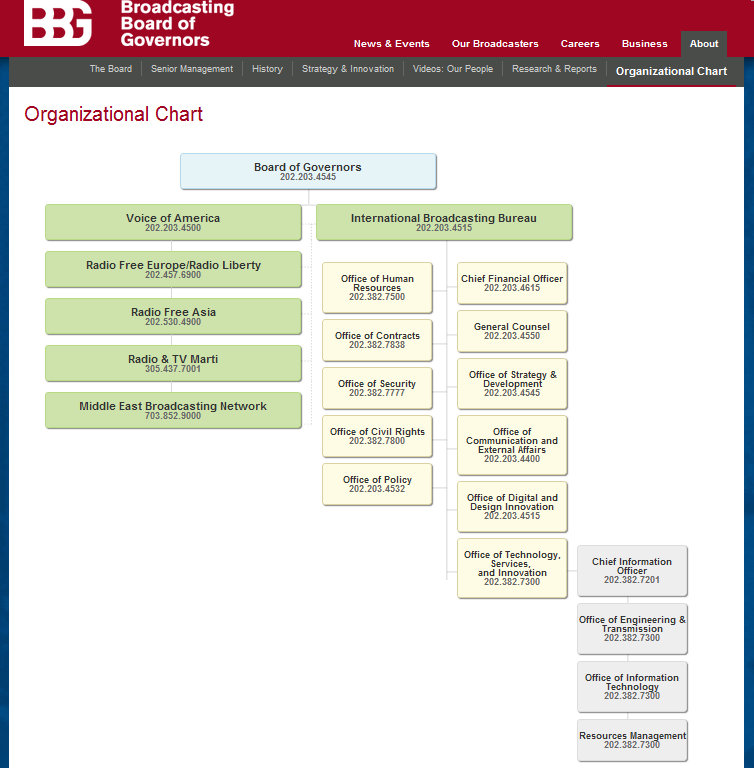
The BBG (Broadcasting Board of Governors) is the governing body of US international Broadcasting. The IBB (International Broadcasting Bureau) is over all of the broadcast/transmission facilities, engineering functions, human resources, finances and other agency support services. To be clear, the Voice of America, Radio Free Asia, Radio Free Europe, Radio Marti and the Middle East Broadcasting Network all take direction from the BBG, not the IBB.

The organizational chart (below) can shed some light on this.

The BBG Organizational Chart as of May 2012 (Click to enlarge)

Edward R. Murrow Transmitting Station: re-dedication videos

Last week, we noted the upcoming re-dedication of the Edward R. Murrow Transmitting Station and the significance of this particular broadcasting location.

Videos of the event have now been posted on the BBG Watch website, including this one, which features the original dedication of the site in 1963:

Local CBS affiliate, Channel 9, provided raw video feeds from the event, which are also posted.  Of particular note is the footage of Governor Victor Ashe’s speech and the tour of the station.

Victor Ashe:

Station tour:

As I previously mentioned, in December 2012, I had the honor of receiving a five-hour tour of the Edward R. Murrow Transmitting Station. Following that marvelous tour, I  wrote a piece for the March 2012 issue of the Monitoring Times in which I describe the day’s experiences; the article has already received many kind comments (thanks!) and continues to draw interest to the station. I think this may be one of the best articles I’ve ever written, and the clear reason for this was my sheer delight in the tour, a dream come true for me.  Moreover, I had early information about the re-dedication of the site, and was immensely pleased that  those who work there should receive such well-deserved accolades.

BTW:  While I have a busy travel schedule this summer, I intend to publish some items of interest in my absence that I’ve been saving for the purpose. This will include the article I wrote for the MT–the full, un-cut version–along with dozens of hi-res photos from the site. It’s quite long, thus will be posted in manageable sections; each post will be tagged: VOA Greenville. Keep an eye open for those!

But if you just can’t wait, you can always download an electronic version of the March issue on the MT’s website.  Hope you enjoy it…!

And to our good friends at VOA Greenville:  thanks again, and congratulations!

WBCQ to send digital message over shortwave tonight

Update: Missed this broadcast? No worries–not only did we record the digital message, but we’ll teach you how to decode it.

(Source: WBCQ on Facebook)

On Friday, May 4, 2012, during Allan Weiner Worldwide (8pm US eastern time, 0000 UTC), we will be presenting an experiment in the transmission of text messages in digital formats. During the show, we will transmit a brief message in MFSK64 format. This message consist of text that listeners can save to a file with an .htm suffix, then open and view it in a web browser.

The message can be decoded using a variety of free software packages. One such package is FLDIGI, which can be found at http://www.w1hkj.com/Fldigi.html.

Thanks to Kim Andrew Elliott, audience researcher at the International Broadcasting Bureau, for coordinating this test.

You can find Allan Weiner Worldwide on 5,110, 7,490 and 9,330 kHz tonight (Friday, May 4th) at 00:00 UTC (20:00 in Eastern US)


The Edward R. Murrow Transmitting Station: VOA “Site B” re-dedication means a new name plus a future

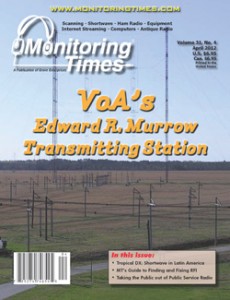
My feature article on touring the Edward R. Murrow Transmitting Station in the March 2012 issue of Monitoring Times

Last December, I had the honor of receiving a personal five hour tour of the VOA transmitter site near Greenville, NC, USA. It was literally a dream come true for me, and providing a more in-depth understanding of the history, the equipment, the antennas and, most importantly, the people who keep this remarkable site on the air 24/7. You can read all about my experience in a feature article I wrote for the  March 2012 issue of Monitoring Times Magazine.

Just before my article was sent to print, I received word from my new friends at the transmitter site that it had been renamed the “Edward R. Murrow Transmitting Station.” Fortunately, timing was on my side and my article carried the new name throughout.

This was much more than a re-naming of the site, however. I knew that to some degree, it was a reassurance by the BBG (Broadcasting Board of Governors) that the site, which had been slated for closure as recently as 2010, was to have a future that would reflect its honored past in international broadcasting. Clearly, the site is very important; it’s the last remaining international broadcating station that is not only wholly owned by the US government, but is nonetheless on US territory, where no restrictions can be imposed upon either what is broadcast, nor for whom the broadcast is targeted.

On a side note, perhaps what disappoints me most about the Radio Canada International cuts, and why I’ve been so vocal about it, is the fact that they plan to close their Sackville, New Brunswick transmitting site. In a sense, it’s the Canadian cousin to the VOA’s Murrow site, which is to say, the only international broadcasting site in Canada, that’s fully owned by Canada and grounded firmly on Candian soil.
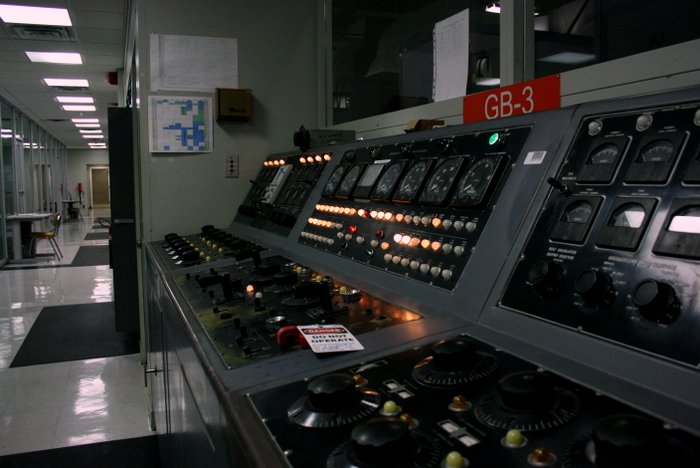
Tuning controls on one of the 500 kW Continental Electronics transmitters I admired at the Edward R. Murrow Transmitting Site. Click to enlarge.

I’m very pleased the US government and the Broadcasting Board of Governers made what I strongly believe to be the right decision, namely, keeping Edward R. Murrow Transmitting station open and active. Once that transmission infrastructure is gone, it’s gone. Fortunately, this re-dedicationconfirms that it will live on.

I was personally invited to the dedication, but sadly will be unable to attend, the distance (twelve hours by car) being fairly prohibitive.

Yet I wish you well, broadcast heroes:  long live the Edward R. Murrow transmitting site!

The Greenville Reflector published an article about the May 2nd dedication of the Edward R. Murrow Transmitting Station:

(Source: The Reflector)

VOA site to be rededicated

A Voice of America site once scheduled for closure has not only been saved but will be rededicated Wednesday in a ceremony featuring the son of broadcasting pioneer Edward R. Murrow.

Voice of America Site B, located 15 miles east of Greenville outside of Grimesland, was named for the legendary broadcaster when it opened in 1963.

Murrow’s name was removed from the building as part of security measures taken after the Sept. 11, 2001, terrorist attacks.

Murrow’s name will be returned during a 10 a.m. ceremony being held at the site, 3919 VOA Site B Road.

[…]The Broadcasting Board of Governors announced in February 2010 it wanted to close VOA Site B so it could save about $3.1 million annually and focus on upgrading its satellite, digital and other broadcasting technologies.

The site B location broadcasts via short-wave radio to Cuba, the Caribbean and South America. In the past it also has broadcast to West Africa.

Jones and U.S. Rep. G.K. Butterfield, D-N.C., worked to stop the closure, aided by another member of the North Carolina delegation, Democrat David Price.

The closure never came because Congress had difficulties finalizing its 2010-11 budget and funding was included in continuation budgets.

The broadcasting board notified Jones in January 2011 that the administration wouldn’t pursue the site’s closure.

By that time Victor Ashe, former mayor of Knoxville, Tenn., and former ambassador to Poland, joined the broadcasting board and toured the VOA Site B facility.

Ashe said he was impressed by the facility’s staff members and their dedication to the organization’s mission.

“We believe free and honest information is a prelude and a foundation of a democratic society,” Ashe said.

Like other proponents of the site, Ashe said it’s important to keep VOA Site B operating because it’s the only short-wave Voice of America facility operating under U.S. jurisdiction. Other short-wave locations can be shut down at the insistence of its host nation.

Other methods of broadcasting — radio, television, the Internet and social media — can be cut off or blocked.

And the invitation from the BBG:

Speakers will include:

Congressman Walter Jones

Casey Murrow, son of Edward R. Murrow and Executive Director, Synergy Learning

Victor Ashe, BBG Governor, former Ambassador to Poland and former mayor of Knoxville

Richard M. Lobo, award-winning media executive and journalist and Director of the International Broadcasting Bureau

Edward R. Murrow’s legacy as a journalist and his rich understanding of the importance of press freedom as part of the bedrock of democracy along with the key role of U.S. international broadcasting as a model of a free press will be highlighted in the ceremony to be held in the lead-up to World Press Freedom Day, May 3rd.

The transmitting station, a 24/7 broadcast facility, supports the mission of the Broadcasting Board of Governors to “inform, engage and connect people around the world in support of freedom and democracy” through about 2,200 hours of transmissions each month.

Program:

Welcome:
André Mendes, Director, Office of Technology, Services and Innovation, International Broadcasting Bureau

Invocation:
Pastor William Thompson, Burney Chapel Free Will Baptist Church

Presentation of Colors:
D. H. Conley High School  ROTC

National Anthem:
Karen Meetze, Choral Director, J. H. Rose High School

Musical Accompaniment by:
A.G. Cox Middle School Band
Barney Barker, Band Director

Remarks about Edward R. Murrow:
Casey Murrow, Executive Director, Synergy Learning

Remarks:
Ambassador Victor Ashe, BBG Governor

Introduction:
Richard M. Lobo, Director, International Broadcasting Bureau

Keynote:
Congressman Walter Jones

Following the ceremony a tour of the facility will be offered.

Register through Eventbrite by April 26, 2012.

For more information, please call 202-203-4400 or email [email protected].

The Broadcasting Board of Governors is an independent federal agency, supervising all U.S. government-supported, civilian international broadcasting, whose mission is inform, engage and connect people around the world in support of freedom and democracy. BBG broadcasts reach an audience of 187 million in 100 countries. BBG networks include the Voice of America, Radio Free Europe/Radio Liberty, the Middle East Broadcasting Networks (Alhurra TV and Radio Sawa), Radio Free Asia, and the Office of Cuba Broadcasting (Radio and TV Martí).

The Toronto Star publishes my thoughts on the cuts to Radio Canada International

As many of you know, I find the downsizing of major shortwave broadcasters around the world deeply concerning, especially since so much of the world still relies on the medium as a source of news and information, and for some the only source of potentially life-saving information.

The recent cuts to RCI, however, were particularly painful. In one stroke of a pen, many people lost their jobs, and RCI’s already-skimpy budget was reduced to virtually nil. What’s more, their only international transmitting station–in Sackville, New Brunswick–is slated to be shut down, meaning there is no intention to continue the service, ever.

The Toronto Star has kindly published my thoughts on the matter.  You can read the full article here.


RCI Cuts: pink slips – no clear strategy for Internet

(Source: RCI Action)

April 25, 2012:

Facing the reality of job cuts in any workplace is hard enough. When you’re an employee at Radio Canada International – it’s more than a job. It’s more than just a job loss.

Most of us have worked several decades for RCI. It may be an  under appreciated service in Canada. But in the last few weeks, since the April 4 announcement that we would be cut by 80% and stop being a radio station, listeners around the world have rallied to our cause to stop the cuts. They have also told us how much they appreciate what we do, and are astonished that our national public radio and television broadcaster CBC/Radio-Canada would hit us with such a huge budget cut, much more then any other service under their control.

Strangely, even when we say an 80% per cent budget cut, it sounds sort of theoretical. When the letter is given to you that you no longer have a job, that your decades of service to Canada’s Voice to the World are redundant, well, that’s something else.

Today that happened to most of us.

About 15 permanent staff have been told they still have a job, 30 have been told they don’t. Three contractual webmasters will remain, but about 10 to 20 contractual employees (researchers, interviewers, hosts) will lose their jobs. Another 10 or 20 people who fill in for staff will have little or no work.

More importantly to us RCI has been almost made to disappear, no more radio programs, just a website, that is yet to be conceived, with little support. How much three employees in each of the five language services: English, French, Arabic, Mandarin and Spanish can do, even with the best of intentions, remains to be seen.

Management is saying we’ll be putting up text, photos, audio, maybe even video. But details are scarce. In fact, that’s the most surprising thing of all. There’s little information on how the website will look or function, there’s no real lead up time to prepare it, we’ll all be busy doing are regular programming until June 24. Then the new website is supposed to be up and running and those of us left, will have to somehow magically make it work.

[…]Next week we are promised a blueprint of the new RCI. Today it’s hard to believe in that future.

I will be very interested to see the blueprint for RCI’s internet future.  Frankly, it will need a strategy to delineate itself from the hundreds of thousands of well-established Internet media sources out there.