Category Archives: Nostalgia

Smithsonian Open Access: Take a deep radio nostalgia dive!

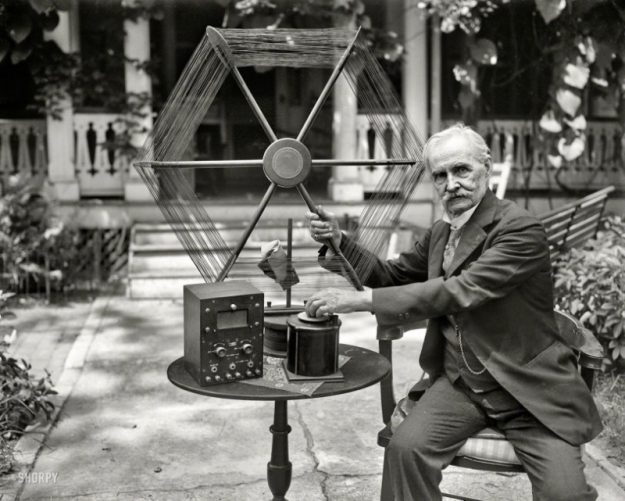
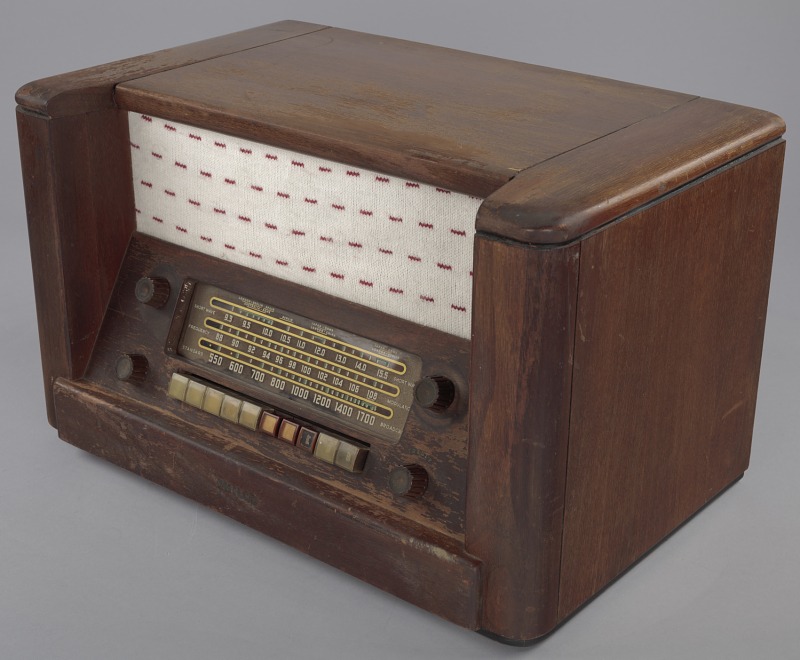
“Radio owned by Herman and Minnie Roundtree” (Source: Smithsonian Open Access)

Many thanks to SWLing Post contributor, Balázs Kovács, who shares the following announcement:

[Check out the] Smithsonian Open Access, where you can download, share, and reuse millions of the Smithsonian’s images—right now, without asking. With new platforms and tools, you have easier access to nearly 3 million 2D and 3D digital items from our collections—with many more to come. This includes images and data from across the Smithsonian’s 19 museums, nine research centers, libraries, archives, and the National Zoo.

As Balázs points out, there are hundreds of radio photos in the archive.

What a treasure trove! Since many of us are sheltering at home, it’s the perfect time to take a deep dive into the SOA archive!  Thank you for sharing!

Radio Nostalgia Trip: RCI Shortwave Listener’s Digest from July 26, 1982

Over at the Shortwave Radio Audio Archive, we receive some truly amazing recordings from our devoted contributors.

How many of you remember Ian McFarland’s Shortwave Listener’s Digest on Radio Canada International? It was certainly one of my favorite DX and SWL shows!

Our good friend Tom Laskowski recently sent in the following recordings of the Shortwave Listener’s Digest recorded (in part) on July 26, 1982 starting around 21:30 UTC on 15,325 kHz.

Tom notes:

Here are two more back to back episodes from my collection of recordings of Shortwave Listener’s Digest from Radio Canada International, this time from July 26 and August 02, 1982.

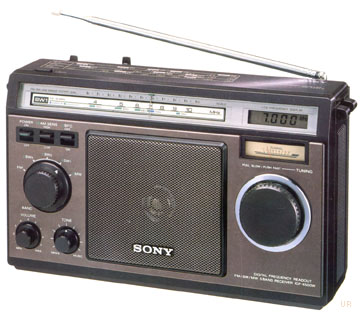
This program’s highlights are: ANARC 1982 Convention promo, Larry Magne’s test of the Sony ICF-6500W, a look at underseas intercontinental cables with Walter Foster of Teleglobe Canada, Glenn Hauser’s DX tips.

The second program highlights are: coverage of the 1982 ANARC convention with guest co-host Bab Zanotti of Swiss Radio Intl., interview with David Meisel about the solar cycle, a rundown of the awards given out at ANARC 82.

This recording is chock-full of shortwave nostalgia. How many of you remember some of the folks featured and mentioned in this show?

Use the embedded player below to listen to the full recording or click here to listen at the Shortwave Radio Audio Archive.

Note that there have been some other amazing recordings posted on the archive recently.  Here’s a small sampling:


Do you enjoy the SWLing Post?

Please consider supporting us via Patreon or our Coffee Fund!

Your support makes articles like this one possible. Thank you!

Radio Waves: WNPV Off Air, Privat-Ear, End of Radio, and China COVID-19 shut-ins tune-in

(Source: JamesButters.com)

Radio Waves:  Stories Making Waves in the World of Radio

Because I keep my ear to the waves, as well as receive many tips from others who do the same, I find myself privy to radio-related stories that might interest SWLing Post readers.  To that end: Welcome to the SWLing Post’sRadio Waves, a collection of links to interesting stories making waves in the world of radio. Enjoy!

Many thanks to SWLing Post contributors Ron, Tracy Wood, and Dennis Dura for the following tips:


WNPV Radio preparing to go off air April 30 (The Reporter)

TOWAMENCIN — When April ends, the airwaves above the North Penn valley region will be emptier, and so will a little brick building on Snyder Road in Towamencin.

Sitting below five 165-foot-tall radio antennas and one cell tower, that brick building has been the home for six decades of WNPV, the local radio station found at 1440 AM and 98.5 FM.

“We’ve been at it for 60 years, and our mission and our core values are really no different today than they were in October of 1960. It literally is to serve the community,” said Phil Hunt, the station’s General Manager.

“It’s gotten to the point where it’s not sustainable for us to continue to do that. It takes resources to do it properly; those resources, primarily, are people, and we were having trouble making ends meet,” he said.

Hunt announced Wednesday that WNPV will go off the air on April 30, bringing an end to an era of live, local news that began on Oct. 17, 1960. The station’s coverage of local sports, politics, breaking news, and key issues have earned dozens of awards, a handful of which greet visitors as you walk past an old teletype machine through the station’s front door.[]

Privat-ear Subminiature Tube Pocket Radio (JamesButters.com)

The Privat-ear pocket radio was manufactured in the USA and released onto the market by Electronics Systems Corporation in 1949 (1a, b, c). Although small enough to fit in a shirt pocket this is not a transistor radio; it owes its small size to the use of subminiature tubes developed during WWII and was designed as an earphone only model. It predates the first commercially available transistor radio by five years and was an innovative, but ultimately doomed, attempt at realizing an American cultural objective; the creation of a portable shirt pocket radio with mass appeal.

The Privat-ear was invented by Frank L Stuck, a Minister of Lakeland Florida. Born in Washington, Pennsylvania on October 13 1904 to William and Maise Stuck, he was the second youngest of four children (1d, e). He studied Theology at Bethany College, West Virginia from 1924 – 1927 and received a Doctor of Divinity degree from the American Theological Seminary at Wilmington Delaware (1f). Whilst attending College he was one of the founding members of Alpha Pi Alpha, was a member of the Student Volunteers and met and married Iva Myrtle Driggs.[]

IN CASE YOU MISSED IT – The End Of Radio. Really? (Radio Ink)

(By Mike Bustell) I try to keep my head down and quietly work behind the scenes helping our salespeople make a killing for our advertisers and our company. However, I had to react to Roger Lanctot’s “Technology Tyranny and the End of Radio” LinkedIn article published in last Friday’s Radio Ink headlines.

How Tesla and Silicon Valley (and other tech giants) feel about local radio is not much different than what our salespeople hear when talking with their local garden center or auto dealer group — that local radio is no longer relevant to bother putting it on their 2020 dashboards.

All these objections are happy opportunities to educate, bond, and sway hearts, minds, and advertising budgets. We have to be happy well-armed warriors with targeted customer-specific information every time we ask for a decision-maker’s valuable time. Once we earn an advertiser’s business we can never stop educating, bonding, or working on helping them grow their business.

Below is the most up-to-date look at the audio sources that $100K+HHI purchasers and lessees for new hybrid and electric vehicles are using. Like Mike Bloomberg taking the salt shakers off of New York City restaurants’ tables, Tesla’s removing easy access to local AM/FM radio stations on their new vehicles’ dashboards shows a similar out-of-touch-with-the-people attitude. Ninety-four and a half percent of $100K+ Age 25+ adults who plan to buy or lease a new hybrid or electric vehicle in 2020 listen to Local AM/FM radio every week — nearly three times that of Spotify, the second most-listened-to audio source every week used by these consumers.[]

China COVID-19 shut-in tunes in to the world via radio (Marketplace)

The battle to contain the COVID-19 virus in China has kept most people at home since the end of January.

Life is slowly returning to streets in cities like Shanghai, but face masks are now required in nearly all public spaces, even though they are not recommended for the general public by the Centers for Disease Control or World Health Organization.

Since there is a shortage of masks, most people are still effectively forced to stay home. As Marketplace’s China correspondent, this includes me. My window to the world for a better part of a month has been through radio.[]


Do you enjoy the SWLing Post?

Please consider supporting us via Patreon or our Coffee Fund!

Your support makes articles like this one possible. Thank you!

Radio Waves: Eugène Aisberg, Filter Design, ABC Workers Face Cuts, and Data via Web SDRs

Radio Waves:  Stories Making Waves in the World of Broadcasting 

Because I keep my ear to the waves, as well as receive many tips from others who do the same, I find myself privy to radio-related stories that might interest SWLing Post readers.  To that end: Welcome to the SWLing Post’s Radio Waves, a collection of links to interesting stories making waves in the world of radio. Enjoy!

Many thanks to SWLing Post contributors Paul, Marty, and Michael Bird for the following tips:

Eugène Aisberg, Radio Writer (OneTubeRadio.com)

After a wartime absence, the January 1946 issue of Radio Craft carried an article by writer Eugène Aisberg.  While that name might not be familiar to American readers, Aisberg was a prolific author in the early days of radio, and wrote some of the best treatises on radio for the popular audience.  He was fluent in French, Esperanto, German, Russian, and English.

Aisberg was born in Odessa, Ukraine, in 1905, and lived most of his life in France. He was the director of the French magazine Toute la Radio and a prolific author of a number of books. His most popular book, which is still in print, is La Radio? Mais c’est très simple (Radio? But It’s So Simple!)  The book, currently in its 29th edition, an extremely solid background covering all aspects of electronics, and is written in a popular, easy-to-read style. While the book was ultimately translated into several languages, it was apparently never published in English.[]

Filter Design Software (Nuts and Volts)

If you’ve ever lived close to an AM broadcast station, you probably experienced the phenomenon known as fundamental overload. It occurs when a receiving device is functioning entirely properly but unable to reject a strong signal. The receiver might be a wireless telephone, a scanner, or even a TV or radio receiver. The AM signal is completely legal but just too strong, disrupting the function of the receiver or overriding the desired programming.

[…]Hams often experience fundamental overload on the 160 meter band (1.8–2.0 MHz) which is adjacent to the AM broadcast (BC) band (550 kHz–1.7 MHz). Antennas for those frequencies pick up a lot of AM band RF, overloading the input circuits and creating distortion or false signals inside the receiver. The usual solution is to install a high-pass broadcast-reject filter at the receiver input, attenuating the unwanted AM signals below 1.6 MHz while passing the desired 160 meter signals with little attenuation.

So far, so good, but a filter that doesn’t attenuate signals very much above 1.8 MHz while attenuating them significantly in the adjacent broadcast band is not a simple thing to design. There are tables and equations, but they are tedious to work with. Practically, you’ll need to build the filter with standard-value components as well, and that will affect filter performance too. Sounds like a job for some filter design software, doesn’t it?

There are several filter design software packages ranging from simple calculators to sophisticated CAD programs. Luckily for hams and other experimenters, there are plenty of free or low-cost programs to try.[]

ABC workers face anxious wait over job, program cuts (The Age)

David Anderson did not mince words at a Senate Estimates hearing last October. “There will be job losses,” ABC’s managing director warned. “It’s not something I can quantify at this point in time. There’s still more work to be done.”

Towards the end of March, Anderson will reveal a five-year plan for the national broadcaster. To the frustration of staff, it’s unlikely to specify which parts of the organisation will bear the brunt of these cuts or how many workers they might lose.

Several senior sources spoke about the situation at ABC on the condition of anonymity, given sensitive funding negotiations are yet to be finalised.

“All these media reports claiming the redundancy numbers will be finalised in March are just wrong,” says one ABC executive. “What we need is some clarity [about long-term resourcing] from the government.”[]

Receiving Data With Web Based Shortwave Radios (Nuts and Volts)

Your computer and the Internet give you free access to over 100 web based shortwave receivers that you can use as if they were your own. Unfortunately, employing these radios to decode data transmissions can be very difficult or impossible — unless you know the secret. So, read on and we’ll guide you through the details of how to do it.

Web based shortwave radios are an amazing new implementation of software defined radios (SDR). These SDRs are free to use and widely available on the Internet. Even more remarkable is that they are located in countries all around the world.[]


Do you enjoy the SWLing Post?

Please consider supporting us via Patreon or our Coffee Fund!

Your support makes articles like this one possible. Thank you!
Radio Waves: B&W to Color, Antenna Wins, Hearing Voices in the Walls, and Beached Whales

Radio Waves:  Stories Making Waves in the World of Radio

Because I keep my ear to the waves, as well as receive many tips from others who do the same, I find myself privy to radio-related stories that might interest SWLing Post readers.  To that end: Welcome to the SWLing Post’sRadio Waves, a collection of links to interesting stories making waves in the world of radio. Enjoy!

Many thanks to SWLing Post contributors Ron, Paul Walker, and Troy Riedel for the following tips:


Colorizing black and white photos (Antique Radio Forum)

Ron shares this link to a discussion about vintage black and white photos that have been auto-colorized.[]

State law protects ham radio operator, frustrates neighbors in Windsor Twp. (York Dispatch)

A Windsor Township resident whose neighbors are upset over her amateur radio tower is within her rights to have the antenna on her property, township officials confirmed Monday.

An engineer went out to the site in the 400 block of White Rose Lane to inspect the 40-foot tower and ensure it didn’t pose a safety threat to neighbors, township engineer Chris Kraft told the board of supervisors at a meeting Monday.

“Based on that review, we feel the tower is structurally safe,” he said.

Lindsey Fowler is the homeowner who built the tower on her property last September. Fowler is a licensed amateur radio operator, according to Federal Communications Commission records, and her license is valid through December 2021.

[…]Marc McClure, one of the neighbors who lives near Fowler, told the board in October that he and several other neighbors were opposed to the tower and said it should be removed, according to minutes from the Oct. 21 board meeting.

McClure said the tower was an eyesore in the neighborhood and that he and others were concerned about the structural safety of the tower were it to fall, as well as the potential unknown health hazards from exposure to radio frequencies.

The neighbors were also worried about a decrease in their property values, McClure said.

[…]In Pennsylvania, amateur radio operators’ rights are protected by state statute, and municipalities are not allowed to unreasonably restrict the installation of towers fewer than 65-feet high.

And now that the township has confirmed there’s no safety risk to Fowler’s neighbors, township officials said the dispute is outside of their purview.[]

Lockport family says mysterious voices, music come from house’s walls; local radio station may be source (ABC 7)

LOCKPORT, Ill. (WLS) — A family in Lockport said strange sounds, including music and talk radio, has been coming out of their walls and keeping them up at night off and on for about six years.

“There are voices in the wall and I don’t know what it is,” said 9-year-old Brianna Smith.

It may sound like an episode of the popular Netflix show “Stranger Things,” but the mysterious sounds Brianna is hearing are real.

“It has been waking me up at night,” she said.

The sounds are coming from the bedroom walls of her home in the middle of the night.

“It kind of keeps us up at night,” explained Brianna’s father Richard.

Richard said the family doesn’t have any speakers in their walls. He captured some of the late night noise on his phone and sent it to the ABC7 I-Team. The music was faint, but the I-Team could hear it.

“It’s one of our favorite songs, but not at 10 o’clock at night,” Richard said.

Richard Smith called Lockport police, who took two detailed reports about the bizarre problem. In one, the officer noted that he could hear “voices and music” and “talking about Christ.” Then the officer said he heard a commercial for the Christian radio station AM 1160.[]

The Surprising Way Solar Storms Can Beach Whales (Spaceweater.com)

Space weather isn’t just for humans. Whales are experiencing it, too. A new study published this week in the research journal Current Biology shows that solar storms can confuse whales and cause them to strand on beaches–and the mechanism is surprising. Get the full story on Spaceweather.com.[]


Do you enjoy the SWLing Post?

Please consider supporting us via Patreon or our Coffee Fund!

Your support makes articles like this one possible. Thank you!
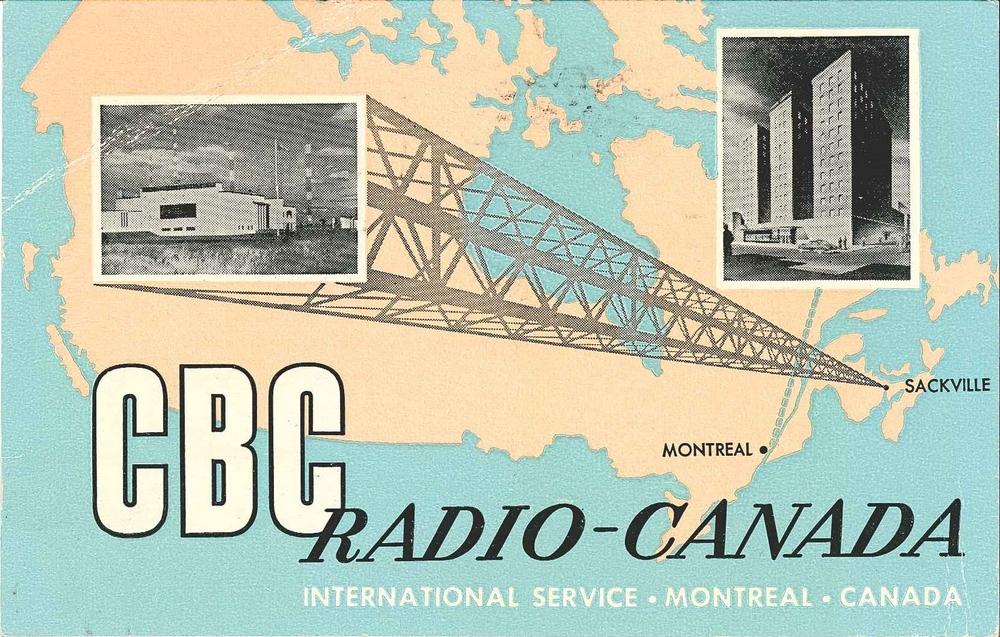
Radio Canada International at 75 years

(Source: RCI.net via David Iurescia)

Today is an auspicious day for RCI. It was February 25, 1945 that the CBC International Service began shortwave broadcasting to Europe. It was designed at the time to provide accurate news to occupied areas in

English French and German, and to provide news from home for the huge contingent of Canadian military personnel serving and fighting in the Second World War.

Since then the “IS” has gone through a variety of changes, including the name which was changed to Radio Canada International in 1970. It has been through several moves, from its first location in a former brothel, to the converted Ford Hotel a few years later, to rented office tower space, to the main headquarters of the French service, Radio-Canada.

It has also gone through a number of language-service changes, from 14 languages during the cold war broadcasting to formerly free countries then under the control of Moscow, to its current five languages, Mandarin, Spanish, Arabic, English and French.

Other changes include the drastic cuts of 2012 which saw some 80 per cent of staff cut and the cessation of shortwave to become its current online operation.

Throughout it all RCI continues to inform on Canadian issues including political, scientific, cultural and societal and provide Canadian viewpoints and positions on world affairs.

Click here to read the full article at RCI.net.

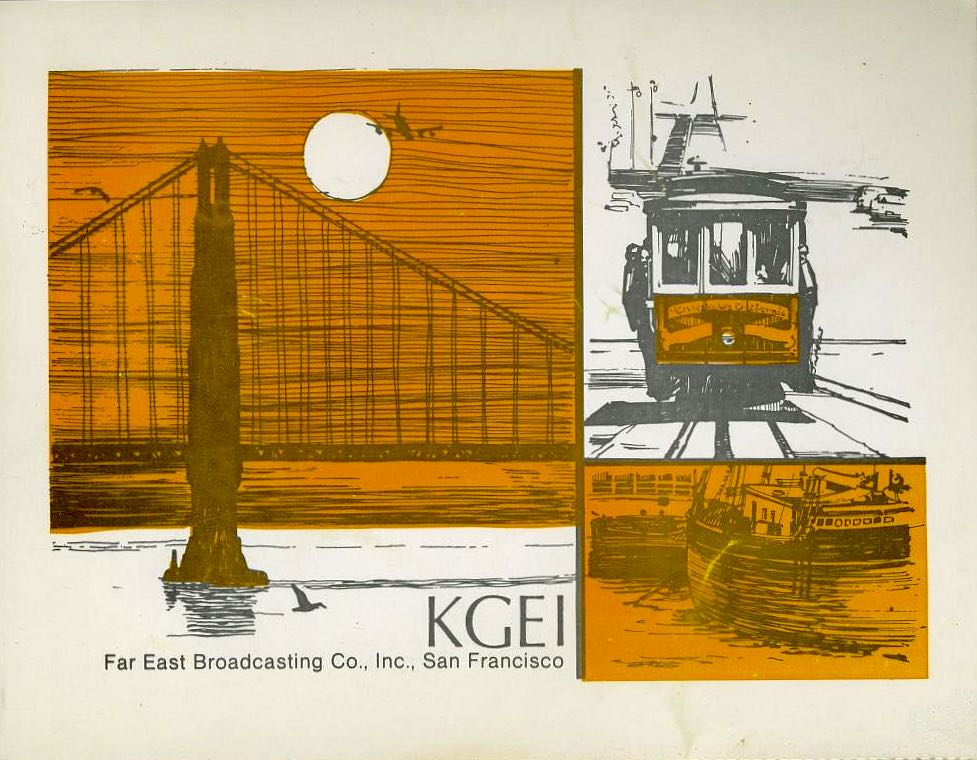
Dan shares memories of work at KGEI

Many thanks to SWLing Post contributor, Dan Van Hoy (K7DAN), who shares the following comment in reply to our recent KGEI post.  Dan writes:

It was my privilege to work at KGEI as a broadcast engineer and antenna rigger with FEBC from 1981-85. After that we went off to serve FEBC in Davao City in the Philippines. Never had any problems with the 50KW GE transmitter except one night when a driver tube failed. Nice to have a transmitter you could walk into! It was back on the air in about 45 min with a new tube. Mario Barahona was the main announcer most nights faithfully bring the Good News from the Voice of Friendship in Spanish.

I also painted the building tan with a dark brown trim while I was there. As I recall, I painted the KGEI name in dark brown too. The biggest project for me was helping install the TCI 16 folded dipole slewable array with reflecting screen stretched between two 365 ft tall towers. I was the only antenna rigger on the project.

The 250KW transmitter was primarily used for Russian broadcasts over the North Pole using the TCI antenna. The ERP was somewhere between 15-20 million watts depending on how the antenna was slewed. We were often heard loud and clear in a variety of home devices in nearby Foster City. I called the 250KW transmitter the worlds biggest Heathkit. It was ably maintained by an amazing radio engineer named Loch Gordon. Jack Brooks, WA6DBT, was the station manager. Hiley Rainer was the jack of all trades do it all engineer. It was one of the most enjoyable periods of my life.

Wow, Dan…I had no idea! Thank you for sharing those wonderful memories.  I can’t imagine singlehandedly installing the antennas you did! I need to call you next time I have an antenna hanging party!