Category Archives: Shortwave Radio

Skyline Radio Germany celebrates 20 years with special broadcast

Many thanks to SWLing Post contributor, Gerard Koopal, who shares the following announcement for Skyline Radio:

SKYLINE RADIO GERMANY – 20 YEARS ON AIR! – PLEASE SPREAD THE WORD!

WE WANT THE AIRWAVES – IF ROCK IS GONNA STAY ALIVE!

Shortwaveradio.de kindly gave us another possibility to be on air with some brand new shows via their transmitters in Northern Germany.

If you would like to try to catch our programmes, 6 hours on October 26th, 2019, Saturday before Halloween, 13.00 – 19.00 UTC would be a good time to give us a listen again.

Try the 75 metre band shortwave on 3975 kHz!

Let’s keep fingers crossed that propagation is good again!

We received more than 30 reception reports again in June and we hope we can beat this result again! So don’t hesitate to write in again.

It might be a good chance for you to catch our very special and unique 1999 – 2019 anniversary eQSL-card! This is available as eQSL-card only!

We look forward to your reception reports and comments to:
SKYLINE RADIO GERMANY, P.O.Box 2702, 6049 ZG Herten, The Netherlands
or via e-mail to: [email protected]

Have a great time with us and Good DX,
DJ Jan-Hendrik

SKYLINE RADIO GERMANY – 20 JAHRE IN DER LUFT! – BITTE GERN WEITER
VERBREITEN!

WIR WOLLEN DIE RADIOWELLEN – DAMIT ROCKMUSIC LEBENDIG BLEIBT!

Shortwaveradio.de hat uns freundlicherweise die Möglichkeit gegeben,
erneut über seine Sender in Norddeutschland mit unseren neuen Shows
auf Sendung zu sein.

Wenn Sie versuchen möchten, unsere Programme zu empfangen, 6 Stunden
am 26. Oktober 2019, Samstag vor Halloween (13.00 – 19.00 Uhr UTC)
wäre wieder ein guter Zeitpunkt, um uns wieder zuzuhören.

Probieren Sie das 75 Meterband Kurzwelle auf 3975 kHz!

Wir drücken die Daumen, dass die Ausbreitungsbedingungen wieder gut sind!

Wir haben im Juni wieder mehr als 30 Empfangsberichte erhalten und wir
hoffen
wir können dieses Ergebnis wieder übertreffen!
Also zögern Sie nicht, uns noch einmal zu schreiben.

Es könnte eine gute Gelegenheit sein, unsere neue spezielle, einzigartige
1999 – 2019 Geburtstags-eQSL-Karte zu erwerben.
Diese ist nur als eQSL-Karte zu erhalten.

Wir freuen uns auf Ihre Empfangsberichte und Kommentare an:
SKYLINE RADIO GERMANY, P.O.Box 2702, 6049 ZG Herten, Niederlande
oder per E-Mail an [email protected]

Viel Spaß bei uns und Good DX,
DJ Jan-Hendrik
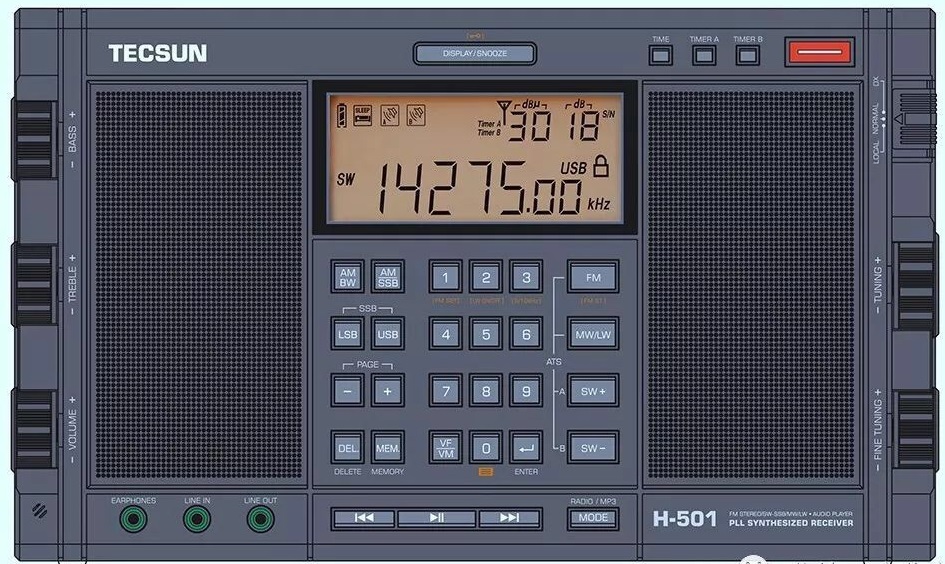
Tecsun H-501 prototype drawing and photo

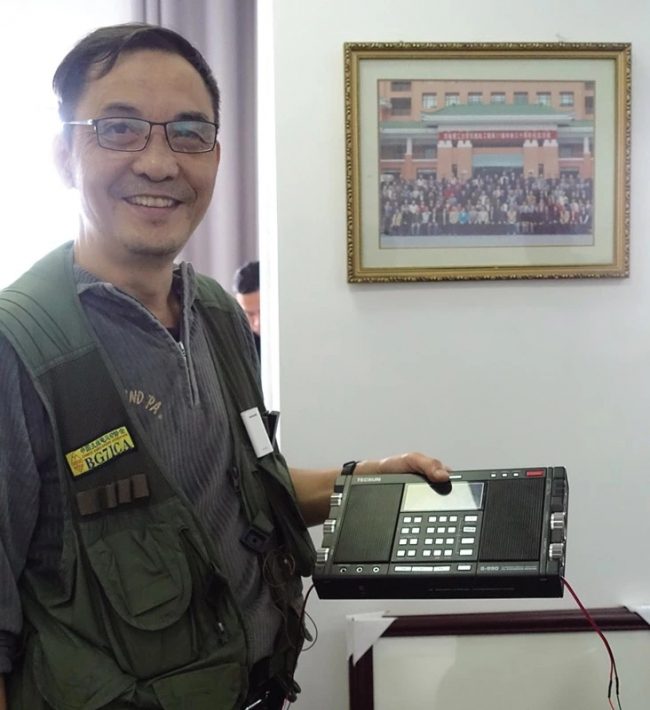
Many thanks to SWLing Post contributor, Robert Richmond, who shares two images of the Tecsun H-501 dated June 21, 2019 from this radio forum.

As Robert notes, “Probably a prototype, so YMMV.” Very true–it’s quite possible further changes could be made to the design or silkscreening before a full production run.

The photo above with BG71CA does give us an indication of the radio’s overall size.

Thanks for sharing, Robert!

Listen to RFE Hungary’s 1956 Revolution Broadcast

Many thanks to SWLing Post executive producer, Scott Gamble, who shares the following article from Hungary Today:

From October 19th until November 12th, Radio Free Europe‘s (RFE) Hungarian broadcast recorded around and during the 1956 Revolution can be listened to online, exactly how it was aired 63 years ago minute by minute, HVG reported.

The Hungarian broadcast of RFE’s 1956 program that was aired on shortwave, through foreign transmitters, was recorded at the repeater stations, and has been preserved thanks to the German government’s examination of the radio’s role in the revolution, launched after the events.

After the inquiry, however, the footage, consisting of 60 tapes, was concealed in a basement for decades, until it was rediscovered in the 90s, transferred to cassettes, and digitized.

In the framework of the First University Radio in Pest’s (Els? Pesti Egyetemi Rádió- EPER) voice memorial project dubbed “SZER56” (derived from the radio’s Hungarian name: Szabad Európa Rádió), people can hear (once again) these recordings. The recordings were restored, digitized, and published by the National Széchényi Library (OSZK), which EPER then restored to the original broadcast session.

The footage includes four days that preceded the outbreak of the Revolution, making it the only available recording that preserved the 50s’ “every day” shows. Moreover, this would be the first time the public can hear this outstanding piece of media history. In addition to political broadcasts, the recordings include radio plays, musical compositions, and even quizzes.

The “broadcast” will be available from Saturday on eper.elte.hu or here and here.

Click here to read the full article at Hungary Today.

Thank you for the tip, Scott!

Readers: If you know of any way we could obtain these recordings, I would love to add them to the Shortwave Radio Audio Archive.

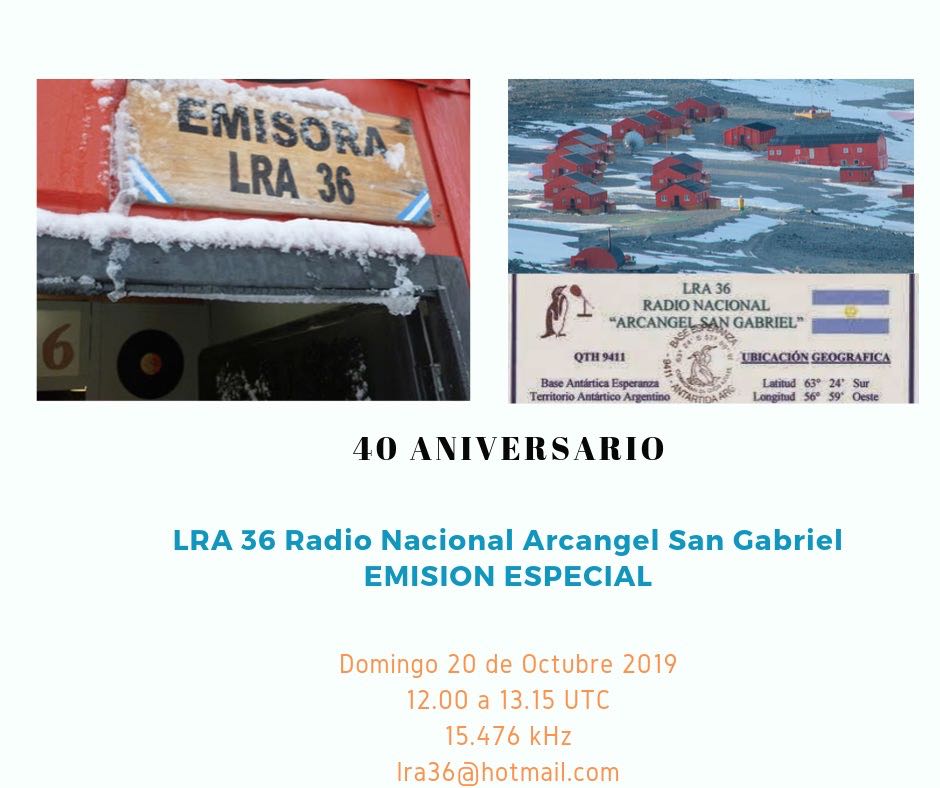
LRA36 anniversary broadcast today!

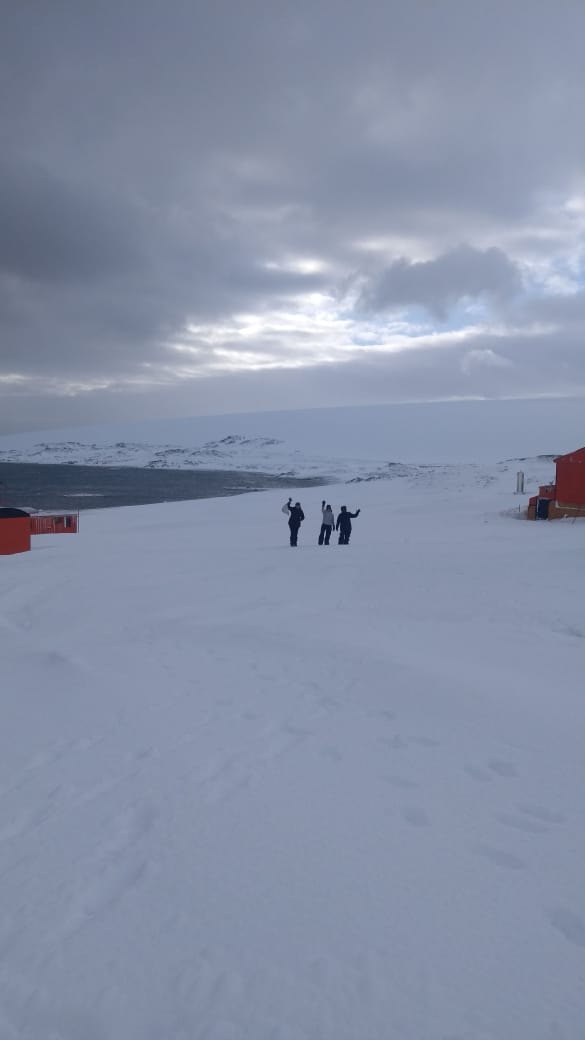
Many thanks to SWLing Post contributor, Adrian Korol, who shares the photo above and video below of the LRA36 crew heading to the broadcast building on the Argentine Antarctic Research Station this morning.

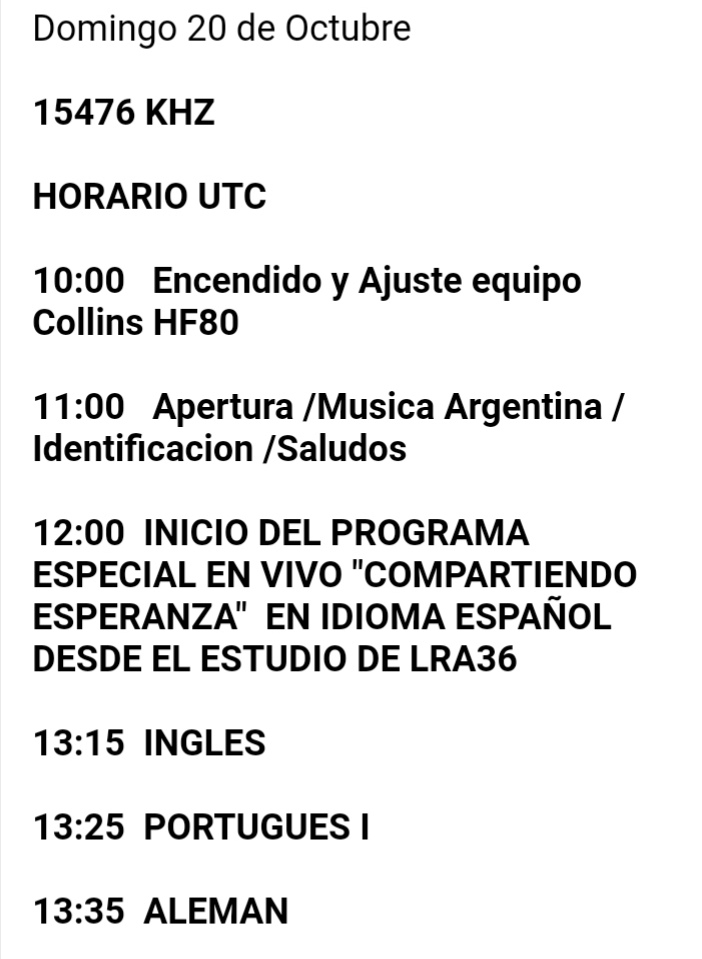
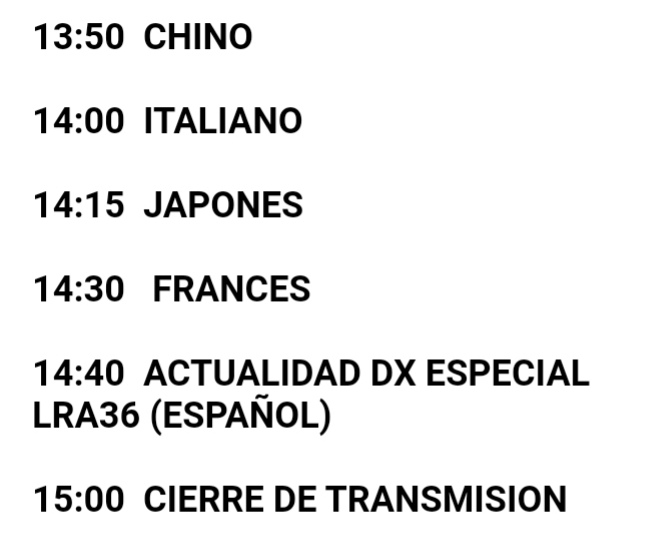
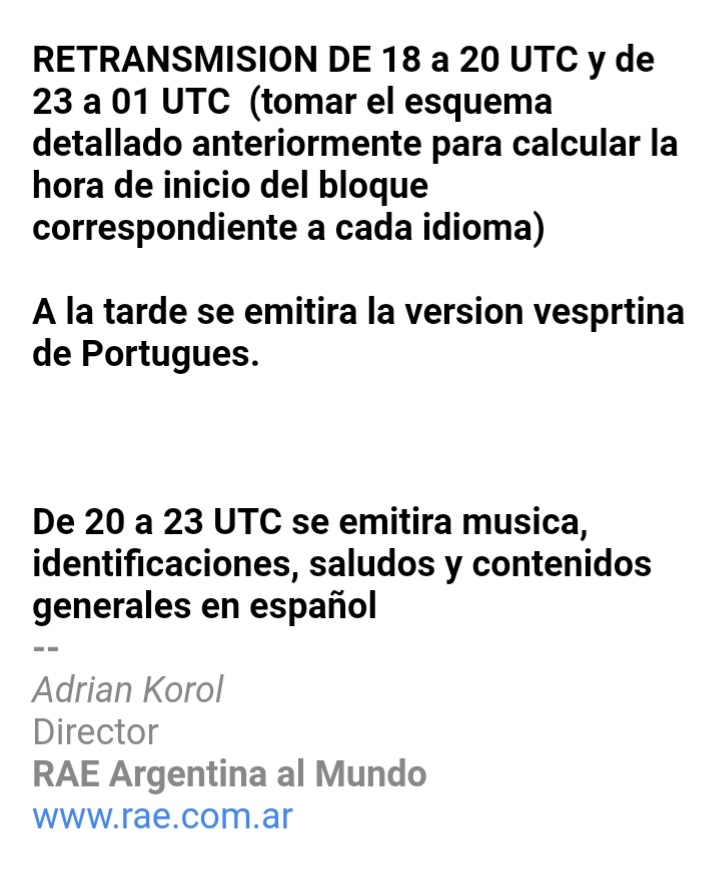
Adrian has also provided the following broadcast schedule (in Spanish) for the anniversary program:

This frequency has not yet opened to eastern North America, but I will be listening today, all day. I have noted that there are few KiwiSDR stations in South America available at the moment. No doubt, listeners are taking up the available seats in hopes of hearing the anniversary broadcast.

I suspect this may be one of the largest audiences LRA36 has broadcast to over its 40 years on the air!

Post Readers: If you manage to capture a good recording of the broadcast, I’d love to post it on the Shortwave Radio Audio Archive.

LRA 36 40th anniversary broadcast reminder and new promotional video

Many thanks to SWLing Post contributor, Adrian Korol, who shares the following promotional video for LRA36’s 40th Anniversary broadcast tomorrow:

Click here to view on YouTube.

For more information about this special broadcast, please read this post.

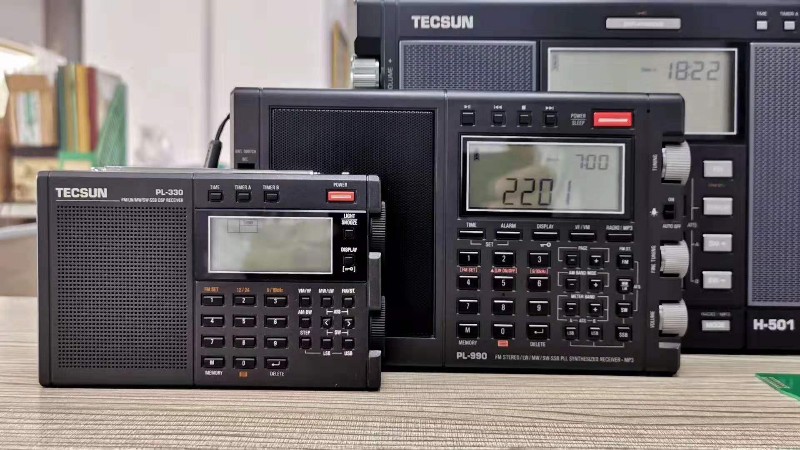
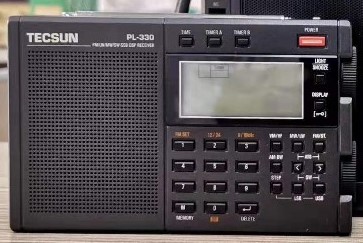
Photo of the new Tecsun PL-330, PL-990, and H-501

Many thanks to SWLing Post contributor, Lee, who writes:

Hi Thomas, I just found this photo [above] on Reddit of three new radios from Tecsun: the PL-330, the PL-990, and the H-501. I knew about the PL-990, but I didn’t realize there was a PL-330 or H-501. Any inside info? 73, Lee

Thanks for your message, Lee. I had not seen the photo of the PL-330 until you sent this one.

The PL-330, I assume, is the latest in the PL-3XX line which has primarily been DSP-based ultralight broadcast receivers. I believe only one model, the PL-365/CountyComm GP5-SSB, had SSB capabilities. The PL-330 appears to have dedicated LSB and USB mode buttons on the front panel (lower right in photo below).

Since both the Digitech AR-1780 and XHDATA D-808 both have selectable sideband, I’m not surprised the new PL-330 does as well. I’m very curious if the PL-990 will be priced competitively like PL-3XX models have been in the past–perhaps below $80 US.

The PL-330 certainly appears to have taken design cues from the PL-990 in terms of overall control layout.

The Tecsun H-501 is a new model that was previously referred to as the Tecsun S-9900.  I believe a pilot run has been made of the PL-990 and H-501–possibly the PL-330 as well.

I will be reviewing each of these radios as soon as they’re available here in the US.

Thanks for the tip, Lee!

Radio Malaysia QSL and memories

In response to our post regarding Radio Sarawak, SWLing Post contributor, M Breyel, shares the following:

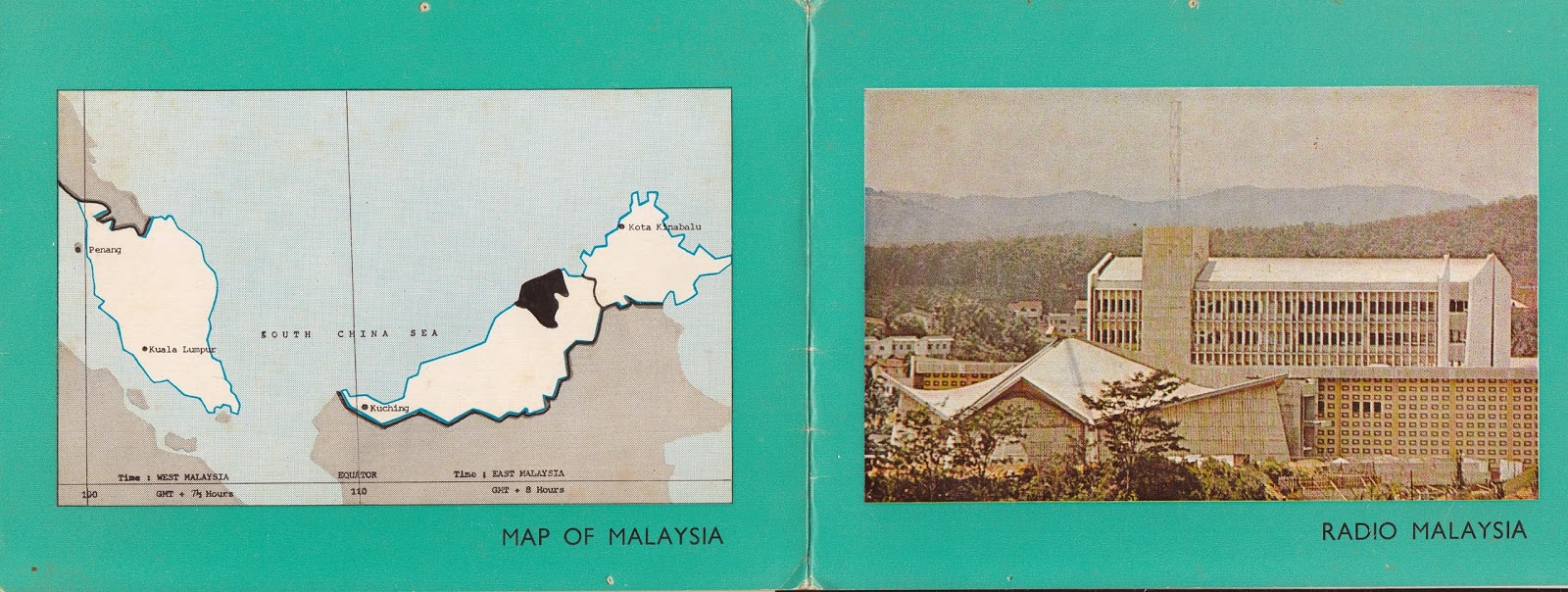
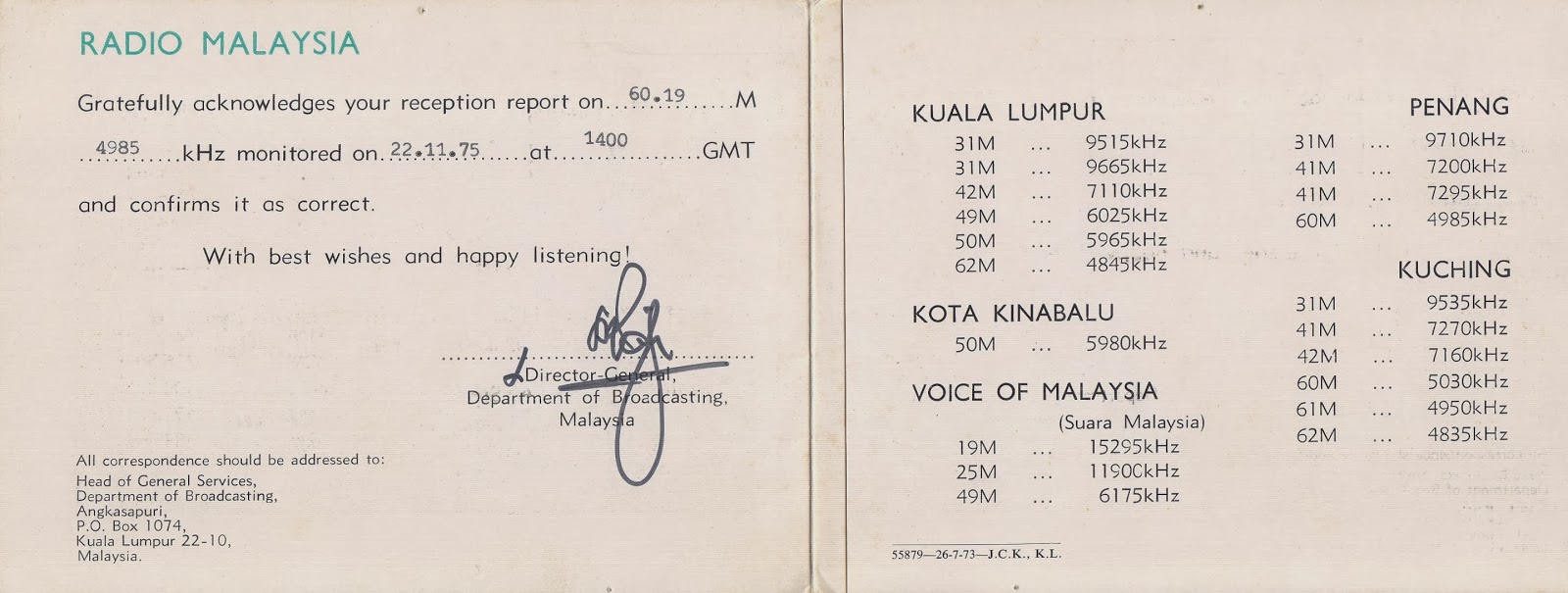
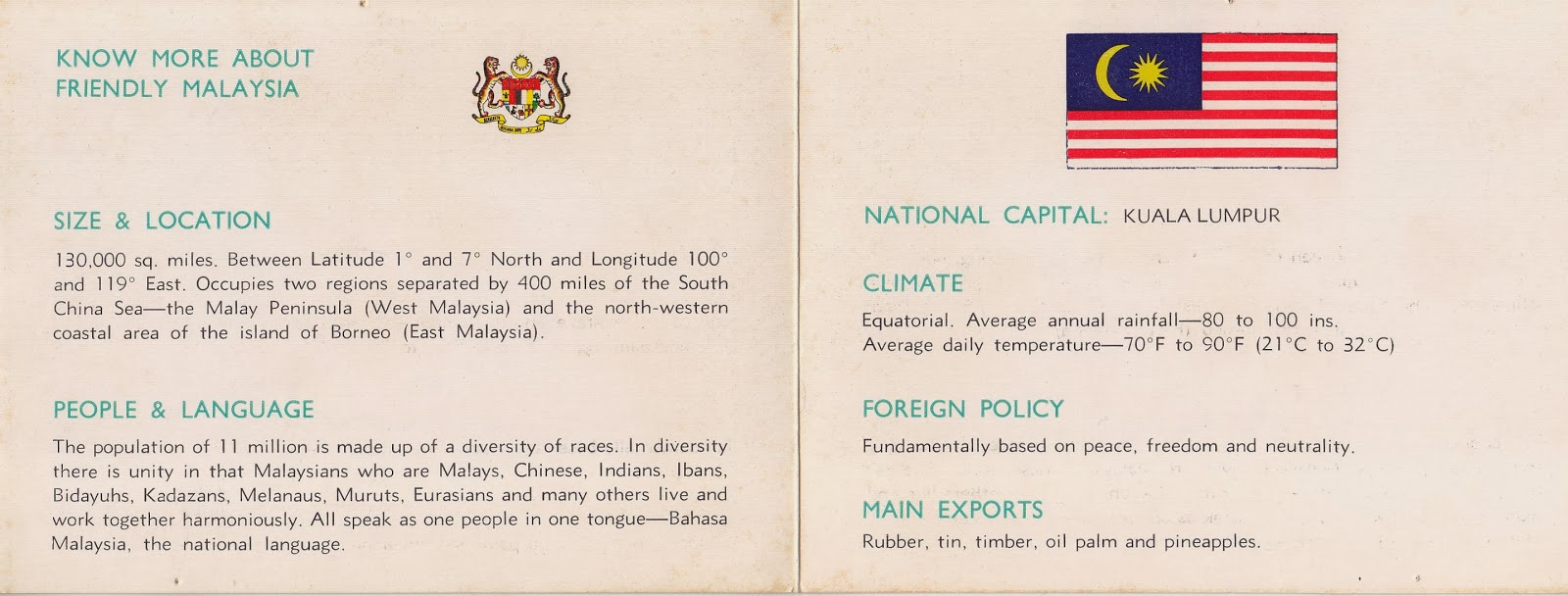
These were the shortwave frequencies RTM used in 1975. This is my QSL card for an RTM transmission originating from Penang, as received on Denver, Colorado. [Click images to enlarge.]

Most MW stations in Malaysia ceased operation after 2000. That said, a 750 kW MW station in Sabah remained operational as late as 2008, if I remember correctly. My guess is FM became more prominent thereafter.

Certainly here in peninsular Malaysia (Kuala Lumpur), particularly in 1987, we had six government FM stations. Sign-off was usually at midnight or 1 am, depending on the station. An annual license (tax) was issued for each radio owned.

Note, the QSL card [above] appears to have first been printed in 1973, judging by the smaller date printed at the bottom of the card. It was one of the few folded cards I received in my DXing years from 1967 to 1980. It features three sections, folded twice and printed on both sides. The Angkasapuri studio in Kuala Lumpur, map and flag of Malaysia, caption about the country, transmitter sites and frequencies and verification data is depicted on it.

This particular card was issued for a reception report I posted on 22 November 1975, nearly 40 years ago. Unbeknownst to me then I had picked up Radio Malaysia via Penang, according to the frequency legend (4.985 kHz) stated on the card. I assumed it was Kuala Lumpur and, more importantly, I was excited to have logged a new country to my growing list of international broadcasters.

At the time I lived in Northglenn, Colorado — a suburb north of Denver. As I recall Radio Malaysia was usually received in the early morning hours between 5 and 8 am. Reception was always weak, yet music and speech was audible despite atmospheric noise.

The receiver I used was a Zenith Trans-Oceanic H-500, a 5 valve/tube radio originally manufactured in the early 1950s. The antenna was an inverted L, elevated at over 30 feet, spanning approximately 75 feet in length.

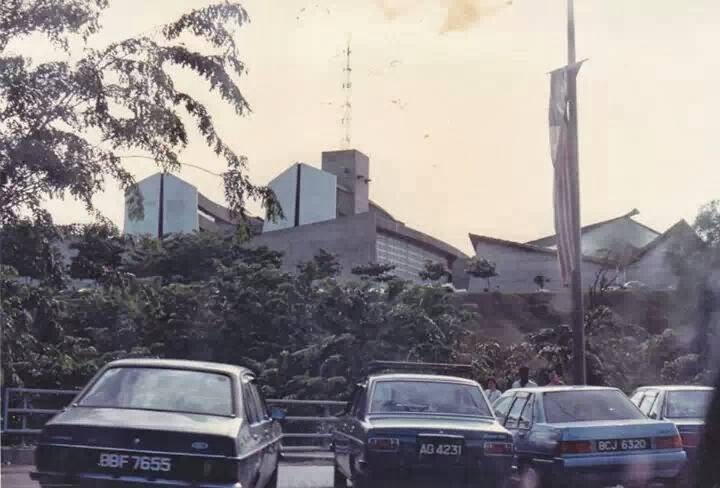
This is a photo of Angkasapuri, the RTM Headquarters in Kuala Lumpur, as it appeared in 1987. The HQ as changed very little since then:

Interestingly, the Australian Armed Forces had a radio station based in Penang in the late 70s-early 80s.

For more on vintage QSLs from Malaysia, please refer to my blogsite.

Or see this video.

Wow–thank you for sharing your DXing experience with us! It sounds like the Zenith Trans-Oceanic H-500 served you quite well back then! What a classic set.

Post readers: Please check out M Breyer’s blog for more interesting DX and radio history.


Do you enjoy the SWLing Post?

Please consider supporting us via Patreon or our Coffee Fund!

Your support makes articles like this one possible. Thank you!