Category Archives: Shortwave Radio

USAGM’s Chief Executive John Lansing resigns

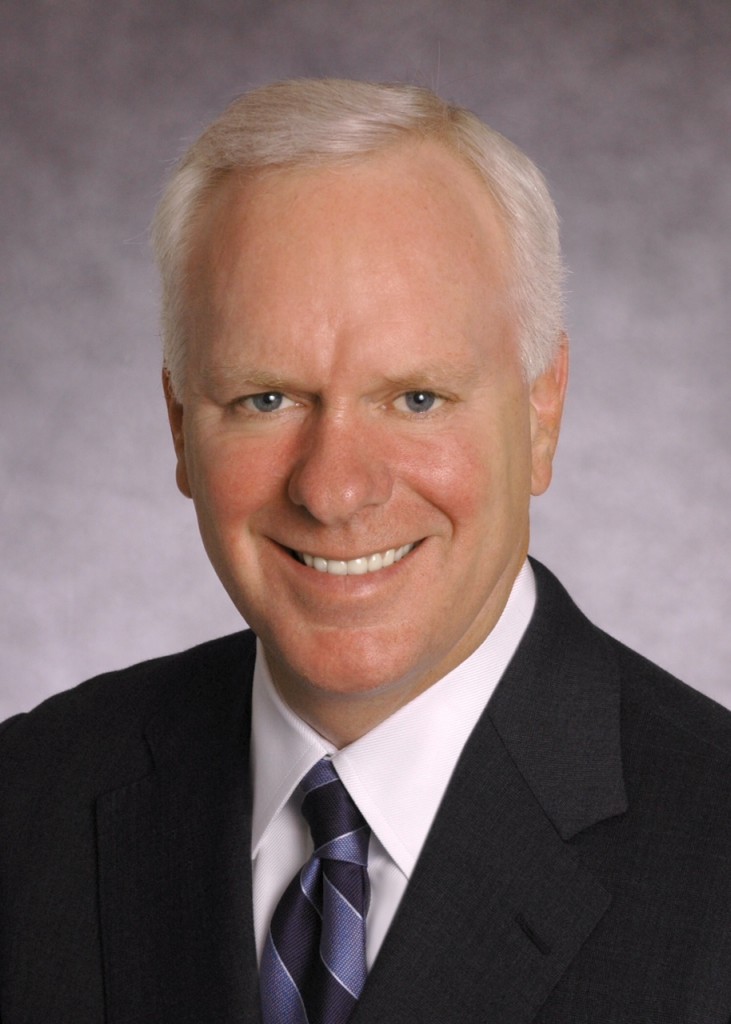
John Lansing (Source: BBG)

(Source: VOA News via Richard Cuff)

WASHINGTON – The U.S. Agency for Global Media’s Chief Executive John Lansing said he will be leaving his post at the end of the month.

Lansing, a veteran government broadcast and cable television executive, was named four years ago by U.S. President Barack Obama to be the first chief executive of the U.S. Agency for Global Media, which oversees the Voice of America, Radio and Television Martí, Radio Free Europe/Radio Liberty, Radio Free Asia, and Middle East Broadcasting Networks.

Lansing made his mark at the agency early on by championing a free press.

“Despite some very dark moments, we have not been silenced. We will continue to report the truth. We will continue to find new ways to get independent reporting and programming to global audiences who rely on it,” he said this year on World Press Freedom Day.

USAGM board Chairman Kenneth Weinstein said in a statement, “John has put USAGM on solid footing to advance our mission to inform, engage and connect people around the world in support of freedom and democracy. … The Board is very grateful for, and deeply impressed by, the results achieved during his tenure.”

Lansing has boosted the networks’ global weekly audience by more than 100 million and expanded the agency’s use of platforms from encrypted live broadcasting to shortwave radio to push content into countries that jam or ban American programming.

Under his watch, the agency also created Current Time, a network broadcasting news, features and documentaries for Russian speakers in 2017. Polygraph and Faktograph are websites aimed at combating a stream of disinformation by Russia state-controlled media. A new Persian-language service, VOA365, also started broadcasting earlier this year.

In a statement released late Thursday, Lansing said he would be starting a new position at chief executive at National Public Radio, a publicly funded nonprofit membership media organization based in Washington.

Lansing acknowledged challenges ahead for the agency with countries such as Russia, China, North Korea and Iran trying to control information and spread their influence throughout the world.

“Please keep abiding by the highest standards of professional journalism. Please keep fighting for press freedom. Please keep telling the truth. The world needs you now more than ever,” he concluded in his statement to employees.

Weinstein said in his statement, “It is the Board’s top priority to find the best individual to run USAGM upon John’s departure.”


W9IMS: Last chance for the Checkered Flag Award

Many thanks to SWLing Post contributor, Brian (W9IND), who writes:

If you’re chasing the W9IMS Checkered Flag Award, this weekend marks your last chance to snare the third and final special event of the year. The Brickyard 400 operation will conclude at 11:59 p.m. Sunday, Sept. 8 (Indianapolis time)/0359 UTC Sept. 9.

The W9IMS crew will be working other amateurs around the world, but SWLs can qualify for the same certificate and QSL cards that are offered to hams. The Checkered Flag Award is available to anyone who contacts or tunes in W9IMS during all three special events commemorating the major races at the Indianapolis Motor Speedway – the IndyCar Grand Prix (early May), the Indianapolis 500 (late May), and the Brickyard 400 (September).

For those who already logged W9IMS during the IndyCar Grand Prix and the Indianapolis 500, this is your opportunity to complete the clean sweep and earn the colorful 2019 certificate, as well as the three QSL cards. Even if you missed one or both of the previous races, you’re still eligible for a Brickyard 400 QSL card, which is redesigned every year.

Look for W9IMS on 20, 40 and 80 meters – generally as close as possible to 3.840, 7.245 and 14.245 MHz, and often with two SSB stations on the air simultaneously. W9IMS also has a digital presence, periodically transmitting in FT8 mode.

To see if the station is on the air at any given time, go to DX Summit – http://dxsummit.fi/#/ – and type “W9IMS” in the search box.

For more information about W9IMS, including how to obtain certificates and QSL cards, go to www.w9ims.org. The W9IMS page also contains a link to the Brickyard 400 operator schedule, but remember that ops can get on the air at any time between now and Sunday night.

If all else fails, look for W9IMS during its final hour of operation, between 11 and 11:59 p.m. Sunday (0300 to 0359 UTC Monday). That’s usually the time when W9IMS engages in a contest-style “happy hour” blowout, sometimes on two bands, as the closing minutes tick away.

Thank you for the reminder, Brian!

Guest Post: Missing the Static

Many thanks to SWLing Post contributor, Lou Lesko, who shares the following guest post:


Missing the Static

by Lou Lesko

Nineteen-ninety-one, my girlfriend Michelle and I were asked to house-sit her parent’s place in a remote part of Morgan Hill, south of San Jose, California. One had to drive for two miles on a dirt road through a running creek to get to the house deep in the woods. It was magical. The place ran on generators and a massive array of batteries.

We stayed in the master bedroom. Bob, Michelle’s step-father, had a shortwave radio on his bedside table. The radio was connected to a huge twenty foot high antenna stuck in the ground outside the bedroom window. Fumbling through the controls for the first time I found the BBC in London and a myriad of other broadcasts in different languages from cities all over the globe. It was mesmerizing.

Thanks to a book I found, Passport to World Band Radio, I learned that scanning to find broadcasts was called DXing. The book also listed frequencies and some of the known active times of stations around the world. It also explained the phenomena of shortwave: radio signals within a specific frequency range have properties that cause them to bounce between the ionosphere and the earth’s crust allowing efficient propagation around the globe. Conditions like weather, the electronic interferences of modern life, and solar flares all had an effect on the quality of the signal and how far it could travel.

The more I learned, the more I listened. Scrolling through the static to discover random broadcasts from radio Cuba or radio Moscow was blissful escapism that charged my imagination. At the time the BBC had 120 million weekly listeners. The largest audience of any broadcast medium in history.

It was a sad day when Michelle’s parents returned. Not only did Michelle and I have to go back to our tiny apartment—playing house was fun—I had to give up the shortwave radio.

A month later Michelle gave me a portable shortwave radio as a Christmas gift. It wasn’t nearly as powerful as the rig in Morgan Hill, but it worked fabulously well for receiving strong signals. I listened to it every night before falling asleep.

Three years later, during an annual trip to Yosemite, I wondered what the reception would be like if I were to take the portable radio up a few thousand feet way out of the range of street lights, televisions, toasters—all things electronic that impede reception of anything except the strongest signals.

I embarked on a solo hike up 12,000 feet to the top of Mammoth Peak in Tuolumne Meadows. Optimal listening time was just after sunset and into the night California time. Alone, wrapped in a subzero sleeping bag, a bitting breeze blowing, bathed the etherial pale glow of moonlight reflecting off the white granite, I turned on my radio. It was overwhelming. Every tiny turn of the dial yielded something new I had never heard before. I tuned in to almost every part of the globe.

Shortwave has faded. Its gradual decline started at the end of the cold war, Western governments no longer saw the need to shoulder the large costs associated with transmitting on shortwave frequencies. The demise was further hastened in 2001 when then BBC World Service Director Mark Byford stopped the broadcasts to North America citing the emerging Internet and satellite radio as the future for reaching audiences. He was of course correct.

Radio Garden, a web site that delivers a graphical version of what shortwave used to do, offers an animated picture of the globe dotted with internet radio broadcasters. Click on a dot, listen to a radio station in another part of the world in crystal clarity. Radio Garden is exceedingly clever and a wonder of modern technology. As are podcasts, streaming television, Facetime calls. All of it extraordinary and life altering. And yet, every once in awhile, I miss that unique thrill I used to get when I discovered a voice broadcasting from a far away place I’ve never been. Every once in awhile, I miss the static.


Lou Lesko is a writer, and a former editor-at-large for National Geographic.

Click here to visit Lou’s website.

Lou, thank you for sharing the static!

Starwaves seeks path to “affordable, distributable” DRM receivers

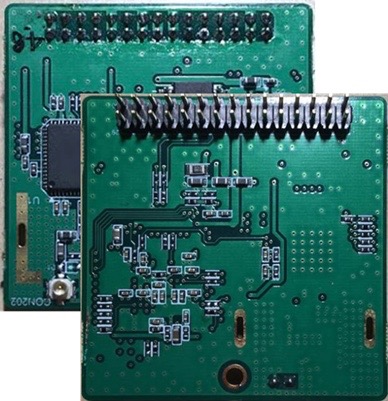
Starwaves Decoder (Source: DRM Newsletter)

(Source: Radio World via Marty)

[…]For years, NASB members have wanted to replace (or at least augment) the poor audio quality of analog SW with the crystal-clear sound of digital SW radio, specifically the Digital Radio Mondiale standard developed in Europe that is now being used in China and India.

[…]There are some DRM radios in use now, which is why some NASB members are offering limited DRM broadcasts alongside their regular analog SW transmissions.

“But the current generation of DRM SW receivers cost about $100 each, whereas you can buy a cheap analog SW radio for as little as $10,” said Dr. Jerry Plummer, a professor at Austin Peay State University in Clarksville, Tenn., and frequency coordinator for U.S. SW station WWCR. “Given that the audiences being targeted by NASB members are largely in the third world, the lack of inexpensive DRM receivers keeps them listening tDRMo analog shortwave.”

[…]Given the NASB’s interest in low-cost DRM receivers, it was no coincidence that Johannes Von Weyssenhoff was invited to speak at the annual meeting. Von Weyssenhoff said his StarWaves manufacturing firm (www.starwaves.de) has the technology, capability and existing prototypes to build DRM radios for $29 each, but only if the sale order is large enough to deliver economies of scale. (He also estimated $18 DRM modules could be built for installation in other radio models.)

“Twenty-nine dollars is doable at volumes staring at 30,000 receivers,” Von Weyssenhoff told Radio World. “Even smaller quantities would be possible at this price for very simple radios — for example, without graphics displays — but these would be special projects that had to be discussed individually. But even more advanced radios with Bluetooth or premium designs will be possible to offer at a reasonable price,” he said — as long as the sales orders was in the tens of thousands or more.[…]

Click here to read the full article at Radio World.

Guest Post: The National Association of Armchair Adventurers (NAAA)

Many thanks to SWLing Post contributor, Bob Colegrove, who shares the following guest post:


National Association of Armchair Adventurers (NAAA)

as recalled by Bob Colegrove

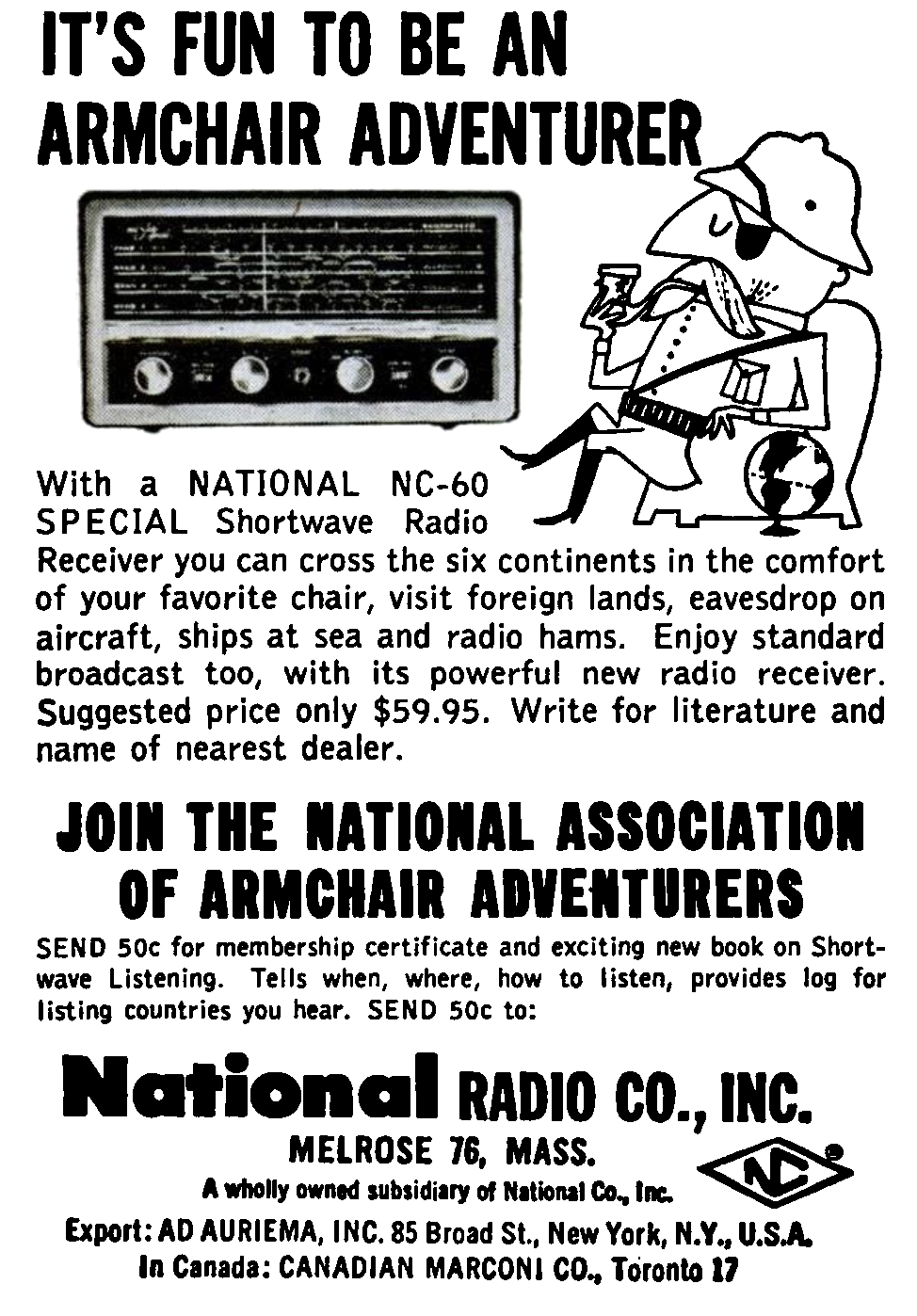
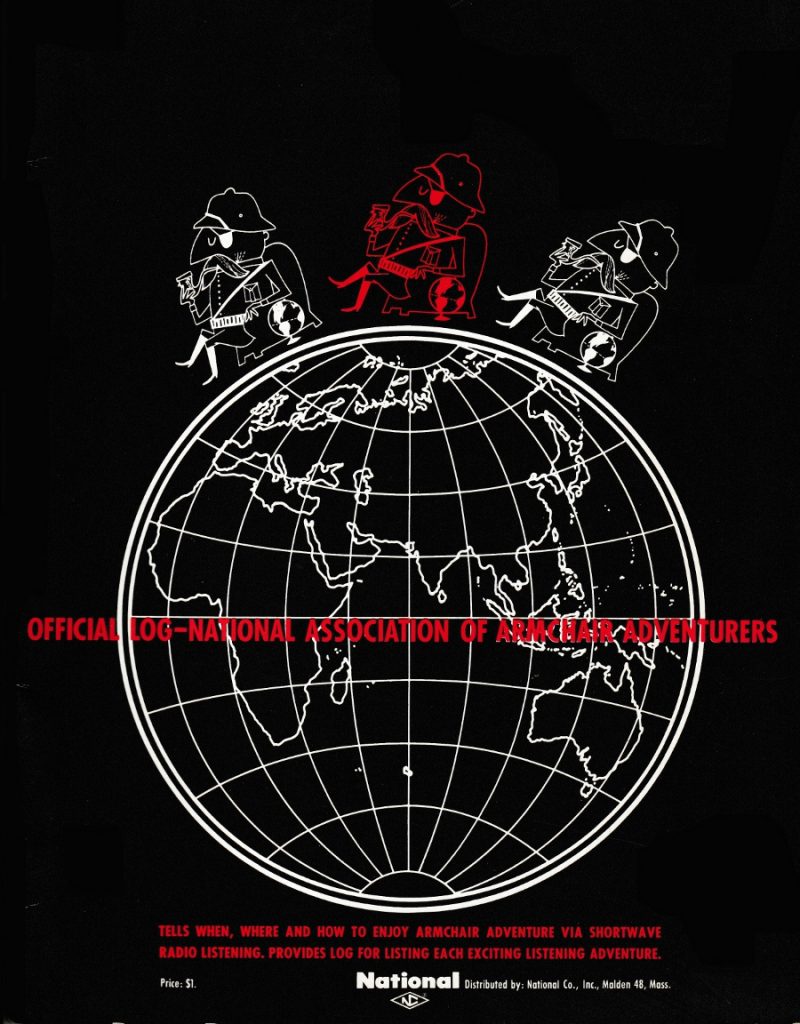
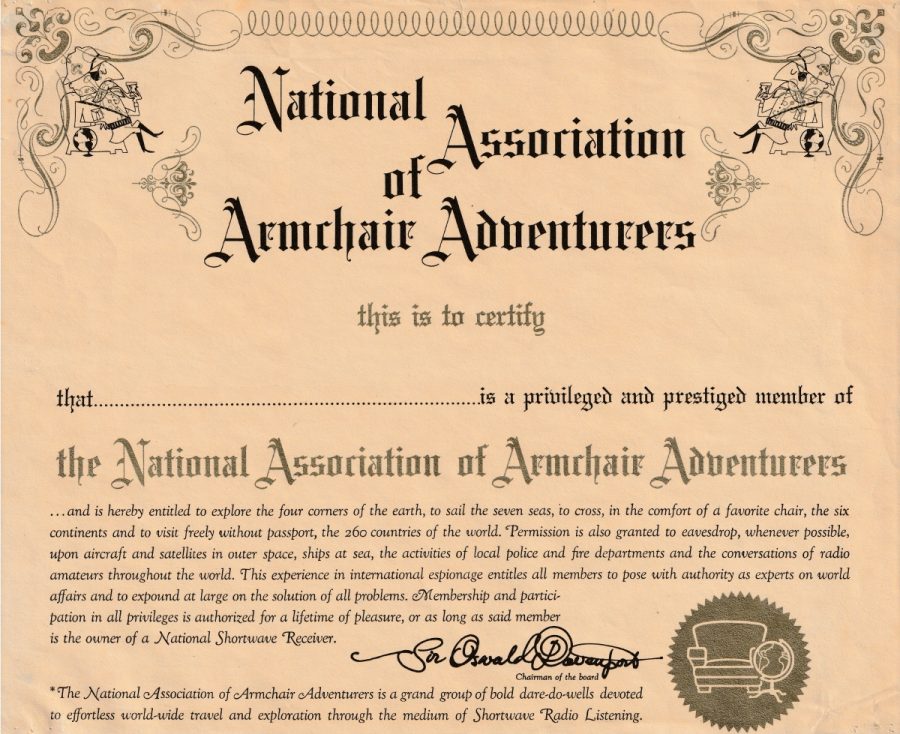
Those of you who were into SWLing in the late ‘50s or early ‘60s may remember the NAAA.  It was an engaging promotional effort by the National Radio Company to generate interest in shortwave listening.  This was done through ads run in magazines such as Popular Electronics, and displays in stores.  Yes, shortwave radios were once sold in brick and mortar stores.  The very proper gentleman depicted below, replete with khaki uniform, pith helmet, jackboots and calabash pipe is none other than Sir Oswald Davenport, Chairman of the Board, and a consummate SWLer of his time who never left the comfort of his own armchair in order to tour the world as it was virtually possible to do at that time.  For those too young to appreciate the connection, a “davenport” was a genericized trademark meaning couch or sofa in today’s parlance.

As the ad indicates, for fifty cents you were admitted to the Association.  This included a nice booklet containing an introduction to shortwave listening by Jack Gould, radio-TV critic for the New York Times, a sampler of stations ‘currently’ broadcasting around the world, log sheets and a large certificate of membership suitable for framing and signed by Sir Oswald himself.

The certificate reads, “this is to certify that (name) is a privileged member of the National Association of Armchair Adventurers… and is hereby entitled to explore the four corners of the earth, to sail the seven seas, to cross, in the comfort of a favorite chair, the six continents and to visit freely without passport, the 260 countries of the world.  Permission is also granted to eavesdrop, whenever possible, upon aircraft and satellites in outer space, ships at sea, the activities of local police and fire departments and the conversations of radio amateurs throughout the world. This experience in international espionage entitles all members to pose with authority as experts on world affairs and to expound at large on the solution of all problems.  Membership and participation in all privileges is authorized for a lifetime of pleasure, or as long as said member is the owner of a National Shortwave Receiver.”

The radio depicted in the ad was the then new National NC-60 Special, a 5-tube ac/dc, entry level receiver, which was a direct competitor of the Hallicrafters S-38E.  This writer recalls standing in front of the two mentioned receivers on display at the local ham shop in downtown Indianapolis in 1959 trying to decide on which radio to invest his hard-won sixty dollars.  The salesman wasn’t pushy, it came down to a coin flip, and the Halli came home with me. Although I’ve never regretted it, I still wonder what exotic mysteries lay behind the NC-60’s dial. Although my pen-and-ink name has long since faded, the NAAA certificate still hangs prominently in the shack.

Proposal to suspend Radio Romania International’s shortwave service has been rejected

Many thanks to SWLing Post contributor, Tudor Vedeanu, who shares the following update regarding the threat to RRI’s shortwave service.

Tudor writes:

I contacted MediaSind asking for more details about the suspension of the SW broadcasts at RRI. Liviu Grosu, the general secretary of MediaSind told me this:

“Following the reactions of MediaSind, the members of the Board of Directors rejected the proposal of the president-general director of the SRR, Georgica Severin, regarding the suspension of the shortwave broadcasts.”

Brilliant news, Tudor! Thank you for sharing this and also many thanks for obtaining Liviu Grosu’s approval to post his message here on the SWLing Post.

Readers, if you love RRI’s shortwave service, I believe this would still be a great time to let them know you’re happy they’re on the air! For the English language service, use the following email address: [email protected]


Do you enjoy the SWLing Post?

Please consider supporting us via Patreon or our Coffee Fund!

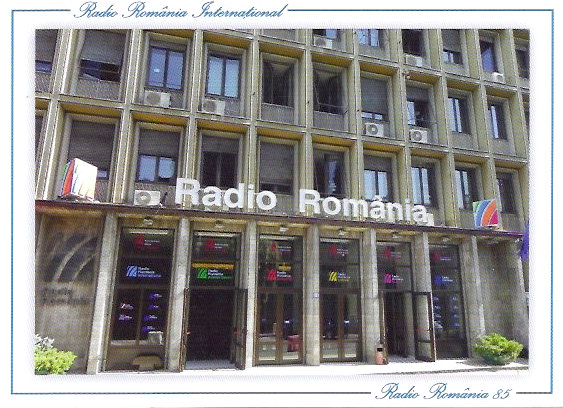
Radio Romania International’s shortwave service under threat

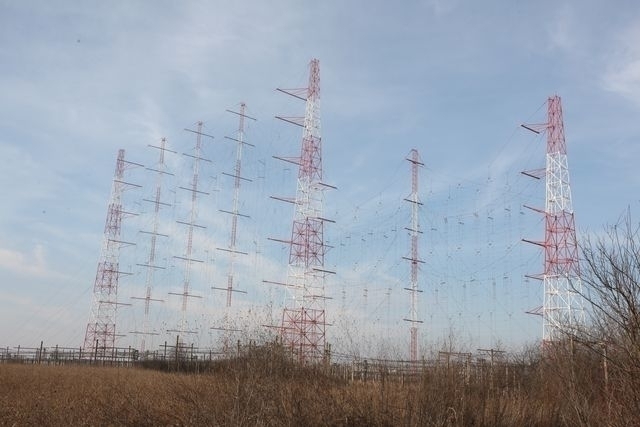
RRI’s Tiganesti-based shortwave transmitter centre (Photo source: Radio Romania International)

Important: Click here to read our update.

Many thanks to a number of SWLing Post readers who have shared a link to this article on the AGERPRES website.

The article is in Romanian and many are interpreting it as stating that the shortwave services of Radio Romani International have already been cut.

I asked SWLing Post contributor, Tudor Vedeanu, for his interpretation. Tudor replied:

[I]t looks like Georgic? Severin, the President and Director General of Radio Romania, repeatedly announced his intention of ceasing shortwave transmissions, due to the recent budget cuts. I could’t find an official announcement about this, but the press release from MediaSind (the Romanian Journalists Trade Union) is worrisome enough.

Tudor will keep us informed as he learns more about this development.

RRI is one of my favorite broadcasters on shortwave. The Romanian service has amazing music programs and I also enjoy listening to their English and French news reports. If the budget cuts are severe, I suspect it may indeed mark the end of their shortwave service.

If you’d like to share your thoughts or express your concerns, consider dropping the English language service of RRI a note via this email address: [email protected]

Click here to read the AGEPRES article.

Tudor, thank you so much for your help and clarification!


Do you enjoy the SWLing Post?

Please consider supporting us via Patreon or our Coffee Fund!

Your support makes articles like this one possible. Thank you!