Category Archives: Shortwave Radio

Update: Discontinuation of NWS High Seas and Storm Warnings on WWV and WWVH

Many thanks to SWLing Post contributor, Mohamed, who comments with an update about the loss of NWS High Seas and Storm Warnings on WWV and WWVH. Mohamed writes:

The decision to terminate the broadcasts has not been retracted. It has only been delayed to January 31, 2019:

(Source: National Weather Service)

NOUS41 KWBC 151610
PNSWSH

Service Change Notice 18-102
National Weather Service Headquarters Silver Spring MD 1210 PM EST Thu Nov 15 2018

To: Subscribers:
-NOAA Weather Wire Service

-Emergency Managers Weather Information Network -NOAAPORT
Other NWS Partners, Users and Employees

From: Craig Hodan, Chief Dissemination Systems Branch

Subject: Discontinuation of NWS High Seas and Storm Warnings
over NIST Time Frequency Broadcasts Effective January 31, 2019

Effective Thursday, January 31, 2019, at 200 pm Eastern Standard Time (EST) or 1800 Coordinated Universal Time (UTC), the NWS will discontinue dissemination of High Seas and Storm Warnings portion of the National Institutes of Science and Technology (NIST) time frequency broadcasts as issued by WWV and WWVH “shortwave” radio covering the Atlantic, Gulf of Mexico and the Pacific.

This service is being terminated because weather information in the current broadcast format does not support frequent enough updates for changes in marine weather and cannot provide enough detail in the allotted window required by mariners to avoid hazardous weather. Additionally, alternative technologies and numerous media outlets that provide weather information in various formats have overtaken the need for providing weather information through the NIST frequency signals.

Other sources of marine weather and high seas alerts and detailed forecasts are available over satellite, telephone, the Internet, Marine Fax, Radio Fax and VHF radio. Currently the NWS, U.S. Coast Guard (USCG), and the U.S. Navy (USN) provide multiple dissemination methods for storm positioning, high sea areas, observations, forecasts, outlooks and warnings for both coastal and oceanic marine zones near the United States using Navigational Telex (NAVTEX), Global Maritime Distress and Safety System (GMDSS) and High Seas SImplex Teletype Over Radio (HFSITOR) in compliance with World Meteorological Organization (WMO) policies and the International Safety of Life at Sea (SOLAS) Convention.
Please refer to the following websites for more information on how to use these technologies:

1. http://www.nws.noaa.gov/om/marine/navtex.htm (NAVTEX)

2. http://www.nws.noaa.gov/om/marine/gmdss.htm (GMDSS)

3. http://www.nws.noaa.gov/om/marine/hfsitor.htm HFSITOR)

4. http://www.nws.noaa.gov/om/marine/inmarsat.htm (SAFETYNET)

5. http://www.nws.noaa.gov/os/marine/vhfvoice.htm (USCG VHF)

For additional information, please contact:

Gregory Zwicker
National Weather Service
Dissemination Systems Branch
301-427-9682
[email protected]

National Service Change Notices are online at:

https://www.weather.gov/notification/

NNNN
Catching coastal shortwaves with the CC Skywave SSB

After Thanksgiving Day (here in the States) my family took a little camping trip on the coast of North Carolina. We spent a few nights near Holden Beach and Oak Island–some of my favorite parts of the NC coast.

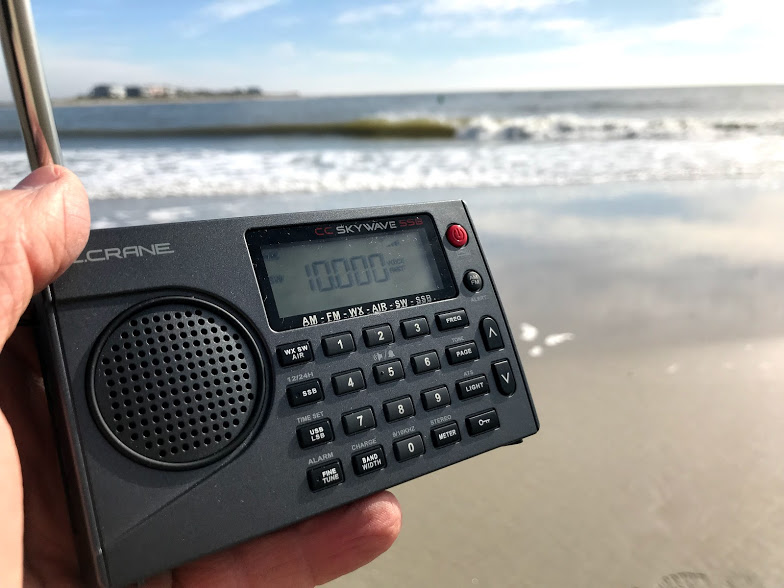
Weather was splendid on Sunday, so we took a long walk on the beach and, of course, I packed a portable radio–this time, the CC Skywave SSB.

The Skywave SSB is a pricey portable, but it has certainly become my choice travel radio as it covers so many radio bands (AM/MW, FM, SW, AIR and WX). It’s also incredibly portable and can hang with the best in terms of sensitivity and selectivity.

I didn’t check propagations conditions on Sunday, but there were signals booming in from everywhere. I took a few short sample videos:

Click here to view on YouTube.

Click here to view on YouTube.

Click here to view on YouTube.

Click here to view on YouTube.

Being away from sources of radio interference and standing next to (and occasionally in—!) the Atlantic Ocean certainly helped a great deal with reception.

I had planned to put my Elecraft KX2 on the air while here, but simply didn’t have the time to fit it in with family activities.

Post readers: Do you have any radio vacations on the horizon?

C. Crane Cyber Monday Sale: 10% off all products

I received a promotional email from C. Crane this morning announcing their Cyber Monday Sale of 10% all products in their catalog. While this isn’t an incredibly deep discount, it’s about as low as you’ll ever see C.Crane go.

If you’ve been considering a C. Crane product, this might be the time to order. Make sure you use their coupon code CM18 at checkout!

Click here to shop C.Crane.

Talking shortwave and spectrum on the Radio Survivor podcast

Last week, I had the honor of speaking with Eric Klein and Jennifer Waits on the excellent Radio Survivor podcast. It’s rare that in one show I get to spread so much shortwave radio love–thanks for making that happen Radio Survivor:

Perhaps you are like me and you have wished that you could go back in time and spin a radio dial and just listen to and browse the full radio spectrum from another time and place. Our guest on the show, Radio Anthropologist Thomas Witherspoon, is building a website for just such a thing. It’s called the Radio Spectrum Archive and it is not magic, it uses a piece of technology called a software defined radio that makes recording a full spectrum of Shortwave, AM and even FM radio (if you have the computing power to handle the load) a very real possibility. Thomas Witherspoon is also the primary contributor to The Shortwave Listening Post (www.swling.com) so we are going to learn a few things about the wonder that is shortwave radio on planet earth.

Click here to download the podcast audio.

Click here to listen via Radio Survivor.

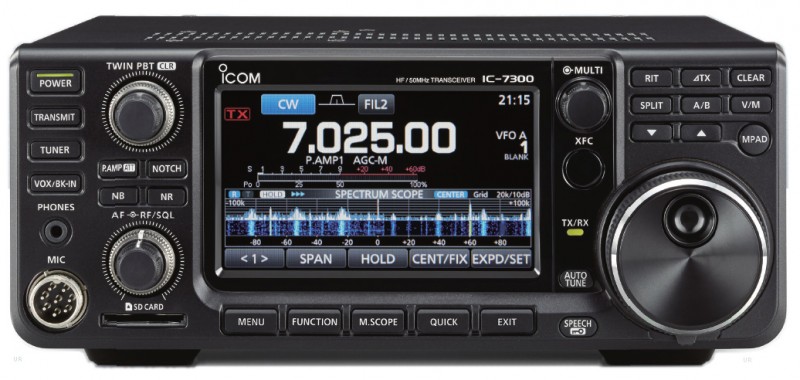
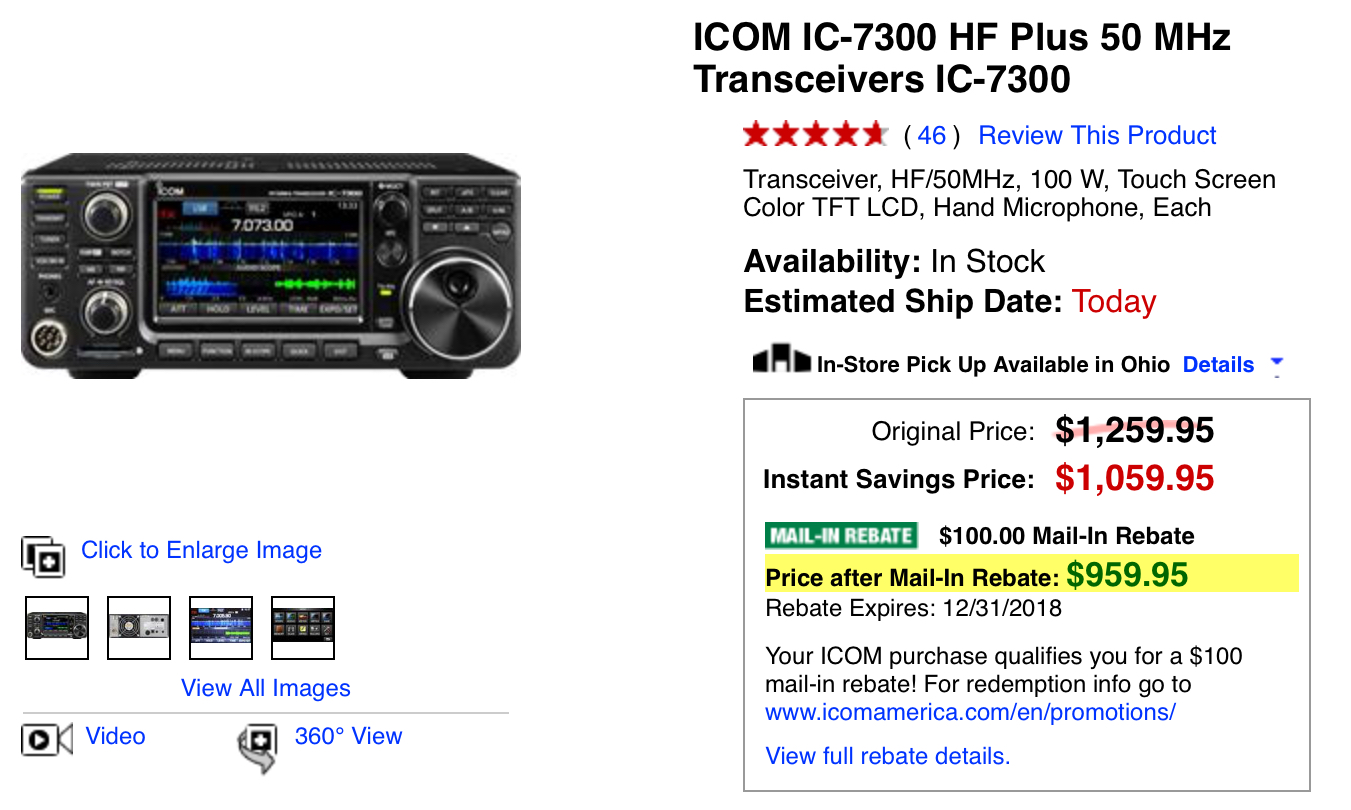
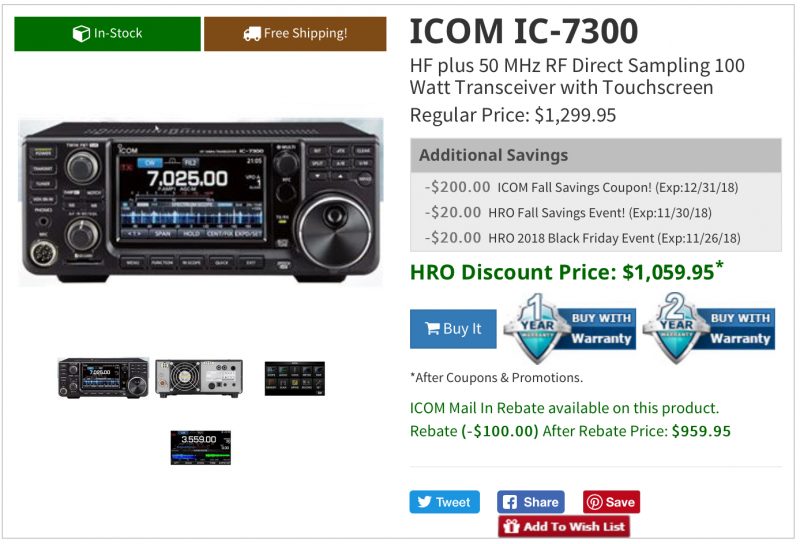
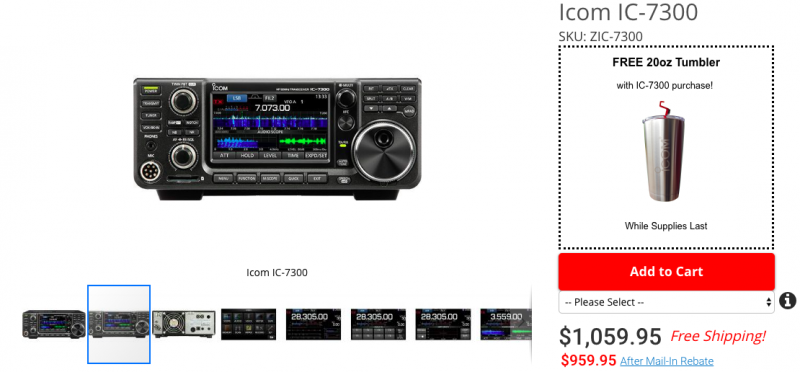
Black Friday Radio Deals: Icom IC-7300 $959.95 after rebate

Many thanks to SWLing Post contributor, James (W4AMP), who notes that the excellent Icom IC-7300 general coverage transceiver (click here to read our review) is currently $959.95 after coupons and rebates at GigaParts, DX Engineering and Ham Radio Outlet. 

DX Engineering

Click here to view at DX Engineering.

Ham Radio Outlet

Click here to view at Ham Radio Outlet.

GigaParts

Click here to view at GigaParts.

Editorial: Need for ABC HF service to remote Australian communities

Many thanks to SWLing Post contributor, Nigel Holmes––formerly of Radio Australia––for the following op ed.


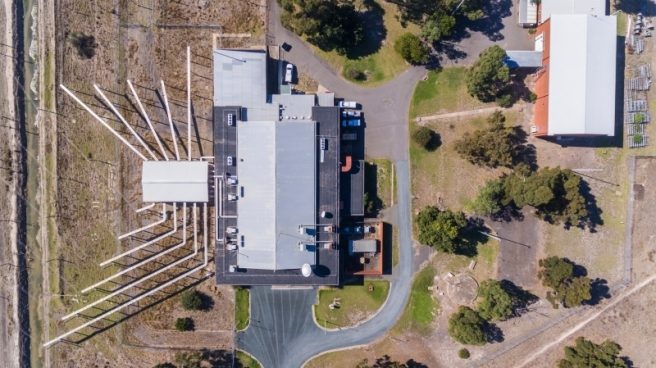
The Shepparton transmitter site of ABC/Radio Australia

Developments in the Australian domestic HF broadcasting scene

by Nigel Holmes

Radio broadcast on HF (high frequency or shortwave) has a solid role to play in the pantheon of media in the Australian and pan-Pacific context. It might be off the radar for the urban masses, but HF radio is the proven, economical alternative to satellite and cable for communication over continental or oceanic distances. Our commercial airlines use HF radio every day. So do our mining companies and emergency services. People holidaying in our remote areas buy or rent HF transceivers for their cars. Australia has the largest number of civilian users of HF radio in the world.

For thirty years a simple system of three HF transmitters quietly provided Australian Broadcasting Corporation (ABC) radio to remote populations across inland Australia, the Northern Territory (NT). Centered on Alice Springs, Tennant Creek and Katherine each transmitter reached out nominally 450 km, covering an area of nearly 2 million square kilometres. In practice the area serviced was larger, extending into Queensland and Western Australia. Such is the utility of this versatile medium. The audience was small, only a couple of hundred thousand, living or moving through the most remote places in Australia, but this was their lifeline.

During the cyclone season, storm alerts and flood warnings would reach people in the inland beyond the call of AM and FM networks. Yes, such people do exist in Australia and elsewhere in the Pacific.

Like many marginalised communities the HF radio listeners of the outback struggled to make urban elites understand their very real world. So in 2016 when the ABC announced the closure of the domestic HF transmitters in order to fund its DAB+ radio rollout in Canberra and Hobart, the backlash from the remote communities was shrugged off and the closures proceeded in 2017. ABC pointed at its satellite as an alternative, but had no answer when asked how to equip a jillaroo’s horse, a dusty 4WD or an offshore tinnie with a fragile satellite dish, an expensive receiver and the power point to run it all.

People who are used to an effective service tend to take its loss badly. So it has been in the NT. Politicians were pursued by the inland listeners wanting a better deal. The matter has culminated with the main opposition Australian Labor Party pledging to restore the HF distribution of ABC within Australia if it wins the forthcoming the federal election.

Let’s hope political expediency at the federal government level and within ABC doesn’t foul this up. We don’t want a half-baked resurrection as a sop to fend off critics of the ABC or to let politicians grandstand.

The three domestic HF sites in the NT cost a lot more than AUD$1.9 million p.a. to run. That was a figure bandied about by ABC after criticism of its DAB+ expansion costs. But for a sum in the order of half that, plus re-establishment costs, a service can be implemented which would have greater coverage, better reliability and lower outgoings. What’s not to like? The key is the former Radio Australia HF station at Shepparton, Victoria.

The cost of electricity at the NT sites was horrendous. Apart from feeding three thirsty 50 kW tx, huge air conditioning plant was required at each site to pull out waste heat and combat 50°C summer temperatures. Maintenance costs were savage. On-air availability was lousy (worst in the ABC network) because of environmental challenges and long maintenance travel times.

So here’s a plan: re-locate a near-new Continental 418G HF 100 kW transmitter from Tennant Creek to Shepparton. Electricity is much cheaper and more reliable at Shepparton. It’s a cooler site and has permanent, trained staff. The consolidation of spares and expertise with the other Continental transmitters at Shepparton makes engineering and economic sense. Re-locate the two small 6-12 MHz HR2/2/0.4 and HR2/2/0.6 aerials from the former RA station at Brandon. Erect them both as AHR2/2/0.4, align one on a boresight of 000°T and the other one on a boresight of 320°T. Feed both aerials from the transmitter via a splitter, run the transmitter at 80 kW so each array receives 40 kW. Run a 5.9 MHz channel at night and a 9 or 11 MHz channel during daylight. Bingo. You now have a two-frequency network covering the sector between 020° & 300° at a range of 1500 km -> 3000+ km. What a great conduit for cyclone/flood alerts, quality news and entertainment and if the ABC can manage that then it might just get back to meeting its charter obligations to all Australians.

Nigel Holmes
November 2018

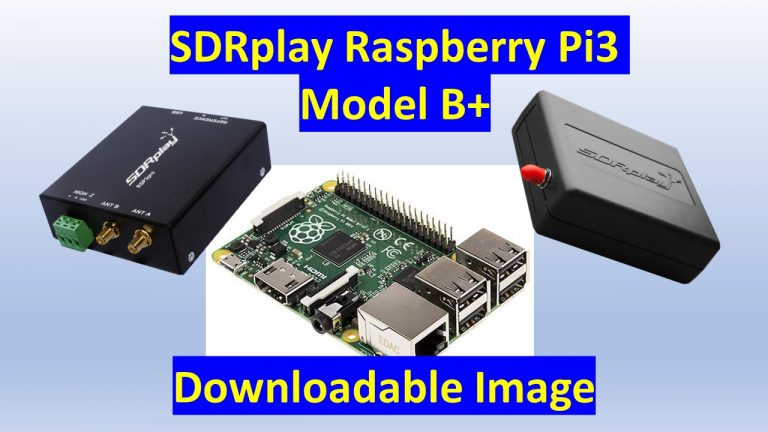
Updated Raspberry Pi image for SDRplay software defined radios

(Source: SDRplay via Jon Hudson)

SDRplay is pleased to announce the availability of an updated Raspberry Pi3 image: This release (V0.4) is a complete image for the Raspberry Pi 3 with a range of pre-built applications for SDRplay devices.

Please note the following:

1. This software is made available purely for the convenience of users to save them from having to build the software themselves from source code.
2. All software apart from ADS-B is provided by third party developers and SDRplay can take no responsibility for any faults or bugs and is unable to provide support. For any support for these applications, we recommend that users contact the original authors.
3. Where the RSPduo is supported by applications, it can only be used in single tuner mode.
4. Whilst this should work with all RPi3s, we have only tested with RPi3 B+ and that will provide the best performance.

List of known issues:

SoapyRemote

Will only work over LAN connections and locally. It will not work over Wide Area Networks

CubicSDR
Will only support the RSPduo in single tuner mode

Gnu Radio
No known issues

GQRX
Some limitations with tuner hardware control
Audio only via USB and HDMI audio
CPU load is quite high and may cause audio stuttering

ADS-B
RSPduo not currently supported
Port B is the default port for the RSP2

Qt-DAB
Will only support the RSPduo in single tuner mode

TCP Server – This is a fork of the RTL-SDR (TCP) server developed by F4HH. This software should work with any client that supports the RTL-SDR (TCP) server software with some limitations. This software should be viewed as being for experimental purposes.
RSP2 works only on port A
RSPduo not supported
Maximum sample rate limited to 3.2 MHz
Some limitations with RSP1A RF gain control

Download links:

https://www.dropbox.com/s/kvaatu0ndet5pns/SDRplay_RPi3_V0.4.img.xz?dl=0

or

https://www.sdrplay.com/software/SDRplay_RPi3_V0.4.img.xz

Size: 2249196664 bytes (2145 MiB)

Checksums:
CRC32: 204AE0BE
CRC64: 76FAA00F83A96F1D
SHA256: 2BDB44BFCA95241AA9FE26F02EFB78FD0370869AC2775F76832AC68F7E9DA153