Category Archives: Shortwave Radio

Guest Post: Backpack Shack 3.0 – Part 2

Many thanks to SWLing Post contributor, TomL, who shares the following guest post as a his Backpack Shack 3 evolves:


Backpack Shack 3 – Part 2

by TomL

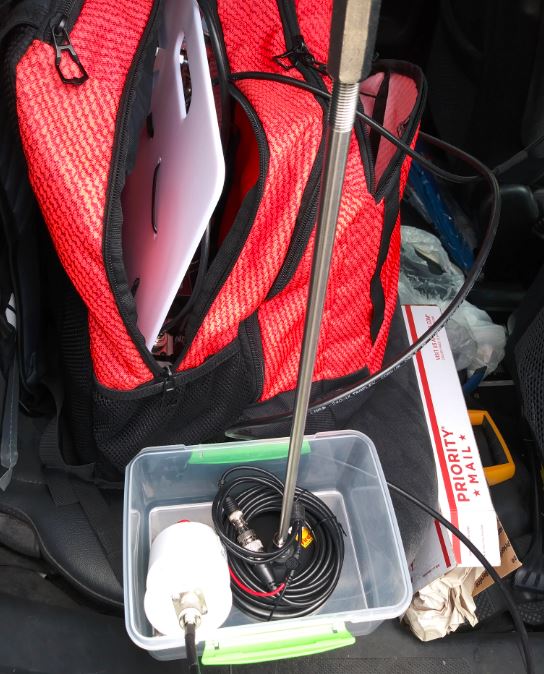
Wanting MOAR options for my recent amplified whip antenna experiment, I decided to add a second antenna input to the kitchen cutting board (can I call it a “Breadboard”? – Ha, that’s an electronics joke!).  The idea behind it came from realizing that I might not want to spend all my time outside at a picnic table or on the beach, especially if it is drizzly and windy. And I still wanted a better ground for the antenna.  So, I thought I could use more Trucker Parts and put an antenna on top of the roof of my vehicle so I could listen in the relative comfort and safety of my small SUV (or even a friend’s car).

Breadboarding

Here is the crowded “Breadboard” with some extra items added.
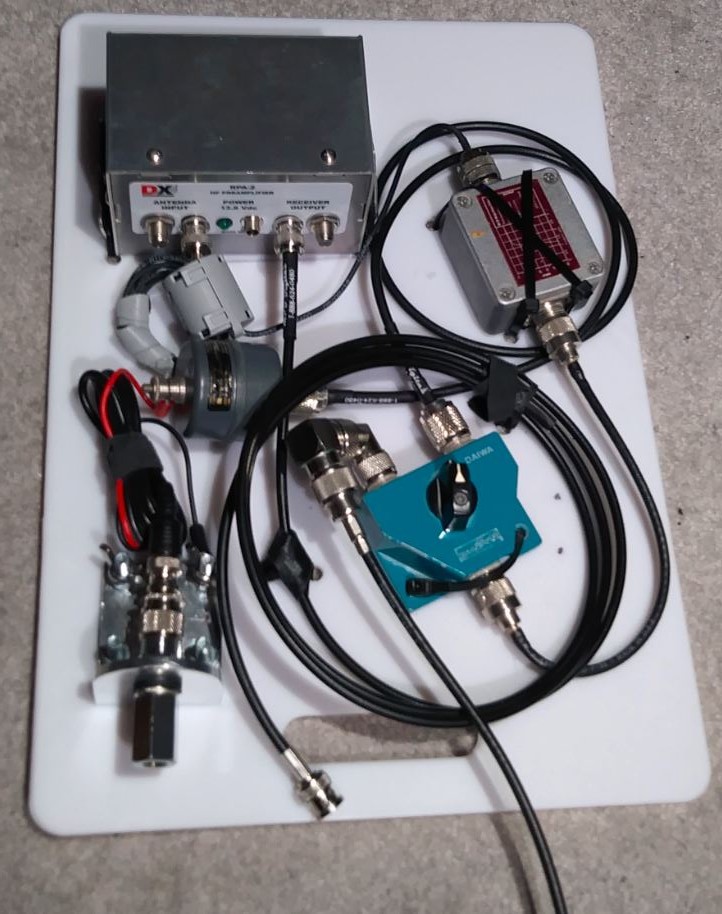
I thought of the vertical antenna as a short longwire and had an old, original RF Systems Magnetic Longwire Balun.  That device allows for an improvement in signal/noise ratio (in theory) if used on a longwire. Perhaps it works on this, too??  You can see the gray cylinder connected right beneath the trucker mirror mount on the left (this will not be tested at this time, see External Antenna below).  The output goes to a greenish Daiwa switch on the right.

A large amplified antenna has the real possibility of overloading the amplifier.  With the Magnetic Balun, I am hoping the VHF band is attenuated enough to preclude any problems because its response naturally tapers off past 40MHz.  But Mediumwave is well within its bandpass. I remembered an old Kiwa Electronics Broadcast Band Rejection filter not being used for a long, long time, so I connected that right after the Daiwa switch (the metal box with red plate).

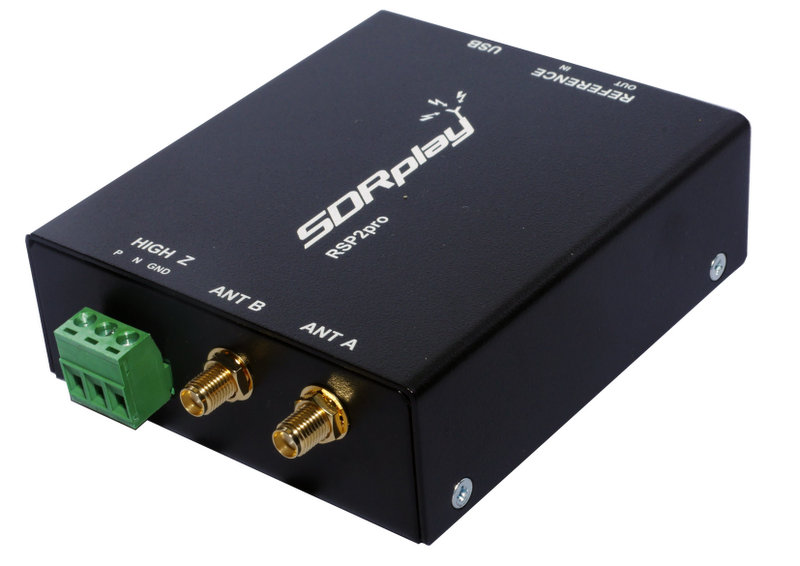
This output then goes to an RF choke just before entering the pre-amp.  I figure I will be using my SDRPlay RSP2 and noisy laptop and wanted to try to reduce any interference traveling on the outside coax braid before it gets amplified.

External Antenna

OK, now for the other Daiwa switch selection.  The external antenna will be connected and disconnected as often as I use it.  I attached two right-angle coax adapters to be the connection point for the antenna.   This is so that the physical switch threads do not have to handle that wear-and-tear. You can see it as the fuzzy out of focus thing sticking up out of the left side switch position.

The wire going out the top of the Breadboard goes to a Firestik K-11 magnetic mount placed on top of the roof of the SUV.  I also wanted this to be connected to a magnetic balun. I just happened to have a nearly unused Palomar Engineers Magnetic Longwire Balun.  It has its own ground lug for use with a counterpoise. Temporarily, I left the 18 feet of wire that came attached to the K-11 Mount and attached an adapter and BNC test lead; on the other end is connected the spade lugs to the Balun (red wire to the lanyard nut, black wire to the ground lug).  It all fits neatly inside a Sistema 3 liter container.
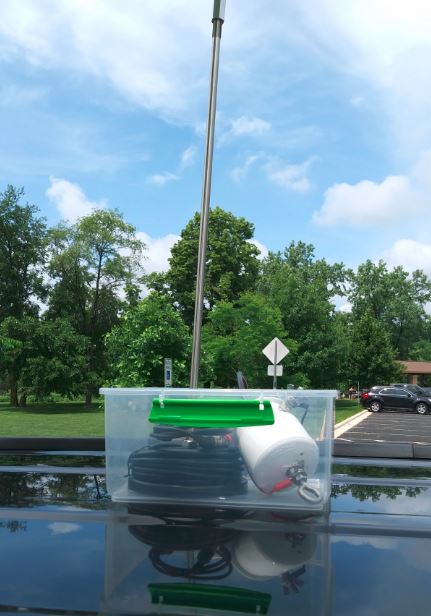
The magnet and box self-clamp easily onto the roof of the vehicle.  I added a new 18 inch section to the Trucker Antenna Shafts creating a full 72 inch antenna, complete with mag mount, ground plane (car body), and magnetic balun.  It is very easy to put up and take down and the box helps keep everything contained.

I am pushing things a bit here.  Magnetic Baluns are not really meant to be used on vertical antennas.  It probably breaks some sort of Cosmic Electrical Law somewhere that causes electromagnetic waves to get very confused and die a horrible, twisted, circular death.  But I figure that it is an unbalanced “line” similar to a longwire antenna; it’s just a little short and goes straight up instead of horizontal! I like the idea, so I am going to run with it.

Warnings!

It goes without saying that the Antenna Shafts, magnet mount, and magnetic balun are weatherproof (but NOT lightning proof!).  Take proper lightning precautions and take it down.  Even so, I might add a small drainage hole to the box since it did rain a tiny bit during testing.

Secondly, this setup is ONLY FOR STATIONARY VEHICLES!!!!  DO NOT TRY TO DRIVE DOWN THE ROAD OR HIGHWAY!!!! The magnetic mount will NOT stay on the car and will damage your vehicle and maybe a vehicle travelling next to you!

Performance
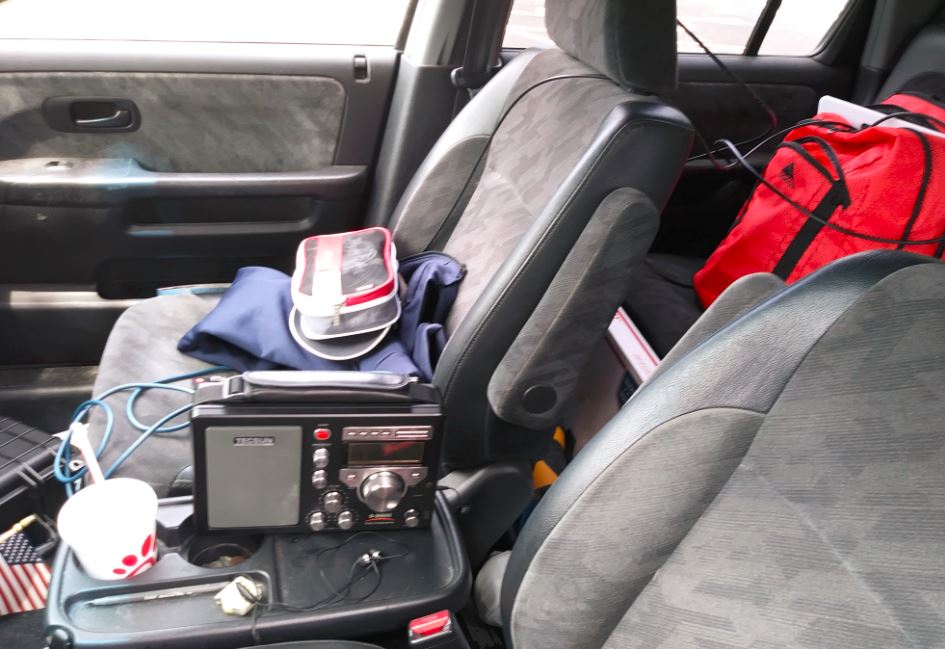
As you can see from the picture, my new Tecsun S-8800 is getting a workout while connected to the Cross Country preselector (not shown behind it) and to the backpack next to the back seat window.  The Tecsun S-8800 is a nice radio. My copy has a couple of quirks that I might have to send it back (the AM band tunes incorrectly 2 kHz lower than it should and the SW SSB tunes 140 Hz higher than indicated and I have to compensate using the fine-tuning dial for these modes–FM seems correctly tuned).

Other than this, the actual performance is really quite good!  DSP does have sharp cutoffs to the IF bandwidth (especially resolving strong station interference when selecting 3 kHz vs. 4 kHz).  With all my filters/balun/choke, I did not notice any MW or FM breakthroughs and signals on those bands were nicely contained and “normal”.  Interference from my cell phone while looking up internet frequency listings was minimal – seems like the cable shielding, choke, and car roof are doing a good job.

The audio output jacks have very thin clearance between the jacks and the housing of the radio. So for the second time, I will not have recordings since the cable I wanted to use has home theater style construction with very thick plug outer connectors and will not fit!

From an RF-quiet “Forest Preserve” (County park), there were a variety of stations received from the 25 through 19 meter bands (Local time 11am-1:30pm). A few stations I have never heard before until now:

  • Radio Free Asia in Korean on 11985 KHz (Tinian Island)
  • Radio China International in Esperanto on 11650 KHz (Xian China)
  • Radio Farda in Persian on 12005 KHz (Wooferton England) – broadcast opposite my direction
  • Radio Bible BCI in Somali on 15310 KHz (Nauen Germany) – Strange sounding but interesting  Christian Somali music
  • Radio Free Asia in Chinese on 13675 KHz (Dushanbe Tajikistan)
  • Voice of Hope Africa in English on 13680 KHz (Lusaka Zambia) – had to use ECSS USB to get away from strong interference from RFA on 13675, fairly good intelligibility (including music)!  I wish there was a 6 KHz option for SSB mode since the audio was slightly muffled and could not compensate much with the tone controls. That kind of feature usually comes with radios costing 3X more, however.
  • Voice of Korea in French (Kujang North Korea) being squashed by Radio China International (Kashi China) in English on 13760 KHz

It was so nice not to be on a beach and have people walk by STARING at me with my weird radio/antenna setup.  And I was dry and comfy sipping a cool drink while there was a drizzle of rain pelting the windshield. Downside might be that the car setup cannot always be located optimally if I want to be next to that Very Large Body of Water (Lake Michigan) to help enhance reception but this is not a bad alternative.   The next test will have to be during early evening when signals are booming into my location and see if performance holds up under those conditions!

Happy Listening,

TomL

Modified Parts List

Parts Repeated from Part 1 article


As always, Tom, a most impressive setup powered by home-grown ingenuity! Thanks so much for sharing the evolution of your field kits with all of us here at the SWLing Post!

By the way, you still have me chuckling about your use of the term, “breadboard!” 🙂
Steve Andrew’s spectrum analyzer software for SDRplay SDRs now available for download

A few weeks ago, we posted an announcement that spectrum analyzer software was being developed for the SDRplay RSP software defined radio series. Many thanks to Andy, at SDRplay, who shares the following announcement:

We are pleased to announce the availability of the first cut of Spectrum Analyser software developed by Steve Andrew specifically for the RSP line of products. Please note that this is first alpha software and so it is still very much in development and some features are still to be added. Currently supported are:

  • RSP1
  • RSP2/RSP2pro
  • RSP1A

This first alpha release gives a good idea as to the look and feel for the software. The main functional limitation is that sweeps of greater than 10 MHz are not currently supported. Steve is currently re-working the algorithms for providing wider sweeps than 10 MHz to improve sweep time and remove the issue of the DC spike in ZIF mode, so please bear with him.

We recommend using the software with AGC turned off and use manual control of the gain for better display stability.

Please see the Spectrum Analyser webpage: https://www.sdrplay.com/spectrum-analyser

Best regards,

SDRplay Support

BBC Monitoring: “spotting fake news” since WWII

(Source: BBC Blog)

BBC Monitoring is a specialist part of BBC News, part of the World Service group. We have experienced journalists and linguists who follow and track international media in foreign languages, in over 150 countries and about 100 languages.

We monitor that information, we report and analyse it, and we work on a subscription website basis. All our content is available to the BBC and to the UK Government and we also have commercial customers.

The service has been through a lot of changes in the last couple of years, and was delivered a savings target which we had to incorporate. We’ve changed the structure of the personnel and the organisation, we’ve changed the delivery platform, updated the technology, and we have new products, new customers and users.

We’ve moved from Caversham House, in Berkshire, which was an absolutely beautiful place to work, but it was expensive to run, and we were at a distance from a lot of our users in the BBC but also in the UK Government. Coming into Broadcasting House gives just that extra sense of being part of News.

[…]BBC Monitoring was set up to counter propaganda from Nazi Germany in the war, explaining propaganda and spotting messaging in media. Verification – and then the reporting of stories where fake news is part of the media, is still part of what we do.

I’m pleased that the World Service is pulling together all its coverage of fake news. Monitoring is a central part of that, and we’re also developing a small team that is solely going to be dedicated to disinformation and the manipulation of messaging in the media in certain parts of the world.

We already work with all parts of News, for example our Iran team work very closely with the Persian service. During the Iranian elections last year some of our team were embedded with the Persian service to help them with their coverage.

We’re constantly following the media in over 150 countries, so when you’re talking about a big, complex, international story we’re able to broaden the lens and say ‘Well, here’s the view from this part of the world’, and ‘Here’s what this other country is saying.’[…]

Click here to read the full story on the BBC blog.

North Korea Summit: Voice of Korea English language shortwave frequencies

Photo of Singapore skyline by Mike Enerio.

Many thanks to SWLing Post contributor, DanH, who writes:

I recorded and edited clips from two Voice of Korea SW broadcasts in English at different times earlier today (UTC). The radio clock in this video is fairly accurate and is set to UTC. The VOK announcer reads a list of VOK English language broadcast times and frequencies near the end of the video. Happy listening! Propagation conditions aren’t that bad.

Click here to view on YouTube.

Thank you for sharing this, Dan. I’m travelling at the moment but will certainly listen via one of my favorite WebSDRs. I’m hoping some listeners will submit recordings to the shortwave archive!

I’ve copied the times and frequencies below for reference:

  • To Europe on 13650 and 15245 kHz
    • 15:00-16:00 UTC
    • 18:00-19:00 UTC
    • 21:00-22:00 UTC
    • 13:00-14:00 UTC
  • To North America on 9435 and 11710 kHz
    • 15:00-16:00 UTC
    • 13:00-14:00 UTC
  • NE Asia on 7620, 9445, and 9730 kHz
    • 4:00-5:00 UTC
    • 6:00-7:00 UTC

VOA’s Music Man For Africa, Leo Sarkisian, dies at 97

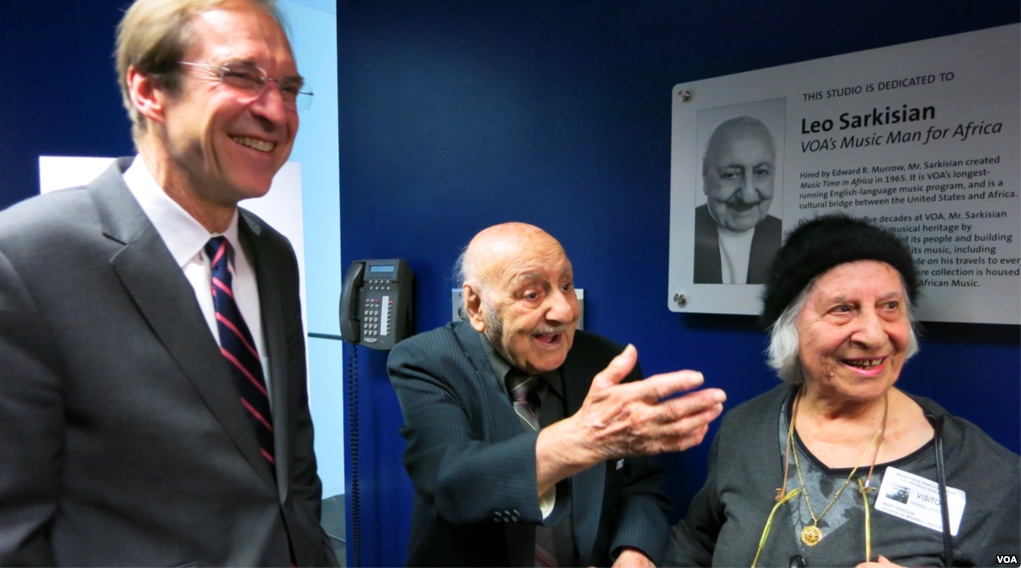
FILE – Leo Sarkisian, center, his wife, Mary, and VOA Director David Ensor smile during a celebration that followed the renaming of VOA Studio 23 in Sarkisian’s honor, Jan. 29, 2014. (Source: VOA News)

In February 2013, Leo Sarkisian and his sweet wife, Mary, invited me to their home and studio in Maryland and I recorded what turned into a 3+ hour audio interview.

Sitting with him, time seemed to disappear as I was absorbed by stories about his travels and experiences. He was so kind and gracious–he even insisted that I walk away with one of his amazing drawings which I’ve since framed for my office.

Leo passed away on June 8, 2018 at the age of 97. Rest in peace, Leo.

Here’s the story from VOA News:

(Source: VOA News)

Leo Sarkisian, the creator and longtime producer of The Voice of America’s “Music Time in Africa,” has died. He was 97.

Known by his fans as the “Music Man of Africa,” Sarkisian spent a half-century traveling Africa, listening to local musicians and capturing their performances. Those recordings became the basis of VOA’s longest-running English program.

“Leo always left you feeling like you were special. He didn’t treat anyone less or greater based on their social standing or age or anything, it seemed. He was a true gentleman and optimist and lover of the beautiful things in life,” said Heather Maxwell, an ethnomusicologist who succeeded Sarkisian as the host of “Music Time in Africa.”

Meeting Murrow

Sarkisian arrived in Africa as a soldier in the U.S. Army. In 1961, a fateful encounter changed the course of his life. Edward R. Murrow, newly minted as the director of the U.S. Information Agency, came to Sarkisian’s apartment in Conakry, Guinea, and asked if he’d like to join The Voice of America. Four years later, he went on the air with “Music Time in Africa.”

He spent the next 47 years traveling the continent with his wife, Mary, whom he married in 1949. Together, they met thousands of local musicians and gave their art a global stage.

Sarkisian’s travels put him at the vanguard of African music. Maxwell said a favorite recording from Sarkisian’s collection was of Nigerian musician Fela Kuti, before he developed the Afrobeat style that would become his world-famous trademark.

Sarkisian was himself a musician and artist. He sketched performers, audience members and dignitaries. Some of his illustrations can be found in “Leo Sarkisian’s Faces of Africa,” a collection of portraits of people he met in his travels.

But his greatest legacy will perhaps be the original collection of about 10,000 recordings that he curated, representing every African country. In 2014, the University of Michigan acquired the collection from VOA on long-term loan. Their work involves digitizing the collection and preserving it for generations to come.

‘I feel as if I’m just beginning’

Sarkisian retired in 2012, when he was 91.

“I feel as if I’m just beginning,” he told VOA’s Vincent Makori in an interview that year.

When asked what African music meant to him, Sarkisian said, “It’s been my entire life. It’s from my childhood right up to today, and maybe into the future. I’ll still be doing my art, and I’ll be dancing with my music. What else? It is passion.”

Sarkisian’s parents emigrated to the U.S. from Turkey in the early 1900s, according to The Washington Post. Born in 1921, Sarkisian studied art and drew maps for the Army, the Post reported.

Sarkisian lived by Murrow’s “last three feet” motto, Maxwell said. That meant the most important part of communication, even across international borders, came from a personal, human connection.

“We still care about Africa,” Sarkisian said in 2012. “We care about them. We love the African culture. And in turn, of course, we have their love, also. And that is the satisfaction of our work.”

Leo and Mary Sarkisian, after spending most of their lives living in Africa, settled in Boston. Leo Sarkisian died June 8 and will be buried in North Andover, Massachusetts, with full military honors.

Click here to read this story at VOA News.

Australian Gov’t reviewing media services (including loss of shortwave) in the Asia-Pacific

Many thanks to SWLing Post contributor, London Shortwave, for sharing the following Have Your Say review of Australian Broadcasting Services in the Asia Pacific:

Review of Australian Broadcasting Services in the Asia Pacific – Terms of Reference

The Government is undertaking a review of Australian media services in the Asia Pacific, including the role of shortwave radio. The review is being conducted jointly by the Department of Communications and the Arts and the Department of Foreign Affairs and Trade.

Purpose

The objective of the review is to assess the reach of Australia’s media in the Asia Pacific region, including examining whether shortwave radio technology should be used.

Scope

The review will analyse the:

  • coverage and access of existing Australian media services in the Asia Pacific region; and
  • use and value of Australian shortwave technology in the Asia Pacific region.The review will cover:
  • all media distribution platforms (i.e. television, radio and online);
  • commercial, community and publicly funded services; and
  • different types of technologies such as analogue, digital and satellite radio and television services and online services.

Have your say

Interested stakeholders in Australia and overseas are encouraged to contribute to this review. Submissions on any aspect of the review should be uploaded to the review website by 3 August 2018.

Timeframe

The review is expected to report to the Government in 2018.

Background

In September 2017 the Government agreed to conduct a review of Asia Pacific Broadcasting Services as follows:

“The Department of Communications and the Arts and the Department of Foreign Affairs and Trade will conduct a review into the reach of Australian broadcasting services in the Asia Pacific region, including examining whether shortwave radio technology should be used. The review will include public consultation and the report of the review will be made public.”


Consultation Period:
June 04, 2018 09:00 AEST to August 03, 2018 17:00 AEST

The Australian Broadcasting Corporation ceased shortwave broadcasting in the Asia-Pacific region in January 2017 ahead of a transition to FM transmission.

The review is assessing the reach of Australia’s media in the Asia-Pacific region, including examining whether shortwave radio technology should be used.

All media distribution platforms – television, radio and online – are being examined including commercial, community and publicly funded services.

The review is also looking at different types of technologies such as analogue, digital and satellite radio and television services and online services.

Click here to view this information and participate via the Have Your Say website.

Shortwave Trading Part II

Last month, we posted a link to an article that explained why traders might use shortwave radio for high-speed, faster-than-optical-fiber communications. The article by Bob Van Valzah originally appeared on the blog, Sniper in Mahwah & Friends where they’ve just posted part two in the series:

I have previously claimed that trading over shortwave radio is real and presented the story of the first evidence I found of it. It was pleasantly surprising to see the story picked up by IEEE Spectrum, Hacker News, Hackaday, and others. But since I hadn’t anticipated such a diverse audience, I didn’t provide details needed to understand shortwave trading in context so a lot of questions were raised. I’ll provide some background here, answer the questions, and also document two other shortwave trading sites I’ve found around Chicago. Traders can skip ahead while I fill in the broader audience.

Why is there a latency race? Isn’t it just a waste of money?

Electronic trading technologist just take the latency race for granted, but it’s important to think about why it exists and what it means to the average person. When you want to fill your car with gasoline, you have the choice of going to the nearby gas station and accepting their price or perhaps comparing prices at stations a little farther away. We would all spend a lot more time comparison shopping if we didn’t have pretty good confidence that the prices at our local stations were competitive. But what keeps those prices competitive?

The analogy between your local gas station and electronic markets is admittedly imperfect, but I think it is helpful in understanding why latency matters and how you benefit. Nobody can buy a tanker of gasoline in New York and immediately sell it in Chicago. The laws of physics prevent us from economically moving such a heavy load over a long distance quickly. But a share of Apple stock weighs nothing. The Chicago price and the New York price can be compared and changed in an instant. Well, about 4 milliseconds is how long it takes for an updated price to make the trip. Prices can make about 250 one-way trips in a single second.

So when buying or selling Apple shares, you don’t have to shop around for the best price. Electronic trading companies have an incentive to build the fastest networks linking financial centers so that prices can move quickly between them. Buyers and sellers benefit because their local market has electronic traders who know the best prices on other markets and will be happy to do a local deal at the best global price (it’s market making). It doesn’t take a rocket surgeon to see the business opportunity in this type of trading, so high-speed traders have to be efficient because they’re competing against each other. The latency race has to happen for each market to have the best price. Competition between electronic traders limits their spend to the benefits that come with better pricing.

Why does radio help win the latency race?

Traders use radio because it can move prices faster than optical fiber.

I won’t bore you with the physics, but I will remind you of this elementary school experiment where a pencil appears to bend in a glass of water. This happens because light moves more quickly through air than it does through water. In the same way, radio waves move more quickly through air than light can move through an optical fiber. In trading parlance, radio is lower latency than fiber over a given distance.

But radio is also faster because it almost always covers a shorter distance. Fiber paths tend to follow roads and property lines that may not go exactly in the desired direction. Radio towers may be inconvenient, but they give the advantage that the signal can take the shortest-possible path allowed by physics, not the kinky path dictated by rights of way.[…]

Continue reading the full article on the blog, Sniper in Mahwah & Friends.