Category Archives: Shortwave Radio

A review of CozyPhones sleep headphones

A few months ago, SWLing Post contributor, Mario Filippi–being both a good friend and an (ahem!) enabler–sent the following note:

My XYL bought me a set of CozyPhones for Christmas.  If you like listening to the radio, especially at night while in bed, these work great. Speakers are nice and flat.  And if you are outdoors you can listen to shortwave and not suffer from ear frostbite hihi.

https://www.cozyphones.com/

[I’ve attached the photo below of] the one I got.  Absolutely amazing!

Little did Mario know that, back in 2014, I ordered a pair of similar sleep headphones by the company Acoustic Sheep after reading SWLing Post contributor Anil Raj’s brilliant entry in our Virtual Radio Challenge II.

I purchased an open-box pair of the Acoustic Sheep SleepPhones for about $33 and was very pleased with the purchased…initially, at least.

I used the Acoustic Sheep SleepPhones a couple nights a week for several months. I was disappointed, however, when the braided jacketing started coming off of the headphone cord, bunching up, and the rubberized jacketing underneath began staining my pillowcase, so I was no longer able to wear them at home or when traveling. My wife was amused and said it looked as if I had worn mascara to bed.  Well, at least until she attempted to clean the marks off of the pillowcase with limited success.

I feel it’s only fair to state that my SleepPhones were a fairly new product in 2014, thus may have been an early iteration and may not accurately reflect what the product is like currently. I’m guessing that Acoustic Sheep have improved the design and reinforced the jacketing since then, because they seem to enjoy relatively positive reviews on Amazon.

Panasonic Ergo Fit (in-ear) Headphones

At any rate, I set the troublesome SleepPhones aside and and went back to using my go-to in-ear sleep phones: the Panasonic Ergo Fit Headphones. The Panasonics are the least uncomfortable of all of the in-ear headphones and do a decent job of isolating any environmental noises while you sleep. Still, having something inside your ear while you slumber isn’t exactly the definition of comfort.

Enter CozyPhones

I replied to Mario’s email telling him about my experience with the SleepPhones. He encouraged me to give the CozyPhones a try.

I took a quick glance at Amazon (the only distributor I could find for CozyPhones) and the price for a pair was only $22. Almost $16 cheaper than a pair of new SleepPhones?  I even noticed combo packs with two sets of CozyPhones for $24. My doubts about quality resurfaced.

I decided to contact CozyPhones customer service directly and ask if their headphones were likely to experience the same problem as my SleepPhones–I mentioned my hesitancy and the fact these would likely be mentioned in a frank review (hint, hint: if quality is poor, this will get a negative review).

They promptly addressed my concerns, standing confidently behind their product, and even offered to send a sample. One week later, the CozyPhones arrived.

The CozyPhones arrived in a thick plastic re-sealable bag (seen above)–a nice touch! Included in the package were both the headphones and a satin carry bag.

Performance

Let’s be frank here: with sleep phones, I’m not expecting the same audio fidelity I would achieve with my Sennheiser HD558s––which, by the way, would be incredibly uncomfortable as sleep headphone; I simply wanted to be able to listen to my bedside radio as I drifted off.

Here’s what I do expect from a pair of sleep headphones:

  • decent audio fidelity at low volume levels–something suitable for listening to AM or shortwave radio
  • something with enough sound isolation that it won’t keep my wife awake while I listen to the Voice of Greece into the wee hours
  • comfort around my head and against my ears as I lie on a pillow…actually, this might be the #1 priority for me
  • headband’s earphones (speakers) stay in place, don’t shift within the band
  • quality construction and the potential for product longevity
  • no black marks on my pillowcase!

Let’s see how the CozyPhones deliver on my points:

Audio fidelity

The CozyPhones easily pass this test. I’m very pleased with audio fidelity for radio listening. Indeed, the audio response is pretty well tailored for AM/SW broadcast listening. FM and music sounds fine, too; good enough that I would consider wearing these in the winter while hiking. Again, these are not audiophile quality to be sure, but they surpass my needs for this application.

Sound isolation

The CozyPhones do a respectable job in this regard. My wife can’t hear what I’m listening to while lying in bed, not even a hint of what I hear. Now, if I were hard of hearing, listening to music and had the volume cranked up, I’m sure she’d at least hear percussive sounds.

Comfort

I should note hear that there are essentially four versions of CozyPhones:

CozyPhones sent me the second version mentioned above, the headphones with Cool Mesh lining and a lightweight Lycra-like exterior. I was quite pleased, as it’s what I would have selected. If anything, I tend to generate a lot of heat, so don’t like products that make me feel even warmer at night while I sleep.

After a few months with the CozyPhones I can say that I’m very pleased with how comfortable they are. The material is soft, the headphone speakers are very thin and seem to stay in place even as I move around and adjust my head on the pillow during the night.

Quality

The SleepPhones I purchased in 2014, in contrast, were also comfortable, but the earphones, essentially mini speakers, tended to migrate within the soft headband. I’d often wake up and find the speakers had completely moved within the band away from my ears; it was then a matter of trying to bunch up the headband material and re-position the speakers.

The CozyPhones don’t seem to have this problem. The ear speakers might shift a little some nights, but not enough to be annoying–certainly not as the SleepPhones initially did.

The braided headphones cord is non-obtrusive and comes out the back of the headphones. So far, the CozyPhones haven’t suffered the same fate as the SleepPhones–the braid has remained intact and seems quite sturdy, resilient to light tugging and normal movement.

And as for my pillowcase?  Still clean…no black marks.

Summary

If, like me, you enjoy listening to radio in bed, but don’t want to disturb your partner, CozyPhones really are a fantastic option.

Perhaps as a side effect of my years of SW listening, I find I’m a bit sensitive to environmental noises when I travel; often hallway noises, nearby traffic, children screaming, doors slamming, can disturb me, so I never leave home without earphones in my pack to quiet the noise. Quite often I’ll listen to my radio at bedtime, then, right before nodding off, I tune to a blank spot on the AM dial to the soothing sound of static. This “white noise” tends to drown out other abrupt environmental noises, and I find I drift off peacefully.

I think CozyPhones will serve you well. At $18-22 shipped? I think they’re a good bargain and a great gift. In fact, I intend to buy a pair for my wife!  Shhhh…don’t tell her.

Click here to view CozyPhones on Amazon.

Schematic for the PLL EDUTEC 4-Band Digital Radio Weltempfänger?

Many thanks to SWLing Post contributor, Cezar Vener, who writes with the following inquiry:

I would like to ask you if you can help me with a schematic diagram for an EDUTEC 4-Band digital radio (PLL EDUTEC 4-Band Digital Radio Weltempfänger). It is not broken, but I would like to modify it. Of course, I could spend some time and manually extract the schematic, but I would lose too much time.

While I know that “EDUTEC” is a registred trade mark for technical (“non-food”) products that was sold by “Eduscho Handelsgesellschaft” in Bremen and also I found that it is now owned by Tchibo, well – I would like to kindly ask you for help in this matter? (course, if you can).

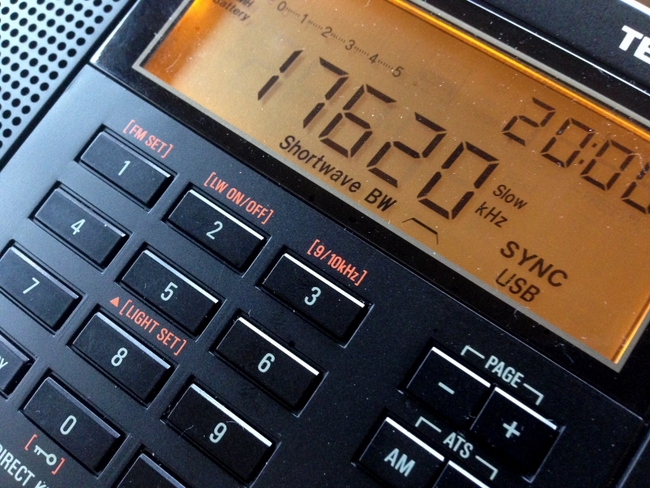
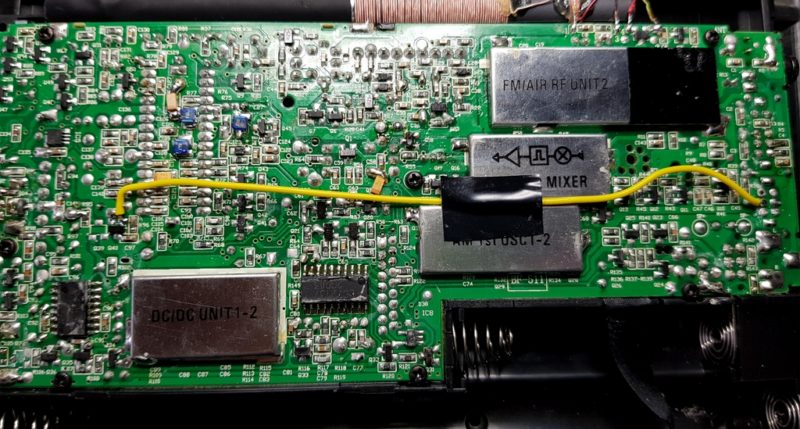
It is an old product, probably made in the 90’s and until now, I didn’t find anything on the net about it. I opened it and I found that its core is TA8132AN, and the FM section is made around TA7358AP. The audio stage is built with C1212C, and there is one more integrated circuit there, TA8148S (no datasheet on the net, but I found that is a DC-DC converter for electric tuning – built-in stabilized supply output for biasing VHF tuner variable capacitor / sine wave oscillation).

BTW, I found it also in SONY CFS-W504L 🙂

The PLL chip is soldered with the unmarked side, so I don’t know what type it is.

[See photo at top of post.]

Here is a photo of the rear back stand:

Unfortunately, there is no other model or name written on the radio.

I see there “CENTRON LABORATORIES LTD”, that points to the company with the same name from Gujarat, India. Very interesting :))

In the hope of an answer from you, please allow me to thank you and to congratulate you for the very nice site that you maintain there!

Many thanks, Cezar! It’s readers like you who make this site such a great one!

Post Readers: I hope someone may be able to help Cezar. This radio looks familiar–perhaps I’ve seen it badged with a different company name?  Please comment if you can help Cezar locate a schematic.

Mike spots the RCA AR-88 in series “Prime Suspect: Tennison”

Many thanks to SWLing Post contributor, Mike Hansgen (K8RAT), who adds the following to our growing archive of radios in film. Mike writes:

Near the end of the current episode of “Prime Suspect: Tennison” [the radio operator mentions] he was listening on “the RCA 88”.

“Tennison” is set around the early ’70’s.

Great catch, Mike (and thanks to Eric WD8RIF for the screen cap).

According to the Crypto Museum:

The AR-88 was a valve-based shortwave general coverage communications receiver, developed and built by the Radio Corporation of America (RCA) in the early 1940s. Although the receiver was initially intended as the successor to the AR-77 amateur receiver, the outbreak of WWII made it evolve into a professional high-end military-grade receiver for which cost was no object.

The AR-88 is a 14-valve (tube) receiver, which covers a frequency range of 535 kHz to 32 MHz. Unlike the National HRO receiver, which had pluggable coil packs for each frequency band, the AR-88 uses a six-position band selector. A special version of the receiver, the AR-88LF, was suitable for LF and MF, covering 70 to 550 kHz (continuously) and 1.5 to 30 MHz (continuously).

Continue reading at the Crypto Museum online… 

The Crypto Museum photo of the AR-88 jogged my memory…

Last year, I visited the Musée de la Défense Aérienne at the Canadian Forces Base (CFB) Bagotville (a museum I wholeheartedly recommend, by the way).

I snapped this shot of this display:

I’m sure I actually have a close up of this receiver somewhere. It also appears to be an RCA AR-88 based on dial and control configuration, though I certainly could be wrong.

Do any SWLing Post readers have an AR-88? Please comment!

The Tecsun PL-880: triple conversion architecture

Many thanks to SWLing Post contributor, Larry Thompson, who writes:

There’s been some confusion on my part whether the Tecsun PL-880 is a dual conversion or triple conversion receiver. Amazon and eBay list the receiver as double conversion, whereas Universal Radio doesn’t mention either.

After scouring the Instruction Manual, I was pleased to learn that the PL-880 uses the Silicon Labs si4735 DSP microchip and has 4 Intermediate Frequencies.

1st IF: 55.845 MHz
2nd IF: 10.7 MHz
3rd IF: 45 kHz
4th IF: 128 kHz (exclusively for FM)

To me, that looks like a triple conversion architecture. The combination of the DSP microchip, and the triple conversion would explain why my Tecsun PL-880 is so much more sensitive and selective than my Sony ICF-SW8600GR.

My CountyCom GP-5/SSB emergency portable also has the same Silicon Labs DSP chip and it is almost as sensitive as the Tecsun PL-880, far more sensitive than the Sony. I’ve owned a Japan Radio JRC-525 and a Yaesu FT-900AT transceiver for many years, and the PL-880 digs out weak signals better than both those tabletop receivers, both dual conversion.

To quell the speculation, yesterday I contacted Anna at Anon-Co, the worldwide distributor for Tecsun radios. Her quick reply confirms my suspicions that the Tecsun PL-880 is indeed a triple conversion receiver. That would explain why it blows my Sony ICF-SW7600GR out of the water in senitivity and its ability to pull out weak stations.

Among all the other great attributes, this is an welcome discovery and one never mentioned in the specs by the various retailers of this receiver!

Thank you Larry, for shedding light on this–Anna would certainly know.

Your note makes me realize that I really should order a second, current production model PL-880. My PL-880 is from one of the first batches produced. I imagine I could benefit from some of the firmware tweaks that have been made to this receiver over time.  Perhaps it would even be a good time to compare the 1st generation with the current generation?

I just checked and Anon-Co is selling the PL-880 on eBay for $153.99 US shipped.

Have any SWing Post readers compared early and late model PL-880 units? Please comment.

Shortwave List: Cap’s shortwave schedule Android app now open to Beta testing

A few months ago, long-time SWLing Post contributor, Cap Tux, designed a simple shortwave schedule application for his Android phone. Though he never intended to make the app public, he shared it with me to test on my Moto G5 Plus.

Cap has recently decided that if others in the SWLing Post community would like to Beta test his app, they’re welcome to do so. He notes:

The app was created initially to meet my own requirements as at the time I was travelling a lot for my job and other apps I tried didn’t meet the requirements e.g. Broadcast stations only, filter by Station, Freq, Time, Language and more recently ‘Target Area’ which was added to the app very recently as I was initially using the AOKI list but found that EIBI was updated more frequently and tended to be more accurate.

I do miss some of the features and simplicity of the AOKI list as programming some of the code to respond to the amount of info in the EIBI list was challenging and there is still more that can be done. There is a bug on Android v4.4 (not my bug but the frameworks bug) which I have fixed in v1.1.10 which I can send through later.

I wrote this app as I needed a phone app for my portable radios (PL-660/PL-365) so I could search for shortwave stations using any combination of Station, Frequency, Language, Time (Specific, Real-time incl. day or Any!) or Target Area. The search can even take account of the day of broadcast so if it’s a Friday and the broadcast is only a Saturday, then it won’t show it.

Shortwave List Features:

  • Search the list using any combination of Station, Frequency, Time, Language, Time or Target Area
  • Only broadcast stations are included in the list
  • Scrollable list of stations based on search criteria
  • Get Station, Frequency, Times, Language, Target, Days on-air, Transmitter location and the Broadcasters country of origin of the selected broadcast by a tap on a station
  • Powerful search features with a simple interface
  • Search for specific broadcast times with any combination of Station, Frequency or Language, Target area with future or past times being searchable, although this lists all stations irrespective of the day (as you may want to know a time for a broadcast tomorrow, or yesterday)
  • Search for stations in real-time with any combination of Station, Frequency, Language or Target Area, so the app only lists broadcast stations on-air now (also takes the day into account, so, for example, a station listed as only on-air on a Friday will not show if today is a Saturday)
  • Search for stations transmitting at any time with any combination of Station, Frequency Language or Target Area

Future features in active development:

  • Update shortwave list from the internet

A few examples of use:

  • You hear a station in an unknown language, Select ‘ON AIR’ and enter the ‘Freq’, ‘SEARCH’ and the app will list the possible stations
  • You hear a station in English, select ‘ON AIR’ the ‘Language ‘ set to ‘English’ and enter the ‘Freq’, ‘SEARCH’ and the app will list the possible stations on that frequency right now
  • Want to know when a station is transmitting at a specific time? select the specific time by selecting the UTC time, set the Hour/Minute and enter the station name in the ‘Station’ box and ‘SEARCH’
  • You are listening to a SDR recording from last week and trying to identify a station, enter the ‘Freq’ and the specific UTC time (or ‘Language’ if known), ‘SEARCH’ and the app will list the possible stations
  • Want to tune into broadcasts right now in your language? no problem, just select ‘ON-AIR’ and select your ‘Language’ and ‘SEARCH’
  • List all broadcasts from a specific station, just enter the ‘Station’ name and click ‘SEARCH’
  • List all broadcasts on right now by selecting ‘ON-AIR’ and ‘SEARCH’

Phones that have been tested and will work (You will need Android v5.0.1 or above):

  • Samsung Galaxy S4/S7 (I think all the S series from S4 above should be fine as all have a good screen resolution)
  • Samsung Galaxy J3
  • Google Nexus 4
  • Moto G5 Plus

It should be noted that due to the number of low resolution display phones out there some will not be able to operate the app correctly at present due to the current layout of the components and recommend you use a phone with a decent screen resolution around 1080×1920. I plan to address the screen res issue soon.

What I need from Beta-testers who want to file bug reports:
Phone Make/Model:
Android version:
Shortwave List version in use:
Ease of use:
Speed/Performance:
What would you change/remove/add:
Any screen issues, layout problems or difficulty using a feature:

Please submit your feedback on my Twitter account: @swbcdx

Thank you, Cap!

Readers, please keep in mind that this application is not in the Google Play store because it’s in Beta. You’ll need to download the application to your phone, temporarily allow “Unknown Sources” (here’s a short tutorial), then install the app. It’s very important to only temporarily allow “Unknown Sources”–once this app is installed, please reinstate this security measure.

Please note: If you’re not comfortable downloading and installing an app that is not in the Google Play store, please simply wait for this app to hit the Google Play market possibly at some point in the future.

Click the following link to download the application file to install:

http://www.filedropper.com/shortwavelist-v119-no-permissions

This app requires no permissions. The trade-off is that updates to the schedules cannot be initiated without re-installing an updated app with new schedules embedded.

For what it’s worth, I really like this app! Very simple, effective and works offline.

Here are a few screenshots–I love how he’s kept the interface clean and simple:

Thanks again, Cap, for opening Beta testing to our community.

Please submit your feedback on Cap’s Twitter account: @swbcdx

Elad FDM-DUO: now available in camouflage!

The Elad FDM-DUO (Photo: Dennis Walter)

Many thanks to Dennis Walter who shares the photo above from the 2017 Ham Radio Friedrichshafen convention.

I’ve always thought the FDM-DUO was a cool transceiver, but I must admit it looks even better in camouflage.

I did warn our buddy Clint (Oxford Shortwave) that he should stick with his stock black FDM-DUO. You see, he takes his FDM-DUO to the field…literally. Can you imagine how he’d feel losing his top-notch camouflaged DX rig in the rough? 🙂