Category Archives: Shortwave Radio

Potomac Valley Radio Club (PVRC) and the US Naval Academy Radio Club to operate NSS special event May 13

Photo: US Coast Guard

Many thanks to SWLing Post contributor, Brian D. Smith, who writes:

Longtime SWLs will recall the repeating CW messages of Coast Guard station NSS and its distinctive “DAH-dit di-di-dit di-di-dit” ID.

There’s even a nostalgia page created in its honor: http://hawkins.pair.com/nss.shtml – along with a Wikipedia entry: https://en.wikipedia.org/wiki/NSS_Annapolis – and an online history: http://www.globalsecurity.org/military/facility/greenbury-point.htm – among other online references.

Unfortunately, like most other such CW stations of its day, NSS is gone forever … right? Wrong! Get this: NSS will return from the dead during Armed Forces Day crossband tests on May 13!

Here’s what the ARRL is reporting:

“The Potomac Valley Radio Club (PVRC) and the US Naval Academy Radio Club will operate NSS on the site of the 1918 Naval Radio Transmitting Station on Greenbury Point in Annapolis, Maryland, across the Severn River from the US Naval Academy.”

How cool is that?
http://www.arrl.org/news/armed-forces-day-crossband-military-amateur-radio-communications-test-is-may-13

So both hams and SWLs can obtain a QSL card from this ghost of a station. Personally, I’m thrilled with the news, because I was never able to get a QSL card from NSS or any similar station during my teenage years.

As far as I know, this is the first time NSS has been heard since … what, 1999? It certainly wasn’t on the air during last year’s Armed Forces Day radio event.

Wow–thank you for the tip, Brian! I, too, would love to snag an NSS QSL card!

On shortwave radio diversity reception

Many thanks to SWLing Post contributor, London Shortwave, who recently shared this post from the blog, Making It Up:

Shortwave Radio Diversity Reception

Shortwave radio diversity reception provides a way to combine several fluctuating signals and get a solid result. It provided the foundation for most radio news received in America for years. 

During World War II, most countries around the world relied on Britain’s shortwave radio broadcasts for the latest news from Europe. In the days before transatlantic audio cables or satellites, distant news traveled fastest by radio. Networks in the America’s, Australia, New Zealand and elsewhere re-broadcast shortwave radio news domestically.

Getting reliable, good quality audio programs over shortwave is always a challenge because of fading. As signals bounce off the ionosphere, they split over multiple paths. Often they fade and flutter, sometimes significantly, as the nature of the layers change with time. Here are several examples of shortwave signals fading, so you know what it sounds like. Skywave radio signals are subject to complex patterns of travel and interference.

Eventually, domestic networks found a clever way to get better audio from these distant signals.

[…]Diversity reception works like this. Instead of one signal, you monitor several signals at once and blend them together. Harold Beverage and RCA pioneered work on shortwave radio diversity reception in 1920’s. Commercial solutions arrived by 1933. Typically, you would use three receivers with three different antennas, spaced 1,000 feet apart. When antennas are widely spaced, signals arrive with different fading. Just combine the signals and let the strongest signal dominate. As long as the fading is not correlated across all three antennas, improvement can be significant.

Diversity reception can be achieved in several ways. The most popular – spatial diversity – is described above. Other methods include frequency diversity – mixing together the same program received on several different channels.[…]

Continue reading…

Disappointment when the power comes back on

Many thanks to SWLing Post contributor, Richard Cuff, for sharing this column from The Athens News. I’m sure many of us relate to Dennis E. Powell (note this is only an excerpt):

If you lose power at just the right time, it can enrichen your life

This is being written last Monday night.

Several hours after the storms of earlier in the day passed, the sun shining, the birds singing, and all apparently right with the world, the electricity went out. Because there is no cellular telephone service in my part of the county, this necessitated a drive much of the way to Athens to register a report with the power company. The power company’s outage report line is the first entry in my cellular phonebook.

[…]The evening was (and as I write this, is) cool, with a bit of wind passing through the open windows, so there was no panic, as there is when the power disappears in the dead of winter or in the 100-degree summer – both of which I have experienced. But there was no fire to build, no need to think of a reason to drive to town for a few hours in some place air-conditioned.

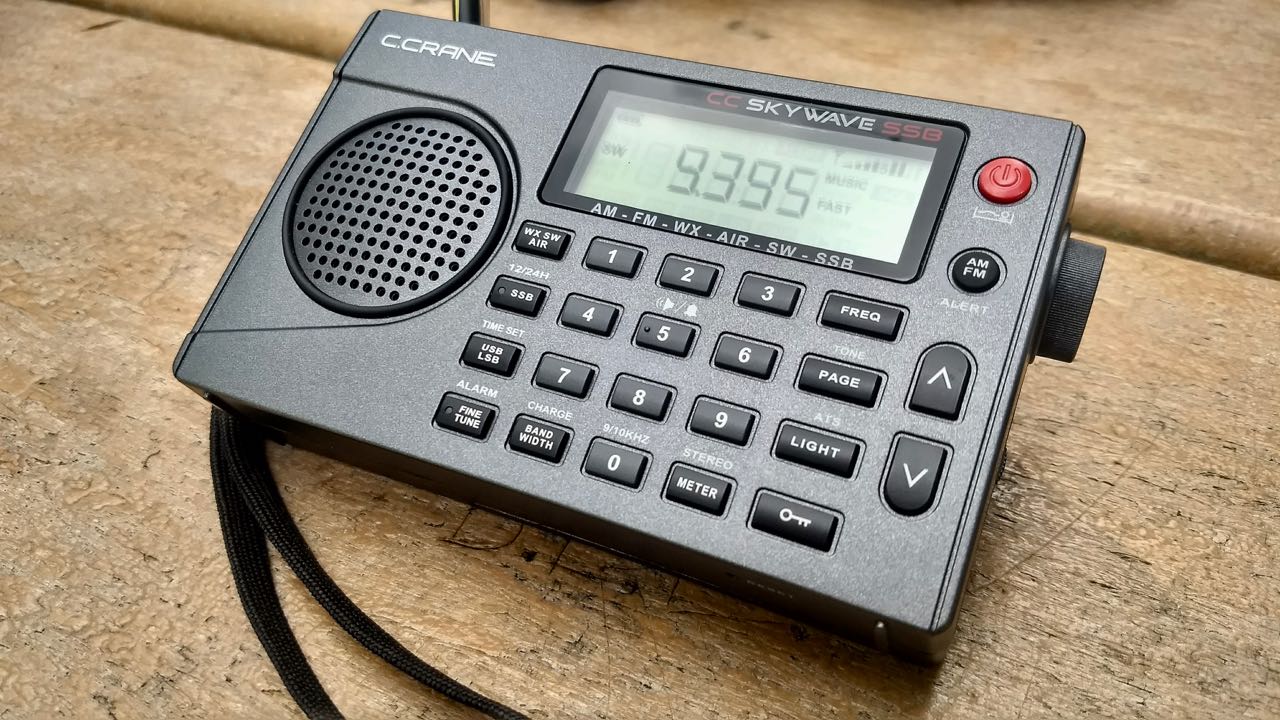
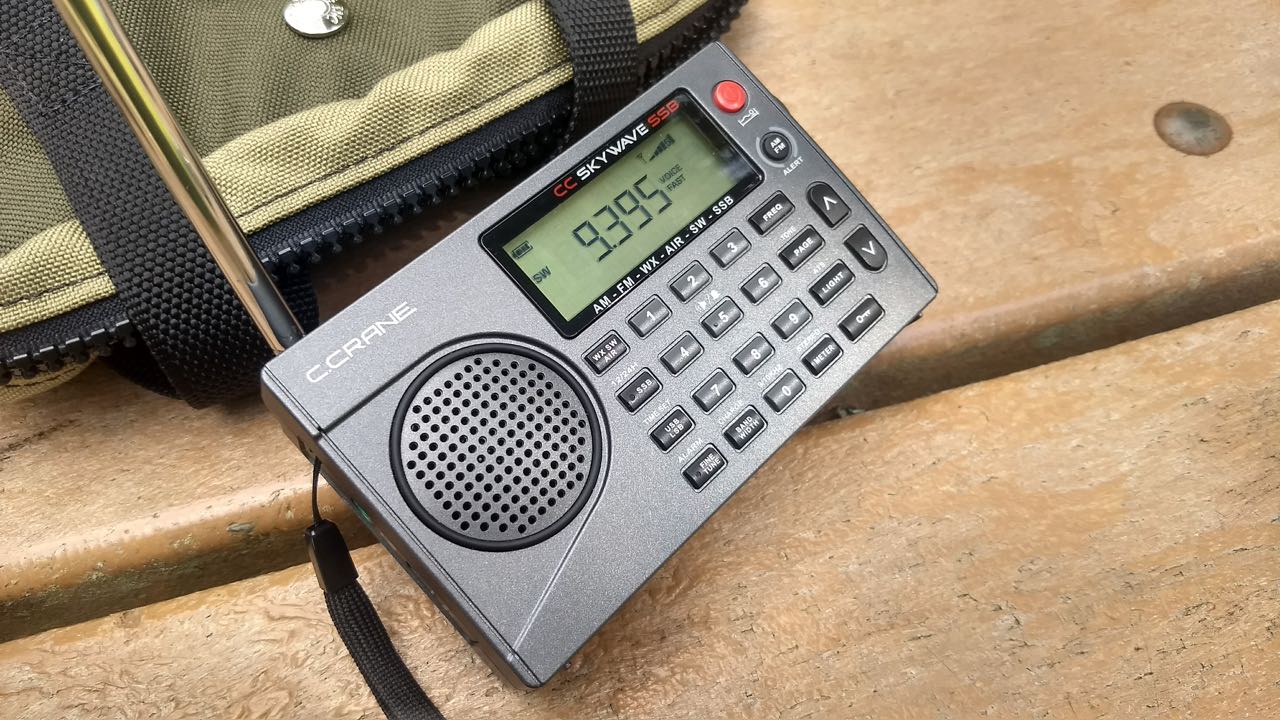
Instead, I remembered that just a few days ago I had pushed the battery-charge button on one of a couple shortwave radios I have around here, this one a decade-old C. Crane CC Radio SW. It has a big speaker and a pleasant sound, though it’s not the sort of radio you get to dig faint signals out of the mud. It is just right for such an evening as this. So I brought it to the living room, extended its built-in antenna, and fired it up.

Shortwave radio is like Forest Gump’s mama’s box of chocolates, and that’s part of its appeal. Poking around the dial I find some Ohio shortwave amateurs putting on a bit of a panel show, passing the mic metaphorically from one to another. Because they are shortwave amateurs, all they talk about was their shortwave equipment.

The power is out all over the neighborhood, so there is not a single static scratch, no 60-Hz whine of interference. And the ionosphere seems stable, no fading in and out of signals.

Heading up the dial, I find a station in accented but easily understood English. I have to listen for a while before I learn that I am listening to Radio Romania International. That broadcast ended, so I retune and find a cranky man and a cranky woman who are discussing how awful things are and how the only thing you can count on is gold.

Moving along, I find an impassioned man with a deep Southern accent. He, too, is discussing how awful things are – and how they soon will be especially awful for those who put their trust in gold or other things of this world.

There is a broadcast from somewhere – from the accents I’d guess the Caribbean or Africa – that features a man and woman talking spiritedly and sweetly about English idioms.

Now I’m listening to the Argentine national shortwave service, which had a talk program in English though they’ve switched to Argentine music.

[…]I do hope the power comes back. Just not tonight. Tomorrow, maybe. Or the next day.

(Note: Just as I set this to email itself eventually to the Athens NEWS, minutes after I was done writing, the power came back on. And it really was a little disappointing.)

Read this full story via The Athens News online…

ABC opposes restoration of shortwave services

(Source: RNZ via Dennis Dura)

ABC opposes bill to restore Pacific shortwave service

The Australian Broadcasting Corporation has made a Senate submission opposing a bill which would force it to restore its shortwave services for the Northern Territory and the Pacific.

The bill was introduced by South Australian Senator Nick Xenophon after the ABC switched off its shortwave transmitters in late January.

The ABC is opposed to the bill and said in its submission that its passing would impinge on its independence by directing the ABC to use broadcast technologies for diminishing audiences and at significant maintenance costs.

Continue reading at RNZ’s website…

Shepparton property listing and photos

Many thanks to SWLing Post contributor, Rafman, who shares the following info regarding the Shepparton broadcast site “Land Banking Opportunity” posted on Sunday. Rafman writes:

I found an excellent slide show & the the listing at

http://property.cbre.com.au/properties/490-verney-road-shepparton-north-vic-3631/

[T]hey’re marketing it as “agricultural”

Thanks, Rafman. Here’s the current property description from the ad:

490 Verney Road, SHEPPARTON NORTH, VIC, 3631
For Sale
By Expression of Interest

Significant Land Banking Opportunity

CBRE Agribusiness is pleased to present for sale 490 Verney Road, Shepparton North. Strategically positioned in Shepparton’s northern growth area, the property offers a large scale grazing opportunity with land bank potential.

Key features of the offering include:

– Significant and strategic 229* hectare landholding set across five freehold Certificates of Title

– Located moments from the Shepparton Town Centre (5* minutes) and just over two hours from the Melbourne CBD and Melbourneâ??s International (Tullamarine) Airport

– Situated opposite the highly regarded Goulburn Valley Grammar School

– Extensive road frontage of over 3,300* metres including Goulburn Valley Highway (417* metres), Verney Road (1,286* metres) and Grahamvale Road (1,606* metres)

– Access to irrigation with 12ML* high reliability water entitlement

– Two constructed irrigation channels

– Future Urban Development Opportunities (STCA)

– Site adjoins Low Density Residential and General Residential Zoned land to the west

*approximately

One SWLing Post reader, who works in real estate in Australia, explained to me that:

“An Expression of Interest (EOI) sale is a bit like a combination of an auction and private treaty sale. Typically, the property will be on the market for a set amount of time (often 1-2 months). During that time, potential buyers evaluate the opportunity, then submit their confidential bids with any conditions via the agent. When the consideration period ends, the seller reviews the offers and picks the best. EOIs are often used for unique properties like Shepparton.

They’re plugging the agricultural potential with the idea that an investor might “land bank” the purchase…meaning, buy the site, then use it for agriculture (grazing, etc.) until zoning and capital are in place for future urban development. Unless the buyer has very deep pockets and local political pull, it would likely take many years to have things set for residential development. If this were zoned residential already, it would be indicated (IN BOLD!) in the listing. Hi hi!”

Thank you for the clarification. I also understand that the site is still being managed and serviced by BA engineers and technicians.

Shepparton IHFTS for sale: land banking opportunity

Many thanks to SWLing Post contributor, Nigel Holmes, who shares the photo above and notes:

Better get your cameras & long lenses oiled & hard hats, safety glasses & ear plugs ready. Or see your bank manager about an investment loan. I wonder if Babcock want a site down here?

Certainly not encouraging in terms of any future for this former Radio Australia transmission site. I imagine there would be a substantial up-front cost to simply tear down the existing infrastructure.

Thanks for the tip, Nigel!

Soviet Era Radio: Dennis reviews the Shoroh R-326 receiver

Many thanks to SWLing Post contributor, Dennis Kalinichenko, who shares the following review:

The Shoroh R-326 military radio

by Dennis Kalinichenko

I believe the piece of Soviet military equipment I recently bought to my collection would be interesting to all readers and contributors.

This is the R-326 “Shoroh” (“Rustle”) general coverage military tube shortwave radio receiver. These were produced decades ago, back in 1963. These portable receivers were in active military use in the Soviet Army until the early 2000s, when the R-326 was finally discontinued . Today, this set is no more a spy secret, but a great collector’s item and also a good receiver for home use.

My set cost me about $150 US, which is rather expensive for this radio. The R-326 was plentiful in the local market in 90-s, right after the fall of the Soviet Union, very cheap and popular between radio amateurs, but nowadays this radio has become more and more rare, so the price rises up.

My R-326 arrived from Khabarovsk city, the Russian Far East, where, I believe, for many years it was on duty in some of the Soviet radio intelligence and defense forces division.
The set includes the radio itself, original military 100 ohm headphones, original rectifier box for 2,5 V output, 12 meter long wire antenna on a reel, the 1,5 meter famous “Kulikov” mini-whip antenna, the isolator for placing it on top of the radio and some minor accessories.

Originally, the R-326 radio came with two batteries–1,25 V each–for field use, but mine are totally drained and need to be serviced, so I haven’t used them so far.

The radio is a light-weight, only 33 lbs, which is a real minimum for Soviet military equipment–the famous R-250 radio’s weight is up to 220 lbs–so, in comparison, this unit is really portable. You can easily put it in your car using the attached leather handle and take it with you on a weekend trip. No other military radio can be so “travel-friendly”; this is one of the reasons it was so popular in the ham radio and SWL communities.

The case is made out of steel and looks so solid you may want to use it as a nutcracker. And you can! In no way could you harm the box constructed to resist nuclear attacks. It is waterproof and sealed–so I can be confident that no previous owner has ever tried to solder something in the guts.

The radio is a super heterodyne containing 19 (!) special mini tubes and covering 6 SW bands, from 1 to 20 MHz. It works in both AM and SSB (CW) modes, having an on-board adjustable bandwidth control from 300 Hz to 6 kHz.

On the front panel, there are two scales: one is rough/coarse, and above is the precise one, a so-called photoscale, which may be adjusted to match real radio-frequency using the four screws near the sun protection visor. With this scale, you don’t actually need a digital readout. It also has a BFO control with a zero setting, adjustable AGC levels for AM and CW, and adjusting screw for matching the antenna input, as marked for 12 m long wire, 1,5 m and 4 m whip.

The radio has no built-in speaker. Instead, there are two output sockets on the front panel, for 100 ohm headphones and 600 ohm line-out.

The power consumption is very low for s tube radio, the rig needs only 1,4 A at 2.5 volts DC (including the lightscale). I use the original power transformer (transistor rectifier) and therefore switch the unit into the 220 AC outlet.

The sensitivity of the radio is extremely high and equals some modern transceivers. The selectivity is also impressive. No doubt it was really great for 1960s. But there’s negative side as well: the radio easily overloads even from the outdoor long wire antennas. The best fit is the “Kulikov” mini-whip that you can see in the photos.

When you switch on the radio, you hear noise, the level of which seems high, so you lower the volume down. Yes, the radio is sensitive and a bit noisy. But thanks to the tubes it sounds really amazing in the headphones. The SSB ham operator’s voice is warm and very clear.
The tuning is very smooth, being actually 2-speed: outer wheel is for fast tuning, inner wheel for precise tune.

It’s absolutely obvious that nowadays a simple Degen or Tecsun may be more useful than this old and heavy unit with big and tough knobs and switches. But what a pleasure sitting in front of this perfect tube radio at night, with the headphones on, turning the huge tuning wheels, looking into the moving dim scale, listening into distant voices and rustles, feeling yourself a Cold War times operator near the rig.

Isn’t this experience priceless?

Indeed the experience is priceless, Dennis! Better yet, your R-326 now has an owner that will keep it in working order and enjoy it on a regular basis. I personally believe keeping these vintage rigs on the air is one way to preserve, and experience first hand, a little of our collective radio history.

Thank you so much for sharing your review and excellent photos of the R-326!

Post readers: If, like Dennis, you have a vintage radio you would like to showcase/review here on the SWLing Post, please consider submitting your story and photos. Being a huge fan of vintage radio, I truly enjoy reading through and publishing your reviews.  I know many other readers feel the same!