Category Archives: What’s On Shortwave

Radio Australia antenna azimuth settings

RA-PropMap

SWLing Post reader, George, recently asked about the new Radio Australia antenna settings accompanying the modified (trimmed) broadcast schedule.

The following are the new azimuth settings for the antennas at the Shepparton transmitter site:

  • 9,580 kHz: 070 degrees 0900-2100 UTC
  • 12,065 kHz: 355 degrees 0900-2100 UTC
  • 12,085 kHz: 030 degrees  0900-2100 UTC
  • 15,240 kHz: 030 degrees 2100-0900 UTC
  • 15,415 kHz: 355 degrees 2100-0900 UTC
  • 17,840 kHz: 070 degrees 2100-0900 UTC

Pulling Radio Santa Cruz out of the interference

BoliviaI recorded Radio Santa Cruz early this morning around 05:00 UTC on 6,135 kHz using the TitanSDR I currently have under review.

Radio Santa Cruz‘s 10 kW signal from Santa Cruz, Bolivia, was very much audible here in North America, though RSC was competing with another station on-frequency at the time. Actually, Radio Santa Cruz was broadcasting slightly off-frequency–6134.8 kHz instead of 6,135 kHz. In this case, the fact that RSC was slightly below frequency helped me delineate the station’s audio from that of a competing station.

Fullscreen capture 272015 54241 PM

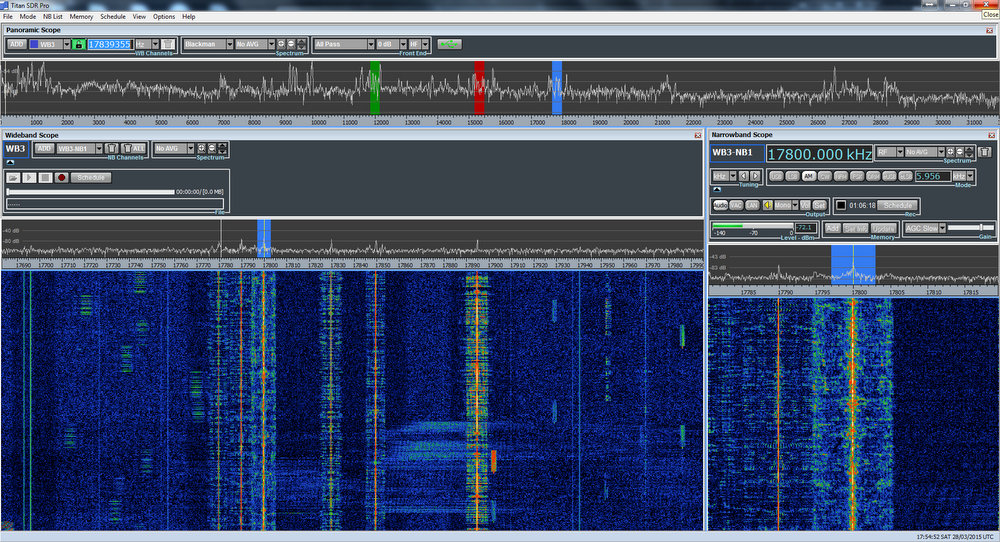
In the screen-grab of the narrowband channel from the Titan SDR (above–click to enlarge) you can see two distinct carriers spaced only .2 kHz apart (represented by the two peaks in the spectrum display and two parallel vertical lines in the waterfall display).

Here is what the audio sounds like in normal AM mode when we center on the Radio Santa Cruz frequency of 6,134.8 kHz:

You hear a hetrodyne and garbled noise from a competing station. Not pleasant audio.

If we change from the AM mode to eLSB mode (essentially, the TitanSDR’s version of synchronous detection on the lower sideband) we are ignoring all of the noise in the upper sideband, allowing the desired signal of RSC to pop out.

Fullscreen capture 272015 54317 PM

You can see in the screen-grab above that now only the lower sideband of the RSC signal is highlighted. Here’s a 21 minute recording:

Makes quite a difference!

It’s easy to see competing signals and interference on an SDR’s spectrum display, but if you hear something similar on your portable, try the techniques above to see if it clears up the signal.

If your receiver lacks a selectable synchronous detector, much of the same results can be gained by zero-beating (tuning in) the desired signal in lower sideband mode. Of course, if you have a receiver that lacks SSB mode, the best you can do is tune slightly below frequency in AM, in which case the results will not be as dramatic.

Conclusion? Listening in single-sideband or with a selectable sync detector might be all you need to dig a signal out of the interference.

Shortwave Radio Recordings: Detecting Radio Guyana/Voice of Guyana

GuyanaMap-SAMYesterday I learned that Voice of Guyana (a.k.a. Radio Guyana) is back on the shortwaves after being off-air for many years. Evidently, the station repaired some of its transmitters and antennas with the assistance of station supporter and technician Jamie Labadia. At this point the station is only capable of a 1,000 watt AM signal.

To be clear, 1 kW AM is not an easy catch for most of us in North America unless propagation is in our favor.

Last night while testing a new military-grade SDR (the Enablia TitanSDR) that I’m reviewing, I decided that Voice of Guyana might make for a good weak-signal test.

And so, last night at 21:00 EST (02:00 UTC) I tuned the TitanSDR to 3,290 kHz; I could see a faint carrier on frequency, but the audio was lost in the noise. I could detect talking and music, but I couldn’t base an ID from it. I set the TitanSDR to record a wideband chunk of spectrum throughout the night.  This morning, I played the spectrum recording and found that the signal was at its best around 0945 UTC.

TitanSDR-RadioGuyana-3290kHz

Above you can see Radio Guyana’s AM signal on the TitanSDR narrowband spectrum display (click to enlarge). While still quite weak, I could make out station IDs and music quite easily. It was wonderful to hear Voice of Guyana on the air again!

Note: the TitanSDR was exceptional at pulling the audio out of the static. More about this SDR to come…

Here’s a 27 minute recording I made with the TitanSDR, using its eUSB mode (ECSS), beginning around 0945 UTC:

Voice of Guyana back on the air

Guyana-FlagMany thanks to David Goren who shares this dialog between Jamie Labadia and Glenn Hauser via the DX Listening Digest:

** GUYANA. Hi Glenn, I have the Voice of Guyana on the air at, don’t laugh, 400 watts. 3.290 MHz is the freq. I am going to repair a few more amplifiers and get them up to about a kilowatt for now. Have to reconfigure the combiner though. The antenna is in rough shape, but surprisingly being heard well down into interior Guyana, which is the main purpose. (On a portable no less!!) I’ll keep you posted on how it’s going. It’s 80 degrees and very “tropical” here now. Best Regards (Jamie Labadia, visiting Guyana, 0147 UT Feb 2, DX LISTENING DIGEST)

Checking around 0300 UT Feb 2, I do have a JBA carrier on 3290- via the DX-398 but not the PL-880 – could be it. Slightly on the lo side; much weaker than 3320 S Africa, 3330 Canada. Will it be on all-night?

After local noise sources diminish, Feb 2 at 0629 I try again, and now a very poor signal on 3290- in English sounds like BBCWS, but not // or not synchro with 9460.

Meanwhile after I post this news ASAP on the DXLDyg, reports come in: Brandon Jordan in TN had it at 0333 on 3289.973, 0359 switching to BBC overnight feed just like they used to do. Bruce Portzer in Seattle also had a carrier around 0500. Daniel Wyllyans in Brasil was already hearing it as an unID. Forwarded these reports to Jamie and he replies at 1127 UT Feb 2:

“Yes, That’s us!! That was a repeat of the Sunday afternoon program. Made for great listening while working on the amplifiers — Nat King Cole, Glenn Miller, Woody Herman. Thanks to all of the great DXers out there. I will be working on the transmitter until just after local sundown, then leave it on the air until the next morning. Glenn, thank you very much for this great resource. Surprised more engineers aren’t using it as their “remote S meter”!! Jamie“

He said he planned to put V of Guyana on a higher frequency for better domestic coverage. 5950 used to be the daytime channel on the originally 10-kW transmitter, and it might be OK in the daytime now with possible het from Bolivia on 5952+, but at night there would be clashes from Germany, Iran, Ethiopia; and R. Pio XII until it closes (Glenn Hauser, OK, DX LISTENING DIGEST)

If you like to follow DX news closely, consider joining the DX Listening Digest email list and make sure you listen to World of Radio with Glenn Hauser. Many thanks to GH for permission to re-post this.

Additional note (06 Feb 2015): SWLing Post reader, Harald DL1ABJ, writes:

Dear Thomas,

Guyana was active on 3290 kHz till June 2012 when the transmitter went faulty. It was a new 10 kW unit installed only in April 2010.

Before 2010 the station was inactive on shortwave for a longer period.

Reception on 3290 kHz was quite ok during good dx conditions here in Central Europe. I even managed to catch their signal on 5950 kHz once during the 1980s or 1990s.

Kind regards

Harald DL1ABJ

Radio Australia silent on 9,580 kHz this morning

Fullscreen capture 1312015 25334 PMThis morning, when I tuned to Radio Australia on 9,580 kHz, they were not transmitting–or, at least, I couldn’t hear them.

I hope this is merely a transmitter glitch (they do happen).

You see, Radio Australia recently issued their new shortwave broadcast schedule which included cuts to the Pacific broadcast footprint. The changes take effect today. 9,580 kHz, however, should still be on the air between 09:00-21:00 UTC–this morning, I was listening at 15:00 UTC.

I can’t think of the last time I couldn’t hear Radio Australia on 9,580 kHz in the morning hours here in the eastern USA. Indeed, some of my earliest memories of listening to shortwave radio include RA on 9,580 kHz.

I need to look further into the changes to the broadcast plan. I’m beginning to wonder if the transmitter output and orientation have been changed. As you can see in the screenshot from my Elad FDM-S2 (above), there is a faint carrier on 9,580, but it’s much too weak to hear. I’ve no clue if it’s Radio Australia or not.

Fortunately, Radio Australia is quite loud on 12,065 kHz and very audible on 12,085 kHz (see below), which means I still get my Saturday morning dose of Saturday Night Country.

Fullscreen capture 1312015 25452 PM

Fullscreen capture 1312015 25537 PMI’ll post an update about 9,580 kHz as soon as I have more details.

Radio Australia propagation map and revised schedule

RA-PropMapSpeaking of the Radio Australia shortwave service reductions, I just received RA’s new propagation map (above) and schedule (below). Click images to enlarge.

RadioAustralia-RevisedSchedule

My source also sent a few RA internal notes/points regarding services, feeds and transmitters:

Radio Australia

  • Babcock ended 14th January.
  • Brandon last broadcast 31st January.
  • Shepparton reduced schedule from 1st February. 3 transmitters only.
  • RAS 1 is Pacific Satellite Feed
  • RAS 2 is Asia Satellite Feed
  • RAW 5 is Asia Web Feed
  • RAW 6 is Pacific Web Feed

Reminder – preferred backup domestic source is Classic FM, not Radio National.
[…]Radio Australia News ex N05 will be the SERN bed news 0600-1800 Monday-Friday.

Shortwave Radio Recordings: Radio Österreich International

Rotating high performance directional antenna of the ORF (Image: "Drehbare Hochleistungsrichtantenne ORF Moosbrunn“ von Daniel Csiky - selbst fotografiert. Lizenziert unter Bild-frei über Wikipedia - http://de.wikipedia.org/wiki/Datei:Drehbare_Hochleistungsrichtantenne_ORF_Moosbrunn.JPG#mediaviewer/File:Drehbare_Hochleistungsrichtantenne_ORF_Moosbrunn.JPG

Rotating high performance directional antenna of the ORF (“Drehbare Hochleistungsrichtantenne ORF Moosbrunn“ von Daniel Csiky)

For your listening pleasure: Radio Österreich International.

This recording was made on 6,155 kHz on January 29, 2015 starting about  05:59 UTC.

Only recently, SWLing Post reader, Eric asked about orchestral music on shortwave–as you’ll hear, Radio Oesterreich International is certainly a good source!

Click here to download the recording as an MP3, or simply listen via the embedded player below. Enjoy: