Shortwave Radio Recordings: All India Radio – Ravi Shankar

Ravi Shankar passed away December 11, 2012. Like many people, Shankar was a complicated fellow, but no one can deny his talent on the Sitar. His music will live with us forever, not to mention through the musical talents of his children, Anoushka Shankar and Norah Jones.

I recorded this clip of him on All India Radio some weeks ago.  Click here to download or enjoy below:

Shortwave Radio Recordings: Firedrake?

"Who can this be?"

“Mum, this sounds like Firedrake. Quick, make a note of it in the logs!”

I’ve noticed a broadcaster that routinely transmits weekends at 11:00 UTC on 6,970 kHz.  Some mornings, it’s much stronger than others. Saturday morning, my time, I managed to record it in its typical format: music. Specifically, Chinese folk music, at least so it sounds to my untrained ear.

I searched through logs and in the WRTH, and I could find no mention of a broadcaster on 6970 kHz. It doesn’t help that the 27 minute broadcast contained no audible IDs.

So, I’ve come to the conclusion that my initial hunch is correct–that this is the Chinese jamming service, Firedrake.  Using Firedrake, the Chinese government transmits music on top of broadcasts they wish to block. It’s fairly effective (and annoying). While I’ve heard Firedrake a number of times over the bands, I can’t say I’ve ever tried to listen to the one-hour production.

The following recording contains a 27 minute broadcast of what I believe may be Firedrake on 6,970 kHz, starting around 11:00 UTC, Saturday January 26, 2013. Click here to download the MP3, or simply listen via the embedded player below. Note that the first two minutes have some digital noises (in the lower side band) that affected my receiver’s AGC.

If you can confirm or correct my supposition, please comment!

Shortwave Radio Recordings: Radio Havana Cuba’s DXers Unlimited

ArnieCoroDXersUnlimitedIf you live in the Americas and you regularly listen to a shortwave radio, you have no doubt heard Radio Havana Cuba across the shortwave spectrum. When I travel in North or Central America, I can easily hear RHC, often without even extending the telescopic antenna on my portable.
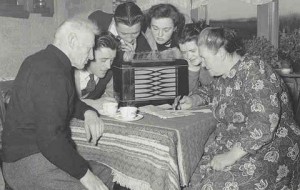
A long-running program on RHC’s English hour is Arnie Coro’s DXers Unlimited.

Tuesday night, I recorded the DXers Unlimited segment from RHC’s The English Hour on 6 MHz, and offer it here for your listening pleasure.  If the recording doesn’t sound typical of shortwave radio, it’s because: a) RHC’s signal is exceptionally strong into North America, and b) I recorded this with an AM filter 24 kHz wide.  In other words, I widened my DSP filter to match RHC’s bandwidth on my spectrum display–and to put this in perspective, I regularly record between 7-9 kHz wide. (This results in the crisp, high-fidelity audio you hear in this recording, though unfortunately at the compromise of any adjacent stations abiding by HF broadcasting etiquette.)

You can download the MP3 directly by clicking here, or simply listen in the embedded player below:

Dave’s FM station empire

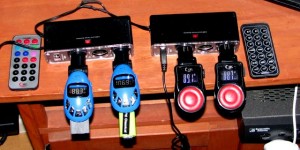
FMMegaplexDave Schmarder (N2DS) enjoys making radios and featuring them on his website, http://makearadio.com. What you may not know is that he also runs his own FM stations empire…and you can too:

I thought your visitors might be interested in my FM stations empire. I bought a bunch of mp3 players with built in fm transmitters that are usually used in a car and adapted them for home use. They all cost me under $4 each, plus a TF card for a couple bucks for each music transmitter.

At the moment I have 8 transmitters running, mostly with usb sticks looping music, but also a transmitter hooked to my tv cable box and another one to my internet radio.

This allows me to be anywhere in my little house and listen to these audio sources using a small Tecsun FM radio. During the summer I could sit on my porch and listen without dragging my radios or iPad outside.

Perhaps some of your visitors might be interested in having their own fm radio megaplex. Here is the link: http://www.n2ds.com/musiccenter/musiccenter.htm

73, Dave
N2DS

Thanks, Dave!

I’ve often thought of broadcasting 1930’s and 40’s music over a micro shortwave transmitter in my house. I would love to know if any readers have done this. Admittedly, it would take a pretty committed shortwave radio geek. Anyone? Anyone?

RootIO: community powered micro radio stations

RootIOThanks, Benn, for sharing this:

Radio continues to be a powerful tool for community information, and the RootIO project amplifies it by mixing its power with new mobile and Internet technologies. RootIO is an open-source tool kit that allows communities to create their own micro radio stations with an inexpensive smartphone and transmitter, and to share, promote, and collaborate on dynamic content. The project will be piloted in Uganda in partnership with the Uganda Radio Network, UNICEF Uganda and UNICEF Innovation Unit.

http://www.knightfoundation.org/grants/20123667/

http://rootio.org/

https://twitter.com/RootioRadio

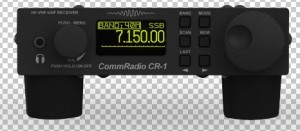
CommRadio is introducing the CR-1, a new tabletop shortwave receiver

The CommRadio CR-1

The CommRadio CR-1

US-based CommRadio is introducing a new tabletop, SDR-based, shortwave receiver this year: the CR-1. Their website has a few specifications and the video I’ve embedded below.

The CR-1 receives the full medium wave and shortwave spectrum (.5-30 MHz), plus some portions of VHF and UHF (FM broadcast band, Aircraft, Marine, NOAA weather radio, GMRS and FRS services).

The receiver architecture is a dual conversion super-heterodyne design with low-IF , I-Q digital sampling, 16 bit DSP with digital audio CODEC.  Their website also mentions DSP algorithms for all demodulation: DSB-AM, SSB, CW, WBFM, NBFM and channel filtering.

Other impressive features:

  • Can be powered from USB or a 6-18 VDC power source (from a separate 2.1mm jack).  The CR-1 possibly has the most flexible power source I’ve ever seen in a shortwave receiver!
  • The knobs are black anodized machined aluminium and front panel is powder coated machined aluminium; case is 20 gauge powder coated steel
  • Three antenna inputs
    • BNC for HF/MW
    • 3.5 mm audio jack (rated at 1000 Ohm, for roll-up antennas or telescoping whip),
    • BNC for VHF and UHF
  • Very portable size!

Full specs are available on their website: commradio.com

We will also keep you posted with any future updates.