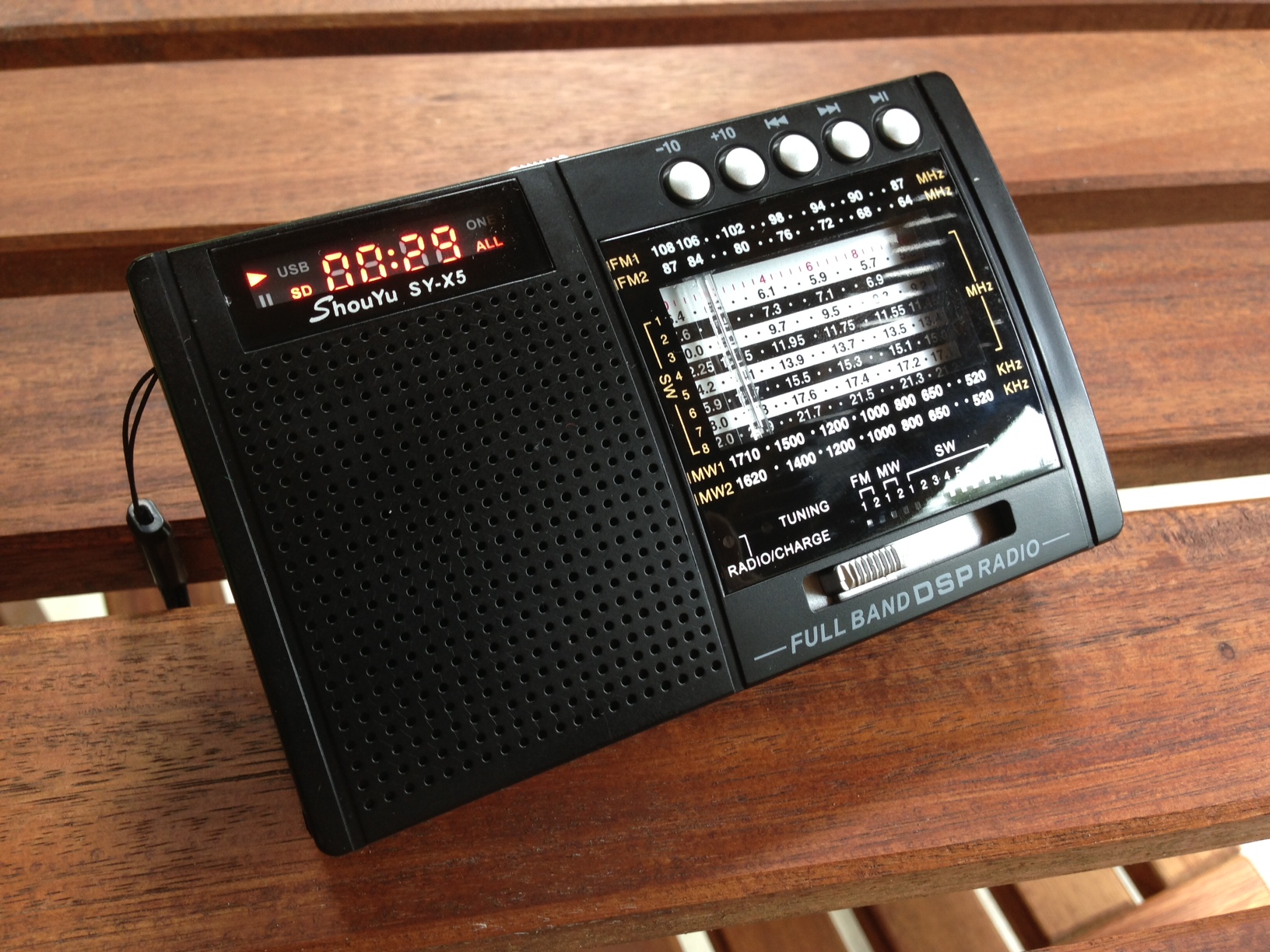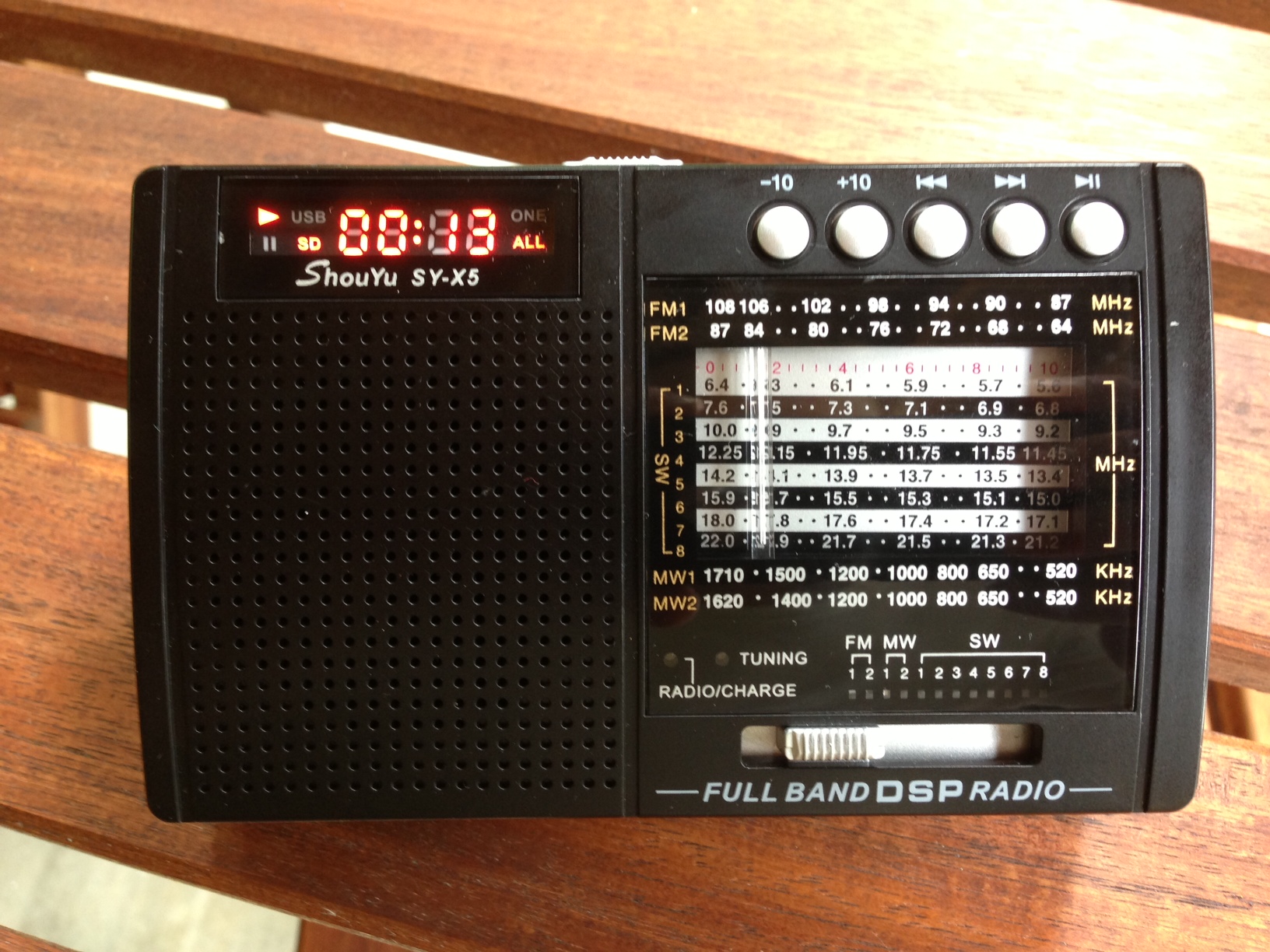
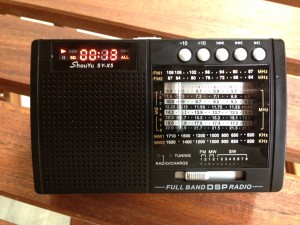
The Shouyu SY-X5 mechanically-tuned, DSP portable radio. (Click to enlarge)
The ShouYu SY-X5 shortwave radio came to my attention only a few weeks ago. It is yet one more mechanically-tuned, DSP based, portable shortwave/AM/FM radio. I have reviewed several other models based on the same DSP chipset: the Silicon Labs SI4844–see my reviews of the Degen DE321, Degen DE32, and the Kichbo KK-9803. I also recently reviewed the Tecsun R-2010D, though it is based on a slightly newer, though similar, SiLabs DSP chipset.
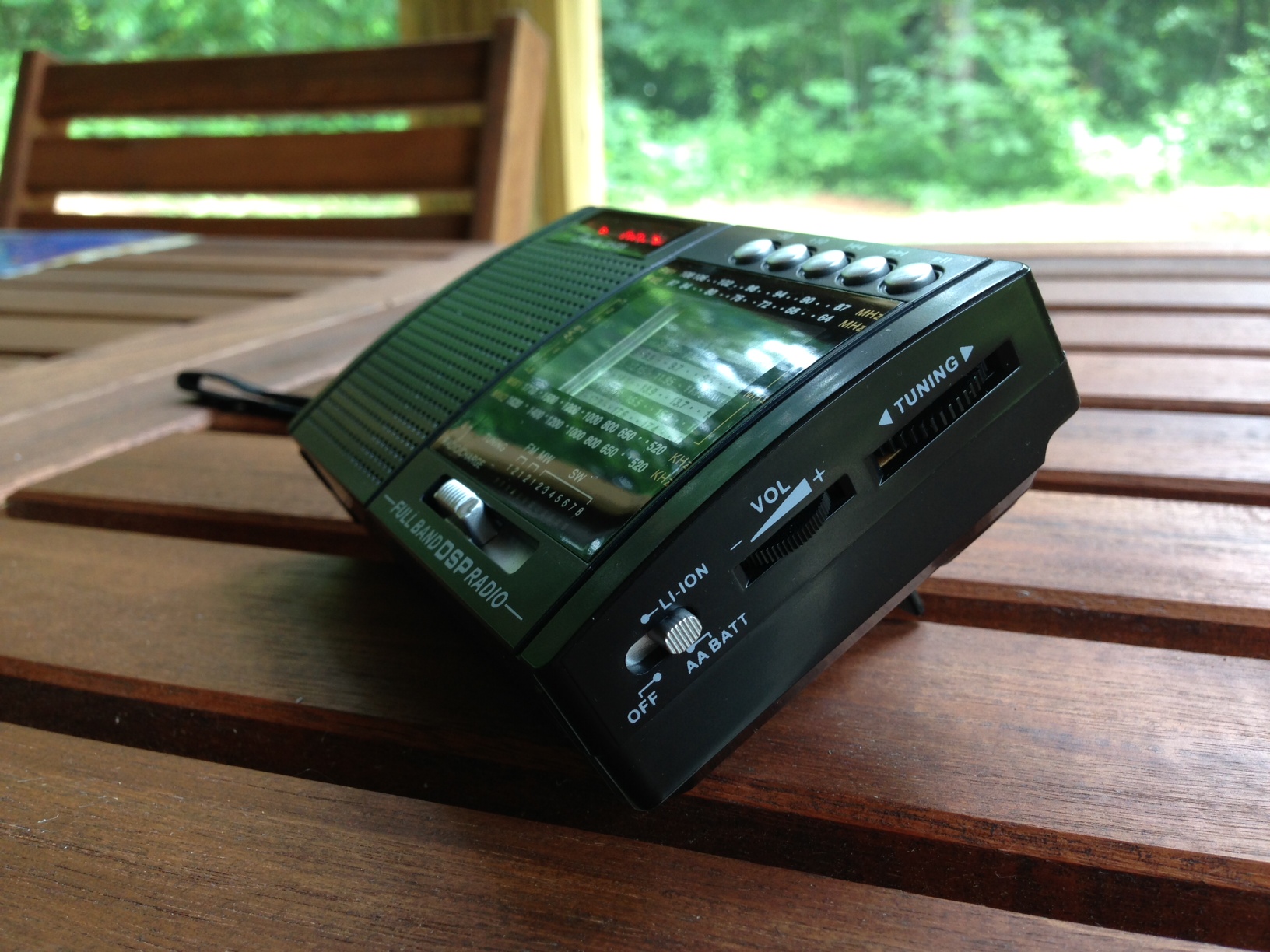
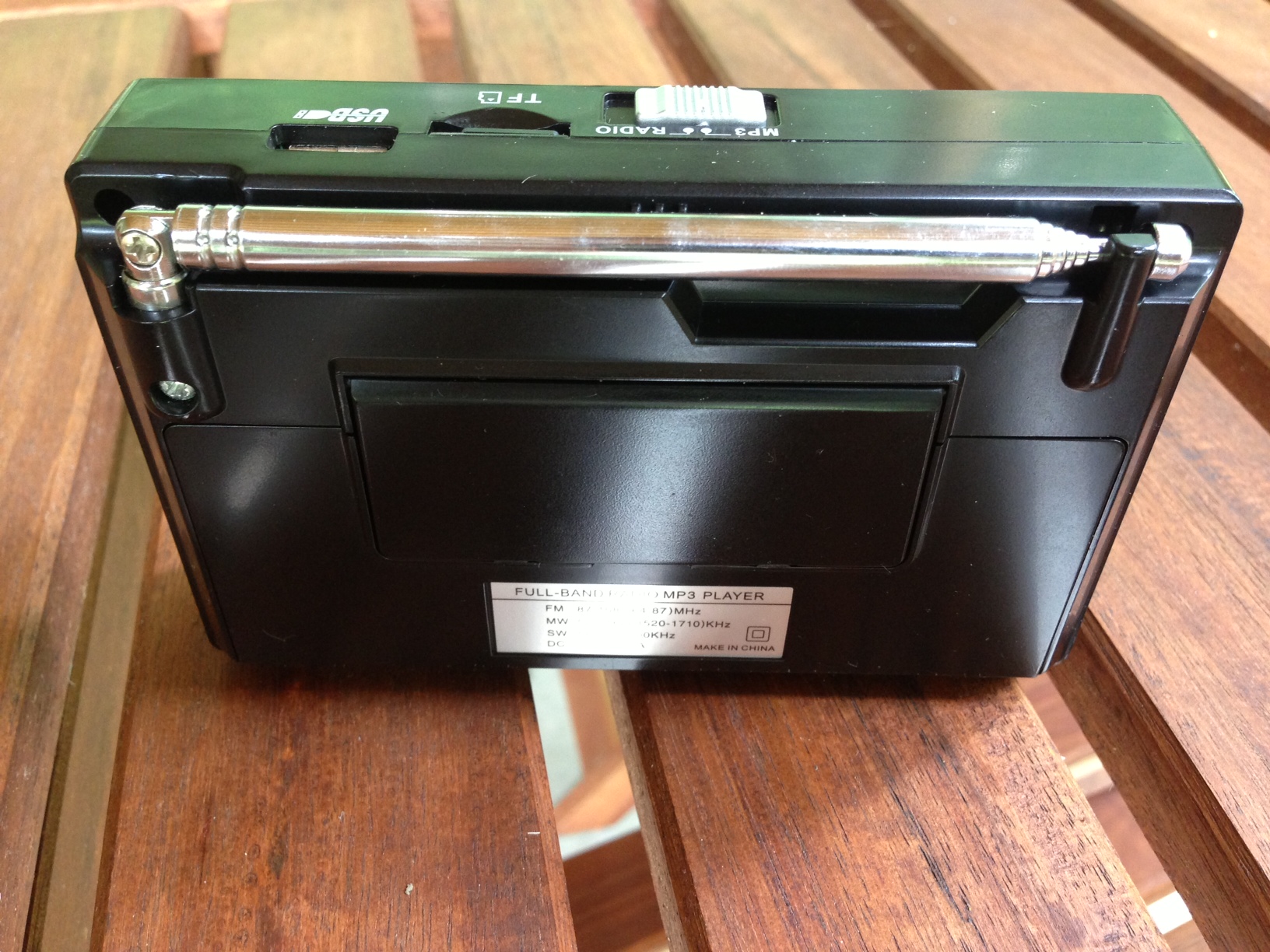
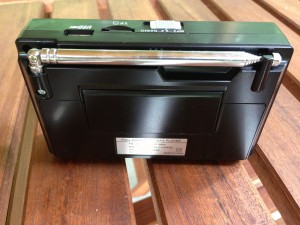
What makes the ShouYu SY-X5 stand out is the fact that it can be powered by either a rechargeable slim battery pack (found in the DE32) or three standard AA batteries. It also has a built-in MP3 player that uses a standard microSD card for media storage. Why are these features of particular note for me? I have been searching for a shortwave radio/mp3 player for use by my charitable non-profit, Ears To Our World. ETOW works in parts of the world where people lack mains power as well as access to the Internet (or else simply can’t afford Internet service). In such settings, radio allows teachers and school children to hear up-to-date international news via shortwave, and through pre-recorded educational material, they can play (and replay) MP3 content as needed.
Therefore, I immediately ordered an SY-X5 for review here, hoping to donate it for use in the field care of Ears To Our World.
First impressions
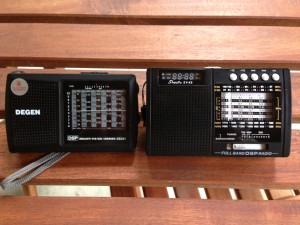
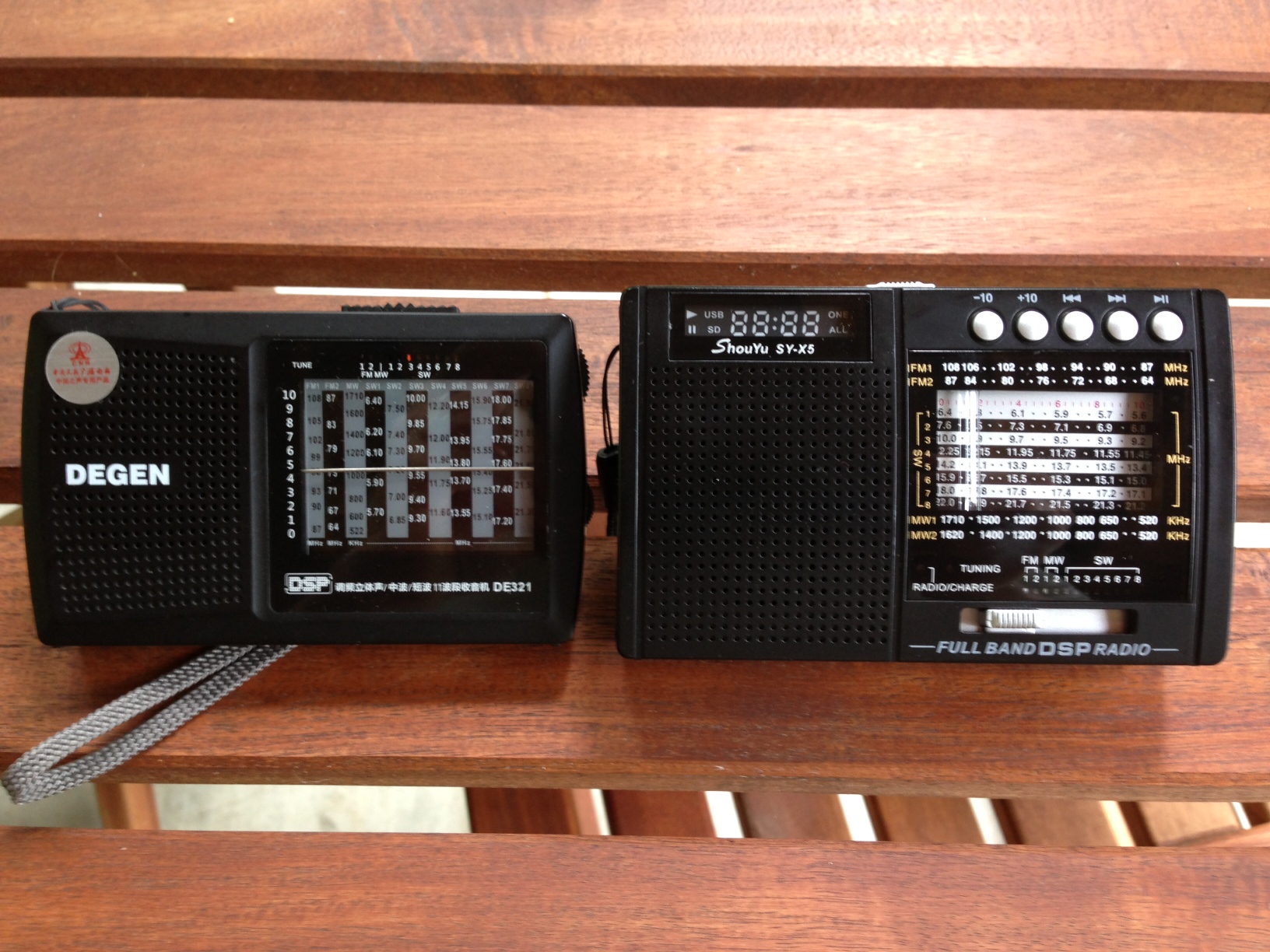
Degen DE321 (left) Shouyu SY-X5 (right)
The ShouYu SY-X5 is a small radio, almost exactly the same size as the very portable Grundig G6 and only slightly larger than the Degen DE321 (see left). It feels sturdy and even slightly heavy in your hand (no doubt, due to the number of batteries it holds). The antenna is rotatable and feels more robust than other radios in its price class.
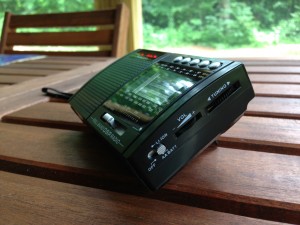
The SY-X5 has a back stand that likewise feels sturdy enough. Note: to open the battery compartment, you must lift up the back stand.
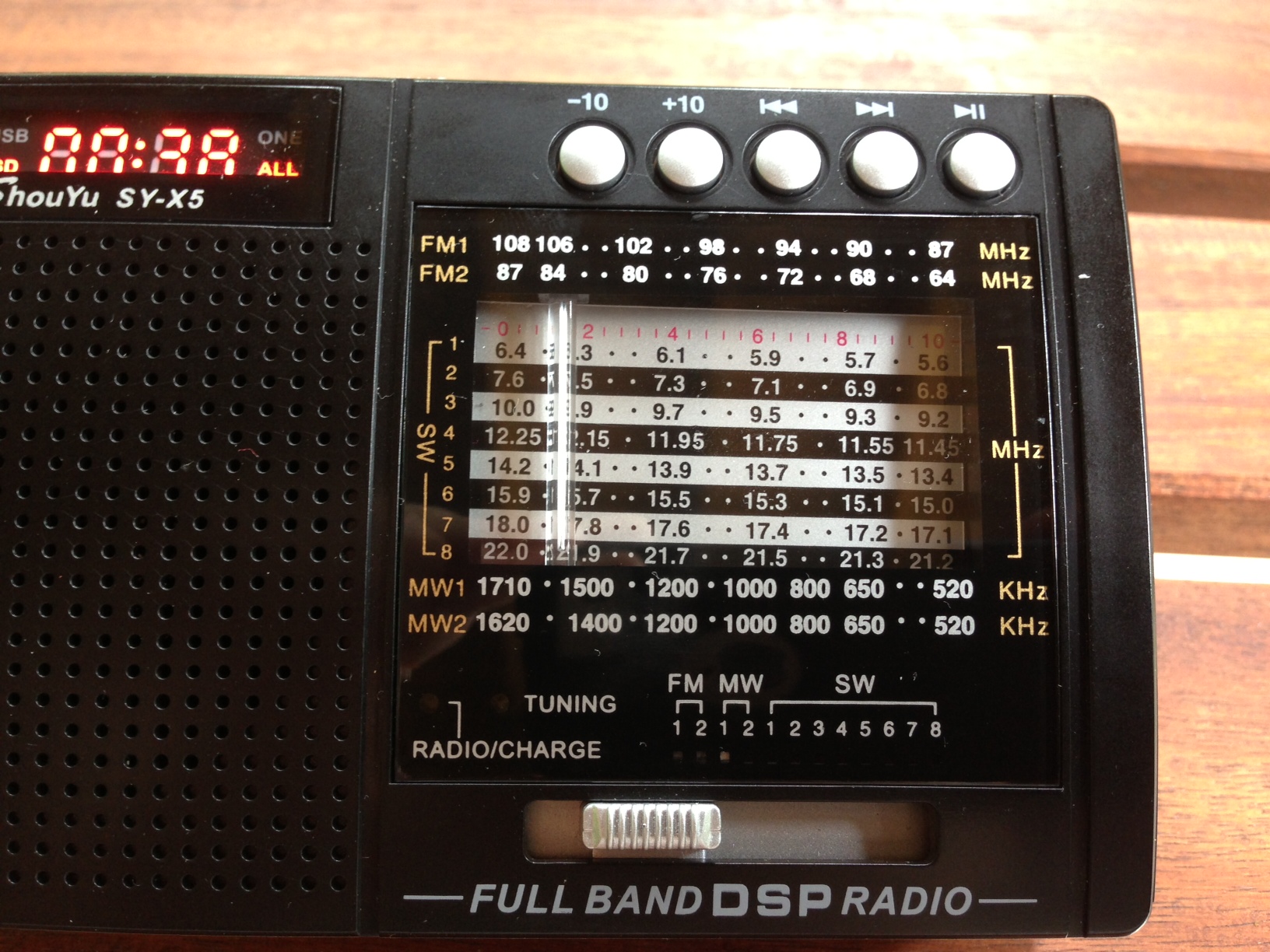
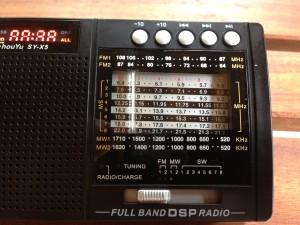
The overall quality is better than one might expect for $27 (US), with one notable exception: the printed frequency display behind the analog dial on my unit is positioned slightly off-center and not level, making needle position on the dial, well, frankly ambiguous.
Audio
Without a doubt, the greatest aspect of the SY-X5 is the audio delivered from the built-in speaker. It is exceptional for this size radio, full and with impressive bass characteristics. It very much reminds me of the Melson M7 (not yet reviewed here) and the Degen DE1129.
(Click to enlarge)
Performance
I’ve reviewed enough of these mechanically-tuned DSP-based radios now that I’m beginning to note performance commonalities that can only be attributed to the design of the DSP chipset itself (regardless of how they are implemented in each model of radio).
At risk of sounding like a broken record, this radio’s sensitivity, selectivity and AGC performance is nearly identical to the Degen DE321 on every band; here’s a summary:
- Shortwave
- sensitivity is mediocre–expect to hear all strong stations
- AGC circuit has difficulty coping with weak station and fading
- selectivity is mediocre
- Medium Wave (AM)
- strong daytime stations sound great
- the SY-X5’s AGC circuit struggles with night time conditions, even with some strong stations
- selectivity is mediocre
- FM
- FM performance is quite good
- Both selectivity and sensitivity are great for the price–in this case, $27 US
(Click to enlarge)
Between the two FM bands, the SY-X5 should easily accommodate world-wide FM broadcasts (even Russia). The two AM (medium wave) bands are almost identical in frequency allocation, but have been set up so that one is on 9 kHz spacing and the other on the 10 kHz spacing typically used here in North America (nice touch).
Tuning
While the “feel” of the tuning wheel on the right side of the radio seems smooth, in reality it is not. The tension or actual mechanics behind the analog tuner are problematic; I find that upon tuning in even a strong station, when I let go of the tuning wheel, it immediately moves off-frequency. It’s most annoying. Over the course of several days of use, it doesn’t seem that the mechanism has broken in at all as I had hoped. This is perhaps the biggest negative of the ShouYu SY-X5; it is just not easy to accurately tune it.
(Click to enlarge)
MP3 Player
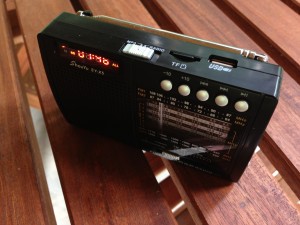
While I haven’t spent hours using the MP3 player, I find that it’s simple, yet quite effective. Most notably, it lacks fast-forward and reverse controls, though it does have buttons for ten-second skips both in the forward and reverse directions. Of course, you can pause, stop and skip to next/previous MP3 files.
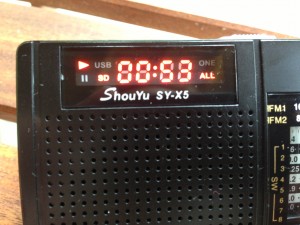
The SY-X5 has a dedicated MP3 player red LED display; it is very bright–almost too bright, in fact, for low light conditions–and quite simple, offering only basic functions (no alpha-numeric tags, for example). Unfortunately, I find that the LED display does inject a little noise into the audio, but it’s nothing that would deter me from using it with the built-in speaker.
(Click to enlarge)
Summary
Every radio has positive and negative attributes; below are the pros and cons I noted from the moment I unpacked the SY-X5:
Pros:
- Audio from internal speaker excellent for size
- Integrated digital audio player
- Uses standard Micro SD card for storage
- Very bright red LED display (see con)
- Dedicated, tactile buttons for basic MP3 functions
- Multiple power sources
- Internal rechargeable slim battery pack
- Standard AA batteries
- Charged/powered via standard mini USB cable
- Relatively sturdy construction
- Good FM sensitivity
- Tuning indicator light
- Inexpensive
(Click to enlarge)
Cons:
- “Sticky” tuning wheel/dial results in immediate and annoying digital “drift” off-frequency
- Sloppy selectivity (typical of this class of mechanically-tuned DSP radios)
- MP3 player’s LED display almost too bright for low light settings; the LED does inject some slight noise into the headphone amp chain
- Shortwave and medium wave sensitivity is mediocre, typical of other SiLabs SI484X radios
- MP3 capabilities are only as a player, the SY-X5 cannot record in any capacity
- Analog dial is small enough to make tuning accurately quite difficult
- The dial’s printed frequency display in my unit is positioned off-center and tilted, resulting in ambiguous needle alignment
Conclusion
The ShouYu SU-X5 is very similar, performance-wise, to the Degen DE321. Out of all of the mechanically-tuned DSP portables reviewed thus far, the SY-X5 may have the best audio fidelity via its built-in speaker (save the Tecsun R-2010D). Also, like other similarly sized and priced models in this family, the SY-X5 has tuning issues; in its case, a tuning wheel that will not stay on frequency without practice.
(Click to enlarge)
I’ve decided to take my SY-X5, on behalf of Ears To Our World, to inner Belize City in the near future. I’m going to offer this radio–together with a microSD card packed with VOA Special English programming (and a host of other English language educational materials, music and stories)–to a visually-impaired, economically-disadvantaged school child who will hopefully give this basic little radio lots of use, and perhaps even maximize its potential. While the SY-X5 has shortcomings, for this particular use–serving an individual who will not rely primarily on sight, but on tactile response, to operate it–I think it may serve its purpose. Perhaps this will be the best litmus test for the SY-X5’s utility and longevity: I may post an update when I receive feedback in approximately one year, as to whether this radio has required repair, replacement, or has offered (as I sincerely hope!) some measure of benefit to the child-owner.
For the radio hobbyist, I would encourage you to skip the ShouYu S-X5 and, instead, invest in a Tecsun PL-380, PL-390, PL-398BT, Degen DE1102, DE1103, or the Tecsun PL-600. Though all are pricier, each is under $100 US, and will actually provide a lot of performance for the price. The SY-X5 and other mechanically-tuned DSP radios seem only to offer mediocre performance and a low price.
Click here to search for the Shouyu SY-X5 on eBay.

 Thanks to Andrea Borgnino for sharing this article: