Radio Bulgaria, another broadcaster down: can shortwave be saved?

Yesterday, a message from Radio Bulgaria floated around the shortwave community that indicated the broadcaster may stop all shortwave broadcasts soon. Upon hearing this, my heart sunk.

Radio Bulgaria is no BBC World Service or Voice of America, nor is it the go-to station for the latest in international news.  However, what this unique little station does, and does remarkably well, is provide their listeners with news that is relevant to their part of the world. Like shortwave broadcasters of old, Radio Bulgaria draws listeners in, interacts with them, tells them about life in their ever-changing country.  Radio Bulgaria was once a mouthpiece for its government; after the Berlin wall fell, it became a true community-based station with both domestic and international listeners.  In short, Radio Bulgaria is a traditional shortwave station with accompanying warmth and charm.

Alas, my heart sunk a bit further this morning upon reading another, more substantiating, message; this time, from Ivo Ivanov, Radio Bulgaria’s frequency manager (via Mike on Cumbre DX):

BULGARIA / Dear listeners and friends of the short waves and Radio Bulgaria, / With a huge regret to inform you very bad news. After more than 75 years in the world broadcasting from January 31, 2012 at 2200 UT, Radio Bulgaria cease broadcasting on short and medium waves. The solution is that Radio Bulgaria is not necessary now its short waves and medium waves listeners. The reason –– no money for broadcast on short and medium waves. And who listens to short waves today? Already has internet. Maintaining the short waves was “Mission Impossible”! Hope dies last. As a frequency manager in the last 19 years my main task was to provide best quality signal of Radio Bulgaria in worldwide coverage. There will be no short waves, there will be no frequency manager. For all people who work in Radio Bulgaria that bad news is shock and horror Beginning of the end. But expect your moral support. Please send e-mail to:

Albanian section: <albanian @ bnr.bg>
Bulgarian section: <bulgarian @ bnr.bg>
English section: <english @ bnr.bg>
French section: <french @ bnr.bg>
German section: <german @ bnr.bg>
Greek section: <greek @ bnr.bg>
Russian section: <russian @ bnr.bg>
Serbian section: <serbian @ bnr.bg>
Spanish section: <spanish @ bnr.bg>
Turkish section: <turkish @ bnr.bg>

and from January 14, 2012:

Thank you and goodbye,
Ivo Ivanov

P.S. SW txs Kostinbrod & Padarsko will be destroyed in the next few months.

Heartbreaking.  It sounds as though the decision was swift, with little regard for those good station operators and others who work at Radio Bulgaria, nor for those who listen to its broadcasts.

Is this a sign of the times?

Weak Economy + Strong Internet = Shortwave Closures

This is, sadly, a prime example of what is happening to many international broadcasters. It’s that combination of shortwave radio listenership being on the decline (in parts of the world connected to the internet; my apologies to our kind readers who are the exception) while our weak global economy forces belt-tightening in governments and other organizations which support international broadcasters. Shortwave programs, which can be costly, often find themselves “justifiably” lopped off.  After all, it’s much more difficult to gather listener numbers than to track internet users and outlets over the internet. But most heartbreaking, those who actually listen to and rely upon shortwave are the least able to protest these closures. These listeners tend to be people who have no internet, and often live in remote, impoverished parts of the world.

Imagine you live in central Africa, for example, and tune into your radio every day for your world news.  Then one day, you attempt to tune in a favorite station program, but find only static…Have you made an error?  You tune again, but the station is nowhere to be found.  Then the next week, another favorite is absent…and another…

Here, in North America, I have very little ground to stand upon when complaining about shortwave closures. I have excellent internet access and some local radio, internet and TV outlets to turn to for news, music and more. When I stand up for shortwave broadcasters and protest closures, it’s for those I just mentioned, those without a voice.

Here in the US, I can’t help but draw an unlikely analogy.  I grew up in a small blue-collar town that manufactured furniture–lots of it. My father worked for a furniture factory his entire life. Indeed, almost everyone I knew had someone in their immediate family who built furniture. Something strange happened in the 1990s, though; suddenly, it became cheap, very, very cheap, to manufacture furniture abroad. As our local manufacturers started competing with others whose prices were supported by cheap foreign labor, locals felt the pull to move much of their manufacturing abroad too.

We put all of our eggs in the least expensive, most convenient basket. Today, in our little hometown, there are massive factories that have been sitting dormant for nearly a decade. They have no equipment inside, they have no skilled labor to build things. But that’s not the worst of it:  now, we couldn’t manufacture something if we needed to.  We’ve exported our entire infrastructure. Family and friends are without jobs, and this is the reason.  The same could be said of many, many other industries throughout the world.

Let me be clear: I’m no opponent of international trade–just like I’m certainly no opponent of the internet–but if we invest everything in the internet, we may very well lose our ability and means––our infrastructure––to broadcast over shortwave, should we need to do so in the future.  Already, there are many examples in which we need to do so.

I urge you to contact Radio Bulgaria via email (above) and sign the online petition at Save Radio Bulgaria. Whether or not we can stop this closure, I am uncertain, but we can make our voices heard.


Degen DE1128: More photos and features released

This blog has published more details about the DE1128. For those of us not fluent in Chinese, Google translate seems to do a fair job of translating details.

We have updated the SWRI entry for the Degen DE1128 with our interpretation of the translated features.

It appears it has many of the features we had assumed and is strikingly similar to the Grundig G2 Reporter.

Thanks to the Herculodge for the tip!

UPDATE: eBay seller Tao Qu has informed us that the Degen DE1128 will have AM (Mediumwave) steps locked in at 9kHz, meaning this portable would not be ideal for the MW DXer  in the US.

BBC World Service awards £200M contract to Babcock International Group

(Source: Radio Today)

Babcock International Group has won a 10-year contract to continue providing radio and TV transmission and distribution services to the BBC’s World Service.

The deal sees the firm manage more than 150 FM relays around the world as well as 180,000 hours of shortwave broadcasts each year.

The contract kicks in on 1 April and is worth around £200m over the 10 years. Babcock says it will build on the work they’ve been doing with the BBC over the last 15 years to ensure the corporation ‘provides a reliable and resilient service to its global audience’.

[…]The contract includes:

  • Scheduling and co-ordination of all BBC World Service shortwave broadcasts across the globe. In the first year of the new contract Babcock will co-ordinate a total of 180,335 hours of transmissions for the BBC.
  • Operating and maintaining the BBC’s six high power sites and a power station to ensure global coverage. This includes the BBC key target areas of Africa and the Middle East, the Indian Sub-Continent and South East Asia.
  • Monitoring of high frequency broadcast performance (using independent data). The BBC is committed to offering the best quality of service to its worldwide audience and Babcock’s monitoring ensures the best possible audio quality is achieved in the desired target areas.
  • Managing the satellite network contracts and support of the satellite distribution systems including 1,300 receivers worldwide in over 650 locations in 128 countries.
  • Maintaining the BBC World Service’s FM Relay network. In addition to the satellite receiver maintenance, Babcock will support the equipment of more than 150 FM relay sites around the world. This will underpin the resilience of the service offered by the BBC.

Read the full article on Radio Today’s website.

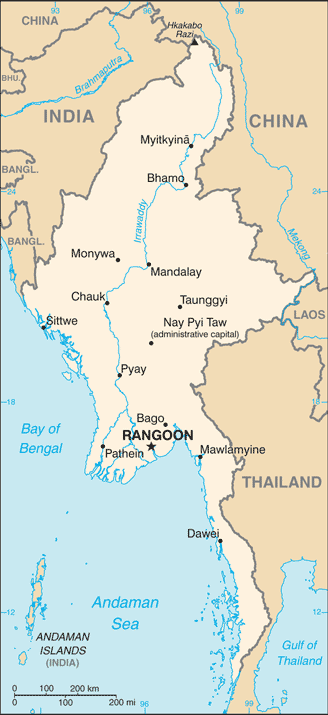
Shortwave radios keep Burmese informed

Filed under our ever-growing tag, “why shortwave radio“:

(Source: The Guardian, via Kim Andrew Elliot)

Zigon does, however, have electricity – unlike 90% of Burmese villages – installed by the government late last year. This has meant a number of changes. One of the more significant is the arrival of television. A satellite dish has now been installed at the village tea shop, largely used to watch state TV networks and Premier League football.

Though censorship has been eased in recent months, information is still tightly controlled. News of the Arab revolts last year was blocked for weeks – though millions use cheap Chinese-made radios to listen to the BBC, Voice of America or other networks broadcasting in local languages.

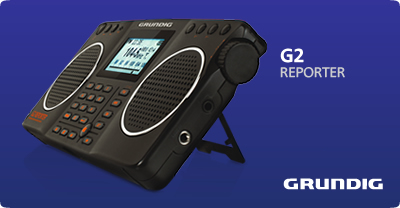
The Grundig G2 Reporter – a new shortwave radio from Eton Corporation

(Photo source: Eton Corporation)

It looks like a new Grundig shortwave radio is in the works, with availability as early as 2nd quarter.

I was just sent the following press release which was published prior to the 2012 CES:

(Source: Eton Press Release)

(Palo Alto, CA – January 9, 2012) – Etón Corporation, a leading creator of high-performance, green-powered consumer products, announces the Grundig G2 Reporter. The Grundig G2 is a portable travel radio that features multi-language capabilities and five tuning methods, providing a convenient way to listen to your favorite content wherever you go, from anywhere in the world.

The G2 Reporter is another reliable radio and information source added to the Grundig series. Use the five tuning methods – jog, manual, auto, memory, or ATS (Auto Tuning Storage) – to quickly scan or browse stations from anywhere in the world – hearing broadcasts in each country’s native language. The G2 furthers its international appeal with multiple language capability, allowing users to choose from a variety of languages to be shown on the LCD display.

Additional features of the G2 Reporter include:
AM/FM/WB frequencies
Dual stereo speakers with digital volume control
Signal strength indicator
Sleep timer and alarm clock functions
Multiple language selection
Ports: 3.5mm headphone output, line-in, MIC,
MINI-USB 2.0 jack (high speed)
Rechargeable lithium battery (1250mAh), charge through USB

“Etón has partnered with Grundig for the past three decades and we are proud to continue the brand’s long-standing quality tradition with the introduction of the G2,” said Esmail Amid-Hozour, CEO of Etón Corporation. “Grundig enthusiasts remain loyal and we know they won’t be disappointed with the innovative products in our 2012 line.”

Weighing only 9.6 oz. (272 g), The Grundig G2 Reporter is the ideal product for global travelers. Available in Q2 2011, the Grundig G2 Reporter will retail for $150 USD. For more information on Etón Corporation and its products, visit www.etoncorp.com.

Though very similar in appearance and features to the Tecsun PL-398MP or, better yet, the future Degen DE1128, I imagine that Grundig has put their own spin on this small rig. I have found that quality control tends to be much better via Grundig than Degen. With these specifications, it would indeed be a great portable SW radio for travel.

Update 1/11/12: Universal Radio has now listed the Grundig G2 in their catalog.

Pop’Comm Monitors – get your own shortwave listening post call sign

At SWLing.com, one of the most frequent email questions we’ve  received over the years is regarding the availability of call signs (station identification) for shortwave monitoring stations.  Until today, I’ve had to tell these inquiring folks that there was no known organization managing such a program. Some people have even suggested that SWLing.com begin one, but this sort of program needs to be organized, maintained, and curated–no small task, and one which is frankly outside our scope at SWLing.

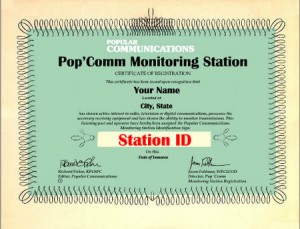
I’m delighted to report that Popular Communications Magazine has stepped up to the plate and is now steward of just such a radio monitoring  program, to be known as Pop’Comm Monitors.

So, Pop Comm is granting shortwave listening post call signs. What’s more,  you can request–much like amateur radio’s vanity callsign system–the 3 letter suffix of your choice.

What is the utility of a SWL callsign?  I think fellow radio listener and operator, John Harper sums it up quite well on his site.  In my view, it’s just one more way to conveniently connect and engage radio hobbyists across the globe.

Click here to go to the dedicated website for Pop’Comm Monitors, and sign up! There is no cost for joining the program.