Large Coronal Mass Ejection (CME) to hit earth January 24th

(Source: SpaceWeather.com)

CME‘s have a very negative effect on shortwave radio. This particular CME is the largest to hit earth in 7 years–certain high-flying airplanes may even be re-routed. On the positive note, the strong ensuing geo-magnet storms should create some beautiful aurorasin northern latitudes. More details:

(Source: Space Weather)

The Solar and Heliospheric Observatory (SOHO) and NASA’s STEREO-B spacecraft detected a CME rapidly emerging from the blast site: movie. Analysts at the Goddard Space Weather Lab say the leading edge of the CME will reach Earth on Jan. 24 at 14:18UT (+/- 7 hours). Their animated forecast track shows that Mars is in the line of fire, too; the CME will hit the Red Planet during the late hours of Jan. 25.
This is a relatively substantial and fast-moving (2200 km/s) CME. Spacecraft in geosynchronous, polar and other orbits passing through Earth’s ring current and auroral regions could be affected by the cloud’s arrival. In addition, strong geomagnetic storms are possible, so high-latitude sky watchers should be alert for auroras.


NPR stories expose internet tracking (while shortwave remains immune)

This morning, NPR’s (National Public Radio’s) Weekend edition aired two intriguing stories sharing one strong common thread. First, “CIA Tracks Public Information For The Private Eye“–a look inside the CIA’s Open Source Center:

Secrets: the currency of spies around the world. The rise of social media, hash-tags, forums, blogs and online news sites has revealed a new kind of secret, those hiding in plain sight. The CIA calls all this information “open source” material, and it’s changing the way America’s top spy agency does business.

While you must listen to or read the full story to fully appreciate it, its gist is that this featured department of the CIA essentially uses readily-available public information in order to unlock and predict all sorts of activities they’ve traditionally tracked through covert operations. It’s a paradigm shift in how they’ve traditionally done business. Though not surprising, if you know the nature of the internet, it is fascinating nonetheless.

The second story, “Technological Innovations Help Dictators See All” dealt with the flip side:

As technology gets better–and cheaper–it’s becoming easier for authoritarian governments to watch and record their populations’ every move. John Villasenor of the Brookings Institution joins host Rachel Martin to discuss the phenomenon.

This discussion covers a real and growing problem:  the online Big Brother phenomenon.  Many people feel secure and anonymous online, but are not.  Moreover, as tracking technologies get better, I fear it will give these governments even more control over (and methods to intimidate) their people.

[Incidentally, NPR’s Fresh Air did a story in December 2011 which focused on tracking technologies regimes use–it’s a must-listen, as well.]

I hope international broadcasters are listening to stories like these. It’s more clear than ever that VOA, BBC World Service, Radio Australia, Radio France International, Radio Netherlands Worldwide, and the like still hold the key to getting uncensored information into oppressed countries without bringing harm to listeners, namely, via broadcasts over shortwave radio.

For, as we’ve often said, shortwave radio is impossible to track, works at the speed of light, is everywhere, and requires very simple and affordable technology on behalf of the listener. Let’s keep it alive and well:  burgeoning democracies rely upon it.

Yet more supporting stories for our ongoing series, “Why shortwave radio?

Test a professional SDR from the comfort of your home–free!

Though I’ve not yet achieved particularly advanced age, my history in radio certainly started with the analog. The vintage Zenith Transoceanic my great-aunt gave me when I was eight was a wonder to tune, and its ability to extract signals from across the planet captivated me. But there was a certain amount of guesswork in the tuning process.  So, when I purchased my first digital portable in 1990, it seemed revolutionary:  in a snap, I could punch in a frequency, and there I was (virtually speaking). No guessing required.
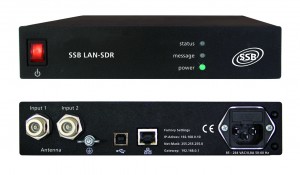
Front and back of the SSB LAN-SDR software-defined receiver

Front and back of the SSB LAN-SDR software-defined receiver

The next step in receiver evolution was, of course, Software-Defined Radios–those little boxes that you hook up to your computer that allow you incredible tuning flexibility and which permit amazing receiver performance.

So, you’ve never tried an SDR–? I know a fix for that.

In the course of an email conversation with Willi Paßmann, SDR support for SSB-Electronic, I learned that–simply by downloading a couple of files from their website–you can “test-drive” their high-end SSB LAN-SDR.

First, a brief primer…

Some SDRs–like the SSB LAN-SDR–actually allow you to record and to play back HF spectrum segments.

In a basic example: if I want to record pirate radio stations one evening, but am not sure where they might pop up on the spectrum, I can set my SDR to record, say, an 80 kHz swatch of bandwidth from 6,915 to 6,995 kHz, from, for example, 9:00 pm to midnight.
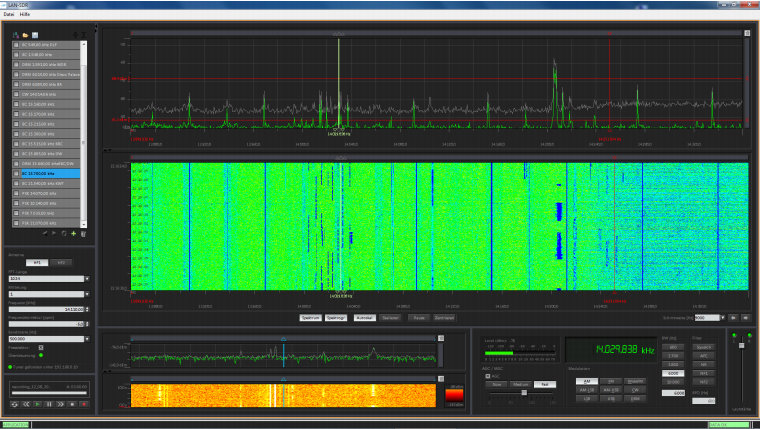
Later, I can play back and listen to the recording, with full demodulation and tuning capabilities.  In other words, during playback, I can literally tune around in the spectrum, using all/any receiver functions of my SDR. It is as though I am listening and tuning, live, in real time, though it may be many hours or days later.

Those of you with SDRs will not be surprised by this remarkable feature, as most likely, you’ve already experimented with this incredible time-bending functionality.

Now, back to SSB-Electronic, and how to test-drive their LAN-SDR receiver.  It’s easy, actually:

  1. You download the software that runs the LAN-SDR
  2. You download one (or both) available spectrum recordings

Once you install their software and import the recording, you can literally tune through and use all of the receiver’s features within the spectrum recording. You can listen to the noise floor, test the notch, adjustable filters, DSP, tuning rates–literally experience all the receiver functions in this process.

In my humble opinion, this is perhaps the most convenient and enjoyable way to try out a receiver.

Hopefully, other SDR manufacturers will follow SSB-Electronic’s lead and make their control software and spectrum recodings available online for download and testing.

Happy test-driving!

Ian McFarland CDs now available as a digital download

Ian McFarland (photo courtesy: DXer.ca)

Want to do something good for yourself, your knowledge of SWL–and, in the process, help others? Let me tell you how…

Ian McFarland has made available his excellent shortwave radio CD series for download on DXer.ca (an already excellent site, if you haven’t yet visited). This CD set includes a series on interval signals, foreign language recognition, a look back at shortwave history, the state of international broadcasting today, and even a bonus antenna series.  I purchased these the moment I heard that they had become available as MP3 downloads in December.

And how, exactly, are you helping someone else by enjoying these programs?  Fully 100% of the proceeds benefit Ian’s favorite charity, a food bank and soup kitchen in Duncan, British Columbia.

It’s a win-win, and you need to be one of those winners! What are you waiting for? Click here to go to the DXer.ca online store!

Description of CD’s from DXer.ca:
Series 1 – Were you a shortwave listener back in 1974? If you were a regular listener to RCI’s popular SWL Digest program, which went off the air in March of 1991 in the wake of a devastating budget cut at RCI, then you may remember the SW station Idents & Interval Signals Series that was featured on this award-winning program.

That series featured over 100 identification and interval signals from SW stations around the world. Many of the ident signals heard in that long-running series are no longer on the air. If you feel nostalgic about the “good old days” of SWLing, you’ll be interested to know that this unique series is now available in an autographed two-CD set.

Series 2 – CD#1: The Foreign Language recognition course + A bonus CD of classic McFarland.

Ever feel like you could do better with radio listening on the SW, MW and LW bands if you could only identify the language? Help has arrived with the release of Ian McFarland’s foreign language-recognition course. CD One of this series contains 55 language samples analyzed by noted linguist, the late Dr. Richard E. Wood.  You’ll be pinning down DX faster than ever with this concise and complete audio series CD. A second bonus CD contains three flashback shows in their entirety from the Ian McFarland catalog of classics.

Series 3 – Yesterday and Today:  20 Years of SW Broadcasting. In what they feel is their “finest work ever,” Ian McFarland joins Bob Zanotti, Kim Eilliot of VOA, Jef White of WRMI, and a cast of listeners from the 20th Anniversary Kulpsville, PA, SWLing Winterfest in 2007. They combine a 2009 live forum with a flashback to 1989 – The joint SWL Digest-Swiss SW Merry-go-round program devoted to the International Radio Days conference in West Berlin in 1989.

Bonus Download Series A – The Ian McFarland Antenna Series – A must-listen for SWL’s, DXers, and radio enthusiasts at all levels, this 11-part study series covers all things made of solid and stranded copper wire. From the most basic random wire to the windom and the beverage antennas, Ian discusses the most common types of radio antennas, protecting your antennas and equipment with lightning arrestors, and some antenna book references. The McFarland Antenna series was first aired in the seventies, and this is the first time in almost twenty-five years that these recordings have been available in a high quality MP3 download. Two dollars provides one hour of interesting and informative listening on the subject.

Recording of Radio Bulgaria on shortwave

This morning at 00:00 (Universal Time), I recorded the Radio Bulgaria originating from their Plovdiv, Bulgaria transmitter, 5,420 miles from my home. I started my recording on 5,900 kHz at 00:00, then moved to and stayed on 7,400 kHz after Radio Havana Cuba started transmitting nearby at 00:30 UTC and bled into their frequency (a very common occurrence with RHC).

The first hour is (00:00 – 00:59 UTC) Radio Bulgaria’s English service, the second hour (1:00 – 2:00 UTC), their Bulgarian Service and third hour, (2:00 – 3:00 UTC) French service.

In this recording, you’ll hear multiple announcements regarding the closure of their shortwave service as of Feb 1, 2012. They did mention they will continue services over the internet.

This was recorded with a Zoom H1 on an Alinco DX-R8T–antenna was a vertical delta loop.