FTIOM & UBMP, August 4-10


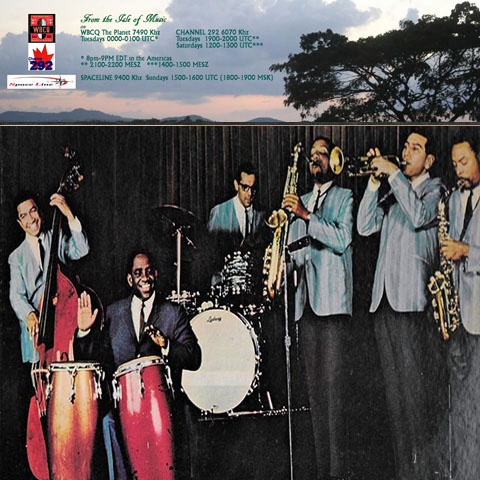
From the Isle of Music, August 4-10:
This week, we look at the career of the late Mongo Santamaria, who left us a vast and diverse body of work recorded in Cuba and the United States.
The broadcasts take place:
1. For Eastern Europe but audible well beyond the target area in most of the Eastern Hemisphere (including parts of East Asia and Oceania) with 100Kw, Sunday 1500-1600 UTC on SpaceLine, 9400 KHz, from Sofia, Bulgaria (1800-1900 MSK)
If you don’t have a shortwave radio or are out of range, you can listen live to an uplink from a listening radio in the Netherlands during the broadcast at
http://websdr.ewi.utwente.nl:8901/?tune=9400am
2. For the Americas and parts of Europe, Tuesday 0000-0100 UTC (New UTC) on WBCQ, 7490 KHz from Monticello, ME, USA (Monday 8-9PM EST in the US).
If you don’t have a shortwave or are out of range, you can listen to a live stream from the WBCQ website here (choose 7490)
http://www.wbcq.com/?page_id=7
3 & 4. For Europe and sometimes beyond, Tuesday 1900-2000 UTC and Saturday 1200-1300 UTC on Channel 292, 6070 KHz from Rohrbach, Germany.
If you don’t have a shortwave radio or are out of range, you can listen live to an uplink from a listening radio in the Netherlands during the broadcast at
http://websdr.ewi.utwente.nl:8901/?tune=6070am
Uncle Bill’s Melting Pot, August 4 and 6, 2019:
Episode 124 brings you music from Japan that spans over 80 years.
The transmissions take place:
1.Sundays 2200-2230 UTC (6:00PM -6:30PM Eastern US) on WBCQ The Planet 7490 KHz from the US to the Americas and parts of Europe
If you don’t have a shortwave or are out of range, you can listen to a live stream from the WBCQ website here (choose 7490)
http://www.wbcq.com/?page_id=7
2. Tuesdays 2000-2030 UTC on Channel 292, 6070 KHz from Rohrbach, Germany for Europe.
If you don’t have a shortwave radio or are out of range, you can listen live to an uplink from a listening radio in the Netherlands during the broadcast at
http://websdr.ewi.utwente.nl:8901/?tune=6070am
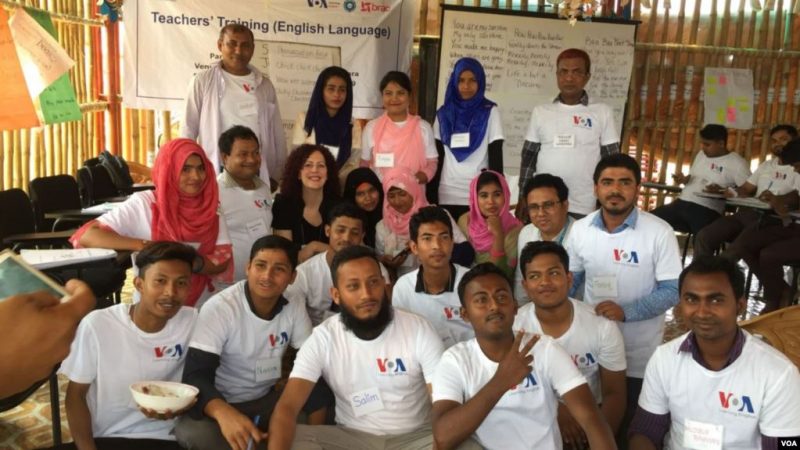
“VOA Launches Rohingya Language Program”

Teachers gather with VOA Learning English instructor at the end of training. (Source: Inside VOA)

Many thanks to SWLing Post contributors, Eric McFadden and Bruce who share the following item from NPR:

The Voice of America has begun a daily radio show in Rohingya, the language spoken by Muslim refugees who have been forced to flee Myanmar. The program is called “Lifeline.”

Click here to read/listen at NPR.

Also, Inside VOA published the following press release:

VOA Launches Rohingya Language Program

Today the Voice of America’s Bangla language service started a five-day-a-week radio show in Rohingya, the language spoken by Muslim refugees that have fled Myanmar. More than 800,000 people have taken refuge at the Kutupalong camp, one of the world’s largest refugee camps at the Myanmar-Bangladesh border.

Titled Lifeline, the 30-minute radio show, is available through short and medium wave signals. The program focuses on the lives and needs of the refugees, providing them with valuable information on security, family reunification, food rations, available shelter, education and health including vaccinations and water purification. In addition, a daily segment of the program offers the refugees the opportunity to share their stories, extend greetings to their families and learn about the hazards of joining extremists groups. One overarching objective of the broadcast is to counter Muslim extremists’ narratives and recruitment efforts in the camps and inform the Rohingya about the U.S. and the international community’s involvement in the crisis.

“After visiting Cox’s Bazaar and the Kutupalong refugee camp last year, it became obvious to me that we needed to address the informational needs of these people caught in the fastest growing refugee crisis in the world today,” said VOA Director Amanda Bennett. “Providing them with a reliable and authoritative source of news, as well as practical information that will improve their lives, is what the Voice of America does well in various hotspots around the world.”

Prior to launching the Rohingya language program, a VOA Learning English team travelled to the Rohingya refugee camps in Cox’s Bazar, Bangladesh, in March of this year at the invitation of the United Nations High Commissioner for Refugees. The VOA instructors offered six days of intensive training on teaching techniques and methods for 100 selected English teachers. The teachers, in turn, will use the acquired knowledge to train another 5,000 of their colleagues in the camps.

Click here to read at Inside VOA.

Imre’s HanRongDa HRD-737 modification increases sensitivity

Many thanks to SWLing Post contributor, Imre Olajos, who writes:

Hi, HRD 737 lovers! I have a good news!

I  (became brave enough to) modify my HRD-737.

I tried reverse-engineering- but I gave up. No numbers on IC-s. I found specifications for the analog switches (one for each band ) and found information about the transistors around those analog switch IC-s. Nice, 1 GHz fT transistors, all surface mount, so I gave up that line.

I found an NPN SM transistor in a damaged TV remote. It is only a 300 MHz transistor but
I had no better than that, so I started to build a little antenna amplifier circuit, wide band and simple.

I lost a few SM capacitors during the soldering but I have plenty of those. So the 1/4 square inch circuit board was finished last week. I tested it with an external 3 volt battery and I found it good working. Today ( 07-27-2019 ) I opened up the HRD-737 and wired it into the radio.
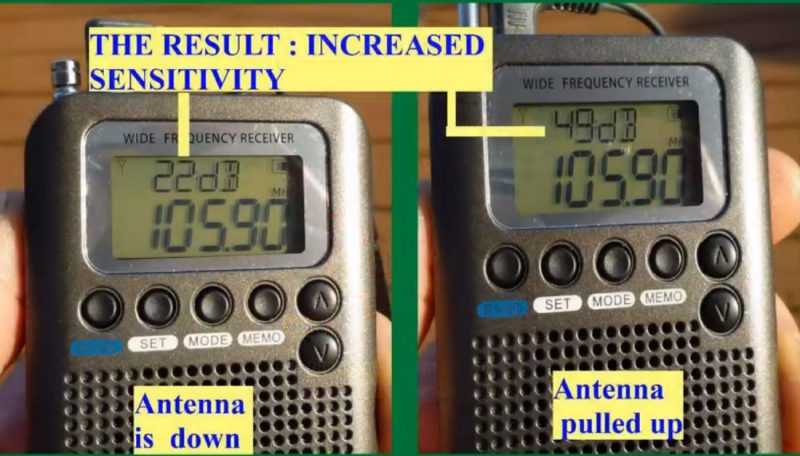
The results are much better than I expected. The HDR-737 became a good shortwave radio!

When I touch the built in antenna by my finger, radio is sensing the touch and station comes in. This effect was not there before. Radio became more sensitive on CB band than my Realistic DX392.

I have a YouTube channel [in the following video/slideshow] and I will show you the little ugly but great working circuit in the radio:

Click here to view on YouTube.

Later on next week I will try to record some video of the shortwave reception and post up it on the same YouTube channel.

I am a shortwave lover since 50+ years and I will be very happy to share the good news with others. Now I can listen my Greek music on this little radio, on 9420 kHz. Yes, the radio became [more sensitive than I had hoped].

You can see my other shortwave radios on my YouTube channel too, Have fun and never give up the hope!

Many thanks, Imre, for sharing and documenting this modification. One of the lessons here, too, is that if you have an inexpensive radio like the HanRongDa HRD-737 and you feel tempted to try a modification, there’s little to lose. It’s not like modifying a $1000 transceiver–just dig into the little radio and give it a go. If you harm the radio, you’ve only invested $37 or so in the project. That’s a much better solution than letting it sit on a shelf collecting dust because it’s not sensitive enough! Well played, Imre!

Special event stations celebrating anniversaries of famous European pirate stations

Many thanks to SWLing Post contributor, Harald Kuhl (DL1AX), who writes:

At the beginning of August there will be two special event amateur radio stations active on shortwave, celebrating anniversaries of famous European pirate stations Radio North Sea International and Radio Caroline:

Radio Northsea International PA45RNI

from 01-08-2019 to 31-08-2019

http://www.radio-northsea.org

email: [email protected]

[source: https://www.qrz.com/db/pa45rni]

and

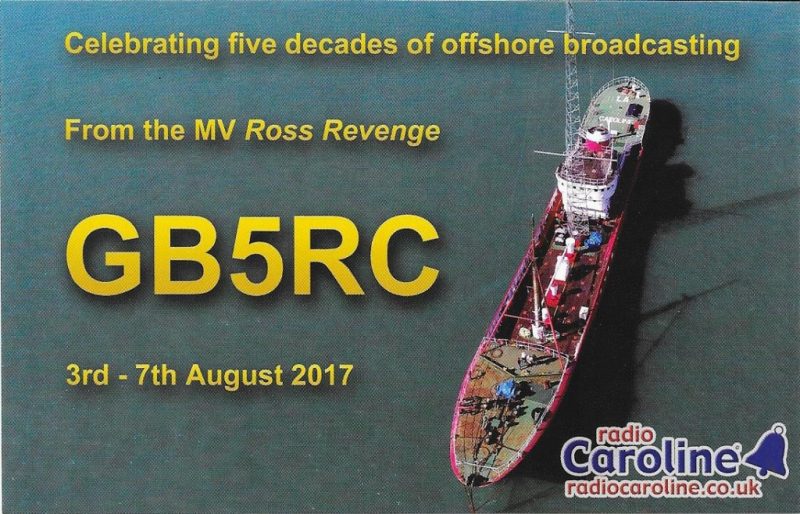
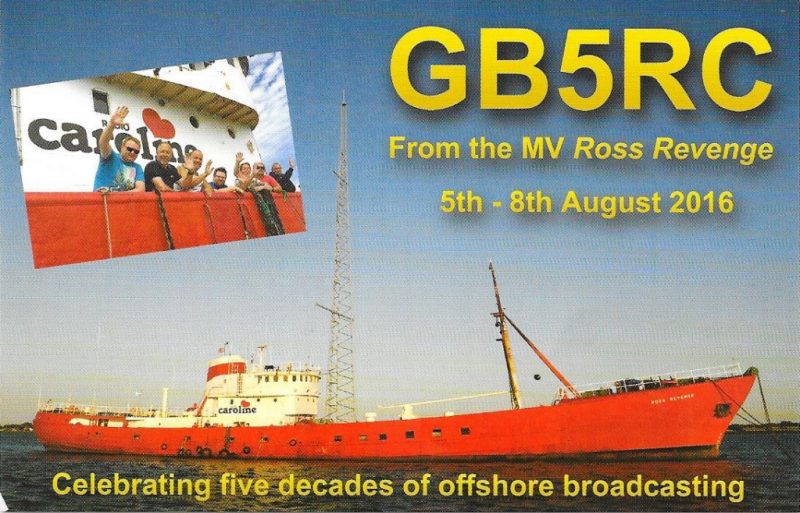
GB55RC will be active from the Ross Revenge:

Celebrating fifty five years of Radio Caroline

Thursday 1st – Monday 5th August 2019

2019 is the fifty fifth anniversary of Radio Caroline and the Martello Tower Group are pleased to be able to activate the world famous MV Ross Revenge again in August. This year we have been granted the ‘special’ special callsign of GB55RC. […]

[source: https://www.qrz.com/db/gb55rc]

Special QSLs will be available.

[The QSLs above are] from previous GB5RC activities.

Thank you for the tip, Harald! I’d love to grab one of those QSLs!

A photo tour of the 2019 WCARS hamfest

Yesterday, I attended the WCARS hamfest in Waynesville, North Carolina, with my friend Sébastien (VA2SLW) who is currently on vacation in the area.

The WCARS hamfest is a smaller regional hamfest, but it attracts a lot of folks from the mountain regions of north Georgia, Tennessee, South Carolina, North Carolina, and beyond.

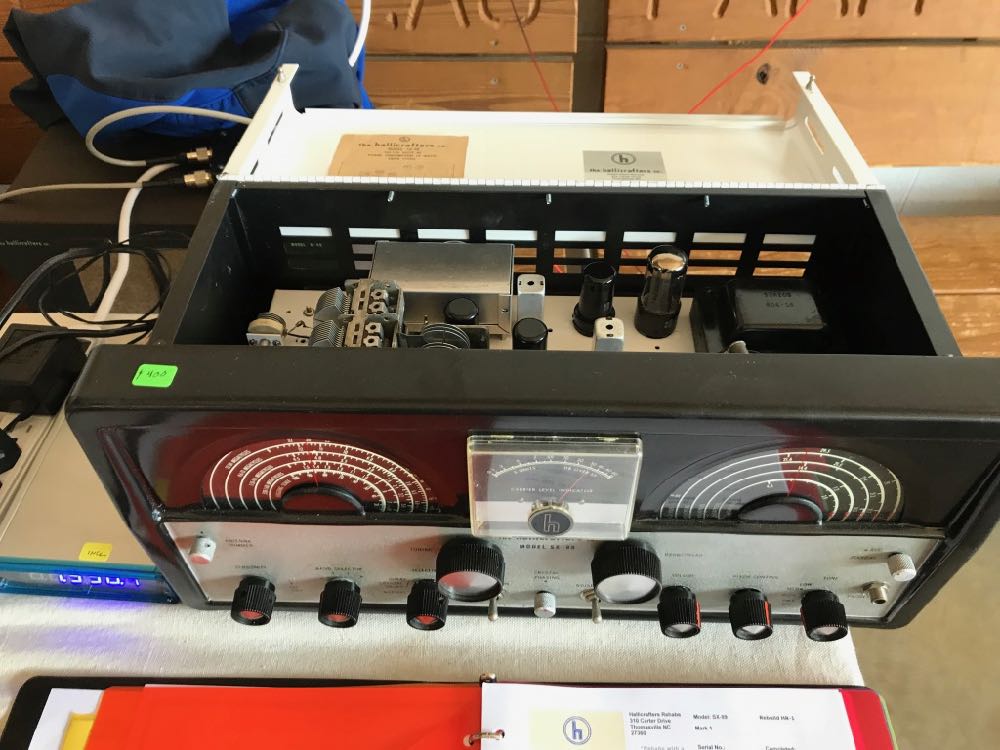
The WCARS hamfest flea market always has quite a variety of radios, including a number of great vintage models. I’ve been very lucky in the past finding excellent deals, too. This year, I (reluctantly) passed up a few deals knowing I’m also attending the Huntsville Hamfest in August and the Shelby Hamfest in September.

Below, you’ll find a selection of photos from the hamfest. Note that you can click on the image to enlarge it and I attempted to include price tags when possible:


Do you enjoy the SWLing Post?

Please consider supporting us via Patreon or our Coffee Fund!

Your support makes articles like this one possible. Thank you!

SDR Academy presentation videos

Many thanks to SWLing Post contributor, Alexander (DL4NO), who writes:

Parallel to the Hamradio fair in Friedrichshafen, Germany, there are talks and whole conferences. Over the last years, the “Software-Definded Radio Academy” (SDRA) was one of them.

You find the presentations on Youtube: https://www.youtube.com/playlist?list=PL6D0CPBQoIVpMflpSZFqbkmr2Xt_10D_Z

At least most of them are in English.

Thank you for the tip, Alexander! These videos are amazing! Wow–now I just need to find the time to watch them all.

I’ve embedded the videos and links below, for your convenience:

Markus Heller, DL8RDS: SDR-Academy @ HAM-Radio 2019 – A Summary


Dr. Carles Fernandez: An Open Source Global Navigation Satellite Systems Software-Defined Receiver

Mario Lorenz, DL5MLO: The AMSAT-DL/QARS Ground Stations for Qatar-Oscar 100

Mack McCormick, W4AX: FlexRadio: SDR Technology that Will Change How you Operate HF

Christoph Mayer, DL1CH: KiwiSDR as a new GNURadio Source

Manolis Surligas, SV9SFC: SDR Makerspace, Exploid SDR technology for space communications

Michael Hartje, DK5HH: Digital signal processing for the detection of noise disturbances

Prof Dr Joe Taylor, K1JT: Welcome Address and Questions & Answers

DL1FY, DC9OE, DG8MG, DL8GM: Charly25 SDR Transceiver

Alex Csete, OZ9AEC: SDR-Makerspace: Evaluation of SDR boards and toolchains

Encore – Classical Music on Sunday on Radio Tumbril


Encore – Classical Music on Shortwave – Broadcast on Sunday afternoon in Europe and USA

Encore – Classical Music this weekend is being broadcast as usual by Channel 292 (Europe) on 6070 kHz at 15:00 UTC Sunday 26th July.
And by WBCQ on 7490 kHz at 00:00 – 01:00 UTC Monday 27th July.
There is a repeat on 6070 kHz on Friday 2nd August at 19:00 UTC.
This week’s show starts with the overture from the Marriage of Figaro, then a slightly off-piste treat sung by two jazz legends – lifts the hairs on your arms. The whole of a Beethoven string quartet. Then some Buxtehude organ music, some Barbara Strozzi, and lastly a Swedish Rhapsody by Hugo Alfvén.
Both Channel 292 and WBCQ do live streams if the reception is poor in your location. Easy to find their sites with a google search.
Thank you for spreading the word about Encore – Classical Music on Shortwave. And thank you to everyone for letting us know how well/badly the signal is received where you live.
Brice Avery – Encore – Radio Tumbril.
Regular Broadcast times are:
15:00 – 16:00 UTC Sunday, and repeated 19:00 – 20:00 UTC Friday on 6070 kHz (Channel 292 Germany).
00:00 – 01:00 UTC Monday on 7490 kHz 9WBCQ – Maine).