Shortwave listening and everything radio including reviews, broadcasting, ham radio, field operation, DXing, maker kits, travel, emergency gear, events, and more
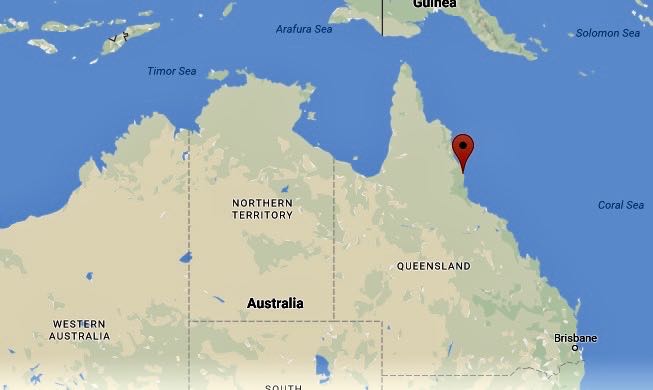
The 4KZ transmitter is located in Innisfail, Australia
Many thanks to SWLing Post contributor, Phil Brennan (VK8VWA), who notes that 4KZ started broadcasting today in Australia. Phil notes:
At last! ID for 4KZ confirmed at 0750 [UTC] Wednesday 20 December on 5,055 kHz.
Thank you, Phil–and thanks for following this development so closely over the past few weeks.
I tried tuning to 5055 kHz at my home in eastern North America, but of course conditions weren’t ideal to receive a 1,000 watt AM signal from Australia. I wasn’t ready to give up, of course, so I turned to the KiwiSDR network.
The following recording was made on December 20, 2017 starting around 11:33 UTC on 5,055 kHz . The receiver is a KiwiSDR located in Goulburn, NSW, Australia.
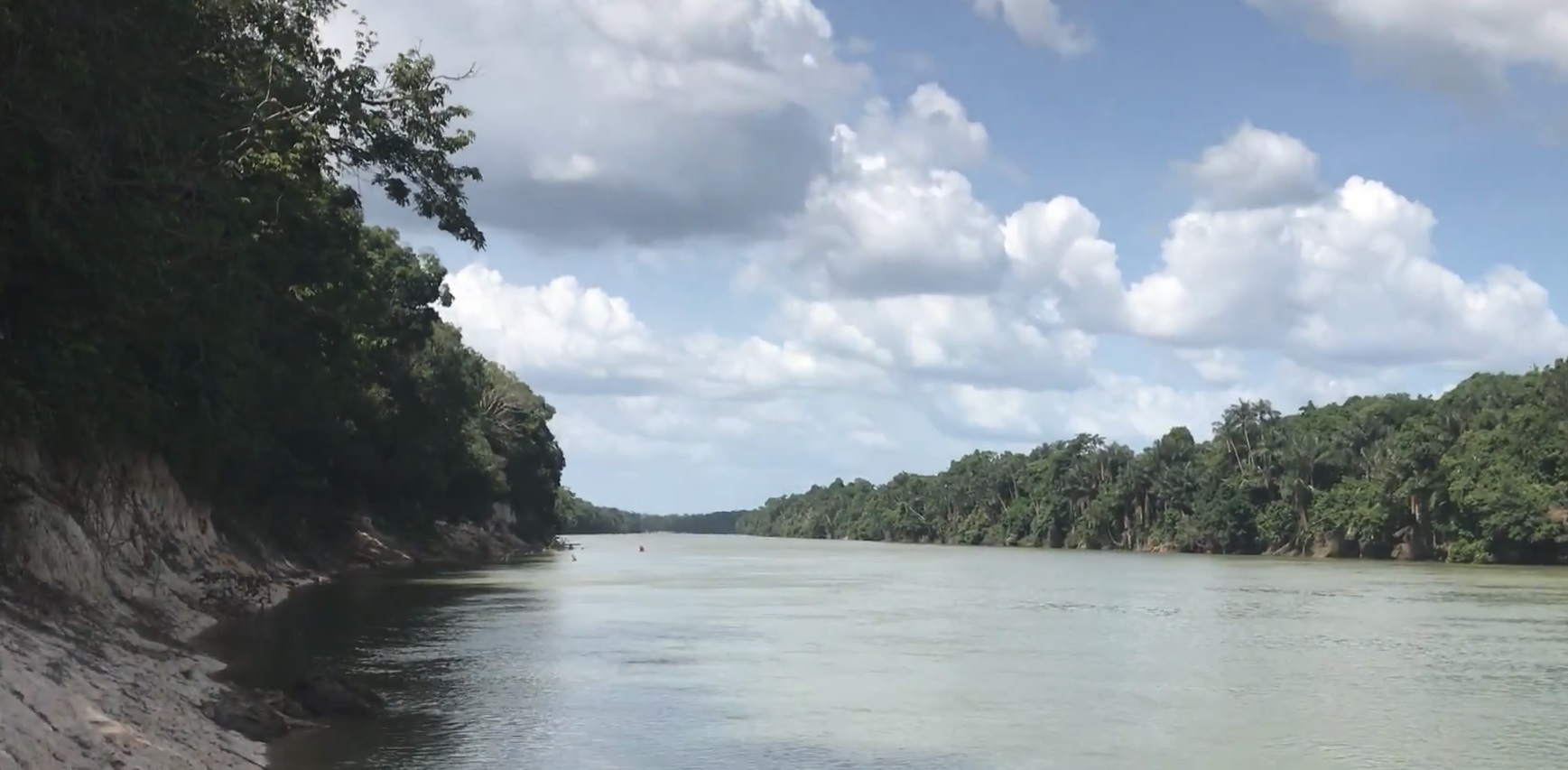
The beautiful Capim River in a land of Jaguars, Tarantulas and occasionally, wonderful shortwave DX
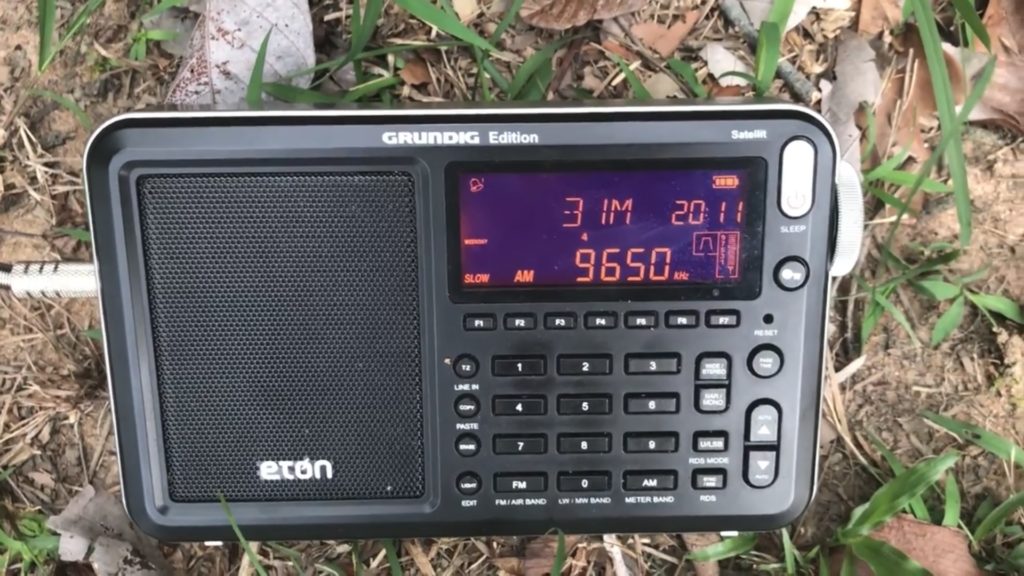
Hi there, I returned from my third trip to the Rio Capim area of Pará, Northern Brazil about 5 weeks ago, having been out there for exactly a month. Now, whilst this was strictly a business trip I always make time to tune around the bands, mostly shortwave, in the hope of copying some interesting DX. My previous two trips were reasonably successful; however, I didn’t really hear anything new – just lots of Tropical Band – and tropical stations with much greater signal strength and clarity. Part of the problem is one of which most of us suffer from – the dreaded local QRM. Even in the depths of the rain forest noise is present from building electrical systems (particularly lighting) and other equipment. In my first attempt to escape the noise on this trip I ventured out of my accommodation building (basically a very large hut) to the wire fence that separates us and the larger fauna (although having said that, the monkeys and everything else that lives in the area appears to have no difficulty scaling a 6 foot fence – funny that! ). Anyway, ultimately, you’ve really got to want to hear something special quite badly to venture out. I suppose it could be the definition of hard-core DX! I tried this only once because as I was copying a very nice signal from Radio Guinea on 9650 kHz, I found myself about 2 feet from a Tarantula Hawk Wasp dispatching a very large spider (check out the very brief video on my YouTube channel). That was me done for alfresco DXing in the jungle.
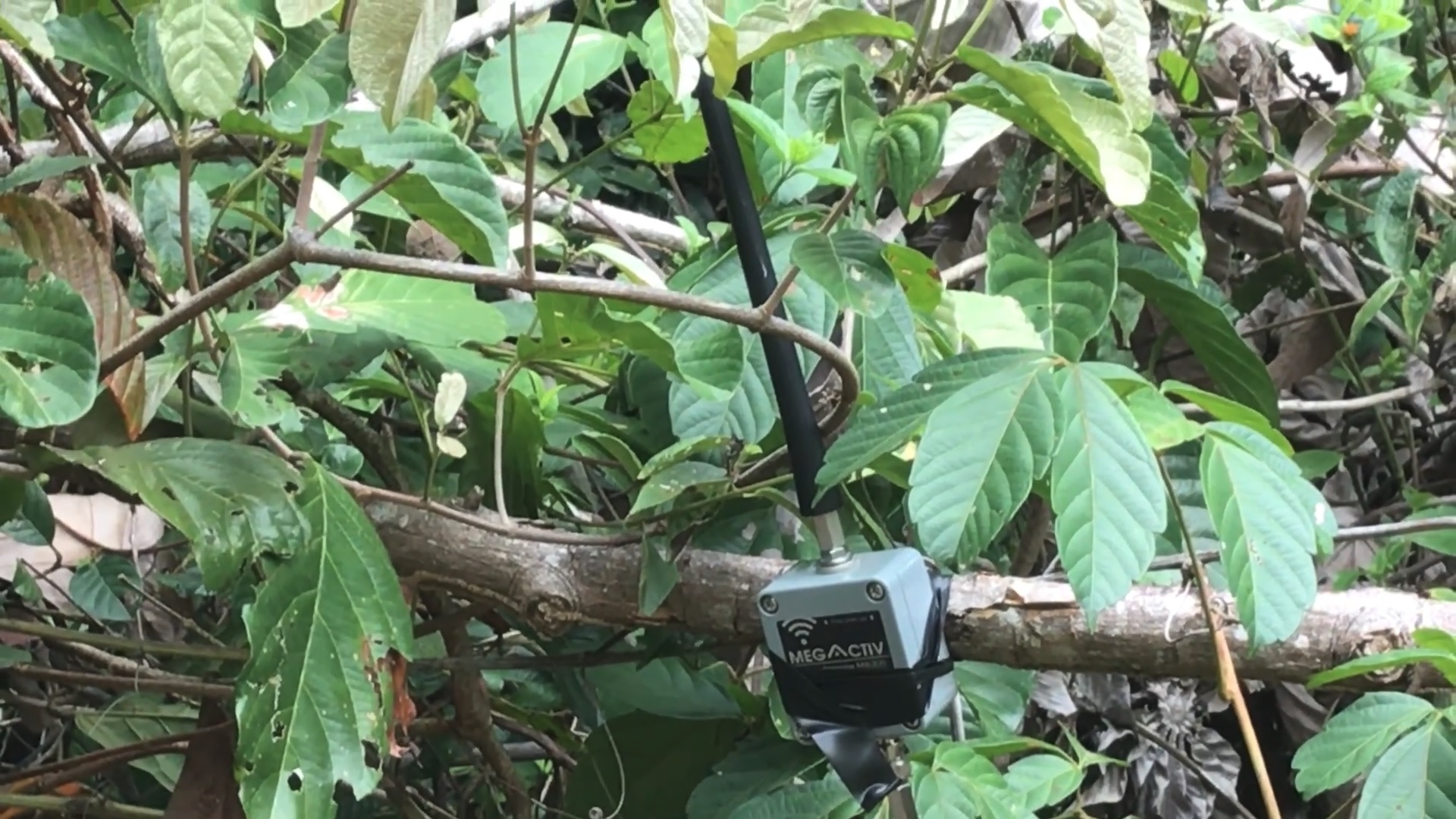
Bonito’s USB-powered MegActive MA305 E-field antenna up a tree…performed superbly in Brazil
Fortunately, I was lent a 4-wheel drive truck for the duration of my visit and so I decided to find a quiet location to park up and listen to the radio – therefore only having to venture outside (at night) to place my antenna. One evening after dinner I got in the truck and drove around the site for a while until I found a location, effectively on the edge of the jungle that was mostly very quiet. Perfect…as long as I didn’t end up as something else’s dinner. I took the super-compact USB-powered Bonito MegActive MA305 antenna with me on this trip because I’d already tested it at home on DXpeditions and in Crete and thus I was confident as to how superbly well it would perform in a quiet location. To supplement my antenna choices, during the first weekend, I made the 90 km drive to the nearest town and bought, amongst other supplies, a 40 metre length of speaker wire and a 3.5 mm jack connector to make a temporary long-wire antenna.
In my experience, there are roughly 3 tiers of Tropical and Tropical Band DX on short wave. There’s the bottom tier of stations which with a decent portable and a few metres of wire can be readily heard in the UK on a Dxpedition – and at home with a magnetic loop antenna, for example and a good quality table-top receiver or SDR. Amongst this group of signals I would include Rádio Clube do Pará, Brazil on 4885 kHz, Radio Difusora Roraima on 4875.3 kHz, Emisoras Pio XII 5952.5 kHz, Radio Santa Cruz, 6134.8 kHz etc. etc. On the next tier are tropical stations that are really difficult to hear in the UK – but can be heard with good propagation and good equipment. This group includes Radio Aparecida on 6135.2 kHz particularly, Rádio Educação Rural on 4925.2 kHz, Radio Tarma Internacional on 4774.9 kHz, Rádio Evangelizar (formerly Radio RB2) on 6040.7 kHz etc. There are many more examples from these two groups I could use, but you get the picture. Lastly, there is a tier of stations that are very rarely or never heard in Europe, irrespective of equipment or propagation. Often these stations operate with low TX power which makes them extremely difficult to copy anyway – and that leads to ambiguity farther as to whether they are even on-air. Furthermore, some of these stations broadcast very irregularly, which makes copying them even more of a lottery.
My mainstay travel receiver, the brilliant Eton Satellit..two-time veteran of South American DXing
In this context, a month in Northern Brazil was a useful timescale for surveying the Tropical Bands and geographically tropical stations for the presence of very rare signals. Fortunately, over many hours of listening in Rio Capim with the Eton Satellit and mostly the Bonito MegActive MA305 antenna, I manged to record six signals that are very rarely heard outside of South America. The list of stations follows below, complete with the antenna arrangement. Further below you will find embedded reception videos and text links to the same videos on the Oxford Shortwave Log YouTube channel. Please take the time to watch the videos and note the comments made by some of my subscribers with local knowledge. In particular, Rádio Gaúcha and Rádio Canção Nova on 4825 kHz are very irregular broadcasters and therefore I was fortunate to be in the right place, at the right time to copy their signal. More luck came my way with the reception of Radio Sora de Congonhas on 4775 kHz – made possible because of a total power cut on site, reducing noise effectively to zero (I was indoors at the time). I, personally, never heard anything else other than Radio Tarma, Peru on or around 4775 kHz – itself something of a rarity, except when conditions are very good.
In conclusion, I have to say, once again, the DXing credentials of the Eton Satellit and the Bonito MegActive MA305 USB-powered antenna are clearly demonstrated here. The perfect travelling companions for the serious DXer and broadcast band listener alike, I had no issues getting through security at any of the airports and their combined weight is unnoticeable in a fully loaded backpack. I definitely recommend both products. It’s also worth noting that if you’re travelling to a relatively remote location, even with modest equipment, you might be able to copy rare signals that will provide good information to the rest of us trying to hear those same signals from 1000’s of km away. I will be returning to Rio Capim early in 2018 and I’m seriously considering taking my Perseus SDR with me. A superbly sensitive and selective receiver with noise reduction that actually works, it opens up the possibility of even more exotic DX on that trip.
As always, thanks for watching/listening/reading and I wish you all excellent DX and Season’s Greetings. 73!
The list of exotic catches and antennas utilised:
Radio Apintie 4990 kHz, Suriname – Bonito MegActive MA305
Radio Cançao Nova 9675 kHz Sao Paulo – 20 metre long-wire
Radio Verdes Florestas 4865 kHz, Cruzeiro do Sul – Bonito MegActive MA305
Rádio Gaúcha 11915 kHz, Porto Alegre – Bonito MegActive MA305
Radio Sora de Congonhas 4775 kHz, Congonhas – Bonito MegActive MA305 antenna
Rádio Canção Nova 4825 kHz, Cachoeira Paulista – Bonito MegActive MA305
Clint Gouveia is the author of this post and a regular contributor to the SWLing Post. Clint actively publishes videos of his shortwave radio excursions on his YouTube channel: Oxford Shortwave Log. Clint is based in Oxfordshire, England.
From the Isle of Music, December 24–30:
This week, a potpourri of excellent albums from 2017 plus a touch of Cuban Christmas Jazz.
Four opportunities to listen on shortwave:
1. For Eastern Europe but audible well beyond the target area in most of the Eastern Hemisphere (including parts of East Asia and Oceania) with 100Kw, Sunday 1500-1600 UTC on SpaceLine, 9400 KHz, from Kostinbrod, Bulgaria (1800-1900 MSK)
2. For the Americas and parts of Europe, Tuesday 0100-0200 UTC on WBCQ, 7490 KHz from Monticello, ME, USA (Monday 8-9PM EST in the US) NOTE THAT UTC CHANGES BUT EASTERN US TIME IS STILL THE SAME.
3 & 4. For Europe and sometimes beyond, Tuesday 1900-2000 UTC and Saturday 1200-1300 UTC on Channel 292, 6070 KHz from Rohrbach, Germany.
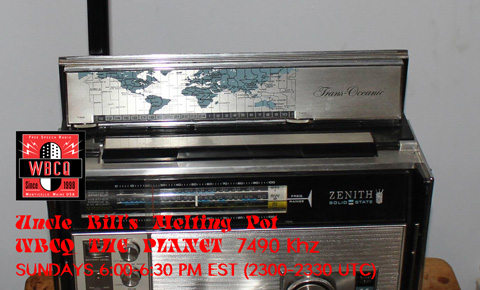
Uncle Bill’s Melting Pot, December 24
If We’re Going to Hell, We Want Company…
Episode 42 of Uncle Bill’s Melting Pot will include some “XXXmas music” for people who can’t take any more Christmas music. That parental warning at the beginning of every show is real for this episode due to language in some of the songs. Fans of the Swiss Broadcasting Corporation of the 1970s will also enjoy this.
Sunday, December 24
2300-2330 UTC (6:00PM -6:30PM Eastern US) on WBCQ The Planet 7490 KHz from the US to the Americas and parts of Europe
The WBCQ transmissions are via a backup transmitter due to their recent fire, and any reception reports are therefore especially welcome.
Weather and technology permitting, our programmes on 648 kHz will commence originating from the Ross Revenge at 7.00 AM on Friday 22nd December.
The changed schedule for the day will be :
7am Johnny Lewis
9am Top Fifteen
10am Ray Clark – with the official launch at midday.
2pm Kevin Turner
5pm Resume normal programmes
No doubt Bob Lawrence, Martin Fisher and Jerry Wright will personalise their evening shows to mark the day.
Of course we are delighted to have found and secured what must be the best possible AM transmission site for our service. We thank Cobra Mist Ltd for this facility whilst noting that this is a private site which cannot at this time be visited.
So, another date for the Radio Caroline calendar of events and the inevitable question. Where do we go from here?
Many thanks to SWLing Post friend “Karen” who writes:
My husband reads your website every day and is a dedicated radio geek. I’ve decided I’d like to get him an extra last minute stocking stuffer for Christmas. Any suggestions? We buy a lot from Amazon and are Prime members but any retailer that could get something delivered by Friday would work fine. Since this is a stocking stuffer, I don’t really want to pay more than about $70-90.
Thanks for your inquiry! Readers, “Karen” has kindly allowed me to post her message publicly and no that’s not her real name–!
Karen, you didn’t mention what radios he currently has, so you may double check before committing. I’ve listed a few options with links below. This list is by no means comprehensive–I just did a quick scan of a few retailers based on what’s currently a good deal and can be shipped ASAP.
Since you like Amazon and get free two day shipping via Prime, I’ll list several options there. I’d also encourage you to check with radio retailers like Universal Radio, Ham Radio Outlet and C. Crane–they, too, can ship via two or one day service, but it might be at a premium.
Just note to check the delivery date very carefully as we are down to the wire! Note that prices, especially those at Amazon, can change without notice.
Last minute stocking stuffers for the radio enthusiast
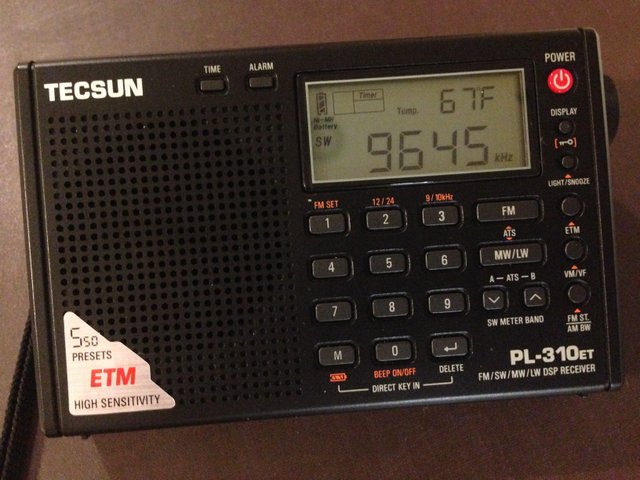
Tecsun PL-310ET ($42.00): The venerable PL-310ET is a classic little ultralight radio and performs quite well for the price. Click here to check out past posts. The PL-310ET is also available on eBay, but I don’t think you’ll get it delivered before Christmas if you purchase from a China retailer. Click here to view on Amazon.com (affiliate link).
Shortwave Receivers Past and Present ($39.95): This book is sure to please any radio geek that is interested in vintage radios. Click here to read my review. It is in stock at Universal Radio but I’m guessing you’ll need to budget for two day shipping since this book is very heavy! Still…I think it’s worth it and will surely surprise the radio enthusiast in your life if they don’t already have a copy. Click here to view at Universal Radio.Note: I would urge you to call Universal Radio to make sure Shortwave Receivers Past and Present can be delivered prior to Christmas.
Thank you for your question, Karen, and for allowing me to post your message, thus my suggestions, publicly. Since you asked specifically about Amazon, and since you get free two day shipping, I focused on Amazon offerings here. Note that my links are affiliate links and if you chose to purchase using one of these links, the SWLing Post will receive a small commission at no cost to you.
With that said, please consider purchasing from one of the radio retailers I mention above. The total price may exceed Amazon’s, but you can actually call these retailers to place orders and ask questions.
Post Readers who live outside of the US will have to check with radio retailers in their country regarding pricing and shipping on the items above. I wish I had time to list links to international options. Perhaps readers can comment with links and other suggestions?
Update: Stair has waved his rights to a bond hearing. See details and video at bottom of page.
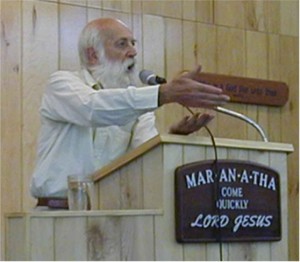
I’m sure many–if not a majority of–shortwave listeners have heard the Overcomer Ministry on the air via various private broadcasters. Ralph G. Stair, the leader and voice of Overcomer was taken into custody this morning on eight criminal charges. I’m personally not a fan of Overcomer and I don’t typically post this sort of news content, but if Overcomer is eventually shut down, private broadcasters will certainly notice the loss of income stream. Could be profound to smaller stations.
Update | Arrest of Brother Ralph Stair confirmed on multiple charges | News | The Press and Standard
(Photo source: Overcomer Ministries)
Colleton County Sheriff’s Office personnel arrived at the Overcomer Ministry at 12680 Augusta Highway early Monday morning to take Ralph G. Stair, the leader of the religious compound, into custody on eight criminal charges.
Lt. Tyger Benton, public information officer of the Colleton County Sheriff’s Office said a large contingent of law enforcement officers arrived at the church compound Monday at approximately 7:30 a.m. to take Stair, 84, into custody.
The charges, all filed by the sheriff’s office investigators, include three counts of first-degree criminal sexual conduct and single counts of assault with the intent to commit criminal sexual conduct, kidnapping, second-degree assault, first-degree burglary, and third-degree criminal sexual conduct with a minor.
Stair was transported to the Colleton County Detention Center on the charges and is expected to have a bond hearing Monday afternoon.
The sheriff’s office personnel arriving enmass at the compound were joined by agents of the South Carolina Law Enforcement Division and officers from the Federal Bureau of Investigation and Homeland Security Investigations.[…]
Alleged Colleton Co. cult preacher charged with 8 counts waives bond hearing
COLLETON COUNTY, SC (WCSC) –
The accused leader of a cult in Colleton County facing eight criminal counts waived his right to a bond hearing Monday afternoon.
Ralph Stair, 84, has been charged with a total of eight charges. The charges include three counts of first-degree criminal sexual conduct, one count of assault with intent to commit first-degree criminal sexual conduct, one count of kidnapping, one count of burglary, one count of second-degree assault and one count of third-degree criminal sexual conduct with a minor.
Stair was arrested Monday morning two months after a Live 5 News investigation.
Agents with the State Law Enforcement Division and the FBI, and Colleton County Sheriff’s deputies worked together to make the arrest at 7:48 a.m. Monday at the Overcomer Ministry on Augusta Highway in Walterboro, according to Colleton Co. Sheriff’s Lt. Tyger Benton.
A search warrant for the property was also executed, he said.
Stair was located on the property and taken into custody without incident, Benton said.[…]
Belgium’s telegram service is about to stop. Stop.
One hundred and seventy-one years after the first electrical message was transmitted down a line running alongside the railway between Brussels and Antwerp the final dispatch will be sent and received on 29 December.
The fact that this 19th-Century technology is still up and running in the age of Instagram and Snapchat may seem rather odd – especially when you consider that the UK, which invented the telegram in the 1830s, abandoned it as long ago as 1982.
The United States followed suit in 2006 and even India, which had been by far the world’s biggest market for the telegram, finally closed its system down in 2013.
Just 10 businesses and a handful of individual customers have kept the Belgian system going until now. It has been chiefly used by bailiffs, who had need of a system which provided legal guarantees of dispatch and receipt.
The buyer can call up a telephone operator to spell out their message, which is then sent by post.
But with a “flash” telegram costing €23.75 (£21) for a basic 20 words, plus €0.90 for delivery in and around Brussels, it is not difficult to see why the system is struggling to survive in the age of unlimited texting on cheap mobile phone tariffs.

 My mainstay travel receiver, the brilliant Eton Satellit..two-time veteran of South American DXing