Tag Archives: BBC

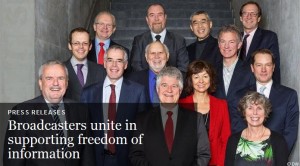
International Broadcasters support freedom of information

JointStatementThe international broadcasting arms of France, Australia, the US, the United Kingdom, Germany, Japan and the Netherlands issued a joint statement in support of press freedoms across the globe. With the exception of the Netherlands (RNW), all of these countries still broadcast over the shortwaves.

(Source: BBC Media Center via Kim Elliott)

We, the representatives of Audiovisuel Extérieur de la France (AEF), Australian Broadcasting Corporation (ABC) [Australia], British Broadcasting Corporation (BBC) [United Kingdom], Broadcasting Board of Governors (BBG) [US], Deutsche Welle (DW) [Germany], Nippon Hoso Kyokai (NHK) [Japan] and Radio Netherlands Worldwide (RNW), have met in Berlin to discuss common concerns.

We find international journalism is facing unprecedented challenges from countries that seek to deny their own citizens access to information from outside their borders in violation of Article 19 of the Universal Declaration of Human Rights, which states:

“Everyone has the right to freedom of opinion and expression; this right includes freedom to hold opinions without interference and to seek, receive and impart information and ideas through any media and regardless of frontiers.”

We call upon the world’s nations to strengthen their commitment to Article 19 and to support expanded opportunities to share information across borders through digital and mobile technologies.

Yet we note with dismay that certain governments continue to control the flow of information. For example, China routinely blocks the Web and social media sites of our broadcasters and jams our shortwave signals, or Iran and Syria interfere with the satellite signals that carry our programs. Governments in Eurasia, Africa, the Middle East and Latin America also seek to control what their own citizens can see, hear and read.

Many of these actions, including intentional jamming of satellites, violate international regulations. We condemn them without reservation.

We also call attention to troubling new challenges to free expression. Some governments are seeking to enact far-reaching telecommunications regulations to stymie free speech.

At the World Conference on International Telecommunication (WICT) in Dubai, representatives of the world’s nations have considered telecommunications rules that might explicitly apply to the Internet for the first time.

We cast a wary eye on such efforts to control the Internet, and we denounce efforts to identify and track Internet users in order to stifle free expression, inquiry and political activity.

We have agreed to increase, whenever possible, our support for efforts to circumvent Web censorship through the use of new and innovative hardware and software tools. We also agreed to increase our advocacy for Internet freedom.

The BBC in the news

(Photo source: NY Times)

(Source: CS Monitor)

Britain’s BBC could be doomed unless it makes radical changes, the head of its governing trust said on Sunday, after its director general quit to take the blame for the airing of false child sex abuse allegations against a former politician.

Chris Patten, chairman of the BBC Trust, said confidence had to be restored if the publicly funded corporation was to withstand pressure from rivals, especially Rupert Murdoch‘s media empire, which would try to take advantage of the turmoil.

“If you’re saying, ‘Does the BBC need a thorough structural radical overhaul?’, then absolutely it does, and that is what we will have to do,” Patten, a one-time senior figure in Prime Minister David Cameron’s Conservative Party and the last British governor ofHong Kong, told BBC television. [continue reading…]

(Source: NY Times)

[…]Mr. Patten, 68, a former Conservative cabinet minister who gained a reputation for feisty independence when he was Britain’s last colonial governor in Hong Kong, said critics of the BBC should not lose sight of its reputation at home and abroad for impartial, trustworthy journalism.

“The BBC is and has been hugely respected around the world,” he said. “But we have to earn that. If the BBC loses that, then it is over.”

Public confidence in the broadcaster has slumped further in opinion polls in the wake of its coverage of a scandal involving allegations of abuses by a senior politician at a children’s home in Wales in the 1970s and ’80s. But the British public would not support breaking up the BBC, Mr. Patten said, adding, “The BBC is one of the things that has come to define and reflect Britishness, and we shouldn’t lose that.”

Barely 12 hours earlier, Mr. Patten stood outside the BBC’s new billion-dollar London headquarters with George Entwistle, the departing director general, as Mr. Entwistle announced his resignation after only eight weeks in the post to atone for his failings in dealing with what he called “the exceptional events of the past few weeks.”

Mr. Entwistle’s resignation was prompted by outrage over a Nov. 2 report on “Newsnight,” a current affairs program, that wrongly implicated a former Conservative Party politician in the pedophile scandal. Responding to reports that the “Newsnight” segment was broadcast without some basic fact-checking that would have exculpated the 70-year-old, retired politician it implicated, Alistair McAlpine, Mr. Entwistle said it reflected “unacceptable journalistic standards” and never should have been broadcast.

[…]

More immediately, the BBC has to deal with a rebellious mood in its own ranks. Over the past 48 hours many of the BBC’s top journalists and presenters have unleashed angry outbursts against the broadcaster’s management, mainly directed at Mr. Entwistle and Mr. Thompson for what the employees have called a pattern of failed leadership. A persistent complaint has been that reforms initiated in the 1990s have created a vast hierarchy of overpaid managers who were insulated from programming decisions.

It was a critique Mr. Patten endorsed in his remarks on the Marr show, saying at one point that “there are more senior leaders in the BBC than in the Chinese Communist Party.” Jonathan Dimbleby, a well-known presenter, said on the same show that because of the layers of bureaucracy between Mr. Entwistle and the “Newsnight” producers, “George was at the receiving end of nothing, when he should have known everything.”

[continue reading…]


BBC internal memo outlines year three cuts and changes to the BBC World Service

This BBC internal memo, sent to employees by World Service Director, Peter Horrocks, outlines the unfortunate pending cuts and changes in much greater detail than those presented by the press.

Here is the memo in its entirety–it concludes with further comments from internal sources:

Dear colleagues 

Today we are announcing Year 3 Savings from the 2010 Comprehensive Spending Review settlement for the World Service.

We took quick action last year to deliver the bulk of the required savings immediately after funding cuts were announced in 2010. As a result, we have already achieved nearly £30m of our £42m three-year savings target. However, this still leaves £12m of savings for 2013/14, the final year of Grant-in-Aid funding.

We will be making changes to programming, staffing, scheduling and distribution. We have tried to avoid job losses wherever possible. Of the £12m savings, a significant £4.8m will be achieved via reductions in shortwave and medium wave distribution, details of which will be announced next week. However, it is impossible to make cuts of this scale without impacting on jobs and the plans announced today will result in 73 post closures. Affected teams and individuals have, of course, already been informed and we will work with them to help them through this.

The main changes today are as follows:

WS ENGLISH

  • We are simplifying the World Service English global schedule to have fewer regional variations, creating a more coherent offer which we can also promote and cross-trail more effectively. Being able to link together all the programmes in an hour will also make it easier to fit our content into partner stations’ schedules.
  • A new programme, The Newsroom, will replace World Briefing. This new programme will be live and reactive and it will showcase the best of our Newsgathering presence across English and WS Languages. There will be six editions of The Newsroom across the schedule, with World Have Your Say and The Newsroom coming together each day at 11:00 and 11:30 BST, a prime spot in the schedule.
  • Schedule changes mean fewer full hours of news output – down from about eighteen hours each weekday to about fourteen hours. As a result, there will be post closures in WS News. Further savings will be found in WS News through efficiencies and by integrating some functions across BBC News. In addition, there will be some reductions in Newsgathering, resulting in some post closures.
  • World Service English is also creating a smaller single management team working across distribution, channel management and scheduling. There will be a reduction in the number of specialist announcers on WS English.
  • From April, we will close our daily arts programme, The Strand, and at the same time extend Outlook to an hour long format, offering a new approach to covering Arts, Music and Humanities. A daily 10 minute section will look at the people behind the world of music, entertainment, film and the performance arts.

Every Friday, The 5th Floor will run in the Outlook time slot. The move of this programme to a more prominent slot in the schedule is an indication of its success after less than a year on air and it is a great way of bringing the work of our Language Services to an English audience. The 5th Floor will include a 10 minute arts segment drawn from the Language services’ coverage across the week.

We are also making space in the schedule for The Slot: an hour long programme dedicated to arts and culture coverage across the BBC and the Language Services.

These scheduling changes will enable a significant saving, but will ensure that arts coverage maintains prominence and relevance on the World Service, while making best use of our connections across Languages and the broader BBC.

  • There will be a reduction in the number of documentaries: instead of having four weekly documentary strands, we will now have three with Your World ending. There will be no post closures as a result of this change.
  • Bottom Line will no longer be reversioned for the World Service. Again, this will not result in post closures.

These changes in WS English will result in the closure of 25 posts.

WS LANGUAGES

Year 3 savings affect those Services which were not required to make changes in Years 1 and 2 of the Spending Review settlement.

  • There will be a change in the editorial purpose and remit for the English Language Teaching team. For the last four years, the team has been asked to earn revenue from commercial sources. In the future, the team will focus on public service provision. This change in remit will result in post closures.
  • There will be post closures in BBC Afghan, BBC Burmese, BBC Bengali, and French for Africa. In some services, this will be mitigated by the creation of new posts in bureaux overseas driven by new editorial and operational considerations.
  • A number of currently vacant posts in the Near East hub, African English, BBC Swahili and BBC Brasil will not be filled and will therefore close.
  • In 2013, BBC Swahili morning radio production will move to Dar es Salaam, and the dawn transmission for BBC Somali will move to Nairobi. This will deliver savings for these two services. One vacant Swahili post will close. There will be no impact on Somali posts.
  • BBC Hausa and Great Lakes will be making changes to their schedules to deliver savings. There will be no impact on posts.

The changes to WS Languages, including a few extra post closures outside the UK to be announced at a later stage, will result in 44 post closures.

In addition to the above, now that we have moved out of Bush House, we will be closing four posts in WS Property.

Despite financial pressures, we have continued to adapt our services in response to changes in our audiences and this strategy will continue. We have already seen the successful launch of new TV programmes, Focus on Africa in English for partners and on BBC World News, and Dira Ya Dunia in Swahili, carried by partner broadcasters across sub Saharan Africa. We plan to develop similar programmes in Hindi and Urdu and hope to be able soon to announce a successful conclusion of negotiations with our partners on this new programming.

As we prepare to move to Licence Fee funding, we will be able to demonstrate that the World Service remains strong despite the funding cuts of recent years, is more efficient than ever, and remains a vital force in today’s complex media world. As the new Director General stated in his opening address to staff, he is very supportive of the World Service, as is the BBC Chairman. No doubt, following two major reductions in two years to the size of the World Service, many of you will have questions about its future.

Before 2014, the BBC Trust will prepare a licence describing the purpose, remit, strategy and budget of the World Service in the Licence Fee. The Trust will consult and publish on this licence ahead of transfer to the Licence Fee. This licence will be the key document that will, from April 2014, govern the size, shape and character of the future World Service. All World Service staff will have the opportunity to share their views with the Trust and this will include opportunities to hear from and question individual Trustees.

As I said above, the changes we are announcing today do impact on individuals and teams. We have notified the NUJ and BECTU of these proposals and will consult both them and staff affected so that we can look for ways to reduce the number of compulsory redundancies where possible. I know you will all be supportive of your colleagues through what will be a difficult time and I and the World Service management team will do all that we can to help them through this.

Peter

Internal sources also suggest:

  • nearly all Arabic on shortwave is to end (apart from broadcasts targeting Sudan)
  • the BBC Cyprus relay on SW is to close and English MW from Cyprus is also closing
  • BBC English World Service to Africa, the Middle East, and Asia is to be cut from 18 hrs a day on SW to 7 hours a day

It seems much of the monies are being diverted from shortwave to fund TV ventures, instead.

Radio 4: And now an urgent SOS message…

This is a fascinating Radio 4 documentary about a BBC service that typically had a target audience of one individual.  Before the proliferation of telecommunications in the 1990’s, the BBC’s SOS message service acted as a communications link of last resort for people who needed to be urgently connected with loved ones.

This radio documentary reminded me of the fact that, even in our information age, radio can interact with a large audience of listeners who are doing everything from working to driving in a uniquely efficient manor.

I listened to this documentary yesterday, but it will be available on the BBC website for 5 more days (as of time of posting). Thanks to Andy Sennitt for bringing this documentary to my attention. 

(Source: BBC)

Radio 4 used to broadcast SOS messages – “could Mr and Mrs Snodgrass, believed to be travelling in the Cotswolds please ring this hospital where their auntie is dangerously ill”.

Eddie Mair wants to know more about them. He hears from listeners whose lives were dramatically changed through the SOS service. These short messages were transmitted regularly on The Home Service, and later Radio 4, for much of the 20th century. They appealed for relatives of dying people, often on holiday and thus, before mobile phones and internet cafes, uncontactable, to return home before it was too late.

Eddie invited readers of his Radio Times column to send in their recollections of the SOS Message Service, and little did the PM Presenter expect such a rich response of vivid memories, first person experiences and in one case, unexpected consequences as a result of the broadcast.

Some of these remarkable testimonies are told, in understated, haunting and even cheery ways in this narrative tribute to radio, and a nation, – “as it was”. Best summed up by the tale of a six year old girl in the North East who while staying with a relation in 1958, was hospitalised with a very serious illness. She survived and tells Eddie her story. In the days of very few domestic telephones, the BBC’s SOS message brought her parents to her bedside from London courtesy of an observant member of the public who heard the message and recognised the car number plate that had been announced.

The SOS Service, was the vision of John Reith, the first General Manager, and later Director General of the BBC. But its heart was the listener, as Eddie reveals.

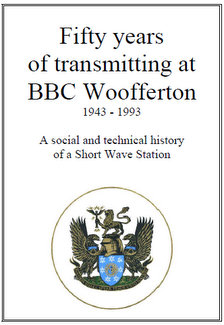
Shortwave Radio History: 50 years of transmitting at BBC Woofferton

Click here to download your copy.

Thanks to the efforts of a dedicated radio historian and author, Jeff Cant, you can download and read an excellent history of the first fifty years of the BBC’s Woofferton transmission station. Cant began his history as an internal document to the station; he later finished it in his retirement. I wish every shortwave transmitter station had such a well-documented history providing a perspective on the station’s broadcasting. We owe Mr. Cant a profound debt of gratitude.

To download the PDF, simply click here.

A special thanks to Jonathan Marks for finding and sharing this great bit of radio history.

Should the link to the PDF above ever become inactive, I’ve placed an archive copy available for download on the SWLing Post server.

Guardian article on “the rise and rise of radio”

(Source: Susanna Rustin, The Guardian)

What is it about radio that has made it so durable, and able to coexist not only through the age of television, but the age of new media too? As social networking giant Facebook prepares to float itself and raise an astonishing £5bn, what has enabled radio to stand its ground?

[…]Radio can be made at a fraction of the cost of television, meaning that programme-makers, DJs and entrepreneurs can all have a crack at it. Commercial broadcasters as well as the BBC value it as an incubator for future TV talent. Added to which, radios themselves are cheap, and all over the place: by people’s beds, in the bathroom, in the car.

“Despite the fact you think we’re a visually saturated culture, there are all sorts of places where you get radio and nothing else. The technology of radio is cheap, simple and idiot-proof, and older listeners in particular are going to be very reluctant to let it go,” says [Mark] Damazer.

[…]There is a confidence among many of those who work in radio that what they do will carry on. We remain attached to radio and its rhythms, to the hum and the sound of it. And we get attached to the people who present it, when we don’t violently take against them. Radio is personal.

Couldn’t have said it better myself. Another article filed under “why radio?”

Read Rustin’s full article at The Guardian website.


BBC Hindi brings Indian and Pakistani artists to talk music and peace

(Source: indiaPRwire)

London, Delhi, London, August 2, 2011 /India PRwire/ — BBC Hindi is launching special programming which will bring together musicians from India and Pakistan. Every day, between 3 and 7 August, the Friendship beyond Borders series on the BBC Hindi FM programming, broadcast via partner FM stations across India, talks to some of the best known singers and musicians from India and Pakistan about music, mutual understanding and peace.

Artistes such as Shafqat Amanat Ali, Arif Lohar, Ali Azmat, Rekha Bharadwaj, Salim-Sulaiman and Mohit Chauhan are talking to BBC Hindi about the role of music in bringing people together from across the borders. Talking on the Friendship beyond Borders series, Salim Merchant of the Indian singer and composer duo, Salim-Sulaiman, says that music has no language: “It is a business of the heart. It has no nationality or religion.” The Pakistani singer, Shafqat Amanat Ali, tells the BBC that visa issues between the two countries should be relaxed so that people can meet their loved ones and families without any obstacles.

[…]The Friendship beyond Borders series will be aired across India by BBC Hindi’s FM partner radio stations. BBC Hindi will also broadcast the series on shortwave in the lead-up to India’s Independence Day on 15 August. The website bbchindi.com will feature special stories based on the series as well as the audio of the music of the profiled artistes.

Read full article at indiaPRwire.