 Sunday was the FIFA World Cup Final, and not only was I looking forward to the game, but (to tell the truth) I was also looking forward to recording the game via the BBC World Service for the Shortwave Radio Audio Archive. Due to the BBC WS cuts, part of me fears this may be a last chance to capture this radio and sports history.
If you would like to hear the recordings of the World Cup Final, skip to the bottom of this post. But if you want to know how I managed to make the recordings, and why I made the choices I did, feel free to continue reading…Warning: full-on radio geek tech ahead!
Making the recording
I had two SDRs (software defined radios) at my disposal: the Elad FDM-S2 and my trusty WinRadio Excalibur. To record this match, I choose to use an SDR rather than a tabletop receiver for several reasons, namely:
- I wanted to make a spectrum recording so that I could record more than one frequency at a time;
- SDRs make recording radio content on the fly much easier than using a tabletop receiver, which must be connected to an external audio recorder, and I wanted ease of use so I could enjoy the game, too.
Propagation was rather mediocre Sunday, and there were only three feasible BBC World Service English frequencies I could tune in mid-afternoon, none of which, of course, were targeting North America:
- 11,810 kHz from Ascension Island
- 13,660 kHz from Woofferton, UK
- 15,400 kHz from Ascension Island
- 9,915 kHz from Woofferton, UK (starting at 20:00 UTC)
My hunch was that either 13,660 or 15,400 kHz would be my best bet for the early part of the match (pre-game starting at 18:30 UTC, half time at 20:00 UTC), however, I knew they would drop off after the first half of the game. And 11,800 kHz would be my best bet in the latter part of the game, unless 9,915 kHz happened to be stronger.
In the past, 11,800 had served me quite well for afternoon BBC listening, but yesterday there was an unscheduled religious broadcaster on 11,825 that was causing interference a full 30 kHz on either side of their carrier! During my pre-game check of the frequency, each attempt I made to block this broad interference was unsuccessful–very frustrating.
Which SDR?
The FDM-S2 is a fine SDR, and I was very tempted put it to the test. But while the Elad FDM-S2 is quite capable of making very wide spectrum recordings (up to 6 MHz) and could easily record all four frequencies on four different meter bands at the same time, I decided to use the WinRadio Excalibur, instead.
Why? If 11,800 kHz was my only viable frequency option in the latter half of the game, I needed a receiver that could sync to the less noisy lower sideband of 11,800 kHz. While Elad plans to add USB/LSB selectable synchronous detection in the next version of their SDR application, it currently does not have this capability.
I suppose, too, I feel more comfortable with the WinRadio Excalibur; I’ve been using it now for well over two years. If something were to go wrong during the broadcast, I knew I could diagnose it quickly on the Excalibur.
In addition, the Excalibur can do both a spectrum recording and up to three individual AF recordings at the same time (though limited within a 2MHz bandwidth). I’m not sure if Elad has plans for this in their next SDR.
Setting up the Excalibur
The Excalibur only has a 2 MHz bandwidth for spectrum recordings. I knew if I focused on the middle frequency of 13,660, I would be able to record it and either 15,400 or 11,810 at the same time, but not all three.
The first half of the match, I recorded both 13,660 kHz and 15,400 kHz in a 2 MHz wide spectrum recording. At the same time, I recorded the audio (an AF recording) from 13,660 kHz, which was consistently the stronger of the two frequencies.
Half time
By 20:00 UTC, I knew both 13,660 and 15,400 kHz would stop transmitting and I would need to either hop to 11,810 kHz or 9,915 kHz.
While maintaining a good audio recording of 13,660, I stopped the 2 MHz spectrum recording and moved it to encompass 13,660 and 11,810 kHz. A quick check proved that 11,810 was the strongest station. Fortunately, the interference above 11,810 had quieted somewhat at that point, and by using the LSB sync lock, this noise was successfully mitigated a bit.
Still, I could hear a chuffing sound coming from the splatter 11,825 was producing. So I enabled the notch filter and widened it to 2 kHz. By shifting it around in the upper side band, I was able to find the “sweet spot” where most of the splatter noise was canceled. I then started the audio recording on 11,810 a few minutes prior to 20:00 UTC, making a little audio overlap with simultaneous recording on 13,660.
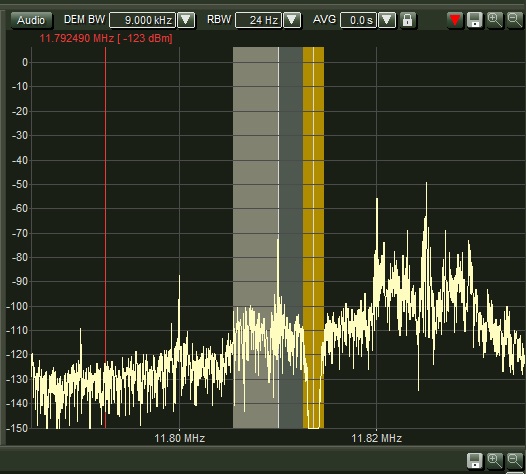
Syncing on the lower sideband and using the notch filter in the upper sideband mitigated most of the splatter interference.
In the end, I was very pleased with the results of the recordings. While capturing the BBC World Service isn’t exactly like snagging rare DX, I felt I had a lot riding on this recording, so pre-game preparations were necessary, especially since the Excalibur couldn’t record spectrum from 9,915 to 15,400 kHz.
And in theory, had I used the Elad FDM-S2, I could have recorded the entire chunk for three hours and then revisited the material later to make audio recordings from the AF.
The recordings
For your listening pleasure: the full 2014 World Cup final via the BBC World Service. This broadcast is broken into 3 sections: pre-game and the first half, second half, and extra time. Enjoy!