Tag Archives: Shortwave Radio

Editorial: Need for ABC HF service to remote Australian communities

Many thanks to SWLing Post contributor, Nigel Holmes––formerly of Radio Australia––for the following op ed.


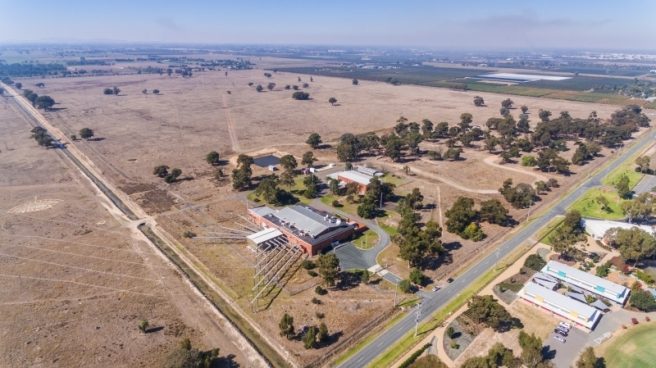
The Shepparton transmitter site of ABC/Radio Australia

Developments in the Australian domestic HF broadcasting scene

by Nigel Holmes

Radio broadcast on HF (high frequency or shortwave) has a solid role to play in the pantheon of media in the Australian and pan-Pacific context. It might be off the radar for the urban masses, but HF radio is the proven, economical alternative to satellite and cable for communication over continental or oceanic distances. Our commercial airlines use HF radio every day. So do our mining companies and emergency services. People holidaying in our remote areas buy or rent HF transceivers for their cars. Australia has the largest number of civilian users of HF radio in the world.

For thirty years a simple system of three HF transmitters quietly provided Australian Broadcasting Corporation (ABC) radio to remote populations across inland Australia, the Northern Territory (NT). Centered on Alice Springs, Tennant Creek and Katherine each transmitter reached out nominally 450 km, covering an area of nearly 2 million square kilometres. In practice the area serviced was larger, extending into Queensland and Western Australia. Such is the utility of this versatile medium. The audience was small, only a couple of hundred thousand, living or moving through the most remote places in Australia, but this was their lifeline.

During the cyclone season, storm alerts and flood warnings would reach people in the inland beyond the call of AM and FM networks. Yes, such people do exist in Australia and elsewhere in the Pacific.

Like many marginalised communities the HF radio listeners of the outback struggled to make urban elites understand their very real world. So in 2016 when the ABC announced the closure of the domestic HF transmitters in order to fund its DAB+ radio rollout in Canberra and Hobart, the backlash from the remote communities was shrugged off and the closures proceeded in 2017. ABC pointed at its satellite as an alternative, but had no answer when asked how to equip a jillaroo’s horse, a dusty 4WD or an offshore tinnie with a fragile satellite dish, an expensive receiver and the power point to run it all.

People who are used to an effective service tend to take its loss badly. So it has been in the NT. Politicians were pursued by the inland listeners wanting a better deal. The matter has culminated with the main opposition Australian Labor Party pledging to restore the HF distribution of ABC within Australia if it wins the forthcoming the federal election.

Let’s hope political expediency at the federal government level and within ABC doesn’t foul this up. We don’t want a half-baked resurrection as a sop to fend off critics of the ABC or to let politicians grandstand.

The three domestic HF sites in the NT cost a lot more than AUD$1.9 million p.a. to run. That was a figure bandied about by ABC after criticism of its DAB+ expansion costs. But for a sum in the order of half that, plus re-establishment costs, a service can be implemented which would have greater coverage, better reliability and lower outgoings. What’s not to like? The key is the former Radio Australia HF station at Shepparton, Victoria.

The cost of electricity at the NT sites was horrendous. Apart from feeding three thirsty 50 kW tx, huge air conditioning plant was required at each site to pull out waste heat and combat 50°C summer temperatures. Maintenance costs were savage. On-air availability was lousy (worst in the ABC network) because of environmental challenges and long maintenance travel times.

So here’s a plan: re-locate a near-new Continental 418G HF 100 kW transmitter from Tennant Creek to Shepparton. Electricity is much cheaper and more reliable at Shepparton. It’s a cooler site and has permanent, trained staff. The consolidation of spares and expertise with the other Continental transmitters at Shepparton makes engineering and economic sense. Re-locate the two small 6-12 MHz HR2/2/0.4 and HR2/2/0.6 aerials from the former RA station at Brandon. Erect them both as AHR2/2/0.4, align one on a boresight of 000°T and the other one on a boresight of 320°T. Feed both aerials from the transmitter via a splitter, run the transmitter at 80 kW so each array receives 40 kW. Run a 5.9 MHz channel at night and a 9 or 11 MHz channel during daylight. Bingo. You now have a two-frequency network covering the sector between 020° & 300° at a range of 1500 km -> 3000+ km. What a great conduit for cyclone/flood alerts, quality news and entertainment and if the ABC can manage that then it might just get back to meeting its charter obligations to all Australians.

Nigel Holmes
November 2018

Robert talks uBITX and navigating the world of used radio gear

Robert’s uBITX QRP transceiver kit with fire red chassis.

Many thanks to SWLing Post contributor, Robert Gulley (AK3Q), who shares the following announcement from his blog All Things Radio:

I have posted two new articles in the Reviews and How-Tos section. These were both previously published in The Spectrum Monitor magazine earlier this year.

The first article deals with buying used and new equipment, while the other article is a review of the uBITX QRP transceiver. Thanks go to Ken Reitz for graciously allowing these to be posted after their initial publication!

Many thanks for sharing, Robert!

Readers, I highly recommend both of these articles.  In his used equipment guide, Robert makes practical suggestions for navigating the world of pre-owned radio gear and shares some important tips. His uBITX QRP Transceiver article is essential reading for anyone who has considered building this incredibly affordable kit.

Shortwave Archive: 1979 Radio Moscow Mailbag Studio Recordings

If you’ve been a shortwave radio listener since the Cold War, you no doubt remember Radio Moscow‘s Mailbag program with Joe Adamov.

Tom Gavaras, a new contributor at the Shortwave Radio Audio Archive, recently shared a series of seven Radio Moscow studio recordings and noted:

These recordings were originally provided to me on reel-to-reel tape directly from Radio Moscow (which I dubbed to a cassette). At that time, I was program director at St. Cloud State University’s radio station KVSC-FM (St. Cloud, MN) and aired Moscow Mailbag once a week during the afternoon news block programming. Transcription shows from other shortwave stations were played on other weekday slots at the same time.

Here’s the first studio recording:

We’re publishing a new recording each week over at the Shortwave Radio Audio Archive. Click here to follow this series.

Many thanks, Tom, for sharing these excellent recordings!

Top DX Radio Club’s SWDX December contest

Many thanks to SWLing Post contributor, John C, who writes:

I wanted to inform your readers and you of a really cool SWDX contest that’s free of charge and lasts throughout the month of December.

The attached website has all the contest rules. I participated last year and enjoyed it very much. They sent a really nice certificate suitable for framing for participating. Hopefully you will post this info on SWLing and maybe some SWDXers will participate. Thanks so much in advance, and 73!

http://www.topdx-radioclub.com/top10dx.html

Thank you for sharing details about this SWDX contest, John!

Radio Romania celebrates 90 years

(Source: Radio Romania International via David Iurescia)

On November 1, Radio Romania celebrates 90 years since a first broadcast was aired in Romania. Since then, the institution has constantly coped with the challenges of a changing world.

A decade after WWI, when all the territories with a predominantly Romanian speaking population that had been under the rule of neighbouring multinational empires got under Bucharest’s authority, Romania started using the most efficient means of communication of the time – Radio – which could reach all corners of the newly united country.

On November 1, 1928, “the Romanian Radio-Telephony Broadcasting Company” aired its first broadcast, “Hello, this is Radio Bucharest” being the first words uttered on air by the first president of the institution, physicist  Dragomir Hurmuzescu. Regarded from the very beginning as a means of information, education and entertainment, the Romanian public radio has practically broadcast programs uninterruptedly for 90 years.  It had to permanently adjust its editorial policy, sometimes paying a dear political price, but it has overcome the challenges posed by radical changes of regime, which Romania has seen from inter-war democracy to right wing dictatorships during WWII and from Communist despotism to democracy, restored during the December 1989 Revolution.

Radio Romania addresses the whole society, all generations, catering for all tastes, and along the years it has tried to preserve unaltered the image of an unbiased national public radio. The channels with a national coverage include “Actualit??i”, “Cultural”, “Muzical” and “Antena Satelor”, that is “News and Current Affairs”, “Culture”, “Music” and “the Village Antenna”, respectively, adding to which are two online channels for children and youth. The Romanian public radio started broadcasting programs for audiences abroad in the early 1930’s. Nowadays, Radio Romania International is trying to familiarize foreign audience with current Romanian topical issues and values, and to keep the Romanian Diaspora in touch with the mother-country, helping them maintain the bond with Romania. Radio Romania International broadcasts programmes in 11 foreign languages (Arabic, Chinese, English, French, German, Hebrew, Italian, Serbian, Spanish, Russian, Ukrainian) as well as in the Romanian language and the Aromanian dialect.

The Romanian Radio Broadcasting Corporation is currently considered to be  the most credible and important media institution in the country, given the large number of listeners who choose to listen to its programmes on a daily basis, the campaigns it carries out and the extensive cultural projects that it develops.  The daily reach of Radio Romania stands at over 4.5 million listeners, with a  market share of 30%. On the occasion of the 90th anniversary of the public radio station, Defence Minister Mihai Fifor, has awarded the “Defence Partner-Emblem of Merit 1st Class” to the “Current and News Affairs” Channel of the Romanian Radio Broadcasting Corporation. The high distinction has been  offered in token of appreciation for the constant support granted by Radio Romania in an effort to promote  the image of the Romanian Army. Also, as a sign of appreciation for serving the public for the past 90 years, at the Film’s Gala in Bucharest, Radio Romania received a trophy from the Bucharest Chamber of Commerce.

Click here to read the full article via Radio Romania International.

Radio Exterior de España: More details about shortwave expansion

Many thanks to SWLing Post contributor, Richard Langley, who writes with an update to our previous post regarding the Radio Exterior de España shortwave expansion:

Listening to [Monday] night’s recording, I note that during the English program, they mentioned that the foreign language programs in English, Arabic, French, Portuguese, Russian, and Sephardic (Ladino or Judeo-Spanish, I presume) all will be returning to shortwave. They gave the English schedule as Mondays, Wednesdays, and Fridays at 23:00 UTC with a repeat on Tuesdays, Thursdays, and Saturdays at 03:00 UTC.

Thank you for sharing this, Richard. I’m impressed that REE has added so many language programs back to their shortwave services.

Hobart Radio International’s three part interval signals specials

Many thanks to SWLing Post contributor, Richard Langley, who writes:

While listening to my recording of yesterday’s Unique Radio broadcast over WINB, I noticed that the Radio Hobart International segment featured the second of a three-part interval signals special. Brought back many nice memories of long-gone shortwave stations. All three segments in studio quality can be found on the Radio Hobart International website:


http://www.hriradio.org/

Thank you for the tip, Richard! Kudos to HRI for putting these specials together. I’ve also embedded the audio from each episode below (email digest subscribers will need to view this on our site, or HRI):

HRI Interval Signals Special: Part 1

HRI Interval Signals Special: Part 2

HRI Interval Signals Special: Part 3