Tag Archives: VLF

Cold War VLF and a Bob’s Homemade “LWL” QSL Card

Many thanks to SWLing Post contributor Bob (K7ZB), who writes:

Hi Tom,

Bob, K7ZB here, and I was just looking at a post on your SWL site for NSS, the US Navy station which was activated back in 1918.

It brought to mind a very unique QSL card I made for a listening event back in the days that I served on board a Polaris missile submarine during the Cold War.
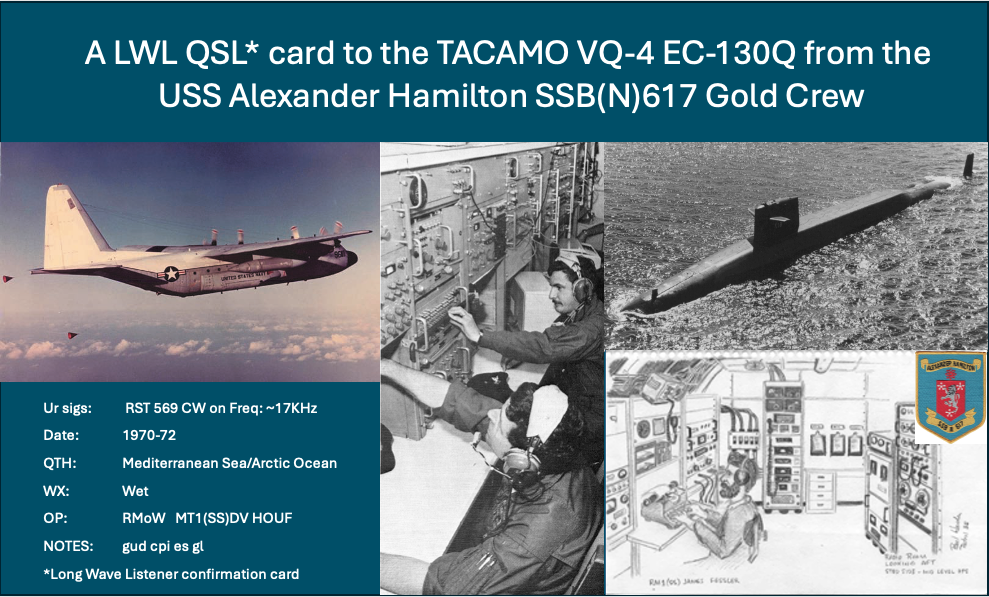
I created an “LWL” QSL card (I did this tongue-in-cheek) for Long Wave Listening confirmation of TACAMO transmissions sent from a special Hercules C-130 aircraft which was used in the event of nuclear war and the anticipated destruction of all land-based military communications capabilities. TACAMO aircraft are still in use in this system today and aviation enthusiasts track them occasionally.

The National Command Authority would issue commands to launch retaliatory nuclear strikes from our missile subs through the signals sent at VLF 17KHz from the aircraft and received by our boats while submerged.

The system is unclassified (like the Doomsday Machine in ‘Dr Strangelove” of the 1960’s film noir – if it is kept secret it is not a deterrent) so you can read about it here:

https://www.wikiwand.com/en/articles/TACAMO

I was a Missile Technician and Navy SCUBA Diver on a missile boat during the Cold War and had been a ham radio operator (WA8KEX) for 6 years prior to serving on board. When I reported to the submarine, the LPO (Leading Petty Officer) of the Radio gang was also a ham and when I spoke with him he got permission for me to qualify as a Radioman of the Watch so I could stand watches in the radio shack while out at sea on our 75 day patrols in the Mediterranean Sea and above the Arctic Circle. I did that when I was off watch back in the Missile Compartment which was my normal duty staton.

Of course we maintained radio silence during patrols but we could copy VLF when we put out our long trailing floating wire antenna when we were near but below the surface. We could then pick up the transmissions from the TACAMO EC-130Q’s flying in very tight circular patterns just above stall speed with a 5-mile long wire trailing behind them which circled down in a helical form just above the sea somewhere out in the Atlantic.

This allowed the VLF signal to travel great distances and we could then copy it while submerged.

The transmissions were digital with the exception that Morse code was also used back in my day. I served on board the USS Alexander Hamilton SSB(N)617 Gold Crew from 1969-72 for 6 patrols out of Rota, Spain.
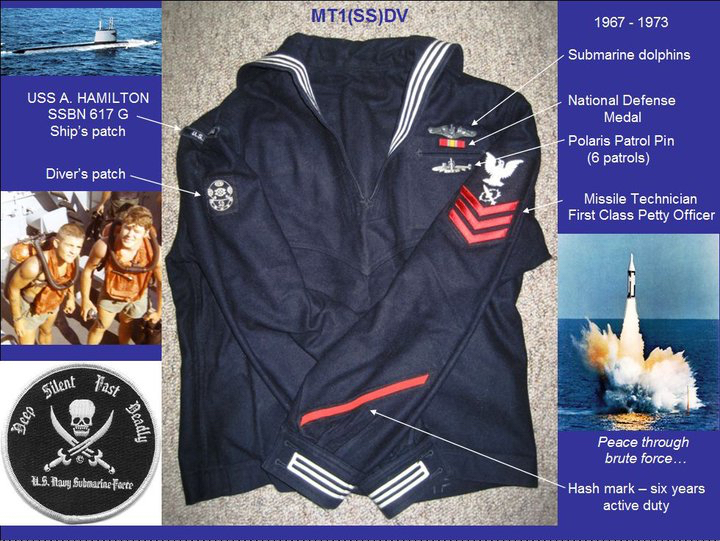
I was an MT1(SS)DV, and here is the uniform I wore. I am on the right in the photo of the two divers and with my swim buddy at the US Navy Diver School in Key West, FL (1970), who was a Recon Marine.

I or another RM (Radioman) would strap on headphones and sit at an IBM Selectric ‘mill’ and copy 5-letter code groups sent in International Morse code from a Navy RM up in the aircraft. That RM was working in tough conditions because the C-130’s had to fly at a steep angle approaching 45 degrees which put them at about 1G and they were sending on a straight key at 15wpm.

Once the messages were received I handed them off to the RM’s and then I left for the Missile Compartment because it meant we were going to have a Weapons System Readiness Test soon – a drill in preparation for the real thing.

Which never came, thank God, or we wouldn’t be seeing this email.

The special LWL QSL card I made shows a real C-130 with the antenna spooling out with its counterpoise – you can just see the drogues at the end of the wires – and the middle photo is of the aircraft internal transmitter gear where the signals were sent.

My submarine is shown in the card with our ship’s patch and a pencil sketch of what the radio shack on board an FBM Polaris submarine looked like – the RM with his headphones is sitting at the mill copying TACAMO messages.

I put a small QSL data block on the card detailing some of the conditions of a typical message received as if we had been SWL QSLing a ham station.

I posted this on my submarine’s FB group as well as the FB Submarine Radioman’s group for their enjoyment – if any of them were also hams or SWL’s they would get it immediately.

73,

Bob
K7ZB

Thank you, Bob, for allowing us a glimpse into this chapter of Cold War communications history through your unique LWL QSL. It’s a wonderful blend of personal story, service, and radio heritage.
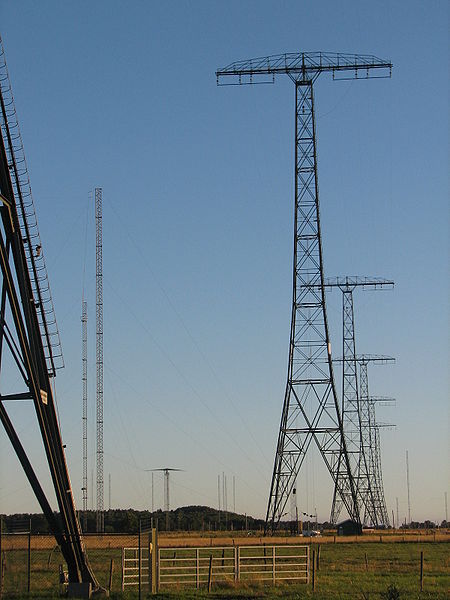
Grimeton Radio Station broadcast Nov 16, 2022 to celebrate UNESCO 50th Anniversary

Source: Grimeton Radio Station

(Source: The Alexander association)

SAQ scheduled to air on November 16th, 2022.

To commemorate the UNESCO 50th anniversary, World Heritage Grimeton Radio Station has scheduled* SAQ to be on the air at 17:00 CET (16:00 UTC) on Wednesday, November 16th, 2022, to send out a peace message to the whole world, using the 200kW Alexanderson alternator from 1924, on 17.2 kHz CW.

Transmission schedule & YouTube Live stream
16:25 CET (15:25 UTC): Live stream on YouTube begins.
16:30 CET (16:30 UTC): Startup and tuning of the Alexanderson Alternator SAQ.
17:00 CET (16:00 UTC): Transmission of a message from SAQ.

Test Transmissions
There may be some test transmissions on Tuesday Nov. 15th or on Wednesday Nov. 16th. Details about the time for the tests will be published on our website, possibly with short notice. During the tests, SAQ will be on air shorter periods of time, when we will be carrying out some tests and measurements. Your comments are welcome to [email protected].

Live video of startup, tuning, and transmitting from Alexanderson Alternator SAQ

Hats off to the crew at the UNESCO World Heritage Grimeton Radio Station!

Today is Sunday July 4, 2021. Besides being Independence Day here in the States, it’s also Alexanderson Day in Sweden!

This morning, I discovered a video on the Grimeton Station YouTube channel: a recording of their live stream live stream starting around 08:30 UTC today.

In the video, you can watch the crew of the Grimeton station startup, tune, and transmit on their 1924  Alexanderson Alternator with the callsign SAQ. Their message is sent in CW on 17.2 kHz. The video is absolutely fascinating and I highly recommend watching it. The startup and tuning procedure are simply amazing. I can only imagine the dedication and resources it takes to keep this marvel of 1920s engineering fully functional today:

Click here to watch on YouTube.

Happy July 4th, everyone!

New Space Weather from VLF Communications

Image Credit: NASA

As an amateur astronomer & SWL enthusiast, I always find it interesting when both disciplines overlap.  I came across an article on the Internet posted by sciencealert.com of such an overlap.

The Earth is surrounded by two radiation belts (Van Allen Belts).  But something strange has been discovered.  After NASA launched a space probe in 2017 – and after analyzing collected data – the two Van Allen belts have been pushed farther away from Earth by a third “area”.  That area is a “man-made barrier” created by Very Low Frequency (VLF) radio communications.

Scientists postulate this new man-made VLF barrier, a form of man-made Space Weather, has pushed the two radiation belts farther from Earth.  And as such, this has created a “protective bubble” from potentially dangerous solar discharges and their radiation streams.

For those interested, you can read the full article here..

Guest post by Troy Riedel

Radio Waves: BBC radio reporters axed, Ham Radio on BBC Surrey, K6UDA on IC-705 features, and VLF balloon launched with request for detailed reception report

Radio Waves:  Stories Making Waves in the World of Radio

Because I keep my ear to the waves, as well as receive many tips from others who do the same, I find myself privy to radio-related stories that might interest SWLing Post readers.  To that end: Welcome to the SWLing Post’s Radio Waves, a collection of links to interesting stories making waves in the world of radio. Enjoy!

Many thanks to SWLing Post contributors Mark Hist, Kris Partridge, John Palmer, and the Southgate ARC for the following tips:


Radio reporters to be axed by BBC and told to reapply for new roles (The Guardian)

Radio reporters to be axed by BBC and told to reapply for new roles
Critics fear end of an era because of plans to make audio journalists work across media platforms

BBC radio voices have described and defined modern British history. Live reports from inside a British bomber over Germany during the second world war, or with the British troops invading Iraq in 2003, or more recently from the frontline of the parent boycott of a Birmingham school over LGBT lessons have also shaped the news agenda.

But now the BBC plans to axe all its national radio reporters and ask them to reapply for a smaller number of jobs as television, radio and digital reporters, rather than as dedicated audio journalists. Many fear it is not just the end of their careers but the premature end of an era for the BBC.

“Radio reporting is a different job. Of course, you can do both, but a report designed for television starts from a completely different place. Radio is also more agile and also a lot less expensive,” said one experienced broadcast journalist. “I am pretty sure most of us will not be given new TV roles. It seems sad to lose all that specific radio expertise.”

Among the well-known voices likely to be affected are Hugh Sykes, Andrew Bomford – who has just completed a long feature on the child protection process for Radio 4’s PM show – and the award-winning and idiosyncratic Becky Milligan, as well as a wider team of expert correspondents.[]

Amateur radio on BBC Radio Surrey (Southgate ARC)

RSGB report Board Director Stewart Bryant G3YSX and SOTA organiser Tim Price G4YBU were interviewed on BBC Radio Surrey on Friday, September 11

The interview starts just before 1:43:00 into the recording at
https://www.bbc.co.uk/sounds/play/p08pkykw

RSGB https://twitter.com/theRSGB

What is Amateur Radio?
http://www.essexham.co.uk/what-is-amateur-radio

Free UK amateur radio Online Training course
https://essexham.co.uk/train/foundation-online/

10 Things That Make The Icom IC 705 A Revolution in Ham Radio (K6UDA YouTube)


VLF Balloon with 210m long antenna launches Sept 12 (Southgate ARC)

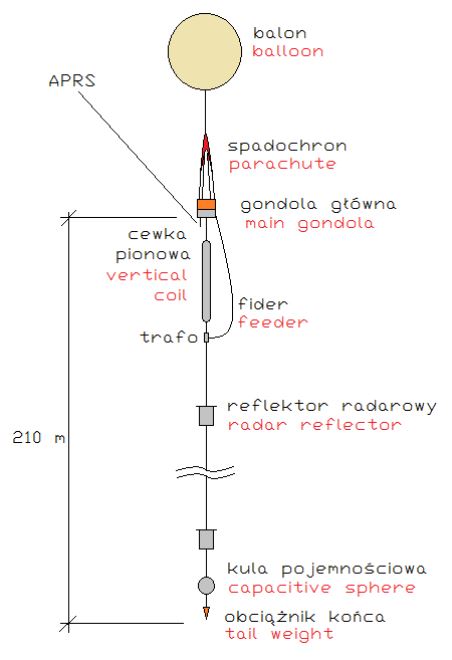
A high-altitude balloon experiment, launched by Warsaw University of Technology, is planned to lift off September 12, carrying a VLF 210-m-long fully-airborne antenna system, transmitting on 14.2 kHz

14.2 kHz is the former frequency of the Babice Radio Station in Poland.

The project is delivering very important data for a doctoral dissertation – any and all feedback on the reception of the signal (reception location, SNR, bandwidth etc.) is extremely important; your help with the listening to the transmission would be invaluable!

The balloon will also be transmitting APRS on 144.800 MHz FM, callsign SP5AXL.

Full details at
https://alexander.n.se/grimetons-sister-station-shall-reappear-in-the-stratosphere/?lang=en


Kris also points out this article which provides more detail about the station and request for reception reports:

Invented for the first time in 2014, in 2020 it will finally be implemented – the idea of „restoring” the TRCN, but in the stratosphere, where there are no mechanical limitations at the height of the antennas, and the achieved range can be gigantic.

The launch of a stratospheric balloon from the Przasnysz-Sierakowo airport of the Warsaw University of Technology is planned for September 12, 2020, in order to perform atmospheric tests – measuring UV radiation, recording the cloudy surroundings with a high-speed camera and conducting an inductive experiment at 14.2 kHz using a special antenna system.

The inductive system uses a modified long-wave transmitter (A1 emission, unkeyed) from the GLACiER project of the Warsaw University of Technology, implemented as part of the IGLUNA – a Habitat in Ice programme (ESA_Lab / Swiss Space Center). The power of the transmitter, due to the emission limits for this type of inductive devices, shall not exceed a few watts. The antenna system is a centrally fed (35: 1) dipole with capacitive (Hertzian) elements and a vertical axial coil. The electrical length is between 400 and 500 m, with a total system length of 210 m. The antenna is equipped with metalized radar reflectors.

The entire balloon mission will use 144.8 MHz (as SP5AXL) and 868 MHz (as part of the LoVo system) for navigation. Flight information will be available in advance in NOTAM (EPWW).
Planned balloon launch (even if the sky is full of ‘lead’ clouds) at 12.00 UTC (14.00 CEST, local time). The 14.2kHz experiment will be switched on on the ground, with the antenna initially folded in harmony. The predicted total flight time is 3 hours – around 13.30-14.00 UTC / 15.30-16.00 CEST it is planned to reach the maximum altitude of 30 km above sea level.

Source: https://trcn.pl/do-stratosfery-to-the-stratosphere/

How can you help with the experiment? By recording as much as possible! Every parameter is valuable – from the spectrum / screenshot with the spectrum, to the EM field strengths, SNR and bandwidth, to the change of the EM field strength over time. The collected data can be sent to our e-mail address: [email protected]. On the day of launch, we plan to post updates on the launch, flight and the experiment itself via our Facebook page: facebook.com/radiostacjababice.
Stay tuned!


Do you enjoy the SWLing Post?

Please consider supporting us via Patreon or our Coffee Fund!

Your support makes articles like this one possible. Thank you!

Grimeton Radio / SAQ Transmission on Sunday, July 5, 2020

(Source: SAQ via Mike Terry)

The annual transmission on Alexanderson Day with the Alexanderson Alternator on VLF 17.2 kHz with the call sign SAQ will take place Sunday, July 5th, 2020.

Two transmissions are scheduled as follows:

Startup and tuning at 10:30 (08:30 UTC) with a transmission of a message at 11:00 (09:00 UTC).

Startup and tuning at 13:30 (11:30 UTC) with a transmission of a message at 14:00 (12:00 UTC)

Watch both transmission events live on our YouTube Channel.

QSL-reports to SAQ (please no E-mails) are kindly received via:

  • Reception report form
  • or via: SM bureau
  • or direct by postal mail to:

Alexander Association
Radiostationen
Grimeton 72
SE-432 98 GRIMETON
S W E D E N

The Amateur Radio Station with the call “SK6SAQ” will be QRV on the following frequencies:

  • 7.035 kHz CW or
  • 14.035 kHz CW or
  • 3.755 kHz SSB

QSL-reports to SK6SAQ are kindly received via:

  • Email to [email protected]
  • or via: SM bureau
  • or direct by postal mail (see address above)

Two stations will be on the air most of the time.

Due to the Corona pandemic, there will be no visitors to the radio station and there will be no visitor activities. Instead you can watch both transmission events live on our YouTube Channel. The association will try to carry out the two broadcasts to the world from the old Alexanderson alternator SAQ with minimal staffing in place.

World Heritage Grimeton Radio station and The Alexander Association

For further details, se grimeton.org or alexander.n.se

https://alexander.n.se/alexanderson-day-2020/?lang=en

Grimeton Radio / SAQ Transmission on June 30th, 2019

(Source: The Alexander Association via Mike Hansgen)

Grimeton Radio / SAQ Transmission on June 30th, 2019.

The annual transmission on “Alexanderson Day” with the Alexanderson alternator on VLF 17.2 kHz with the call SAQ will take place Sunday, June 30th, 2019.
Two transmissions are scheduled as follows:

  1. Startup of tuning at 10:30 (08:30 UTC) with a transmission of a message at 11:00 (09:00 UTC).
  2. Startup of tuning at 13:30 (11:30 UTC) with a transmission of a message at 14:00 (12:00 UTC)
    Both transmission events will be broadcasted live on our YouTube Channel.

NEW! ONLINE RECEPTION REPORT FORM TO REPLACE E-MAIL REPORTS
We are introducing a new online SAQ reception report form to be used by listeners to report reception of any SAQ transmissions. We are kindly asking listeners not to send SAQ reception reports via E-mail.

QSL-reports to SAQ are kindly received via:
– Reception report form at alexander.n.se/receptionreport
– or via: SM bureau
– or direct by postal mail to:

Alexander Association
Radiostationen
Grimeton 72
SE-432 98 GRIMETON
S W E D E N

The Amateur Radio Station with the call “SK6SAQ” will be QRV on the following frequencies:
– 7.035 kHz CW or
– 14.035 kHz CW or
– 3.755 kHz SSB

QSL-reports to SK6SAQ are kindly received via:
– Email to [email protected]
– or via: SM bureau
– or direct by postal mail (see address above)Two stations will be on the air most of the time.

The station will be open to visitors between 10.00 am to 4.00 pm.

WELCOME!

World Heritage Grimeton Radio station and The Alexander Association

For further details, se grimeton.org or alexander.n.se