Author Archives: Thomas

Newsweek: Can radio turn the tide in Syria?

Syria_(orthographic_projection)Thanks to The Professor for sharing this brilliant article by Mike Giglio in The Daily Beast:

“Twenty minutes—this was the small window of time that Majid (not his real name) usually gave himself to broadcast his radio dispatches and then flee. The Syrian was making a name for himself as a bold, young journalist in Damascus, venturing into contested neighborhoods in the capital’s war-torn suburbs to deliver his reports. The broadcasts were low tech and old-fashioned, produced for an upstart radio station called Al-Watan FM, or “The Homeland FM,” and went out on the local airwaves, crackling into a sphere otherwise tightly controlled by the regime. Any Damascus resident scanning the dial could tune in.

It was dangerous work. Pushing into the capital’s FM frequencies meant transmitting an easy-to-track signal from within the city. Government soldiers or regime thugs often came looking for Majid when he went on the air, so he tried to be quick—setting up, going live, then packing up and disappearing within the span of 20 minutes.”[]

Continue reading the full article in Newsweek’s The Daily Beast online.

Shortwave Radio Recordings: Voice of Russia

VoiceOfRussiaSyria is one of the biggest international news items at the moment. If you want to hear Russia’s side of the story, there’s no better place than via the Voice of Russia.

Many thanks to Shortwave Radio Audio Archive contributor, Frank, for submitting this recording of the Voice of Russia English language service. Frank recorded this broadcast on September 14, 2013 starting at 22:00 on 9,465 kHz with his Kenwood R-5000 receiver.

Click here to download an MP3 of the broadcast, or simply listen via the embedded player below:

Shortwave Radio Recordings: Radio Thailand

wiki-800px-Watchaiwattanaram050617Many thanks to Frank, a contributor on the Shortwave Radio Audio Archive, for this recording of Radio Thailand World Service.

This broadcast was recorded in Europe on September, 13 2013 starting at 19:00 UTC on 9,390 kHz.

Click here to download the recording as an MP3, or simply listen via the embedded player below:

The Tuckerton Tower’s long (and unlikely!) history

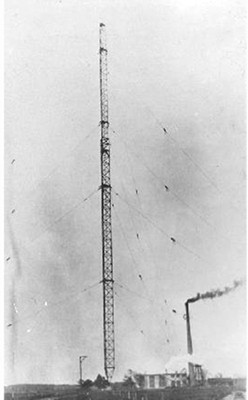
The Tuckerton Tower circa 1916 (Souce: Tom Mcnally mcnally.cc)

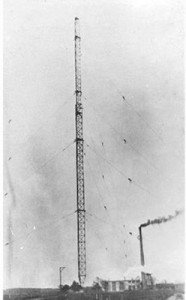
The Tuckerton Tower, circa 1916 (Souce: Tom Mcnally mcnally.cc)

I love radio history, and I dive right into it when something especially piques my interest. This morning, a news item from a local newspaper in New Jersey about that state’s famed, but nearly forgotten, Tuckerton Tower did just that.

Built in 1912, the Tuckerton Tower was once the tallest structure in the US.  Indeed, it was at that time the second tallest structure in the world (the Eiffel Tower had it beat by 243 feet).  Though on US soil, it was originally built by––get this––the German government, in order to communicate with an identical tower in Eilvese, Germany (see comments); of course, it also communicated with naval vessels. According to many sources, the US government may have been completely unaware of the construction of this communication monolith until it neared completion.

But that’s just the beginning of the story:  When the US entered WWI, the US government took over the tower’s operations and placed Tuckerton’s German operators and engineers in a POW camp.  Then, post-war, the newly-formed Radio Corporation of America (RCA) assumed the tower’s operation with the intention of using it for the latest and greatest innovation in radio communications: voice over wireless. Tuckerton Tower continued under RCA’s operation until the US government drafted it into service again, this time during WWII.

But even though the tower survived two world wars, weather events like nor’easters, and The Great Depression, by the late 1940s it was considered obsolete. Several attempts were made to preserve the historic structure, but on December 28, 1955, it was torn down and cut for scrap.  Today, a lower section of the tower can be viewed at the Tuckerton Historical Society’s museum, while the concrete block anchors that once held the monolithic structure upright now rest, somewhat defiantly, in the center of a residential area.

If you find this tower’s history as remarkable as I do, check out this informative and detailed article in The Sandpiper and Tom McNally’s History of Tuckerton Wireless which includes some excellent photos of the tower throughout history.

Are there any readers of The SWLing Post with memories long enough to remember the Tuckerton Tower, or who have heard stories about it?  Please comment!

Redsun RP-3100 ready for pre-order

Redsun-RP3100Radio Flynn writes:

I found some information about the release date of the Redsun RP-3100 and posted it on Herculodge – lets hope it is real:
http://herculodge.typepad.com/herculodge/2013/09/not-to-fan-the-flames-of-redsun-rp-3100-lust-.html

The Redsun RP-3100 has been rumored for ages.  Glad to see it’s coming to fruition!

The Take Away interviews Ajit Pai

AjitPaiMany thanks to Dan Srebnick for sending a link to this piece on The Take Away.

In The Quest To Save AM Radio, John Hockenberry talks about AM radio nostalgia and then interviews Ajit Pai (who was mentioned in a post a few days ago).

Click here to download an MP3 of the interview or simply listen via the embedded player below.

The Ten-Tec RX-320D and Model 1254 have been discontinued

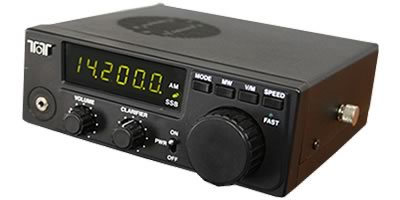
Tthe RX-320D black box receiver

Tthe RX-320D black box receiver

I just confirmed with Ten-Tec that the RX-320D PC controlled receiver and the Ten-Tec Superhet receiver kit, the Model 1254, have both been discontinued.  A Ten-Tec representative told me the reason both of these models have been discontinued and removed from Ten-Tec’s product line is because one of the parts used in production is now obsolete.

A long run…

The RX-320 and RX-320D have had a very long product life as the RX-320 was introduced in the late 1990’s (1998, if memory serves)–pretty amazing.

I owned an RX-320D for a long time and thought that it was still a great value. Here’s a review I wrote in 2009.

The Ten-TEc Model 1254 "superhet" receiver

The Ten-Tec Model 1254 Superhet Receiver kit

As third generation SDRs have emerged, and become so affordable in the past few years, it’s hard to justify the purchase of a receiver whose control software was designed for Windows 95.

So long RX-320D, you’ve had a long run…

I have SWLing Post reader, Larry, to thank as his recent inquiry about the Model 1254 Superhet kit prompted me to call Ten-Tec for verification.