Author Archives: Thomas

New product: the ShouYu SY-X5 shortwave radio

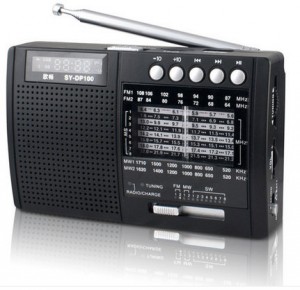
The ShouYu SY-X5

The ShouYu SY-X5

[Update: Check out our review of the SY-X5 by clicking here.]

Thanks to Paul, I just found out about the ShouYu SY-X5: a new analog DSP-based shortwave radio with built-in MP3 player. Like the Degen DE321DE32Kchibo KK-9803 and the recently released Tecsun R-2010D, the SY-X5 has a mechanical tuning mechanism powered by a Silicon Labs DSP chip.

I just purchased the ShouYu SY-X5 from this seller on eBay. The total cost was $27 US including shipping from Hong Kong. There are other sellers offering the SY-X5 on eBay, but their prices are almost double (with shipping from the US).

At a low price of $27 US, my expectations will be adjusted accordingly. My hopes are somewhat higher for the Tecsun R-2010D as Tecsun tends to do a better implementation of DSP chips than their competitors. Since I’ll be receiving both units within days of each other–and I still have the DE321 and DE32–I will certainly compare them.


Shortwave Radio Recordings: Voice of Turkey

Gezi protest in Ankara  (Source: Wikimedia Commons)

Gezi protest in Ankara (Source: Wikimedia Commons)

A few days ago, I posted a recording of the Voice of Turkey that noticeably lacked coverage of the Gezi Park protests.

Friday, I recorded VOT’s English language broadcast and was surprised to find that they actually mentioned the protests (admittedly, without it’s due weight) in several news items. I’m very curious how future VOT broadcasts will cover news of yesterday’s riots in Istanbul as police cleared crowds of protesters with water cannons and tear gas.

Click here to download the full recording, or simply listen via the embedded player below:

More ERT updates from Athens

(Source: radioakroatis.blogspot.gr/)

(Source: radioakroatis.blogspot.gr)

SWLing Post reader, Christos, has been reporting regularly on the state of ERT broadcasting in defiance of a government shutdown.

Here’s his latest report:

My logging on the frequencies used by ERT employees:

  • 1404 KHz – KOMOTINI
  • 1260 KHz -RODOS
  • 1512 KHz – CHANIA, CRETE
  • 9420 KHz – AVLIDA

This radio programme can be heard at the following internet address: http://193.43.93.230/ert.php

  • 1008 KHz CORFU, [is] relaying audio from live video streaming.

This programme can be watched at: http://www3.ebu.ch/cms/en/sites/ebu/contents/news/2013/06/monitor-ert-online.html

  • 729 KHz
  • 96 MHz FLASH FM for Athens, Attiki.

They broadcast another radio programme.

  • 666 KHz , 981 KHz : Transmitters are active, but there is no audio.

Also, check out Christos’ blog where he has posted several photos he took at ERT protests: http://radioakroatis.blogspot.gr/

AOR introduces the AR6000: the 40 kHz to 6 GHz receiver

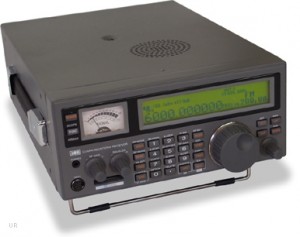
The AOR AR6000

The AOR AR6000

AOR has announced their latest (very) wide band receiver, the AR6000 last month at the 2013 Dayton Hamvention.

As with most AOR equipment, the AR6000 comes at a premium price–$6,500 US–but this receiver is quite unique in that it covers most of the radio spectrum 40 kHz to 6 GHz. I imagine AOR sells most of these to commercial and government entities; indeed it’s only available for export or government purchase here within the US.

Details below:

(Source: AOR USA)

The AR6000 delivers continuous tuning from 40 kilohertz to 6 gigahertz in a wide variety of modes for professional monitoring performance that’s nothing short of amazing in terms of accuracy, sensitivity and speed. Standard modes include AM, FM, WFM, FM Stereo, USB, LSB and CW. An optional module can add the capability to receive APCO25 digital communications plus an optional I/Q output can be added to capture up to one megahertz of bandwidth onto a storage device for later listening or signal analysis.

Designed for the monitoring or technical service professional, there are no interruptions in the AR6000’s tuning range. With exceptional tuning accuracy and sensitivity throughout its tuning range, the AR6000 begins at the floor of the radio spectrum and continues up through microwave frequencies so it can be used for land-based or satellite communications. It works as a measuring receiver for those seeking a reliable frequency and signal strength standard. To support its broad spectrum, the AR6000 has two antenna ports, with the added capability of an optional remote antenna selector from the front panel of the receiver.

With its popular analog signal strength meter and large easy-to-read digital spectrum display, the AR6000 is destined to become the new choice of federal, state and local law enforcement agencies, the military, emergency managers, diplomatic service, lab technicians, news-gathering operations and security professionals

Click here to view the spec sheet and brochure (PDF).

ERT now broadcasting on several medium wave frequencies

(Photo source: AP / Petros Giannakouris)

(Photo source: AP / Petros Giannakouris)

It’s been several days now since the Greek government tried to shut down Greek National TV and Radio broadcaster, ERT. In fact, ERT was only off the air for a few hours; they immediately set up a live Internet stream and restored shortwave service to the Voice of Greece. They’re still going strong and, evidently, expanding.

SWLing Post reader, Christos, lives in Greece and has been keeping us up-to-date with field reports. He writes:

This day [Friday] the employees of ERT took over the frequencies of medium waves 666 KHz, 729 KHz, 981 KHz, 1008 KHz (Corfu) and 1404 KHz (Komotini), that the previous days remained silent.

Short waves (9429 KHZ) and 1260 kHz from Rodos Island continue active.

[There] are now two radio channels in operation.

Thanks again, Christos! Follow this story with the tag: ERT Cuts

VOA Radiogram this weekend mixes bad noise with good noise

VOARadioGram(Source: VOA Radiogram)

During the past weekend, we experimented with mixing music with MFSK text modes. Reducing the MFSK modes by 9 dB was not a problem if the signal level was good, but the MFSK text did break up for some listeners if reception conditions were marginal.

This weekend, 15 and 16 June, we will mix some actual noise taken from shortwave with MFSK text. After the noise begins, a VOA News story in MFSK16 will first be transmitted at full level, then reduced to -6 dB, then reduced to -12 dB. I will probably lose many of you when the level is reduced to -12 dB, but please stay tuned: the audio level will soon be restored.

Here is the lineup for VOA Radiogram, 15 and 16 June 2013:

  • 2:10 MFSK16: Program preview
  • 1:58 MFSK16: Introduction to noise experiment
  • 10:09 MFSK16: At -0 -6 -12 dB versus noise
  • :59 MFSK16: Image of VOA logo
  • :47 MFSK16: Introduction to MFSK32
  • :51 MFSK32: Image of VOA logo
  • 3:19 MFSK32: VOA News re Curiosity Rover on Mars MFSK32: VOA Radiogram logo
  • 2:40 EasyPal Image of the week
  • 1:10 MFSK16: Closing announcements
  • :20 Surprise mode of the week

VOA Radiogram transmission schedule

(all days and times UTC)
Sat 1600-1630 17860 kHz
Sun 0230-0300 5745 kHz
Sun 1300-1330 6095 kHz
Sun 1930-2000 15670 kHz

All via the Edward R. Murrow transmitting station in North Carolina.

Please send reception reports to [email protected]

Christos’ report on ERT shutdown & English statement from broadcaster

GREECE-ECONOMY-MEDIA

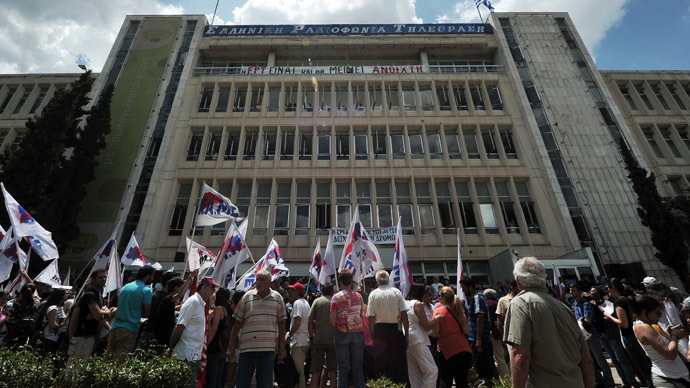
People gather outside the Greece’s public TV ERT headquarters in Athens on June 12, 2013, in support of the broadcaster’s staff and unions. AFP Photo (Source: RT)

SWLing Post reader, Christos, visited the protests at the ERT Radio House yesterday.  Here are his comments:

This evening, I visited the Radio House of ERT (Radiomegeron) in Aghia Paraskevi suburb of Athens. I estimate that about three thousand people had been gathered to protest against the government’s decision of shutting down the radio and television channels. I cannot predict the reaction of authorities but I think that the popular support is limited.

At this time I checked two transmissions. A television one, through EBU internet video stream:
http://www3.ebu.ch/cms/en/sites/ebu/contents/news/2013/06/monitor-ert-online.html

And a radio one, relayed by some local FM stations and two classic ERT frequencies: 9420 KHz on short waves from Avlis and 1260 KHz on medium waves from Rhodes island. I receive both with my eton E5 portable radio right now.

Thank you for the report, Christos!

Also, Mauno Ritola recorded this English statement from the Voice of Greece (9,420 kHz) around 19:45 UTC yesterday:

Mauno believes they’ve been repeating this same statement in English and French throughout the day. He mentioned that he can also hear their 1260 kHz station in Finland. He said, “in the early evening they had regional programming, but around midnight joined the SW feed, which apparently was TV audio [with this feed]”

For more updates on the ERT protests, please follow this tag.