Author Archives: Thomas

All In A Weekend: Bon voyage to David Bronstetter, from an unlikely listener

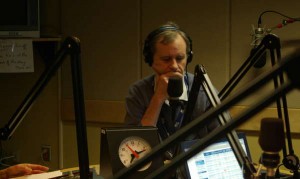
Dave Bronstetter hosting All In A Weekend at the CBC studio in Montreal. (photo: CBC)

I believe it was in the fall of 2007 that I first tuned to the enlightening CBC Montreal program, All In A Weekend, with host David Bronstetter. Unlike listeners in Montreal, or anywhere in the province of Quebec, for that matter, I didn’t hear the show on FM radio, nor streaming over the internet–it was on a shortwave radio.

You see, each Saturday and Sunday morning at 7:00 EST (12:00 UTC) Radio Canada International turns on a shortwave transmitter at their Sackville, New Brunswick site, and broadcasts CBC Radio One Montreal programming on 9,625 kHz for North Quebec. They’ve done this for years.  That means that many of us south of the Canadian border can catch the “back side” of this broad signal quite easily.

When I first heard All in A Weekend, I was favorably impressed by the program’s host, Dave Bronstetter. When I landed on his voice the first time, he was in the middle of an interview, and even in that brief interval of tuning I could tell that this was an insightful interviewer. Returning to hear the following half-hour segments of the show, I learned that his keen intelligence was manifest not only in intimate, articulate, and adaptive interviews with his guests, but also in an absurd wit.

In short, I was hooked.

From that day forward, I joined thousands of Quebec listeners, right here from my home in the southern US, as we tuned in All In A Weekend. Dave and his Montreal crew became my weekend morning coffee companions.
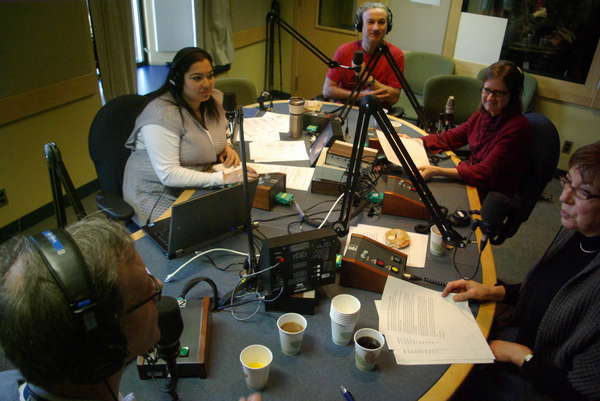
Dave chats with host Sonali Karnick, Elias Abboud, and Nancy Wood. (source: CBC Radio One)

In my many years of listening to radio, I’ve heard hundreds of hosts from around the world, but this guy stood apart. Dave Bronstetter’s hosting was fueled by a quick wit, which he wove into his interviews with an eloquence that would make any comic green with envy.  Moreover, this fun, catch-’em off-guard approach resulted in better interviews with his diverse guests, all excellent listening, such as with famous jazz photographer Herman Leonard, singer Emilie-Claire Barlow (and many other Canadian artists like her, whom I’ve since learned to appreciate), and a stand-out interview with a Palestinian that I haven’t forgotten, nor am likely to.

And more than once, while reporting weather, in the midst of listing all the towns and cities across the vast province of Quebec, Dave slyly inserted the tiny town where I then lived.  This always made me start, and brought a chuckle. Of course, I couldn’t help thinking that this caught the attention of many other listeners, too, but leaving them scratching their noggins–Sylva, Quebec? Where on earth’s that–?

Radio Canada International's Sackville, New Brunswick shortwave transmitter site. (photo: Wikimedia Commons)

How could Dave have known about Sylva? Well, he interacted with his listeners, and I was no exception. It didn’t matter if listeners were sending him a compliment or complaining about the fact that he was reading off the wind speed in Baie-Comeau and Kuujjuaq, he paid attention. I would dash off an email to request songs, play along with his contests, or brag about our lovely Southern-states weather when Montreal was having a brutally chilly day. Many of my emails were sarcastic, and Dave’s rebuttals, two-fold.

Once, Dave actually made a call to my home in Sylva and interviewed me on the air.  A couple of days prior to the interview, he called to ask my permission and to, well, just chat. We probably talked for an hour–even in that casual conversation, I noted his interviewing talent: I felt like I was talking with an old friend, one who understood me and appreciated my offbeat sense of humor.

Many times while listening to All in a Weekend, I reflected, this is what I love about radio. The footprint is vast–it jumps national borders with ease, and offers an instant level of interaction that’s hard to replicate even in our internet-driven age.

To my dismay, Dave recently announced that he was retiring after 33 years with the CBC. Last Saturday’s show was his last.

At least, so he says.

Regardless, I can tell you this:  I will miss my buddy, Dave Bronstetter, on the air. I know of no replacement, and I can only imagine how difficult it may be for the charming Sonali Karnick to follow his tough act. I hope it will be by carving her own unique personality into the show. That’s what gave the unassuming All In A Weekend its moxie in the first place, and drew me in regularly to listen.

My hat’s off to you, Dave; may you enjoy whatever you do going forward. You are unquestionably one of a kind. And please–keep in touch!

Want to hear what the send-off broadcast All In A Weekend sounded like on shortwave radio? Try this:

Can you identify this radio?

Can you ID the radio in this photo? Click to enlarge. (photo: ABC News)

SWLing Post reader, Kim, wondered if anyone could identify the make and model of the radio (pictured right) which had been modified to contain a bomb. Terrorists used these devices recently in Thailand.  ABC News featured an article and video about the attacks, but I’ve seen little about the make/model of radio that had been used.

Update: See JW’s comment below–this is an EPE model FP-103U.

C.Crane “orphan” shortwave radios on sale

The CCRadio-SW is one of our favorite portables for excellent audio fidelity and ease of use.

I received notification that C. Crane is selling some of their “orphan” radios at excellent discounts while supplies last.

Out of their shortwave selection, they are selling the CCRadio-SW (a radio we love) for $99.95 and the ultra-portable CCRadio-SWP (review here) for $34.95.

Click here to see all of the orphan deals.

What are C.Crane orphan radios? Orphan radios are simply customer returns or demo units that have been tested and cleaned.  Orphan items come with a 60-day money back guarantee and are limited to stock on hand. Prices on these are good through 02/28/12.

NOTE: C. Crane is an excellent radio retailer and I would not hesitate to order an “orphan” product from them!

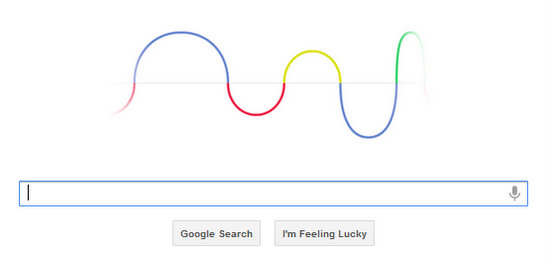
Google Doodle honors Heinrich Hertz’s 155th birthday

If you visit Google’s home page today, you’ll notice that their typical logo has been replaced with an animation of an undulating, multi-colored wave.

If you click on the wave, you’ll be taken to sites telling the story of Heinrich Rudolf Hertz.

We should all take a moment today to thank Hertz for his contribution to the radio spectrum. Indeed, it was Hertz who showed that electricity could be transmitted via electromagnetic waves. This laid the groundwork for developing wireless telegraph and radio. In the 1930’s the International Electrotechnical Commission decided that Hertz’s name would become the unit of frequency for our electromagnetic spectrum–the hertz (Hz)–about four decades after the his death.

To read the story of Hertz, I would suggest browsing his Wikipedia entry.

If you missed seeing the Google Doodle animation, check out the video below:

This isn’t the first time Google has honored an influential innovator in our radio world, a few years ago we posted their Google Doodle tribute to Samuel Morse.

A simple upgrade for your Ten-Tec Model 1254 shortwave receiver

In the video below, Alan (W2AEW), shows us the installation and basic operation of an upgraded micro-controller for the Ten Tec Model 1254 Superhet Receiver Kit.

As Alan points out in the video, this is one of two upgrades offered at Cholakian.com. Both upgrades enhance the operation and usability of the Model 1254, giving it many more choices of tuning steps (yes!), the ability to automatically turn off the LED display, more memories and allowing you to eliminate the 9V battery back-up. This basic upgrade costs $38, the premium upgrade costs $68 even allows you to control the receiver via your PC.

Thanks, Alan, for showing us just how simple this upgrade is to perform:

You can see more of Alan’s projects at his website.

RNW: Antenna repairs under way in Madagascar

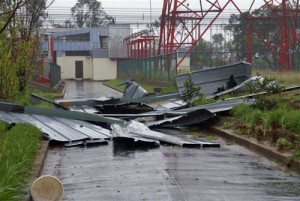
(photo: RNW)

RNW Madagascar was hit by a tropical cyclone last week and incurred heavy damage. I’m very happy to read the report below that antenna repairs are under way:

(Source: RNW Media Network)

We have received some more photos from our colleagues in Madagascar, showing the damage to the antennas caused last week by Tropical Cyclone Giovanna, and repairs under way. The first photo shows the satellite dish that was used to receive BVN TV and the RNW audio channels from the satellite. The broken dish has been replaced by a backup. Damage to several of the antennas was similar to the one in the second photo. One has already been repaired. The third photo shows some repairs taking place on the ground to the feeder of the log periodic antenna.

As BBC World Service moves from Bush House, they open doors

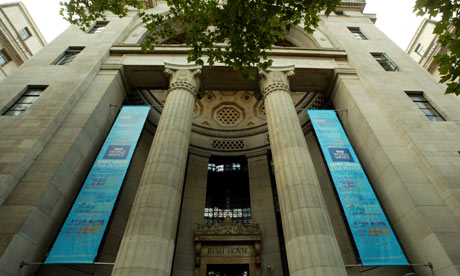
BBC World Service - Bush House

BBC World Service opens doors to celebrate 80th birthday

(Source: BBC Press Office)

Global audience gets unique behind the scenes access as move from iconic London home begins.

Audiences are to be given unprecedented behind the scenes access as part of a special day of live programming on February 29, to mark the BBC World Service’s 80th birthday.

Highlights from the day will include a special global audience with Sir David Attenborough and The Strand – the WS global arts programme – will be edited by guest artist and music producer William Orbit.

Audiences will be able to join a special debate about what they want from the World Service, both on air, online and across social media forums. (#bbcws80)

The day will give audiences around the world a unique insight into production of their favourite programmes and multilingual videos will be produced of all the broadcasts throughout the day online at bbc.co.uk/worldservice.

For the first time audiences will be invited to watch and participate in over 12 hours of programmes in English and across more than 12 different languages. The day will be hosted by BBC Persian’s Pooneh Ghoddoosi and BBC World Service presenter Ros Atkins.

BBC World Service’s daily morning editorial meeting, which normally takes place behind the doors of Bush House, will be opened up and broadcast live for the first time. In this meeting – a daily part of life in the building – the newsroom’s editors discuss and agree the big stories and developments and decide on which stories will shape the day’s news agenda.

The open courtyard of Bush House will host many of the programmes that day. Flagship programmes such as Newshour and World Have Your Say will invite audiences to join a conversation about international broadcasting and the future priorities of the BBC World Service.

Listeners around the world – and the audience at Bush House – will have the chance to shape the news agenda and debate by making suggestions from the floor, or through Twitter, Facebook and Skype.

Peter Horrocks, Director of BBC Global News, said: “The 80th birthday and departure from Bush House means these are historic and changing times for the BBC World Service. We want our audiences to be at the heart of both the commemoration of the past and conversation about the future.”

BBC World Service Commissioning Editor, Steve Titherington, said: “We are turning Bush House inside out showing who we are and what we do to our audiences and asking what the world wants next from the BBC World Service.”

On February 29, BBC World Service is also launching a new series of programmes on the human body. Linked to the Olympics, The Human Race will invite the public to take part in a ‘healthcheck special’ featuring leading international scientists and sportspeople.

Not only celebrating 80 years of broadcasting, this special day of programming marks the start of the BBC World Service’s move from Bush House, its iconic London home for over 70 years, to a new state of the art broadcasting centre in Oxford Circus.

The move will see all of the BBC’s news services – UK and international – based together for the first time. The aim is to create ‘the world’s newsroom’ – enhancing the BBC’s global newsgathering and creating a forum for the best journalism in the world.

Programming

BBC World Service English – much of the day’s global schedule from 07:00 to 23:00 GMT will broadcast live from outside Bush House. Programming highlights from this day include:

09:00 – The live news meeting – normally conducted behind closed doors, audiences will for the first time be given insight into the inner workings of the newsroom.

11:00 – World Have Your Say – the global interactive news discussion programme will ask audiences around the world what they want the programme to be about on that day.

15:00 – A live global audience with Sir David Attenborough.

17:00 – World Business Report and Focus on Africa will link up to broadcast a special programme asking how business journalism is reporting the financial crisis with Alistair Darling on the panel, and looking at the creative energy and entrepreneurship coming out of Africa.

19:00 Health Check – will air a special programme to launch The Human Race Season – a raft of programmes examining the human body. Endurance runners and sprinters, sports psychologists, doctors and coaches will all be in the courtyard to try to answer ‘What makes an Olympic athelete?’

20:00 – 22:00 – Newshour, BBC World Services flagship current affairs show, will broadcast a special debate looking at the future of international broadcasting.

22:00 – 23:00 – The Strand Extra – BBC World Service’s global arts show, will be edited by special guest artist and music producer William Orbit.