Author Archives: Thomas

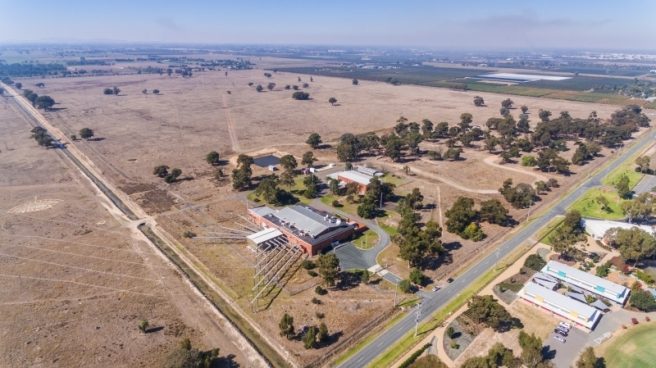
VI3RA: Last RF emanations from RA Shepparton before demolition (March 14-15, 2020)

Many thanks to SWLing Post contributor, Nigel Holmes, who writes:

Those of you who hold amateur (VK) licenses – form an orderly queue to book a spot.

Those of you who listen – make space on your shack wall for the last QSL card from Shepparton IHFTS.

A special callsign has been issued by ACMA for the event: VI3RA (Victor India…)

Amongst other experimental transmissions, will be an attempt will to reflect radio signals from the Moon using the high gain HF aerials at Shepparton. Frequencies in the 18 & 21 MHz amateur bands would be employed. This would emulate the ground-breaking work done by CSIR Radiophysics Laboratory in the 1940s from the Shepparton station which initiated Australia’s entry into radio astronomy.

Click here for more information about VI3RA at QRZ.com and SADARC.org.

Note that the event with take place March 14-15, 2020 (GMT +11:00).

Thank you for the tip, Nigel!  I’ll certainly attempt to put Shepparton in the logs! If I lived in anywhere near Shepparton, I’d make the pilgrimage to be in that long line of people hoping to light up one of those massive antennas!
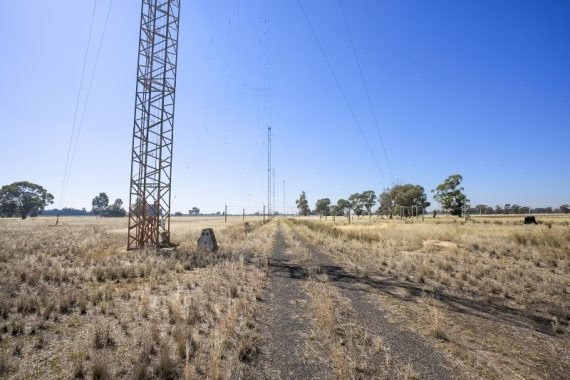
I hope if any SWLing Post readers attend the event or operate as VI3RA, they’ll perhaps snap a few photos to share here with the community!

Coronavirus delaying product development, production, and shipping

Photo by chuttersnap

Earlier this week, I mentioned in a Patreon post that if you’re plotting to buy a radio or other consumer electronics currently in development or production in China, expect delays.

Due to the spread of the Coronavirus, a number of factories have been shut down and production effectively frozen since the beginning of the Chinese New Year. Some companies are attempting to slowly bring operations back to normal levels, but progress is unstable to say the least.

I’ve spoken with a couple of friends who work in the radio and consumer electronics industry in China and both have expressed serious concerns regarding new product timelines this year. Both noted that there’s no need for alarm or panic at this point, but consumer expectations should simply be in-check as the situation unfolds.

In the meantime, expect recently announced products to take longer to hit the market.

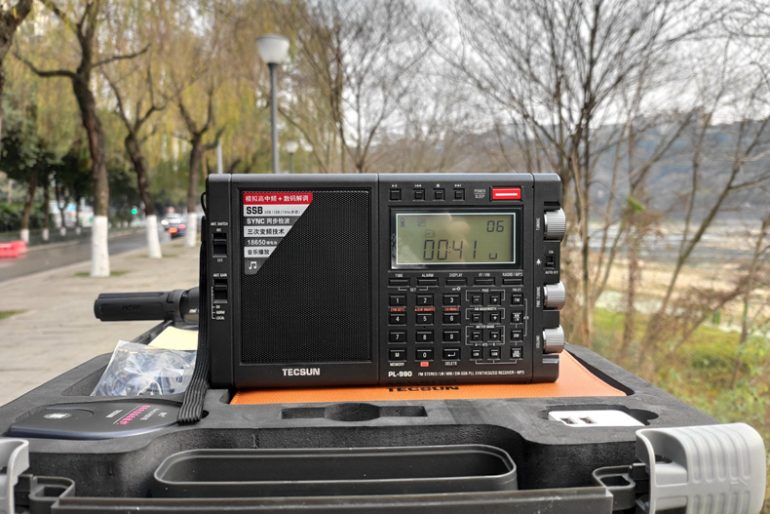
The Tecsun PL-990

I would not be surprised, for example, if the Tecsun PL-990, Tecsun H-501, Eton Satellit Elite, and Icom IC-705 are all delayed a few weeks or even months. Much depends on where each product was in the design, development, or production process when factories were closed.

It’s also possible if your regional retailers and distributors run out of product inventory, it could take an an extended time to replenish stock.

Again, there’s no need to panic about product availability at this point, just anticipate delays!

Post readers: Has this situation already had a direct impact on you?  Please comment.


Do you enjoy the SWLing Post?

Please consider supporting us via Patreon or our Coffee Fund!

Your support makes articles like this one possible. Thank you!

Radio Northern Europe International on shortwave

Many thanks to SWLing Post contributor, Roseanna, who shares the following announcement posted on her blog:

(Source: The Girl With The Radio)

I would like to share something very exciting that I’ve been working on since May 2019:
Radio Northern Europe International

RNEI will be the station for pop and dance music from Northern Europe on shortwave playing music from Norway, Sweden, Denmark, Iceland, Finland, the UK and Ireland!

I aim to play music you haven’t heard before and the first show features a very exciting experiment: Embedded MFSK64! This means, hidden in the final song, there will be the song list sent in MFSK64 in such a way it won’t be off-putting for those of you not decoding!
My shows will mainly consist of lesser known music with a small amount of speaking and jingles. Without spoiling too much of the show I can hint that you’ll hear some Swedish, Norwegian, Finnish, English and Icelandic language music if you tune in!

The first pilot show will go out on 6070 kHz Channel292 from Germany (decent reception all over Europe) at the following times:
February Saturdays 19:00-19:30 UTC (Starting Saturday 15th)

I’m also in talks with shortwaveradio.de so there is a possibility of using 3975KHz & 6160KHz as well (increased reception in the Benelux/UK/Ireland regions!)
After the broadcast, shows will be published on Mixcloud and my reception on YouTube in case you’ve missed the show!

I will respond to all reception reports sent in and, if I get enough, I’ll try and get postcards made to send out (I’ve designed one I want to get printed!)

I would like to take this space to thank RPC Audio (Jono) for the cheap jingles and Daz from HFZone for helping me with making my mic sound good!

I really hope you all get a chance to listen in and that you get decent reception!
until next time,
tgwtr

Free Radio Skybird returns February 16th and 23rd

(Source: Pete Madtone)

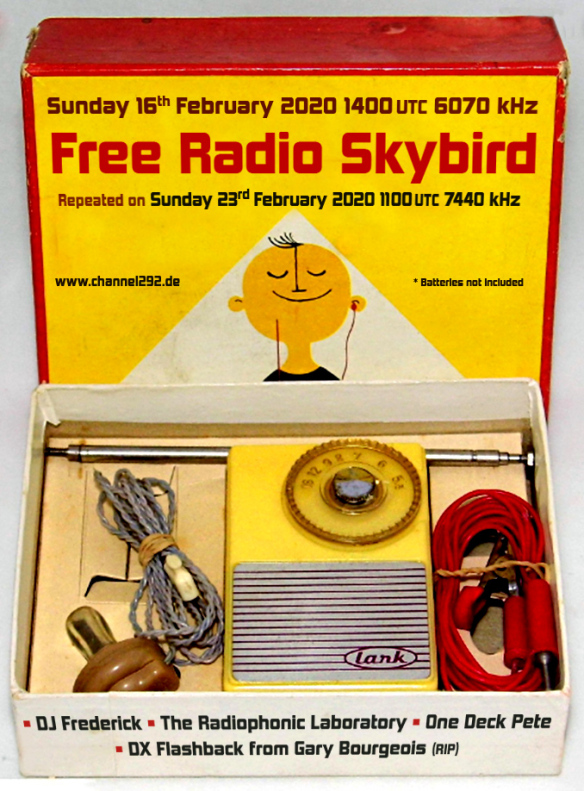
It seems like it’s been a while since DJ Frederick’s Free Radio Skybird was last on the shortwaves. Don’t worry, it won’t be long until the next one on Sunday 16th February at 1400 UTC/UK on 6070 kHz via Channel 292. The show will be rebroadcast on Sunday 23rd February at 1100 UTC/UK on 7440 kHz. If you haven’t got a shortwave radio it can also be heard on the SDR link on Channel 292’s site here.

The programme will feature Justin Patrick Moore’s Radiophonic Laboratory and One Deck Pete (from Weeds up to me knees) presenting the Skybird Mailbag. There’ll also be an airing of Pete’s “Less is more” that has new tunes from MaiMohammad-Reza  Shajarian & Seventh Soul and Blanco.

Mixes from previous shows are available at our audio podcast page here. The programme will be available on DJ Frederick’s Soundcloud page a day or so before transmission date if you want to hear it in true stereo but we here prefer the show with added noises from the ionosphere. Tune in and turn on! #shortwavesnotdead #madtone #freeradioskybird

The secret role of Beaumanor Hall

(Source: Southgate ARC)

The Leicester Mercury reports on the top secret wartime listening station role of a Leicestershire mansion

As we approach the 75th anniversary of VE Day in May, a Loughborough Library Local Studies Volunteer (LLLSV) tells the fascinating story of Beaumanor Hall’s crucial role in the Second World War.

Many readers may not know, but Beaumanor Hall was the site of a vital wartime intelligence service, namely the War Office “Y” (wireless) Group or W.O.Y.G.

The top secret “Y” Group was part of M18 Wireless Intelligence and Beaumanor was a highly-strategic “Intercept Station”, concerned with monitoring the enemy’s main channels of wireless traffic and communications.

The “Y” Intercept Listening Service operated from 1941 to 1945 and its wartime activities were as top secret as those at the Code and Cypher School at Bletchley Park.

Click here to read the full story at The Leicester Mercury.

World Radio Day 2020

Today is UNESCO World Radio Day and this year the theme highlights diversity on the airwaves. Here’s the announcement from UNESCO:

On World Radio Day 2020 (WRD 2020), UNESCO calls on radio stations to uphold diversity, both in their newsroom and on the airwaves.

Radio is a powerful medium for celebrating humanity in all its diversity and constitutes a platform for democratic discourse. At the global level, radio remains the most widely consumed medium. This unique ability to reach out the widest audience means radio can shape a society’s experience of diversity, stand as an arena for all voices to speak out, be represented and heard. Radio stations should serve diverse communities, offering a wide variety of programs, viewpoints and content, and reflect the diversity of audiences in their organizations and operations.

This edition of WRD is divided into three main sub-themes:

    • ADVOCATING for pluralism in radio, including a mix of public, private and community broadcasters.
    • ENCOURAGING representation in the newsroom, with teams comprised of diverse society groups.
    • PROMOTING a diversity of editorial content and programme types reflecting the variety of the audiences.

Click here to check out the UNESCO website devoted to World Radio Day 2020.

Happy World Radio Day, everyone!

Loss of BBC Hindi shortwave service and listener reactions

(Photo by Elle via Unsplash)

Many thanks to SWLing Post contributor, David Iurescia (LW4DAF), who shares the following story from The Print:

Emotional emails & offers to crowdfund — how fans tried to keep BBC Hindi radio on air

The service fell silent last month with its last transmission on 31 January. The BBC management now plans to boost its digital and TV presence.

New Delhi: It was the BBC’s Hindi radio on shortwave that slowly carved an identity for the British broadcaster in India after its launch 80 years ago. With an estimated audience of 40 lakh across India, the radio service was the first choice for consumers of serious news and entertainment alike, particularly in the remote and far-flung parts of the country.

But the service fell silent last month, on 31 January, with the BBC management citing a dwindling audience and plans to boost digital and TV presence as reasons to call time on this chapter of history.

It came as a rude shock for its loyal audience and the dismay was evident, according to BBC insiders.

“It was heartbreaking to see the kind of emotional emails and letters we received on the days preceding the shutdown and after that,” an insider told ThePrint. “They (the audience) pleaded to keep the service afloat. Some even said they were willing to crowdfund it. But it seems the management was interested in the numbers and the BBC Hindi radio service on shortwave was not giving them adequate numbers.”

Another insider in the BBC said audience numbers for the radio service had come down from 1 crore a few years ago to about 40 lakh now, even as its presence on platforms such as YouTube thrived. The service has also established its presence on television with a tie-up with news channel NDTV.

“But in our experience the quality of news consumers is poor in digital as compared to the loyal audience that BBC Hindi radio service in shortwave enjoyed,” the second insider said, basing the assessment on feedback received from both sets of audiences.

“I would say the management was insensitive to the millions of listeners in the remote corners of India who banked on the service as their daily source of news,” the insider added.

The decision to switch off BBC Hindi radio is part of the British broadcaster’s global cost-cutting efforts. It had planned to end the BBC Hindi radio service in 2011, but changed plans owing to massive outrage and a high-profile campaign supported by eminent journalist and author Sir Mark Tully, a former bureau chief of the BBC.

It’s not just the BBC Hindi radio service that has suffered on account of this twin push to cut costs and go digital. Even BBC Urdu announced in December last year that it will end the radio broadcast of its popular news and current affairs programme, Sairbeen.

In India, BBC also has internet broadcasts in other Indian regional languages, but no associated radio services. […]

Continue reading the full article at The Print.