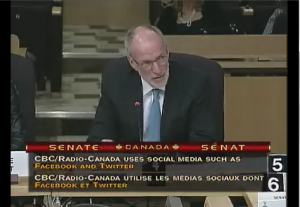
 Last night, I listened to a live stream of the Canadian senate hearings regarding last year’s Radio Canada International cuts to shortwave radio. CBC president Hubert LaCroix and RCI director Michelle Parent met remarkably little criticism or resistance in the hearing, and it appears the report to the senate will be nothing short of cheerleading for the CBC. Indeed, the hearing’s tone overall was one of self-congratulation.
The decision to cut RCI in this manner is a prime example of a few officials with all-too-limited knowledge making decisions in the absence of experts’ input. The business decision seemed to them essentially sound, and yet the impact of the decision has far-reaching negative consequences–for Canadians and as well as the rest of the world–that these officials may never fully comprehend.
Notes from the hearing:
- All but one senator patted CBC and RCI management on the back for becoming more innovative in the wake of devastating budget cuts; only one suggested that such innovation could have been achieved prior to them
- No one asked if the CBC explored the possibility of scaling back shortwave services without closing the Sackville, NB transmitter site and eliminating shortwave broadcasts altogether, which would have been a much better use of funds as well as maintaining foreign relations and domestic security
- Hubert LaCroix basically suggested that people living in oppressed regions could gain access to RCI via mobile platforms (sadly, this is not the case)
- When asked how cuts to shortwave have effected their listenership and demographic, LaCroix basically shrugged his shoulders and pointed out how difficult it is to judge how many people listen on shortwave. (My response: What areas of our world lack a power grid infrastructure? Fully 1/4 of our planet. These are the underserved who rely heavily on shortwave)
- No one inquired about the impact upon their Chinese audience, as RCI’s website is blocked in China; meanwhile, shortwave continues to be comparatively impermeable to firewalls and is untraceable in restrictive countries
Monsieur LaCroix made it clear that the primary CBC mandate is to be a creative, innovative media force within Canada. For him, and most of CBC management, Radio Canada International must have felt like a leech to their dwindling budget. Were I in his position, with limited information and a mandate to protect his main “client” set (Canadians living in Canada)–I might have made the same decision. And yet…it was the wrong one.
What would have solved the problem in the first place? Radio Canada International should have been its own entity, with its own budget to manage, however modest–and if anything, funded through the foreign office rather than the domestic public news/entertainment body. After all, what RCI accomplished on shortwave was far more humanitarian and diplomatic in nature.
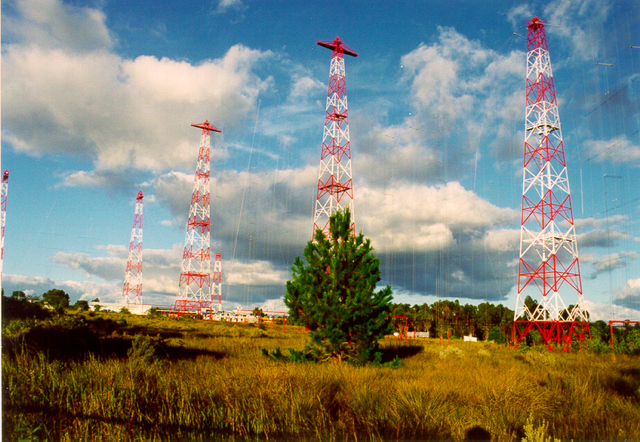
I’ve written at length about the RCI cuts and will not go into them further on this post. But I do believe RCI Sackville could have been a more efficient and productive operation if it employed some sensible changes. Sackville had just finished installing a (paid-for) technology infrastructure to remotely operate the entire transmitter site. Moreover, Sackville management told me they had planned to cut their staff to a skeleton crew (of three people, if memory serves), only to be there if something mechanical on site needed service. These new adjustments were not even tried.
Additionally, using a market model, RCI/Sackville could have offered their relay services to more broadcasters at competitive (even market) rates. Their hourly rate to broadcast on shortwave was simply too high, thus potential customers sought more efficient cost-effective transmission sites. Sackville was never given the tools to become a self-funding operation like so many private broadcasters have become.
Sackville’s infrastructure was an incomparably valuable resource in which many millions in taxpayer money was already invested and paid in full; sadly, these cuts have destroyed this investment. The Sackville site, moreover, had the potential of a sleeping army, both in foreign affairs…and in Canadian security. But it’s gone. Simply because a few politicians doing their near-best didn’t have all the relevant information.
 For what it’s worth
RCI still has some great talent on board. Canadian expats living abroad, and those who are connected to the web, can still enjoy RCI via the website or on mobile platforms. That is an audience that may actually expand through a social media presence–something they could have done more effectively prior to the budget cuts last year.
I was also encouraged to hear that there is a serious effort to distribute RCI’s online audio content–free of charge–to broadcasters in local radio stations around the world. This is very positive: FM, though not as accessible as shortwave in Africa, has a strong community following and stations are appearing everywhere. I hope RCI has a dedicated employee whose sole focus is to identify and build connections with these local outlets for their content.
Barring a takeover or drastic re-organization, it sounds like Radio Canada International over shortwave is now destined for the history books. To honor this history, I sincerely hope the new RCI innovates and penetrates new markets. And I hope RCI employees, many of whom have long memories, find challenge and renewed confidence going forward. We certainly appreciate all of the years during which they graced the shortwaves, and wish them all the best.

 The clandestine station Radio Free Sarawak—who we most recently mentioned in connection with the Malaysian elections–has announced that they are going off the air. There is a note of finality in their announcement (below), yet they do leave some ambiguity by declaring, “We will be taking a break until further notice.”
 From May 19th until June 9th, 2013, PCJ Radio International will be conducting a number test transmissions from Trincomalee, Sri Lanka. Here are the details: