Category Archives: International Broadcasting

Thailand Coup: BBC World Service increases shortwave broadcasts

Original Image by Zuanzuanfuwa via WikiMedia Commons

Many thanks to SWLing Post reader, Richard Cuff, for forwarding this press release from the BBC World Service Group Communications:


 BBC World Service increases broadcasts to Thailand

BBC-WorldService

26 May 2014. As authorities in Thailand take key national and international channels off air in the country, BBC World Service has increased its shortwave English-language radio broadcasts to Thailand, to continue the delivery of its independent news and analysis to audiences there.

From 01:00 GMT on Monday 26 May, BBC World Service expanded its availability via shortwave to Thailand by adding [ten] hours of broadcasts to its daily shortwave schedule (all times GMT):

  • 01:00-03:00 on 11,600 kHz
  • 03:00-05:00 on 7,370 kHz
  • 05:00-11:00 on 11,700 kHz

Acting Director, BBC World Service Group, Liliane Landor says: “In times of national crisis, there is an acute need for accurate, trusted and impartial news. This is why, with our international TV news channel off the air in Thailand, we have increased BBC World Service radio broadcasts in the country.”

The above transmissions add to BBC World Service’s six hours of shortwave broadcasts at peak times for Thailand.

Ends//


For more information about the military coup in Thailand, and how it affects international broadcasting, please follow our tag: Thailand Coup

[Update 27 May 2014: Number of broadcast hours corrected. HT to Dan Ferguson and Richard Cuff]

Budget cuts threaten Radio Australia: how you can help

FriendsOfABCThe Friends of the ABC have asked for your help to support Radio Australia.

In short: the ABC (Australian Broadcasting Corporation) is trying to cope with a 60% cut in funding resulting from the loss of the Australian Network contract. There are fears that Radio Australia could be cut significantly as a result; after all, the number of Australians listening to Radio Australia domestically (either online or via shortwave) is very low.

Those of you who followed the Canadian Broadcasting Corporation‘s cuts in 2012 will remember that Radio Canada International was consequently dealt an unfair and crippling budget cut. I believe the Friends of the ABC’s fears are not unfounded.

Below, you’ll find the message from Friends of the ABC with contacts to send your letters of support:

ABC-Radio-AustraliaPlease take a few moments to write to the Managing Director of the ABC in support of the staff of Radio Australia, who are facing a 60% cut in funding, not by the government directly, but by ABC management!

-Mal Hewitt – President, Friends of the ABC NSW

Message from Jemima Garrett, Pacific Economic and Business reporter, ABC Radio Australia:

“As a long term member of ABC staff I am writing to you now because of a new and urgent threat to Radio Australia. As I am sure you know Radio Australia is a vital service in the Pacific Islands reporting on and covering issues that no other media outlet covers. It has huge audience ratings but is often forgotten in Australia because it is not heard here. The cuts to Australia Network are now set to affect Radio Australia as well. In tough time[s,] radio is an inexpensive and effective way of maintaining our expertise so that we are ready to rise like a phoenix when the political environment improves. It is also able to report on more issues, in more depth and more quickly than TV and therefore is an important source for and method of keeping our online offering as rich and varied as possible.”

Please send you views to:

Background:

ABC management is looking at how to cope with the budget cuts resulting from the cancellation of the Australia Network contract. This doesn’t just affect Australia Network but may result in substantial cuts to Radio Australia as the ABC tries to use some of the money it still has for radio to keep some TV programs, contracts in Asia, the mobile and online services connected with Australia Network going too. The scale of the cut is huge – 60 per cent of our budget has been lost ($21 of $35 million a year). This is for broadcasts to a geographic area ranging French Polynesia in the east to India in the west and FSM and China in the north. (Jemima Garrett, Pacific Economic and Business reporter, ABC Radio Australia)

Radio Thailand: no mention of military coup

RadioThailand_LogoThis morning, I was able to catch the first thirteen minutes of Radio Thailand‘s English language service on 9,390 kHz shortwave. I was curious if RT would mention the Thailand military coup or at least broadcast a sanctioned message from the military authorities. Yet I heard no mention of the coup whatsoever. And why not? Yesterday, General Prayuth Chan-ocha ordered all domestic TV and radio outlets to halt normal broadcasting and only include content the military provides. 

I was only able to record the first 13 minutes of the RT evening news as we had a powerful thunderstorm that forced me to unplug my external antenna. You’ll note the static crashes in the recording.  

The format sounds like a typical RT broadcast, save the lack of national news; instead, the hosts jump straight into global news, mentioning Nigeria, the Philippians, and the economy. Here’s the recording:

As a contrast, here is a recording SRAA contributor, Frank, made of Radio Thailand on May 14th, prior to the coup:

It will be interesting to hear how the nature and content of RT’s news changes with time while the country is under martial law.

BBC: Thailand TV and radio remains blacked out under military control

1000px-Thailand_(orthographic_projection).svg-001Many thanks to Andy who shares this article from BBC News. Here’s a clip:

“The day after the military takeover in Thailand, television and radio remains blacked out and under military control.

Instead, viewers and listeners are being fed a diet of traditional music interspersed with orders and announcements from the country’s new military rulers.

Each of the announcements – around 20 so far on the first day of military rule – is read out several times over both television and radio.

Other forms of communication, such as print media, the internet, landline and mobile phones have not been affected so far, although all media have been requested to refrain from criticism of the military authorities. [Continue reading…]

Reports from shortwave radio listeners are similar: many heard announcements in Thai along with patriotic music on Radio Thailand. I attempted to listen the the RT broadcast targeting eastern North America at 00:00 UTC on 15,590 kHz, but the signal was simply too weak. I could only hear a faint woman’s voice in the static.

If you are able to hear Radio Thailand where you live, consider recording a broadcast for the Shortwave Radio Audio Archive Click here to view for a comprehensive Radio Thailand schedule.

Thailand military suspends TV and radio programming

Original Image by Zuanzuanfuwa via WikiMedia Commons

Thailand’s army chief, General Prayuth Chan-ocha, declared a coup today (Thursday, May 22), and detained key party leaders while suspending the constitution in “a bid to restore order” after nearly six months of ant-government protests.

General Prayuth Chan-ocha has also ordered all domestic TV and radio outlets to halt normal broadcasting and only include content the military provides until further notice. Only yesterday, a group of Thai media bodies accused the Peace and Order Maintaining Command (POMC) of violating the constitution when the POMC banned 14 satellite TV outlets. Now that the constitution is suspended, I suppose it is no longer an obstacle.

I’m curious if Radio Thailand will be on the air today–if so, I assume broadcasts will contain military sanctioned content. I would encourage you to tune to Radio Thailand and, if possible, even record a broadcast to archive if they are indeed on the air.

The following is Radio Thailand‘s English broadcast schedule per Shortwave.am:

  • 9390 kHz, 1230-1300 UTC, Target: Oceania
  • 9390 kHz, 1400-1430 UTC, Target: Oceania
  • 9390 kHz, 1900-2000 UTC, Target: Europe
  • 9390 kHz, 2030-2045 UTC, Target: Europe
  • 15590 kHz, 0000-0030 UTC, Target: Eastern North America
  • 15590 kHz, 0030-0100 UTC, Target: Western North America
  • 15590 kHz, 0200-0230 UTC, Target: Eastern North America
  • 17640 kHz, 0530-0600 UTC, Target: Europe

Thailand is no stranger to full-blown military coups; this is their twelfth since 1932. I’ll be following this story closely as events unfold.

Change to VOA’s mission draws “intense debate”

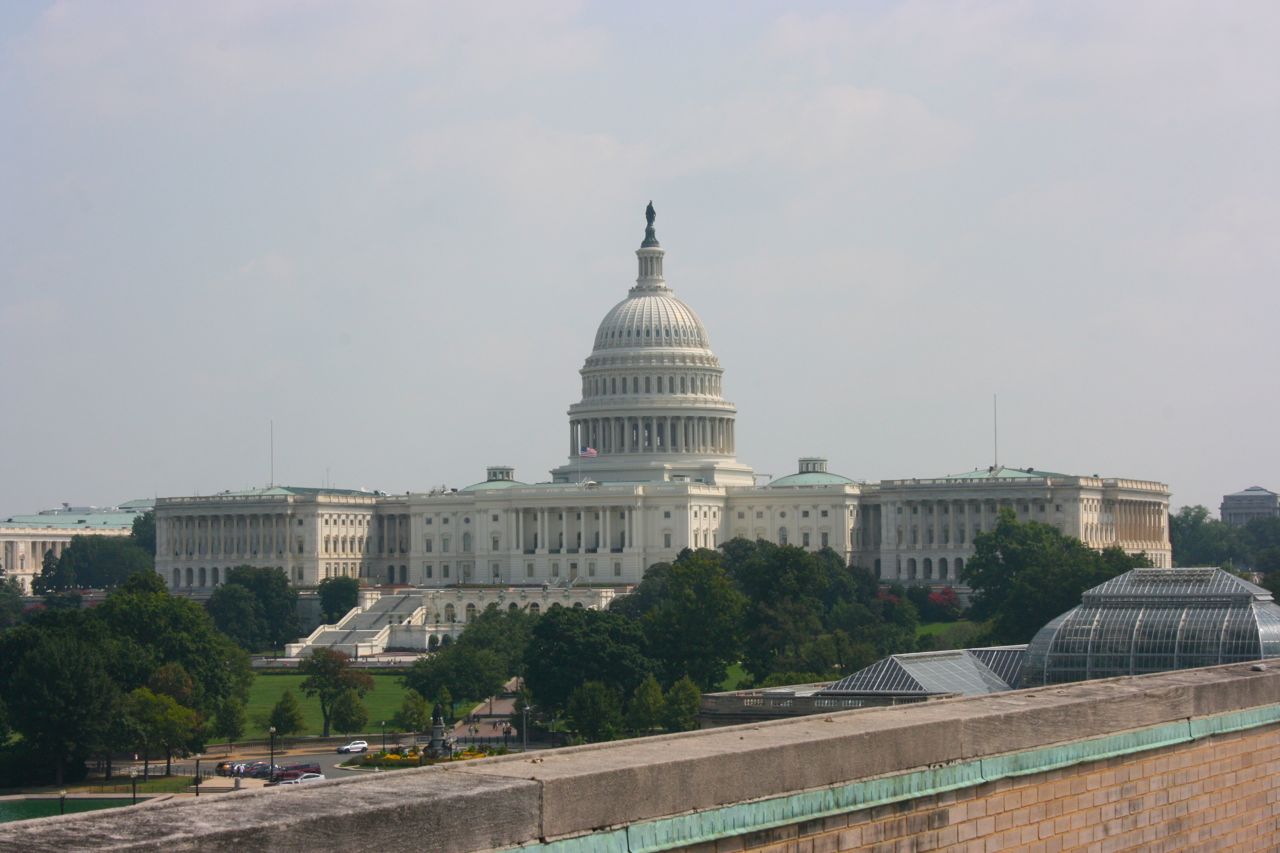
View of the Capitol Building from the roof of the Voice of America on 330 Independence Ave., S.W.

View of the Capitol Building from the roof of the Voice of America (330 Independence Ave., S.W.)

Many thanks to Dan Robinson for pointing out this article by Ron Nixon in the New York Times.  Here’s a clip:

“A bill to overhaul Voice of America has prompted an intense debate among supporters of the legislation who say it will better enable the broadcast news service to counter Russian disinformation and opponents who say it will turn the service into an American propaganda tool.

The legislation, which recently passed the House Foreign Affairs Committee with bipartisan support, would make changes to the mission of the government-financed Voice of America that its sponsors say would more clearly define its role in support of the United States. Specifically, the bill revises the language of Voice of America’s mission to explicitly state that the outlet has a role in supporting American “public diplomacy” and the policies of the government.

The full House is expected to take up the bill as early as this summer. The Senate is working on a similar bill.

Representative Ed Royce, the California Republican who is chairman of the Foreign Affairs Committee, said the legislation was essential in the face of negative and inaccurate information increasingly disseminated about the United States abroad. “While countries like Russia have been working 24/7 on their information campaigns, V.O.A. has abandoned its mission to effectively promote the policies of the U.S. even though its charter is clear in this regard,” Mr. Royce said.

But the bill, the latest in a decades-old debate in foreign policy circles about the role of Voice of America, has prompted a backlash from journalists, many of whom work at the news service once run by Edward R. Murrow and who pride themselves on the organization’s independence.

“The only thing V.O.A. has left is its reputation, built over decades, as a credible news organization,” said one veteran journalist at the service who asked not to be identified criticizing the legislation. “Changing our focus from straight news to policy promotion will undercut any efforts to keep or build our audience.”

[Continue reading at the NY Times website…]

You’ll also want to read the comments in this article.

It is a conundrum: will this legislation save the VOA from budget cuts, or will it rob the broadcaster of credibility and objectivity?

VOA reporters I know have always taken comfort in the firewall that was created by the VOA Charter in 1960, then later signed into law on July 12, 1976, by President Gerald Ford. The charter reads:

The long-range interests of the United States are served by communicating directly with the peoples of the world by radio. To be effective, the Voice of America must win the attention and respect of listeners. These principles will therefore govern Voice of America (VOA) broadcasts:

  1. VOA will serve as a consistently reliable and authoritative source of news. VOA news will be accurate, objective, and comprehensive.

  2. VOA will represent America, not any single segment of American society, and will therefore present a balanced and comprehensive projection of significant American thought and institutions.

  3. VOA will present the policies of the United States clearly and effectively, and will also present responsible discussions and opinion on these policies. (Public Law 94-350)

Many would argue that it’s impossible for a taxpayer-supported broadcaster to “present the policies of the United States” without being somewhat biased. Still, in the past, I’ve heard a number of reports from the VOA that are critical of life here in the US; reports I’ve never heard the likes of from, for example, the Voice of Russia or China Radio International.

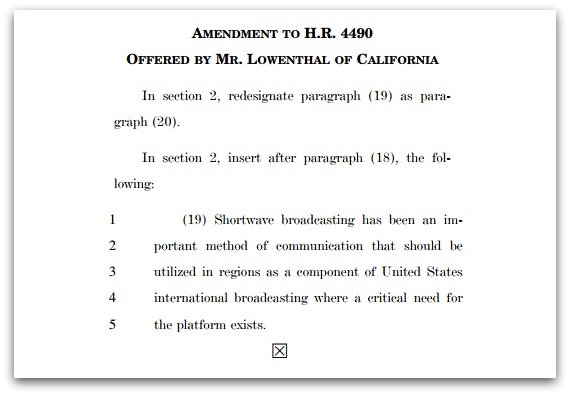
If HR 4490 becomes law, perhaps the proof–VOA’s integrity–will be in the pudding. This is certainly a complex and multi-faceted issue. Regardless: we will be listening.

Numbers Stations in the news

towersThere have been a lot of numbers in the news lately.

Earlier this week, David Goren’s numbers station radio documentary was featured on the ABC Radio National show, Sounds Like Radio.

Click here to listen.

This morning, I also noticed this excellent BBC News Magazine piece on numbers stations, which includes an interview with Akin Fernandez, the creator of the Conet Project.

Here’s an excerpt from The spooky world of the ‘numbers stations’:

“This is the era of hyper-tech espionage, encrypted emails and mindboggling cryptography. But you can hear a very old-fashioned form of espionage on shortwave radio.

It is 13:03 on a Tuesday in a little crammed room of the BBC Monitoring building in Caversham and what is suddenly heard on a shortwave receiving station is a 10-minute message in Morse code.

There is a small community of aficionados who believe messages like this are a throwback to the era of Cold War espionage. They are the mysterious “numbers stations”.

At the apex of the Cold War, radio lovers across the globe started to notice bizarre broadcasts on the airwaves. Starting with a weird melody or the sound of several beeps, these transmissions might be followed by the unnerving sound of a strange woman’s voice counting in German or the creepy voice of a child reciting letters in English.

[…]Times have changed and technology has evolved, but there’s evidence that this old-fashioned seeming method of communication might still be used. Shortwave numbers stations might seem low-tech but they probably remain the best option for transmitting information to agents in the field, some espionage experts suggest.

“Nobody has found a more convenient and expedient way of communicating with an agent,” says Rupert Allason, an author specialising in espionage issues and writing under the pen name Nigel West.

“Their sole purpose is for intelligence agencies to communicate with their agents in denied areas – a territory where it is difficult to use a consensual form of communications,” Allason says.

A former GCHQ officer, who does not wish to be named, whose duty was to intercept signals towards the UK and search for these numbers stations in the 1980s is also adamant that these were broadcasts to agents in the field or in residencies or directed to embassies.

It was “one-way traffic” – the transmitters broadcast numbers to the recipient. The recipient did not reply.”

[…]”This system is completely secure because the messages can’t be tracked, the recipient could be anywhere,” says Akin Fernandez, the creator of the Conet Project – a comprehensive archive of the phenomenon of numbers stations. “It is easy. You just send the spies to a country and get them to buy a radio. They know where to tune and when,” he says.

Continue reading on the BBC Magazine website…

If you would like to know more about numbers stations, click here to read other numbers posts.

Click here to go to David’s website, Shortwaveology.net.