Category Archives: New Products

Hamvention Highlights: The Ten-Tec Model 588+ OMNI VII+

Each year at the Dayton Hamvention I enjoy checking out the latest radio products and services. This year (2019) I found an exceptional number of innovations and will share these in Hamvention Highlights posts. If you would like to check out 2019 Hamvention Highlights as I publish them, bookmark this tag: 2019 Hamvention Highlights

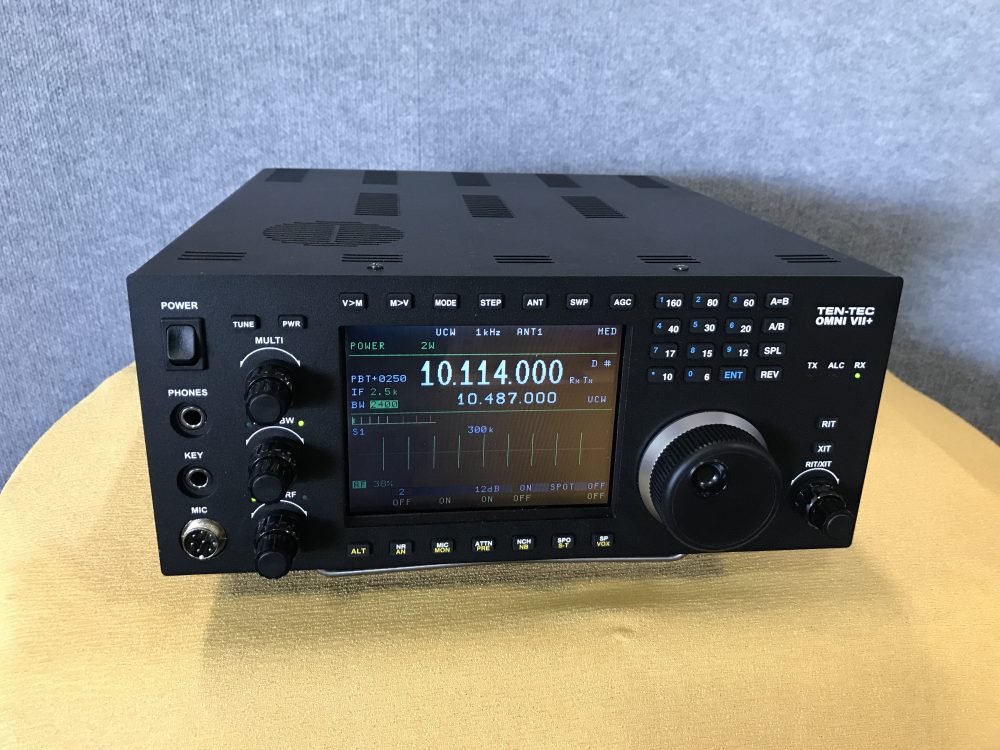
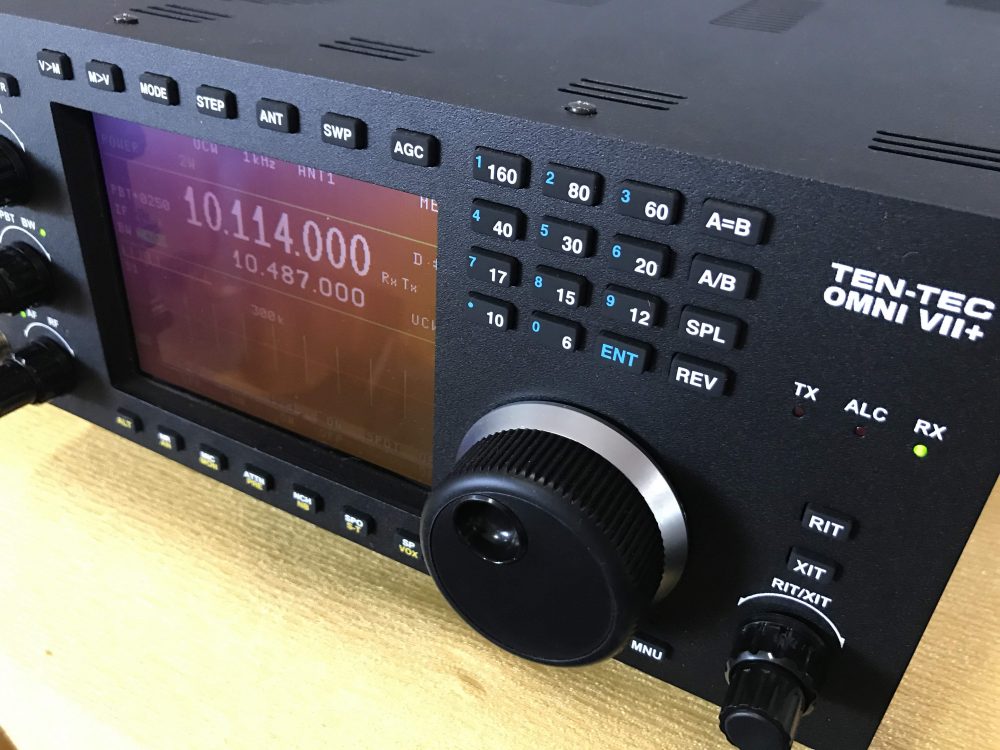
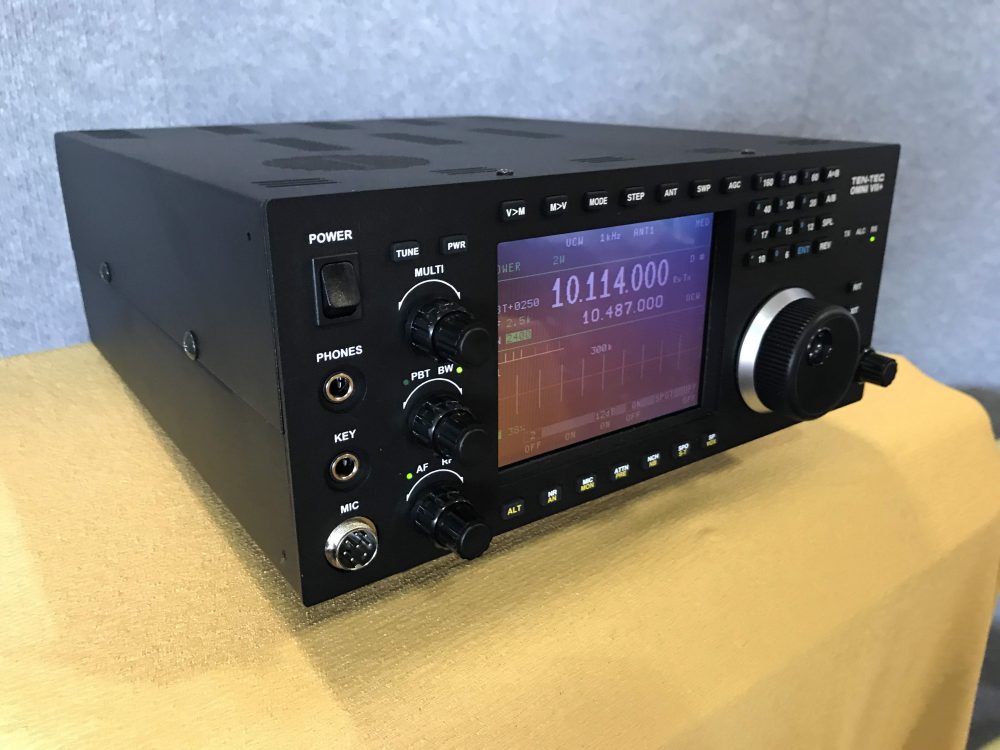
The Ten-Tec OMNI VII+

The Ten-Tec OMNI VII+

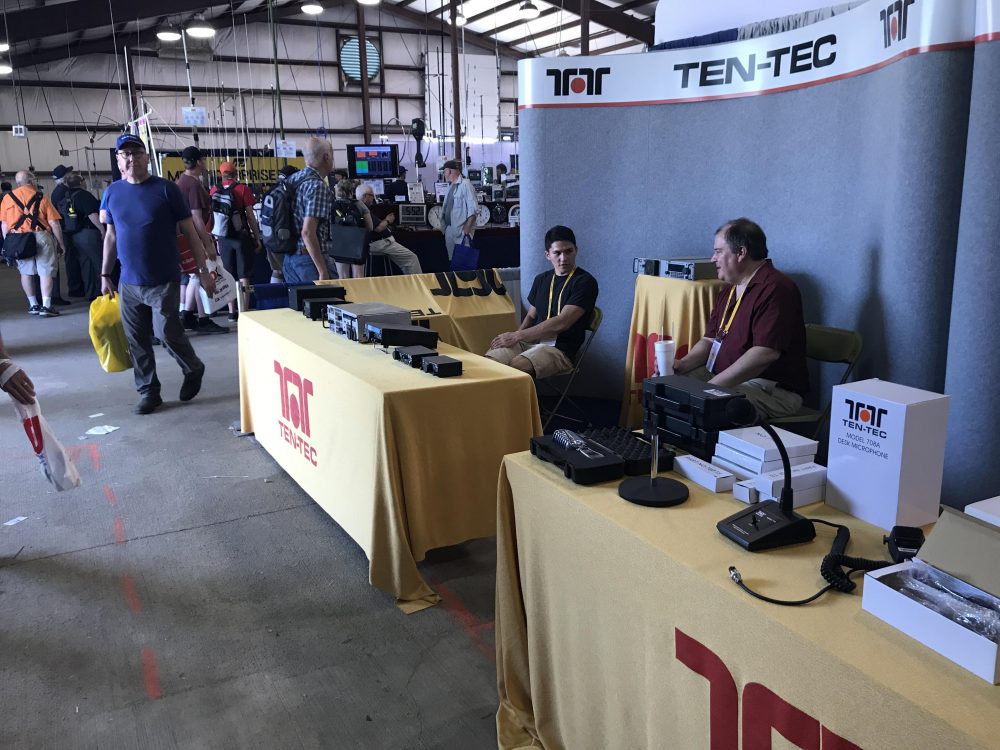
The Ten-Tec booth had more activity this year than I’ve seen in many years. The company is certainly showing signs of entering proper production again and innovating.

According to the T-T representative I spoke with at Hamvention, the company’s focus is on improving/upgrading many of their legacy products like the Eagle, Argonaut, 100 Watt Amplifier,  and the OMNI VII. Iterative improvements will eventually be made to the full product line. Upgraded gear will have an added “plus” to the model name.

Ten-Tec’s featured model at Hamvention was the OMNI VII+—their flagship transceiver.

According to the Ten-Tec website, pricing starts at $2,699 US ($3,078 US configured with an internal ATU) and there are a number of units in stock, ready to ship.

The new OMNI VII+ Features (via the Ten-Tec website):

  • NEW! the 588+ has an All aluminum front face, side feet and side carry handle.
  • NEW! dedicated rear panel pan adapter output jack
  • HF 6 Transmit coverage on 6 through 160 meters, 100 watts output, even on 6. General coverage receives from 500 kHz to 30 MHz continuous plus 48 to 54 MHz. SSB, CW, AM, FM, Digital modes. Dual VFOs with SPLIT and REVERSE functions.
  • Full function Color Screen STN transmissive color LCD display with CFL backlight, 320 240 pixels.
  • Legendary QSK CW includes adjustable rise and decay times. User adjustable at the touch of a knob for hard or soft keying according to your taste. Built-in keyer can be used in Curtis A or B modes, adjustable 5 63 WPM.
  • 17 selectable transmit bandwidths from 1000 4000 Hz. DSP generated to give your SSB audio a well-rounded sound tailored to your voice characteristics. A low-frequency roll off provides further control.
  • RX EQ and TX EQ in 6 dB octave filters selectable in 1 dB steps from high pitched at minus 20 dB to essentially flat response at 0 dB to bassy at plus 20 dB.
  • DSP Noise Reduction, automatic notch, and manual notch reduces interference from undesired carriers and random noise. Manual notch range 20 4000 Hz center, 10 300 Hz width, gt 50 dB rejection.
  • Band Sweep gives you a snapshot of the entire band in seconds. Find the pileups or scout for a clear spot automatically without touching the tuning knob.
  • Broad range Auto Tuner identical tuner as used in the ORION II, matches most antennas up to 10 1 SWR HF only. 100 Tune Memories. Order your OMNI VII with or without this option.
  • Three antenna connectors Two SO 239 transceiver outputs, plus a third SO 239 connector for auxiliary receive only antenna. Antenna switching is front panel selectable.
  • Updates by Flash ROM Serial port interface for local rig control via PC and for Flash ROM updates available via the Internet. Commands are a superset of those used for the Jupiter. To obtain the very latest version of the OMNI VII, visit our firmware download the software below. Connect the radio to a serial port on your PC and you are up to date in a flash. Easy!
  • Quad band-stacking registers and 100 memories
  • Optional Model 302R remote encoder keypad works with the OMNI VII. Plug it in and control selected features sitting back in your easy chair.
  • Aluminum chassis construction and steel outer case makes the rig an easy traveler at only 5 inches H x 12 inches W x 14.75 inches D. Weighs just 14 pounds
  • 8 pin mic connector
  • 70 MHz IF up conversion
  • 455 kHz 2nd IF with Collins Mechanical filters

One of the unique features of the OMNI VII+ is that it sports Collins mechanical filters—likely the only modern transceiver that can make this claim.

I’m happy to see that Ten-Tec is innovating and manufacturing again. Certainly a highlight from the 2019 Hamvention!

If you would like to follow other Hamvention Highlights, bookmark the tag: 2019 Hamvention Highlights

Click here to check out the Ten-Tec website.


Do you enjoy the SWLing Post?

Please consider supporting us via Patreon or our Coffee Fund!

Your support makes articles like this one possible. Thank you!

 

Hamvention Highlights: The Palstar TR-30A EMP, an EMP-hardened HF transceiver

Each year at the Dayton Hamvention I enjoy checking out the latest radio products and services. This year (2019) I found an exceptional number of innovations and will share these in Hamvention Highlights posts. If you would like to check out 2019 Hamvention Highlights as I publish them, bookmark this tag: 2019 Hamvention Highlights

And now for our first highlight…

The Palstar TR-30A EMP

I’ve long been a fan of Palstar, a US company known for their fine antenna tuners and the classic R30 series HF receiver.

At the 2013 Dayton Hamvention, Palstar showcased a prototype HF transceiver called the TR-30. I posted a note about this at the time on my ham radio blog, QRPer.com. The TR-30 never seemed to make it to the market, but that’s not surprising considering the Elecraft KX3 and a number of other QRP transceivers were released the following year.

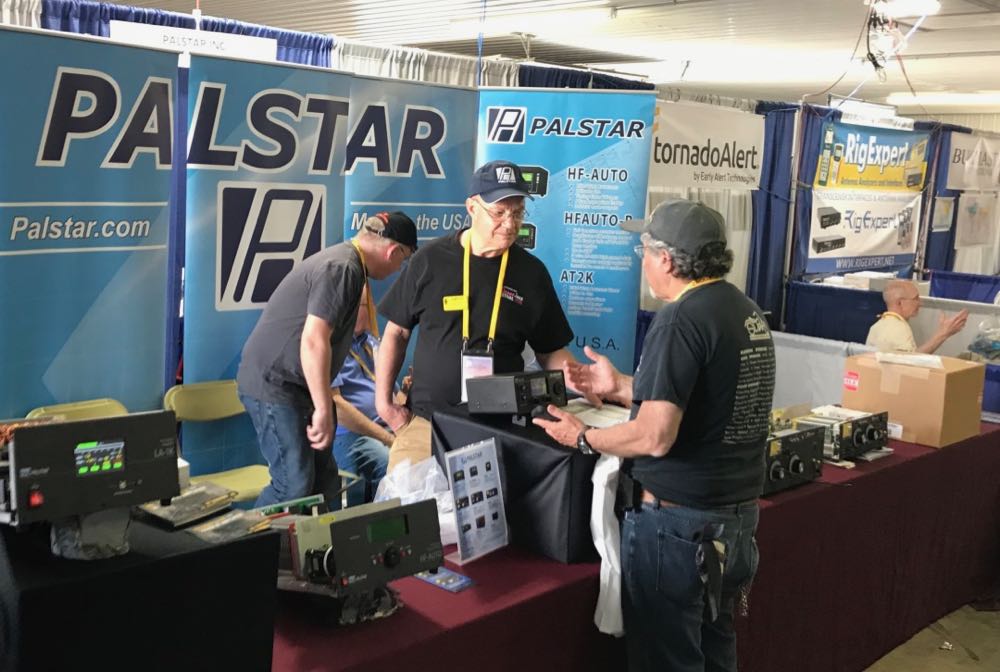
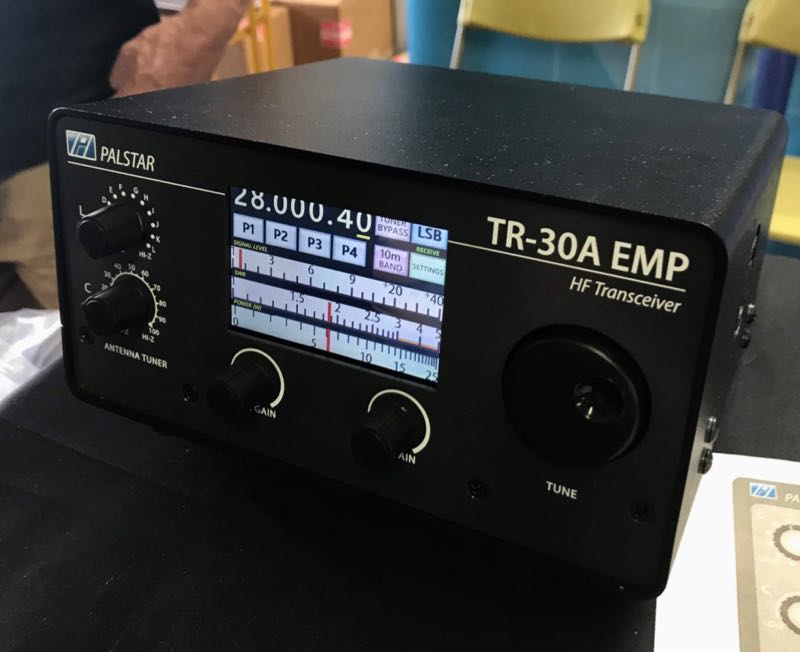
This year when I approached the Palstar booth, I found a new prototype transceiver: the Palstar TR-30A EMP.

This TR-30 iteration will, without a doubt, have a unique place in the radio market since it has been designed to withstand electromagnetic pulses (EMPs). To be clear, I know of no other transceivers on the ham radio market that are EMP hardened.

Post readers might recall a primer we published about how to protect your gear from EMP pulses (click here to read).  I believe taking some simple precautions to protect gear from natural or man-made EMPs is simply a sound practice. In fact, I keep one complete rig stored in an EMP-proof container as described in our primer.

The Palstar TR-30A EMP requires no external EMP shielding or special handling/storage. It will be natively EMP-proof, even while hooked up to an antenna and without an RF ground attached.

I spoke with Paul Hrivnak (N8PH), President and CEO of Palstar, at Hamvention and he shared a few details about the Palstar TR-30A EMP:

  • The transceiver will be general coverage and will be able to operate on all of the HF ham radio bands.
  • It will have a very simple set of functions–at this point, he doesn’t even plan to have dual VFOs.
  • The output power will be 20 watts.
  • The front panel controls will be very simple and intuitive.

The TR-30A EMP’s unique internal antenna tuner will–if I understand it correctly–be able to match pretty much any load.  It will have manual controls, but will be digitally controlled. Paul said that the ATU is being designed so that a satisfactory match can be found for any make-shift field antenna. I can’t wait to check it out for myself because I hold Palstar in high regard when it comes to antenna tuners.

Of course, from the ground up, the TR-30A EMP will be hardened against EMPs.

He hopes the Palstar TR-30A EMP will be in production by the end of 2019 and retail for $1,100 – 1,200 US.

Of course, I will post any news and updates about the Palstar TR-30A EMP here on the SWLing Post. I will also plan to review and evaluate the transceiver when it hits the market.

If you would like to follow product updates, please bookmark the tag: Palstar TR-30A EMP

If you would like to follow other Hamvention Highlights, bookmark the tag: 2019 Hamvention Highlights

Click here to check out Palstar’s website.


Do you enjoy the SWLing Post?

Please consider supporting us via Patreon or our Coffee Fund!

Your support makes articles like this one possible. Thank you!

The Airspy HF+ Discovery: A new high-performance SDR

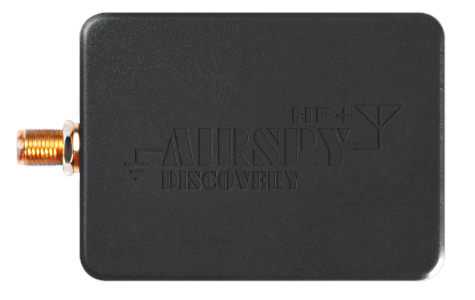
At the 2019 Hamvention, I stopped by the Airspy.US booth and checked out the specifications of Airspy’s latest SDR: the Airspy HF+ Discovery.

At first glance, the Discovery looks a lot like the Airspy HF+ but even smaller and sporting performance upgrades. Keep in mind, I consider the Airspy HF+ (the Discovery’s predecessor) to be one of the best HF SDR receivers on the market–certainly the best sub $200 HF SDR–so of course the Discovery has piqued my interest.

I wanted to get the scoop directly from the source, so I contacted Youssef Touil with Airspy and asked for more insight. What follows is Youssef’s reply:

This new release of the HF+ aims to improve the overall performance in highly demanding situations while fully automating the gain and filtering control. This frees the operator from the RF front-end details and keeps the focus on the actual signals.

The new filters are implemented using a combination of static LC filter banks and other RC filters implemented in silicon. This considerably improves the overall behavior in a crowded band, while still giving a very low noise floor. Also, the very nature of the Polyphase Harmonic Rejection mixer combined with the integrated IF filtering and the high dynamic range Sigma-Delta ADC act like a roofing filter in a heterodyne system. This architecture is quite original with still very few commercial implementations attempted.

A lot of attention went to improve the far-range IIP2 and IIP3 in practical receive scenarios. Other radios just opt to increase the noise figure of the radio to hide the IMD problem, but this also reduces the sensitivity. We opted not to go this way and fix the problem at its root and preserve the maximum sensitivity benefit. The new intercept points protect the front-end from images originating from various IMD scenarios while still using the maximum gain. The LF and VLF bands also benefited from these improvements.

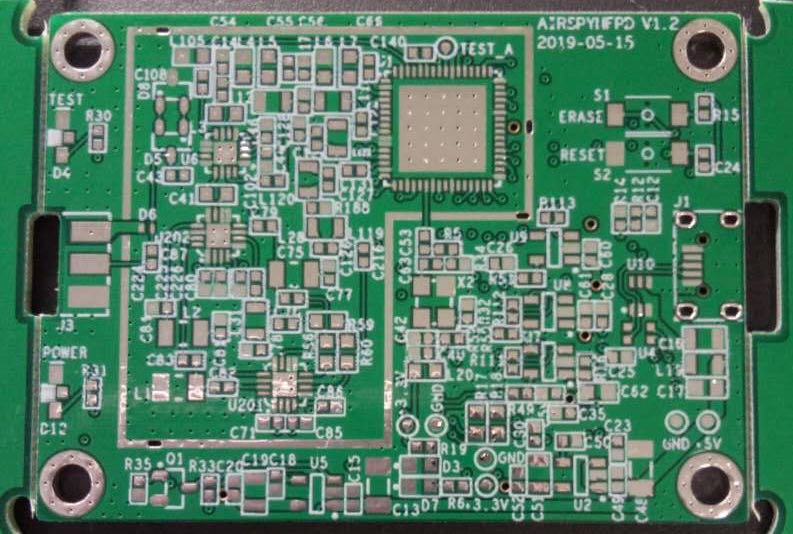
The PCB layout was also improved to get rid of most of the digital noise. The new PCB has 6 layers filled with ground plans and a metal shield can soldered on top of the RF section. This might look overkill for a HF/VHF radio, but given the MDS we are aiming at, it’s really necessary. The older PCB was 4 layers only.

The radio weighs less than 30 grams and fits inside a 45 x 60 x 10 mm volume (ex. The SMA connector). Given the achieved performance and the form factor, we expect it to interest a lot of our SIGINT partners who are already using the first HF+ design.

As you know, when it comes to high performance, the big players still opt for heterodyne systems in the actual RX path and only use direct sampling for the “eye candy” panoramic view. This was confirmed by Yaesu (FTDX101D) and Elecraft (K4). The reason is evident: Good mixers are still better (and scale better) than state of the art ADCs. I think our Polyphase Harmonic Rejection mixer-based SDR architecture is a step in the right direction, where both goals are achieved without compromises, and in the most economical way. The first version was kind of a revolution for us, but the “Discovery” is the consolidation of a lot of polishing opportunities we discovered since the first release.

Thank you for the details, Youssef–it sounds like a lot of innovation and iterative upgrades have gone into the Discovery receiver design.

Of course, I will plan to grab the HF+ Discovery and review it here on the SWLing Post. In the meantime, check out the excellent RTL-SDR website where Carl has posted a short preliminary review of a pre-production HF+ Discovery.

Click here to check out the HF+ Discovery at Airspy and place a pre-order ($169 US). 

Taking the new Mission RGO One transceiver to the field!

SWLing Post readers might recall that last year at the 2018 Hamvention, I met with radio engineer, Boris Sapundzhiev (LZ2JR), who was debuting the prototype of his 50 watt transceiver kit: the Mission RGO One (click here to read that post).

Since last year, I’ve been in touch with Boris, and we arranged to meet again at the 2019 Hamvention so I could take a closer look at the RGO One, especially since he has started shipping the first limited production run.

The RGO One delivers everything Boris promised last year and Boris is on schedule, having finished all of the hardware design and having implemented frequent firmware updates to add functionality.

Excellent first impressions

I’ll be honest: I think the RGO One was one of the most exciting little radios to come out of Hamvention this year. Why?

First of all, in contrast to some radios I’ve tested and evaluated over the past two years, I can tell immediately that the Mission RGO One was developed by an active ham radio operator and DXer.

Here are some of the RGO One features and highlights as taken from the preliminary product manual (PDF):

    • QRP/QRO output 5 – 50W [can actually be lowered to 0 watts out in 1 watt increments]
    • All mode shortwave operation – coverage of all HAM HF bands (160m/60m optional)
    • High dynamic range receiver design including high IP3 monolithic linear amplifiers in the front end and diode ring RX mixer or H-mode first mixer (option).
    • Low phase noise first LO – SI570 XO/VCXO chip.
    • Full/semi (delay) QSK on CW; PTT/VOX operation on SSB. Strict RX/TX sequencing scheme. No click sounds at all!
    • Down conversion superhet topology with popular 9MHz IF
    • Custom made crystal filters for SSB and CW and variable crystal 4 pole filter – Johnson type 200…2000Hz
    • Fast acting AGC (fast and slow) with 134kHz dedicated IF
    • Compact and lightweight body [only 5 lbs!]
    • Custom made multicolor backlit FSTN LCD
    • Custom molded front panel with ergonomic controls.
    • Silent operation with no clicking relays inside – solid state GaAs PHEMT SPDT switches on RX (BPF and TX to RX switching) and ultrafast rectifying diodes (LPF)
    • Modular construction – Main board serves as a “chassis” also fits all the external connectors, daughter boards, inter-connections and acts as a cable harness.
    • Optional modules – Noise Blanker (NB), Audio Filter (AF), ATU, XVRTER, PC control via CAT protocol; USB UART – FTDI chipset
    • Double CPU circuitry control for front panel and main board – both field programmable via USB interface.
    • Memory morse code keyer (Curtis A, CMOS B); 4 Memory locations 128 bytes each

What really sets the Mission RGO apart from its competitors is the fact that it’s compact, lightweight (only 5 lbs!), and has a power output of up to 50 watts. Most other rigs in this class have a maximum output of 10 to 15 watts and require an external amplifier for anything higher.

The RGO One should also play for a long time on battery power as the receive current drain is a modest 0.65A with receiver preamp on.

The RGO is also designed to encourage a comfortable operating position. The bail lifts the front of the radio so that the faceplate and backlit screen are easily viewed at any angle.

The keypad is intuitive and–hold your applause!–all of the important functions are within one button or knob press!

The front panel design is simple and clean. There are no embedded menus to navigate to change filter width, power level, RF gain, keyer speed, mic gain, pre amp, or audio monitor level. Knob spacing is excellent and I believe I would even be able to operate the RGO while wearing gloves.

Even split-operation is designed so that, with one button press, you can easily monitor a pile-up and position your transmit frequency where the DX station last worked a station. (This is similar to the Icom XFC button). The user-interface is intuitive; it’s obvious to me that Boris built this radio around working DX at home and in the field.

Speaking of the field…

Parks On The Air (POTA) with the Mission RGO One

At my request, Boris has kindly loaned me one of the first production run units to test and review over the next few months. I intend to evaluate this radio at home, in the field, and (especially) on Field Day. By July, I should have a very good idea of how well this Bulgaria-born transceiver performs under demanding radio conditions!

I had planned to begin my RGO One evaluation after returning home from Hamvention, but I couldn’t resist taking it to the field, even though the propagation forecast was dismal.

The first leg of my journey home from Hamvention took me to Columbus, Ohio, on Monday, so I scheduled a Parks On The Air (POTA) activation of Delaware State Park, K-1946.

Delaware State Park (POTA K-1946) in Delaware, Ohio.

My buddy Miles (KD8KNC) and I met our mutual friend Mike (K8RAT) at the park entrance and quickly found a great site with tall trees, a little shade, and a large picnic table.

We set up the RGO One and, for comparison, my Elecraft KX2 for the POTA activation.

I won’t lie: band conditions were horrible. Propagation was incredibly weak, QRN was high, and QSB was deep. Yuck!

Still, this activation gave me a chance to test the RGO One in proper field conditions.

I was limited to SSB since the only CW key I had with me, the paddle specifically designed to attach to the front panel of the Elecraft KX2, wouldn’t work with the RGO One. In addition, I was limited to 25 watts output because the antenna I deployed, the LnR Precision EFT Trail-Friendly end-fed antenna, can only handle power up to 25 watts.

Although I had never operated the radio before, I was able to sort out most of its functions and features quickly.

The receiver audio was excellent and the noise floor seemed quite low to my ears. The internal speaker does a fine job producing audio levels that are more than ample for a field setting.  Still, I prefer operating with a set of earphones in the field–especially important on days like this when propagation equates to a lot of weak signals.

Although I failed to make a total of ten contacts to claim a proper POTA activation, I was pleased with offering up K-1946 to seven lucky POTA hunters/chasers. I simply didn’t have enough time available to work three stations more at such a slow QSO rate.

Of course, my signal reports were averaging “5 by 5” and were never more than “5 by 7” regardless of which rig–the RGO One or the KX2–I was using. The reports on the RGO One transmit audio reports were great.

Stay tuned!

I will publish my first review of the Mission RGO One in The Spectrum Monitor Magazine, most likely in August or September.  In the meantime, I will post updates here as I put the RGO One through its paces. I’m especially excited about using it during Field Day with my buddy Vlado (N3CZ) to see how it holds up in such an RF-dense environment.

And now that the POTA bug has bitten me?  Expect to catch me on the air with the RGO One over the next few weeks!

If you’re interested in following the Mission RGO One, bookmark the tag: RGO ONE.


Do you enjoy the SWLing Post?

Please consider supporting us via Patreon or our Coffee Fund!

Your support makes articles like this one possible. Thank you!
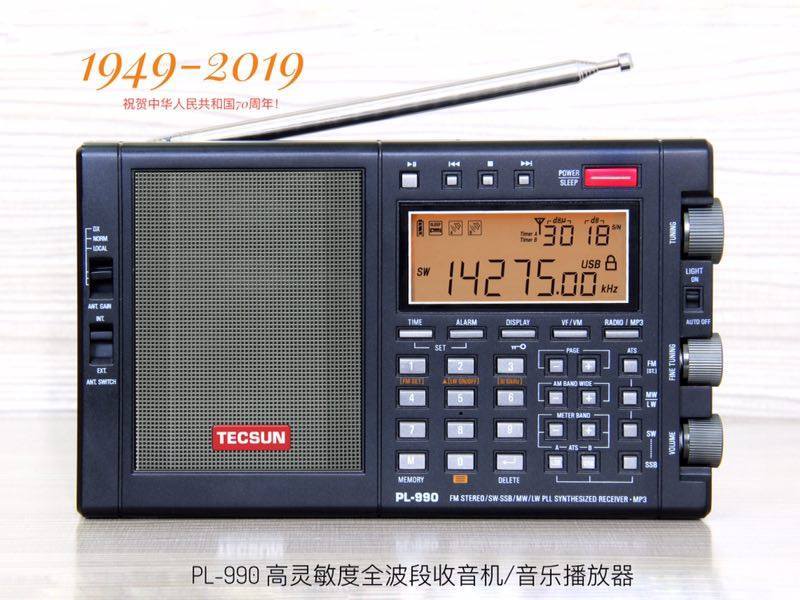
Inntot Technologies focuses on SDR based DRM+ Receivers

(Image Source: @YogendraPal9)

(Source: Inc42)

[…]Inntot Technologies provides software-enabled IP solutions for Digital Radio Mondiale (DRM for AM and FM band, a set of digital audio broadcasting guidelines) enabled receivers, DAB/DAB+ (digital audio broadcasting) enabled receivers and ISDB-T (A technical standard for digital TV broadcast) Digital Television paving way to digital radio transmission.

Though the transmission side in India is almost ready, next-generation digital radio receivers are expensive (can go upto INR 14K), which is posing as a hurdle in the common man from benefiting from the features offered by digital radio.

[…]Inntot Technologies is facilitating software-defined radio (SDR) based DRM+ Receiver solution, wherein the software can be embedded directly to the fixed receivers, automotive/in-car radios, smartphones, as well as USB dongles.

[…]Inntot solution is different from using a separate hardware demodulator which adds to the overall cost of the digital radio receiver.

Inntot’s software solution can also help OEMs, radio receiver manufacturers, and semiconductor chip manufacturers in:

  • Doing away with the recurring cost of the demodulator chip, which, in turn, will reduce the bills of material (BoM) cost — ideal for a high-volume market like India
  • Easy portability on platforms like Android
  • Reusable, fully standard, and specifications-compliant complete stack and no external dependency on any vendor
  • System integration and field testing

[…]Inntot is not the only company looking to offer cost-effective DRM receivers. Launched in 1993, the New Delhi-based OEM manufacturer Communications System Inc., has also put up its digital radio for sale on online websites like Amazon, and IndiaMart.

As of May 2018, the company has put up a notice for being in production for the second batch of digital radio receivers. However, despite tracking for weeks, its status remains ‘currently unavailable’ on Amazon, while we were not able to place an order from Indiamart.[…]

Read this full article at Inc42.


First Look: Elecraft K4 photos and preliminary information

The new Elecraft K4

Today, prior to the open of the 2019 Hamvention, I had an opportunity to hang with the folks at Elecraft and grab some photos of their newest transceiver: the Elecraft K4 direct-sampling SDR (click here to read the announcement).

Elecraft has now published a K4 product page on their website with information about pre-orderswith information about pre-orders. In short, the base model—which includes two full receivers—starts at $3999 US.

Wayne Burdick told me that they expect to start shipping the K4 by the end of 2019.

I snapped a number of photos of the two engineering prototypes of the K4 this morning in Building 1 at the 2019 Hamvention.

Elecraft K4 Photos

Click on the images below to enlarge:


Elecraft introduces the K4 high-performance direct-sampling SDR

Click to enlarge (Source: K4 Product Brochure)

Today we learned about the latest addition to the Elecraft product line, the Elecraft K4.

This fills a niche in the Elecraft product line and is certain to directly compete with the likes of the Icom IC-7610 and a number of Flex Radio transceivers, among others.

Elecraft describes the K4 as having a “modular hybrid architecture”. Below, I’ve pulled the text and images from the Elecraft product brochure.

Wayne Burdick (N6KR) of Elecraft notes that tomorrow (Friday, May 17, 2019) the Elecraft site will (re)launch a K4 product page with pre-order/reservation page.

I plan to learn more about the K4 and report back during Hamvention this week. Stay tuned by bookmarking the tag Elecraft K4:

Elecraft K4 Product Information

(Source: Elecraft K4 Product Information Sheet via Lutz Electronics, Switzerland)

Click to enlarge (Source: K4 Product Brochure)

A direct-sampling SDR you’ll love to use

Our new K4 harnesses the latest in signal processing while retaining the best
aspects of the K3S and P3. The resulting user interface makes the technology
transparent, allowing you to focus on working the world.

160-6 meter, all-mode coverage & dual RX

The K4 includes dual receive over 100 kHz to 54 MHz. Since it utilizes direct
sampling, there’s no need for crystal filters in the K4 or K4D (see Models, back
page). For extreme-signal environments, we offer a dual superhet module
(standard in the K4HD). An internal VHF/UHF module is also planned.

High-resolution mini-pan for each receiver

Our advanced fine-tuning aid, with its resampled bandwidth as narrow as +/- 1
kHz, is displayed separately from the main panadapter. You can turn it on by
tapping either receiver’s S-meter or by tapping on a signal of interest.

Simple operation and setup

The K4 features a large, full-color touch display, combined with a rich set of real
controls. Per-VFO transmit metering makes split mode completely foolproof.
Band-stacking switches and per-receiver controls are both intuitive and versatile,
adapting to operating context. Usage information on these and other features
is just one tap away, thanks to our built-in help system.

Click to enlarge (Source: K4 Product Brochure)

Rich I/O complement

The rear panel includes all the RF, analog and digital I/O you’ll need to complete
your station. All K-line accessories are supported, including amps, ATUs, and our
K-Pod station controller. The HDMI video output supports an external display
with its own user-specified format.

Full remote control from multiple devices

The K4 can be 100% remote controlled, via Ethernet, from a second K4 as well as
a PC, notebook, or tablet. Panadapter data is included on all remote displays.

Modular hybrid architecture

The K4 adapts to your needs, with three models to choose from:

  • Basic K4 with wide-range dual receive
  • K4D with diversity receive
  • K4HD with a dual superhet module for exceptional dynamic range

You can upgrade or add options as desired, or as new technology becomes
available. This extensibility applies to software as well. The K4’s powerful, fast-starting CPU provides unlimited expansion opportunities.

Fast signal processing

The RF signal chain in the K4 incorporates parallel hardware processing of data
streams, including a dedicated DSP subsystem. This, combined with silent,
PIN-diode T/R switching, ensures fast CW break-in. Data and speech-processing
delays are also minimized.
Standard DSP features include easy-to-adjust, per-mode RX/TX EQ; clean,
punchy RF speech processing; full DVR capabilities; and several built-in data
decode/encode modes. Direct-sampling technology results in an ultra-flat
passband response for clean RX and TX audio. Since the signal chain is softwaredefined, the DSP can be field upgraded to add new algorithms and operating
modes.

KAT4 ATU

The KAT4 ATU has a nominally 10:1 matching range. It includes 3 antenna jacks,
any one of which can be selected as an input for one or both receivers.

Internal VHF/UHF module (future option)

An expansion slot is reserved for a high-performance VHF/UHF module, with
output of approximately 15 W. This module will support all modes.

Kit version

A no-soldering kit version of the K4 is planned for later release. Builders will learn
about advanced radio technology as they proceed. All modules are pre-aligned
and tested.

K4 Key Specs and Features

  • Size: 4.5”Hx13.5”W,10”D
  • Weight: Approx.10lbs
  • SupplyVoltage: 12-15VDC
  • Current: ~2ARX,~18-23ATX
  • FrequencyRange: 100kHz-54MHz(VHF/UHFrangetobe determined*)
  • Stablility: +/-0.25ppm(TCXO) Modes: CW, SSB, AM, FM, Data
  • LCD: 7”color;touch&mousecontrol Text modes: CW, PSK31/63, RTTY KAT4ATU:
  • 10:1+range;3ant.jacks RXantennasources: Upto5
  • A-to-D Converter(s): 16 bits
  • I/O: USB-Ax3,USB-B(twovirtualcomports+audio),RS232(DE9), Ethernet, HDMI. front/rear mic, front/rear phones, LINE in/out, speakers,PTTin,KEYout,paddle,key, ACC,12Vout.
  • CWQSK: Silent,PIN-diodeswitched
  • Other: RX/TX EQ, real-time clock,100% remote control including panadapter data, remote antenna switch control*, custom in-box software apps*

Models (K4 & K4D upgradeable by the user at any time)

  • K4: Basic K4 transceiver provides 160-6 m, all-mode coverage; 100 W output; five receive RF sources; and wideband dual watch, allowing the main and sub receivers to be set for the same or different bands.
  • K4D: Adds KDIV4 option, with a second set of band-pass filters and additional direct- sampling ADC module. This allows the two receivers to use different antennas – a requirement for diversity receive. Having two sets of band-pass filters also optimizes signal handling when the receivers are on different bands and/or antennas.
  • K4HD: Includes all of the above, plus our dual superhet module, the KHDR4. Ideal for competitive field day, contesting, and DXpedition stations. Each superhet receive section includes two crystal filters: one SSB/data bandwidth, one CW bandwidth. The superhet’s 8 MHz IF has excellent dynamic range, so additional crystal filters are not required.