 SWLing Post reader, Tom, updates us regarding the price of the Sangean 909X on Amazon–it has dropped again.
The price is now $157.56 if purchased directly from Amazon and $154.40 if purchased by one of their third party vendors:

SWLing Post reader, Tom, updates us regarding the price of the Sangean 909X on Amazon–it has dropped again.
The price is now $157.56 if purchased directly from Amazon and $154.40 if purchased by one of their third party vendors:
It’s time to register! The Winter SWL Fest dates and location have been set for 2014:
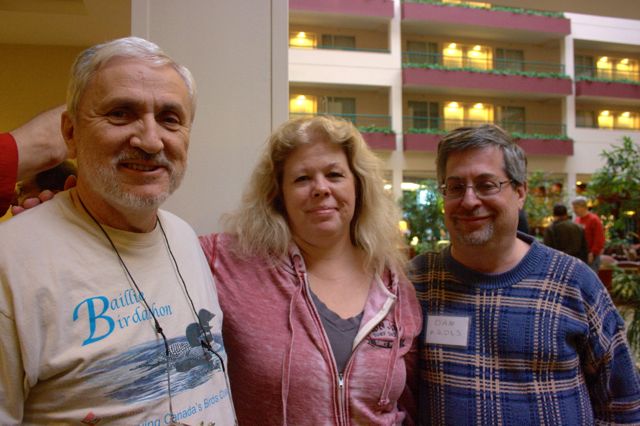
At the 2013 Winter SWL Festival: From Left to right: Sheldon Harvey (of The International Radio Report), Tina Shields and Dan Srebnick
(Source: SWL Fest)
Richard Cuff and John Figliozzi, co-chairs of the Winter SWL Festival, are pleased to announce that arrangements are now set for the 27th (!) Annual Winter SWL Festival, scheduled for March 14th and 15th at the Doubletree Guest Suites Philadelphia West, in Plymouth Meeting, Pennsylvania. Early registration fees will remain as they were in 2013 through the month of January, as an incentive to register early. We strongly urge you to do so as fees will increase for those registering February 1 and later. Single and double rooms are available at a special $99 rate, including breakfast; the event code and online hotel reservation capability will be posted in a few days. The special $99 hotel rate may not be available after February 14th, so it’s best to book early. Links to paper and online registration for the Fest will be posted in a couple days via the Fest website at http://www.swlfest.com/. Those without web access will find a registration form in the January issue of the NASWA Journal; the registration form can also be obtained by sending a self-addressed, stamped envelope to Winter SWL Fest, PO Box 3292, Allentown, PA 18106
If you’ve never been to the SWL fest, check out this post for an overview. You will not find a larger gathering of shortwave radio enthusiasts in North America. I attend every year. Come join us!
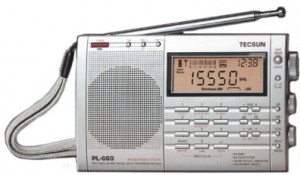 Universal Radio has lowered the price of their Tecsun PL-660 to $109.95. Even with $9.95 shipping, this is still less than the current Amazon price of $129.99.
Note that eBay still has some PL-660s available for $101 shipped, but there would be no guarantee of receiving the radio by Christmas day.
SWLing Post reader, Tom, writes:
Just thought I would tell you that at the moment I am seeing the White Sangean 909X Shortwave radio on sale from Amazon for $163.81 at the moment.
Says on the page it is 64% off which is the cheapest I have seen it so far and it ships from Amazon and not a 3rd party.
Link is http://www.amazon.com/gp/product/B003XU76PQ/ref=oh_details_o01_s00_i00?ie=UTF8&psc=1
Tom
Many thanks, Tom! I believe that is the lowest price for a 909X I’ve ever seen.
Ironically, the price of the Tecsun PL-880 has been climbing on Amazon (currently $179.99) and the PL-660 price is back to $129.99 (up $30 from November pricing).
Note that I could not advise purchasing the PL-880 from Amazon at the moment as it appears that they have a stock of older firmware version radios (see previous post).
Tecsun PL-880 owner, Patrick, has made a video showing how to calibrate SSB on the PL-880. In the video, you can hear what it sounds like to zero-beat an AM carrier. Patrick writes:
Some people reported their PL-880 wasn’t properly calibrated in SSB (off-frequency).
Here is a simple tip to calibrate your TECSUN PL-880 for zero-beat operation (SSB mode) : either tune to USB or LSB, say 500 Hz off-frequency (603.05 USB for example, if you wish to calibrate your radio on 603.00, or 602.95 LSB).
PRESS and HOLD the 0 button of the keypad.
Look at the UPPER RIGHT corner of the display, where stands the clock and S/N ratio. A 2-digits number is BLINKING as well as the Hz digits of the tuned frequency.
RELEASE the 0 button, and properly adjust the FINE TUNING. You will probably have to slightly tune, de-tune and re-tune before calibration is perfect. Play a bit with it to understand how it works … (the change is effective AFTER you press again the 0 number to validate the value).
Do the same for both USB and LSB modes.
Check the tone when tuned to xxx.95 USB and xxx.05 LSB. They should sound exactly the same.
Et voilà !
Merci, Patrick!
You can follow all Tecsun PL-880 updates by bookmarking/checking this link.
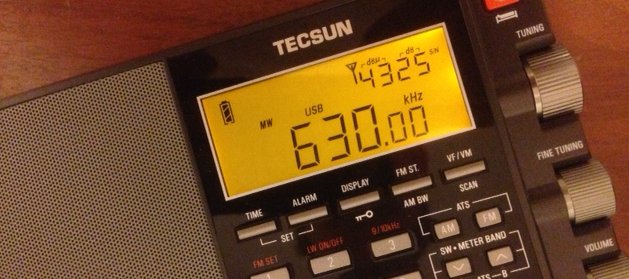 This hidden feature was described by Diemtar on the Tecsun PL-880 Yahoo Group:
I just tried this on my PL-880 (firmware version 8820) and it worked well.
Many thanks, Dietmar!
You can follow all Tecsun PL-880 updates by bookmarking/checking this link.
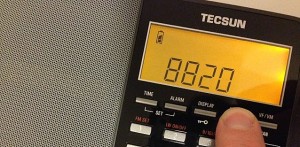
Click here to learn how to display your PL-880’s firmware version.
It seems that there are some important differences emerging between PL-880 firmware versions.
You may have noted that the PL-880 I reviewed yesterday has a firmware version of 8820. I purchased my PL-880 through eBay seller, Anon-Co. As far as I can tell, most, if not all of the units Anon-Co has sold have the same (i.e. latest) firmware version: 8820.
Several readers have contacted me with concern about units they’ve purchased from Kaito Electronics and from their Amazon.com vendor account Electronnix which have firmware version 8819. (Not sure what firmware version you have? Click here to discover.)
It seems that firmware version 8819 lacks a few features that I mentioned in the review I posted yesterday:
It also seems that Kaito’s PL-880s are not shipping with the same carrying case Anon-Co ships.
On a side note, I don’t think Kaito is to blame for this as they probably had no idea there were different versions of the PL-880 firmware. I’m sure they will work with their customers to correct this.
If we found that the PL-880 firmware could be updated by users it would eliminate this problem. So far, I have not heard that this is the case.
Please comment if you notice other differences in firmware versions and I will amend the list above.
You can follow all Tecsun PL-880 updates by bookmarking/checking this link.