Category Archives: News

North Korean numbers station in the press

SWLingPost-Spy-Numbers-Station

I’ve been offline and off-grid this week and have accumulated quite the backlog of email.

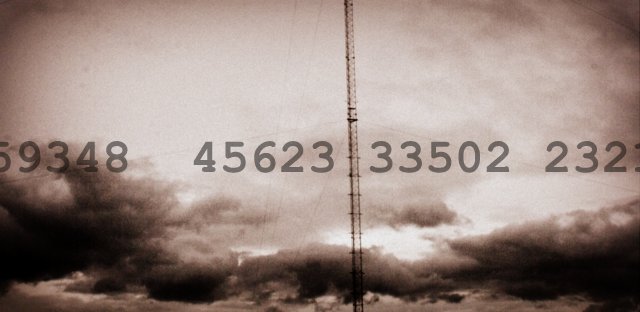
One news item that caught the attention of a large number of readers (thanks to all for the tips–!) was North Korean spy numbers. I’m very curious if any readers have logged and recorded this station–if so, please comment and consider sharing your recording!

The news was featured on at least two prominent news sites:

(Source: The Guardian)

North Korea’s radio broadcast of string of mysterious numbers is possible code

Numbers read on state radio may be cold war-era method of sending coded messages to spies in South Korea – or an attempt to wage psychological warfare

North Korea’s state radio has recently broadcast strings of indecipherable numbers, according to officials in Seoul, in a possible resumption of a cold war-era method of sending coded messages to spies operating in South Korea.

A female announcer at the radio station read numbers for two minutes on 24 June and 14 minutes on Friday, according to Seoul’s unification ministry and national intelligence service (NIS). A copy of those comments provided by the ministry included phrases such as “No 35 on Page 459” and “No 55 on Page 913”.[…]

(Source: BBC)

North Korea is criticised by South Korea for ‘spy broadcasts’

South Korean officials have criticised North Korea after it apparently resurrected a Cold War-era method of contacting spies.

In recent weeks, mysterious strings of numbers have twice been broadcast over the radio from the North.

A spokesman for the South’s Unification Ministry said it couldn’t be sure about North Korea’s “hidden intentions”.

But it urged the North to “desist from such outdated practices”.[…]

The Eleventh HOPE Conference

HOPE-2016

Many thanks to SWLing Post contributor, Ed, who writes:

You might consider reporting on The SWLing Post that there will be several talks at the The Eleventh HOPE conference this Fri/Sat/Sun that might interest your readers, including:

Tuning in to New York City’s Pirates of the Air

David Goren

Pirate radio in New York City is a homegrown cultural phenomenon that is at once aesthetically vibrant, technologically tumultuous, and undeniably illegal. Emanating from clandestine studios and hidden transmitters, the sounds of Kreyol, Yiddish, Spanish, and Caribbean-accented English waft into the urban atmosphere. On an average night in Flatbush, Brooklyn, it’s not uncommon to be able to hear as many as three dozen pirate stations between 87.9 and 107.9 Mhz. This flowering of outlaw micro-radio stations in Brooklyn and throughout the greater New York City region is a major disruption to the status quo of corporate controlled, robo-playlisted mega stations. Their unregulated presence and programming often reflects the throb and hum of a diverse city more authentically than traditional media outlets. Join radio producer David Goren for an audio tour of these stations featuring the music, programs, and personalities that make up New York City’s pirate radio scene.

Monitoring Dusty War Zones and Tropical Paradises – Being a Broadcast Anthropologist

Mark Fahey

Tuning in distant foreign radio and television stations is a conduit to unique and exotic information. These signals are often confronting, uncensored, and unsanitized. In the western world, we blur or pixelate images of death and torture, but signals from war zones or rebellions show tragedies happening live on the air. Other signals broadcast the joy of life on this planet through exotic song, music, and film. Digital wide-band recordings of the electromagnetic spectrum allow virtual time travel, a form of mental teleportation whereby recorded spectrum is tuned to hear stations as if they were being tuned in real time. Take a virtual tour of Mark’s monitoring station in Sydney, Australia which is wired to access the world’s mass media via whatever delivery conduit is needed to capture the content. The station receives hundreds of thousands of inbound digital audio and video channels that let him monitor domestic radio and television from most parts of the world. If he wants to watch breakfast television from Tibet, or maybe the nightly news from the remote Pacific islands of Wallis and Futuna, then it’s available in perfect studio quality. You’ll also see his visits to remote broadcasters and rare, uncensored video from telejournalists that captures the tragedies and joy served up by our planet.

Democratizing Wireless Networks with LimeSDR: Open Source, Field-Programmable RF Technology

Ebrahim Bushehri

This talk presents new, low-cost, open-source, field programmable RF technology, where flexibility is extended from the digital to the RF domain. See demonstrations from the open-source community using the LimeSDR platform, which incorporates two transmitters and two receivers covering 100kHz to 3.8GHz which can emulate GSM, LTE, UMTS, Wi-Fi, Bluetooth, Zigbee, RFID, HDTV, radio astronomy, passive RADAR, 2G/3G/4G cellsites, IoT gateway, amateur radio, wireless keyboard/mouse transmission/detection, aviation transponders, utility meters, satellite reception, remote tire pressure monitoring, drone command and control, RF test and measurement, and more.

We have more than 150 speakers this time over three days in three tracks.

Thank you Ed! I trust a number of SWLing Post readers will attend HOPE 2016. I certainly wish my travels would make it possible for me to attend this year–it would especially be great to see presentations by my good friends, David Goren and Mark Fahey.

Click here to view The Eleventh HOPE site.

UPDATE: Live streams

Many thanks to post reader, Aaron Kuhn, who notes the following:

In regards to those HOPE talks, the conference talks will be streamed.

[The] schedule of the talks is here:

https://hope.net/grid.html

The streams will be at:

http://livestream.com/internetsociety
http://livestream.com/internetsociety2
http://livestream.com/internetsociety3

(depending on the room the talk is in)

A Great Pirate QSL Card!

XFM927

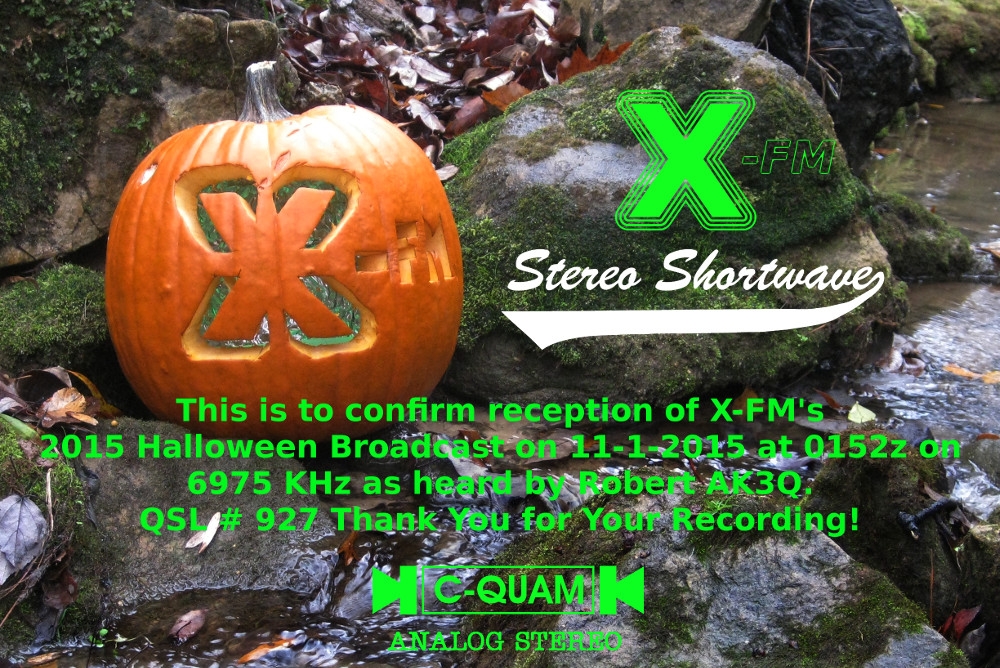
Here’s a great example of a QSL report from Pirate Station X-FM Stereo Shortwave monitored Halloween 2015. Not only is it a beautiful card, Redhat (the Deejay) also included the playlist as a .txt attachment.

As I recall he also made live announcements of who had left reception reports/comments on the HF Underground forum as well as for those who sent him emails directly.

I sent a short recording as part of my reception report, and it was an added bonus to see that mentioned in his QSL card.

I am quite impressed with all the effort made to turn out a quality QSL card, but a Pirate transmitting in stereo obviously appreciates quality!!

Pirate Radio receptions are memorable events on their own, but the QSL cards really make them special! Happy Pirate hunting!

Robert Gulley, AK3Q, is the author of this post and a regular contributor to the SWLing Post. Robert also blogs at All Things Radio.

The AAA-1C: An affordable loop antenna amplifier kit

Active-Antenna-the-kit-product-7

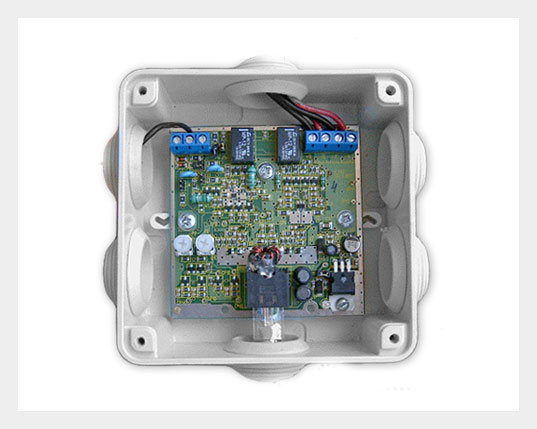
I recently stumbled upon the Active Antenna Amplifier (model AAA-1C) by LZ1AQ. At 87.00 EUR, it’s a pretty affordable and flexible solution for those who would like to design or use a loop antenna.

According to the website, it packs a lot of features:

  • 4 remotely switched modes (Loop A, Loop B, crossed parallel loops A&B and dipole)
  • Each mode can be switched immediately
  • Good sensitivity and a flat frequency response
  • High dynamic range
  • Protected input from strong signals
  • High immunity to local noise with balanced amplifiers and balanced feed line
  • Balun transformer coupling for common mode noise reduction
  • Extensive documentation manuals with detailed description how to build your own small antennas

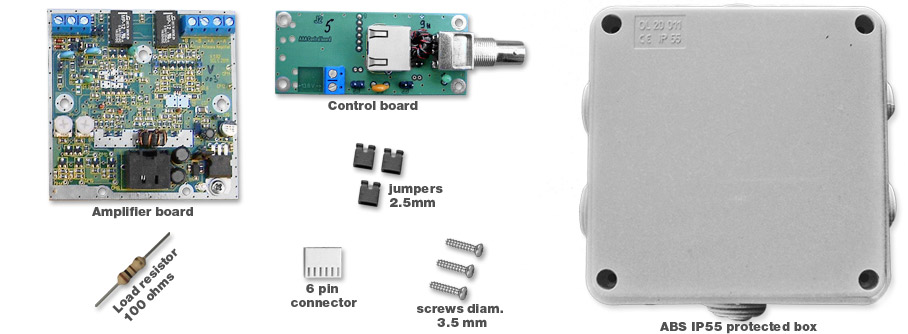
The amplifier is described as a kit because you must mount the board, wire up the antenna and set up remote switching yourself. It appears the SMT board comes pre-populated, though so I’m not sure if any actually soldering is required (perhaps someone can verify).

AAA-1B kit components

AAA-1C kit components

Click here to download the mounting instructions (PDF).

I’m tempted to purchase one this winter for use on mediumwave.

Click here for more info about the AAA-1C at LZ1AQ’s website.

Have any SWLing Post readers built and used this amplifier? Please comment!

Secret life of village that helped crack WWII code

WWii-radio(Source: Southgate ARC)

Whaddon: Secret life of village that helped crack WW2 code

On May 9, 2016, Milton Keynes Amateur Radio Society members operated GB1SOE to establish contact with French special event station TM75SOE using WWII equipment

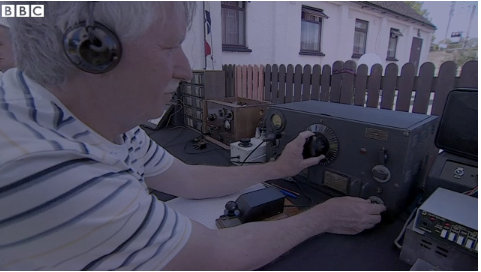
This was to commemorate the 75th anniversary of the first transmission sent back to Whaddon Hall, Buckinghamshire, by Special Operations Executive (SOE) agent Georges Begue. They operated from Whaddon Hall during Monday using a replica MKIII transmitter and HRO receiver,  on the French side a WWII B2 spy set was used.

The BBC report: The Codebreakers at Bletchley Park are well known for their top secret work which helped to change the course of the World War Two.

But the Buckinghamshire village of Whaddon, just a few miles down the road, has long been forgotten, despite the vital role it played. It was codenamed Section 8 and was a satellite station for Bletchley Park.

It is hoped a new memorial will give it its rightful place in history.

Watch the BBC TV report on the commemoration at Whaddon
http://www.bbc.co.uk/news/uk-36245666

A shorter version of the BBC report is at
http://www.bbc.co.uk/news/uk-36248874

Further information in the QRZ.com entries for TM75SOE and GB1SOE

Milton Keynes Amateur Radio Society (MKARS)
http://www.mkars.org.uk/

FM DXing: Troy’s unexpected catch

Troy-FM-DX

Many thanks to SWLing Post contributor, Troy Riedel, who writes:

Thomas, if I were to read this on your blog, I would not have believed the following.

I live in Virginia nearly equidistant from RIC/Richmond Int’l AP (east of Richmond) and PHF AP (in Newport News). I had a 1:40 P.M. doctor’s appt. [July 12] and I took to I-64 East en route to the doctor near Newport News. My Silverado has an XM Radio that I typically listen to, but the reception is bad in the summer because of the wooded nature of the interstate.

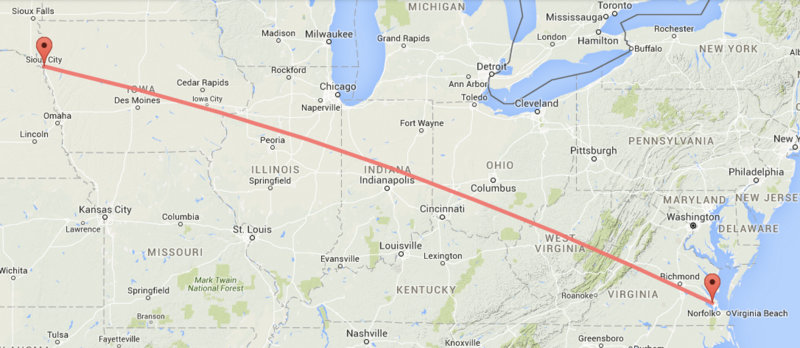
I hit the “FM” button and I quickly found a station at 105.7. There were two other 105.7 stations that periodically interfered, but one station was dominating/booming. After music I heard commercials about concerts in Iowa. I heard an Iowa Lottery Commercial. And a Lasik commercial – yes, all from Iowa. I heard a weather forecast that definitely wasn’t for Virginia. After 10-12 minutes I got a station I.D.. It was KSUX Sioux City, Iowa. Sioux City, Iowa is 1,332 miles away or an estimated 22-hour drive!

KSUX dominated the airwaves until I got very close to my Newport News, VA appt. By then (around 12:55 P.M.) I had picked-up one of the other two stations that were competing on 105.7. It was a station on the Outer Banks, NC (about 2.5 hours by car away).

When I went back to my Silverado at exactly 2 P.M., the KSUX was barely audible as the Outer Banks, NC station was now the most clear. I drove back towards my home on I-64 West and after a few miles (5-10 at most) the third of the three stations became clear. The third station was “Kiss 105.7” originating in Richmond, VA. That means the Sioux City, Iowa station, 1,332-miles away, had obliterated the Richmond, VA signal from 12:30 P.M. to almost 1:00 P.M. even though at this juncture of my drive Richmond was 45-55 miles away.

The KSUX Sioux City, IA station … even though weak on the drive home … still occasionally popped through the airwaves to cause interference with the Richmond, VA signal.

If I hadn’t heard it, I would have never believed it. I did a quick check and I didn’t see anything regarding closer stations possibly simulcasting the KSUX signal. It appears to be 100% legit.

I’m dumbfounded. It’s a head scratcher for sure.

Thanks for sharing your experience, Troy. You, sir, were the recipient of some excellent FM DX openings!

FM DXing conditions

There are a few conditions that make for proper FM DX:

  1. Sporadic-E and tropospheric ducting (DXers often call this, “Tropo”)
  2. Meteor scatter, where signals bounce off of ionized trails left by meteors
  3. Also, when there is exceptionally high sunspot activity, FM signals have been known to bounce off the ionosphere (like shortwave signals)

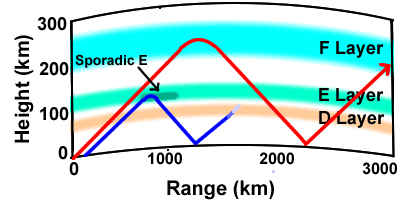
I strongly suspect you were enjoying FM DX from sporadic E. If memory serves (and keep in mind, I’m currently vacationing in an off-grid cabin without Internet), we had a K Index of 5 or so on July 12–at least, I believe I heard a ham radio operator report this on 40 meters that day. I can confirm that the HF bands were absolutely obliterated parts of that particular day. Conditions were very unsettled for the HF (high-frequency) bands, but potentially excellent for sporadic E.
Source: Wikimedia

Source: Wikimedia

Fred Osterman writes about Sporadic E on DXing.com:

Sporadic-E propagation is caused by patches of intense ionization in the E-layer of the ionosphere (approximately 35 to 60 miles above the Earth’s surface). Signals on frequencies above 30 MHz normally pass through the ionosphere and into space. However, sporadic-E “clouds” are capable of refracting such signals back to Earth. The term “clouds” is an apt way to describe the patches of highly charged particles that form during a sporadic-E event. Like clouds, these patches move and are highly irregular in size and shape. It is possible to track the movement of a sporadic-E “cloud” by noting the locations of stations that fade in and out on a frequency as the cloud moves.

Sporadic-E propagation can occur any time of day or year. However, sporadic-E is most common from about mid-May to late July, with another peak a week before and after the winter solstice. Sporadic-E seems to be most common from about mid-morning to noon, local time, and again from late afternoon through the evening hours.

If you’re interested in chasing a little FM DX (’tis the season–!), read Fred’s full article about FM and TV DXing on DXing.com. What I like about Fred’s article is that it’s simple and easy to understand.

Post readers: Has anyone else enjoyed a little FM DX this summer? Please comment! This is a part of the DXing hobby that I rarely feature on the SWLing Post, but would love to highlight more often. Let me know if you’d like to write a guest post on this topic!

DZRP Radyo Pilipinas: advice on obtaining a QSL

dzrpI thought this little tidbit or two of information might be useful to those DX’ers seeking a QSL from DZRP Radyo Pilipinas.

DZRP broadcast in English and Filipino on several frequencies, as seen here: http://shortwaveschedule.com/index.php?station=1089

I found two email addresses listed for them, [email protected] and [email protected]  which I’ve sent reception reports too, but I can’t say either of the two QSL’s I’ve gotten from them came because of the email address. What worked?

Contacting them on Facebook!

It took a few days, but sending the reception report to them via private/inbox message on Facebook got a reply with a promise of a QSL card each time!

Find them on Facebook here: https://www.facebook.com/DZRPRadyoPilipinas/

While writing this post, I found a third email address, [email protected], which I didn’t know about before. Radyo Pilipinas posted this one on their Facebook page in reply to a DX’er asking about reception reports and QSL cards.

Paul Walker is located in Galena, Alaska and is a regular contributor to the SWLing Post. Be sure to check out Paul’s YouTube channel and SoundCloud channel where everything he logs is recorded and posted. Click here to read his other contributions on the SWLing Post.