Category Archives: Nostalgia

Preserving Radio History in Your Community

Many thanks to SWLing Post contributor Dan Greenall, who writes:

I have lived in southern Ontario, Canada my entire life, have been DXing since the late 1960’s and have held the amateur radio call sign VE3HLC for over 50 years.  Most of this area’s AM broadcast stations had been considered “pests” over the years as I searched for more distant targets, until recently, when many of these began quietly slipping from the airwaves.  While this opened up some new frequencies to DX, I soon began to feel that I had lost some old friends, many that I had known since childhood.

When I retired in 2018, I decided to spend a little time trying to preserve some radio history of stations in southern Ontario communities that have played a part in my life. This might include audio clips, QSLs, station booklets, and other types of ephemera, and I would try to place this information where it could be easily accessed by future historians or anyone else who is interested.  In the end, I chose to use the Internet Archive (archive.org), where most uploaded information can be viewed (or heard) and downloaded for free.

CFPL, London, Ontario   980 kHz (still on the air)

“Communications in the Community” is a hardcover limited edition (2000 copies) souvenir book printed in 1966 by the Special Printing Unit of The London Free Press in London, Ontario, Canada.  It includes historical information about the London Free Press (newspaper) and CFPL radio and television.  I was lucky to find this item at a church rummage sale nearly 20 years ago.

CFPL began its life as CJGC in 1922. I acquired one of their QSL cards from 1925 through an eBay purchase a few years ago.

The above and more can be found by clicking on this link.

https://archive.org/details/page-16

CKOC, Hamilton, Ontario 1150 kHz (still on the air)

CKOC radio in Hamilton also started up in 1922.  My parents met while working at the station in the late 1940’s.  My brother and I (both radio amateurs), along with a few friends were given permission to operate on “Field Day” weekend in 1985 from their old abandoned transmitter site at Elfrida, Ontario.

This area has long since been developed to build homes and shopping areas.

“This is Hamilton, Ontario and the story of broadcasting station CKOC” is an undated booklet (I am guessing circa 1950) that I was able to purchase on eBay.  Also found on eBay were two verifications, one from 1931 and the other from 1983.

You can find these scans and more by following this link.

https://archive.org/details/page-13_202209

CKNX, Wingham, Ontario 920 kHz (still on the air)

This station began in 1926 using the unusual call sign 10BP.  It would remain that way until 1935.  I managed to secure this QSL from 1932 through eBay, signed by its founder W.T. “Doc” Cruickshank.

Interesting stories of how the station began can be found at this link.

https://www.communitystories.ca/v1/pm_v2.php?id=story_line&lg=English&fl=0&ex=386&sl=2541&pos=1&pf=1

CKCR, Kitchener-Waterloo, Ontario 1510 kHz  (no longer on the air)

In 1924, this station began briefly in nearby Brantford, Ontario. It quickly moved to Kitchener-Waterloo and existed until 1965 when it became CKGL.  The CKCR call sign was picked up later in 1965 by a station in Revelstoke, BC.

Another eBay purchase, I found this QSL with a not-to-scale map of southern Ontario from 1934.

More Ontario QSL’s can be found in my broadcast band gallery at this link: https://archive.org/details/ckoc-hamilton-on-1983

I would encourage others to save parts of the local radio history in their city, state, province or country and give back to the hobby that we have enjoyed for so many years.   I would also be happy to hear about any efforts you have made!

Bob’s Radio Corner: Uncle Clayton and His National NC-188

National NC-188

As recalled by Bob Colegrove

Uncle Clayton was my very first SWLing buddy.  In the late ‘50s there was no Internet – very few ways for SWLs to interact with one another.  There were clubs that published mimeograph bulletins every month or so.  These were mailed to SWLs across the country and around the world.  To come across a fellow SWL in your own town was rare.  As chance would have it, Uncle Clayton and I quite independently discovered our interest in SWLing about the same time, and then only after knowing one another for several years.

Uncle Clayton was not my real uncle.  He and his wife, Evelyn, were dear friends of my mother and father.  You see, there was a social decorum at that time which frowned upon members of the younger generation from referring to members of an older generation by their first name.  At the same time, “Mr. Smith” and “Mrs. Smith” (not their real surname) were regarded as unnecessarily formal; so, for this situation “Uncle Clayton” and “Aunt Evelyn” became the accepted form of address.

My story begins with television, not radio.  By mid-1950 both the Smiths and the Colegroves had acquired their first black and white TV “sets,” theirs a 12-inch RCA and ours a 12-inch Arvin.  Each of these occupied 8 to 12 cubic feet of space and required two well-fit individuals to move them.  Ironically, they were termed “portable” in that they required a low table or stand for proper positioning.  This contrasted with “console” models which incorporated the stand and the TV in a single cabinet.

One must understand that television at that time was what computers would become a generation later.  The nation was on the cusp of a TV frenzy.  My dad and Uncle Clayton jumped into it with both feet.  They couldn’t let the darn things alone.  Antennas were the most obvious source of tinkering.  “Rabbit ears” were the customary solution but adjusting them was a skill rivaling that of playing a cello.  Later, attic designs were fabricated for the new channel in Bloomington, Indiana.

Vaccum tubes, both necessarily and unnecessarily, became questionable components, and Uncle Clayton and my dad developed well-stocked arsenals of spares.  In retrospect the pair were, well…a couple of hacks, and I say that lovingly.  Picture two large, middle-aged men behind the RCA with the back cover off alternately trying to get a 9-pin peanut tube aligned and reinserted into its socket in the very front of the chassis – all this while trying to avoid the high-voltage discharge from the picture tube.  I still recall the looks of frustration and muffled puffs of blue air.  After some time, Aunt Evelyn appeared, looked over the dilemma, grabbed the tube, and jabbed it into the socket on the first try.

SWLing came along several years later.  I discovered it in the fall of 1958 while idly tinkering with the Howard Radio Co. Model 308 radio-phonograph console, which by that time had been relegated to the basement.  After moving it to my room and stringing up a long wire I was forever captivated.  The single SW band covered 5.5 MHz through 18 MHz across a dial a mere four inches long.  I milked that old radio relentlessly finally coming up with about 20 or 30 SW broadcast stations, all in English.

I have no recollection of how Uncle Clayton and I discovered we were going down the same path.  He had already purchased his National NC-188 with a matching speaker and set up his shack in an unused upstairs bedroom.  How I envied him.  His NC-188 was everything I envisioned in a SW radio. I was still earning my way towards purchasing a Hallicrafters S-38E.

National NTS-1 Speaker for the NC-188 and NC-109.
Better radios had separate external speakers, the claim being that there was insufficient space in such feature-packed units

Uncle Clayton’s NC-188 was my first encounter with a bandspread – a term which has virtually gone out of existence.  I immediately knew what it did, but it would take me a while to understand just how it worked.  On my old Howard console, the dial pointer travelling less than a 16th inch could cover 100 kHz or more, conceivably containing 10 or 20 stations.  Furthermore, this range was traversed by a nearly imperceptible rotation of a small knob.  Conversely, the NC-188 might cover the same tuning range over a space two inches long and require four full rotations of a 2-in diameter knob.  That was an incredible mechanical advantage.

For SWLs, there was a restriction on the use of the bandspread.  Most receivers had scales neatly calibrated for the 10-, 15-,20-, 40-, and 80-meter ham bands.  This provided reasonable frequency readout – not the precision we have with today’s digital radios, but close enough.  For international broadcast bands, the listener had to rely on a 0 to 100 linear logging scale which bore no relation to frequency.  This required the listener to generate several lists or graphs translating log readings to frequency.

The NC-188 and -109 had 4.5” bandspreads, not as long as some, but the 2” knob required 9 full rotations to traverse end-to-end.

Everything I have described so far depended on the position of the main tuning dial.  The bandspread operated electronically in parallel with the main tuning.  In short, the main tuning dial had to be positioned precisely at the high end of the tuned band for the bandspread to produce the same results.  Within these restrictions, a bandspread was still a marvelous device.

Uncle Clayton and I were still in our formative SWLing period when our family would visit him and Aunt Evelyn.  I remember him patiently tuning across portions of the SW spectrum oblivious of the international band boundaries slowly rotating the main tuning dial and stopping at points that interested him.  When my turn at the helm came, I would often seek out the General Overseas Service of the BBC and listen to the football scores or Victor Sylvester and his Ballroom Orchestra.

Victor Silvester conducting his Ballroom Orchestra in 1938. His orchestra was still a fixture on the BBC in the ‘50s and ‘60s. Source:  Victor Silvester and His Orchestra – You’re Dancing on My Heart

Neither Uncle Clayton nor I set the bar very high in terms of DXing prowess.  We had fun and made a lot of interesting discoveries.  Isn’t that what it’s all about?

Some years ago, I had the opportunity to buy a fairly clean National NC-109.  The -109 is an upscale version of the -188.  It has a crystal filter, an early SSB product detector and a voltage regulator.  Otherwise, the two radios are virtually identical.  I did all the usual things, cleaned it up, performed an alignment, and restrung the main tuning and bandspread dial cords.  Later I found a matching speaker.  When I was finished, I had what I regard as a museum-quality radio.  It occupies a prominent corner of the shack, but I don’t operate it that much.  Sometimes I just sit in front of it, spin the dials and remember Uncle Clayton and how it all started.

National NC-109

Shortwave in a Joe Meek Track? Help Identify These 1966 Sounds

Many thanks to SWLing Post contributor and buddy, One Deck Pete, who writes with a question.

I am not sure if I have sent you this before but this alternative version of a Joe Meek produced single has what I think are shortwave samples bookending it and also a couple of times during the tune.

[Note that Pete originally posted this video on his own blog.]

Have you any guesses what they could be? It was produced in 1966, Joe Meek was a bit of an electronics wizard and I was told subscribed to Practical Wireless and loved a sound effect. It sounds like some fast Morse, telemetry or RTTY but I could be wrong.

Perhaps it isn’t shortwave-based but it sounds like it to me!

How about it SWLing Post readers? What are those digital sounds at the beginning and end of this recording? (Bonus points if you can decode!)

KBS World Radio – Then and Now

Many thanks to SWLing Post contributor Dan Greenall, who writes:

Back in the 1980’s, KBS World Radio was known as Radio Korea, and they could be heard quite well at times here in eastern North America. Even with modest receiving equipment, their familiar interval signal, that included regular ID’s in English and Korean, made it fairly easy to spot.

The recording here (circa 1983) was made in Brantford, Ontario, Canada, using a Panasonic RF-3100 portable receiver and a long wire antenna. As a bonus, this station offered a variety of colorful QSL cards to its listeners.

Today, KBS World Radio from Seoul in the Republic of Korea continues to offer programs via shortwave in several languages including English. Transmitter power up to 250 kw is used so they should be audible in most parts of the world. “Sign on” is strikingly similar using the same interval signal with bi-lingual ID’s and opening music.

They also use some of the same frequencies, including 9570 and 15575 kHz, that they have broadcast on for decades. This recording was made using a remote SDR in Hong Kong on August 14, 2025 on 15575 kHz around 1300 hours UTC.

“The Rarest DX In The World” – A 33 RPM Journey Through 1960s Shortwave

Many thanks to SWLing Post contributor Bruce, who writes:

Hi Thomas,

I came across this item on eBay and then found a copy on YouTube:

Enjoy!

– Bruce F.

Wow–what a nostalgic treat! Thank you for sharing, Bruce!

The eBay seller listed all of the broadcasters on the recording:

Side “A”

    1. RadioNepal, Kathmandu, Nepal [00:00]
    2. Radio Thailand, Bangkok,Thailand [04:10]
    3. Fiji Broadcasting Commission, Suva, Fiji[07:09]
    4. Voice of Kenya, Nairobi, Kenya [09:53]
    5. Radiodiffusion du Togo, Lome, Togo [11:57]
    6. Sierra Leone Broadcasting Service, Freetown, Sierra Leone [16:55]
    7. Radiodiffusion-Television Belge, Brussels, Belgium [18:27]

Side “B”

    1. RadioVietnam, Saigon, South Vietnam [00:00]
    2. Radio Hong Kong, HongKong [3:45]
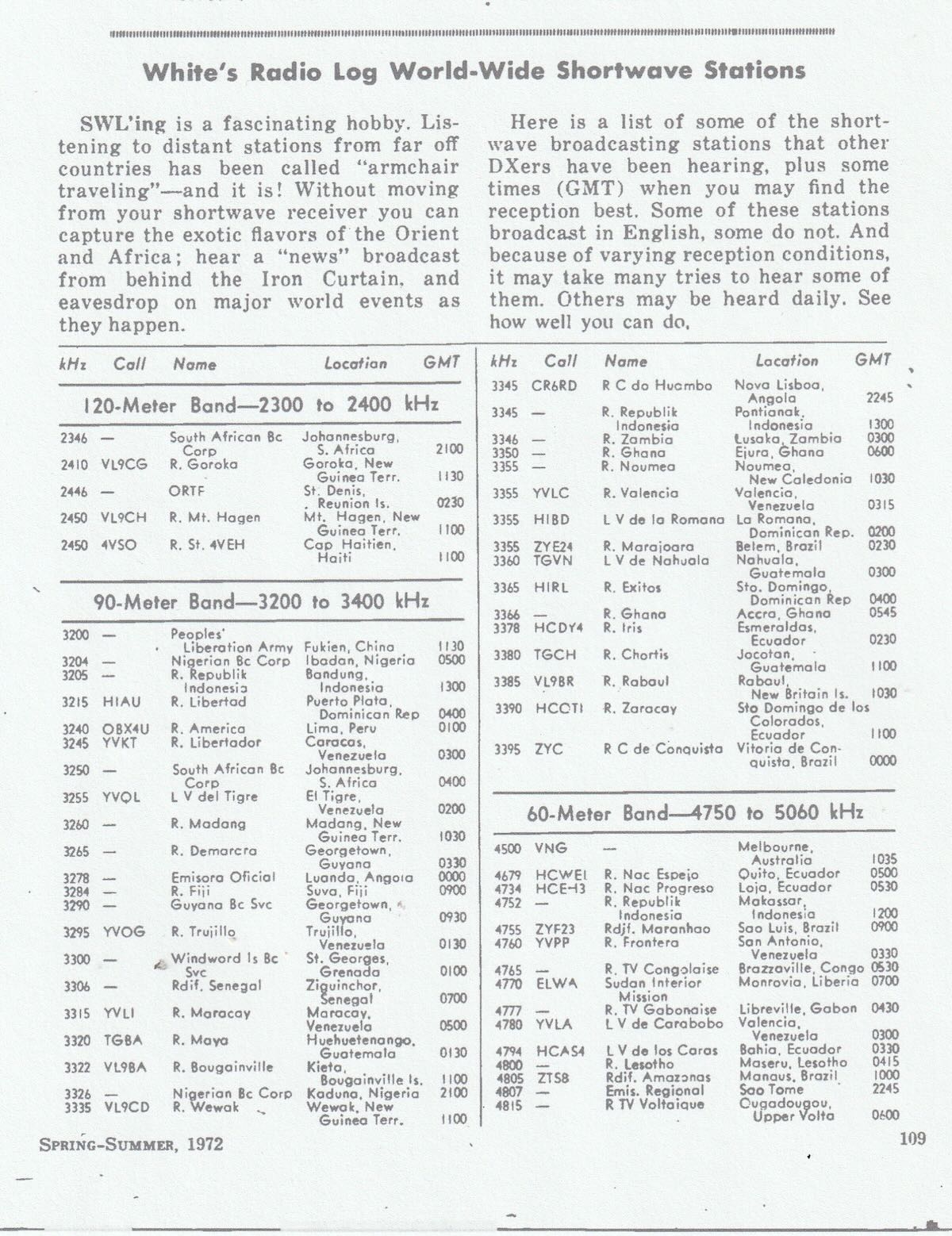
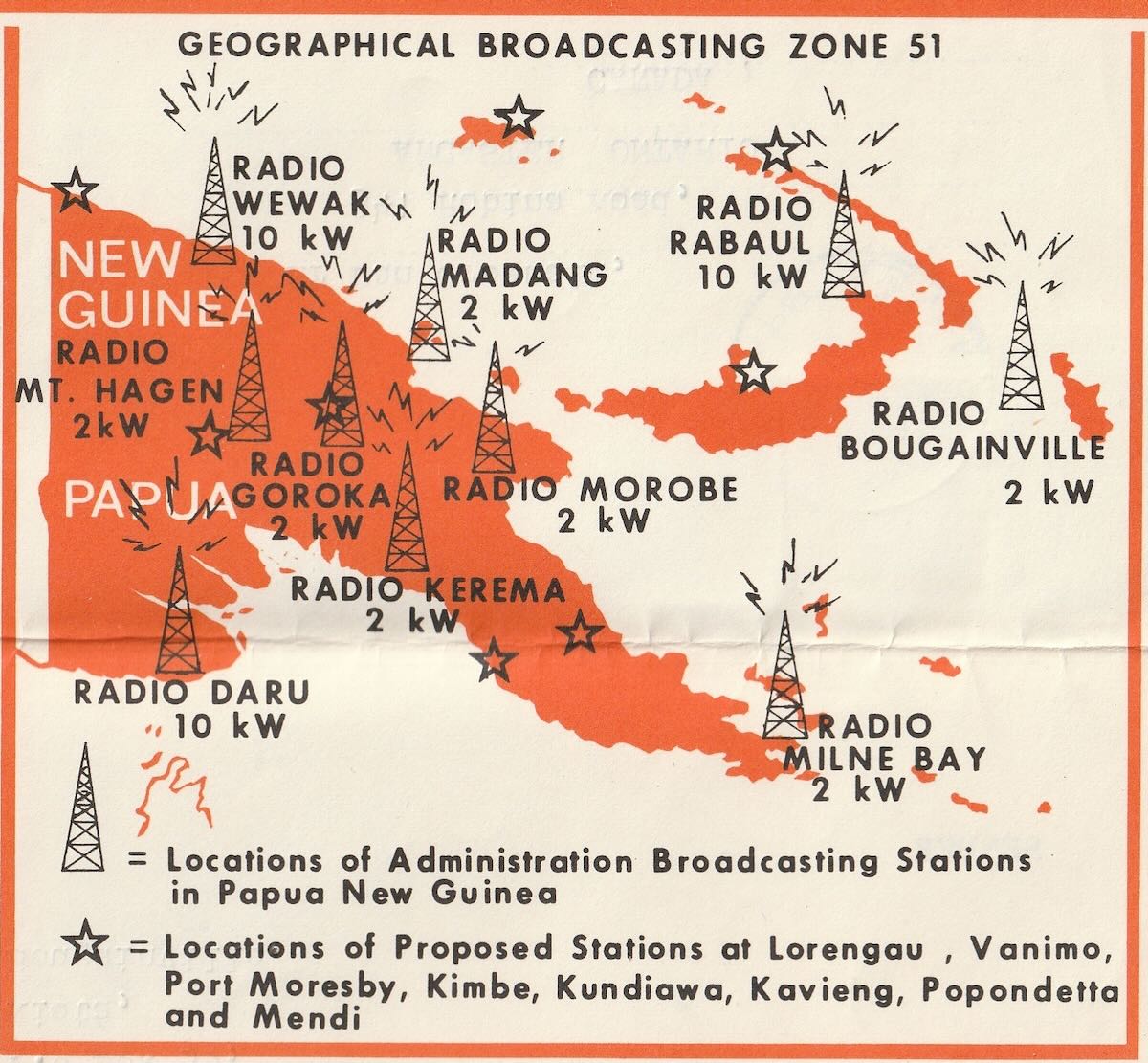
    3. Radio Wewak (VL9CD), Wewak, Papua New Guinea[04:19]
    4. Voice of Tarawa /Gilbert & Ellice IslandsBroadcasting Service (VTW2), Tarawa [07:35]
    5. Radio CookIslands, Rarotonga, Cook Islands [12:36]
    6. Radio Mauritania,Nouakchott, Mauritania [16:22]
    7. Radio Andorra, Roc Des Anellettes, Andorra [18:01]

I’m wondering if any readers have a copy of this record and can share a photo of the jacket notes. I haven’t been able to find a clear image of the back cover online. I’m interested in finding out who produced the album—any information would be appreciated!

Dan Shares Recordings of the Golden Days of European Shortwave Listening

Many thanks to SWLing Post contributor Dan Greenall, who shares the following guest post:


Europe on shortwave in the 1970’s

by Dan Greenall

During the golden years of shortwave listening, many European countries had an international shortwave service and broadcast programs to North America (where I live) in English. As a result, these stations were usually among the first that a newcomer to the hobby would find.  However, since there was no internet or e-mail, schedules often had to be found in the various club bulletins and hobby magazines.  QSLs arrived through the postal system and could often take months to arrive.

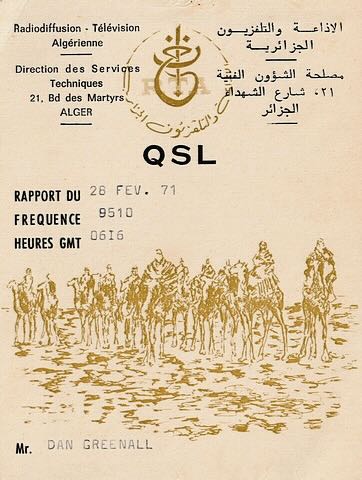
I soon developed the habit of making a brief recording of each station as additional “proof of reception,” and many of these have survived to this day.  These were typically made by placing the microphone directly in front of the speaker of my receiver.  In recent years, they have been uploaded to the Internet Archive, and links to some of them from the early 1970s can be found here.

[Note that each title links to the Archive.org page where you can find more information and QSLs.]

Radio Moscow

Deutsche Welle, Cologne 

Radio Berlin International 

Belgian Radio

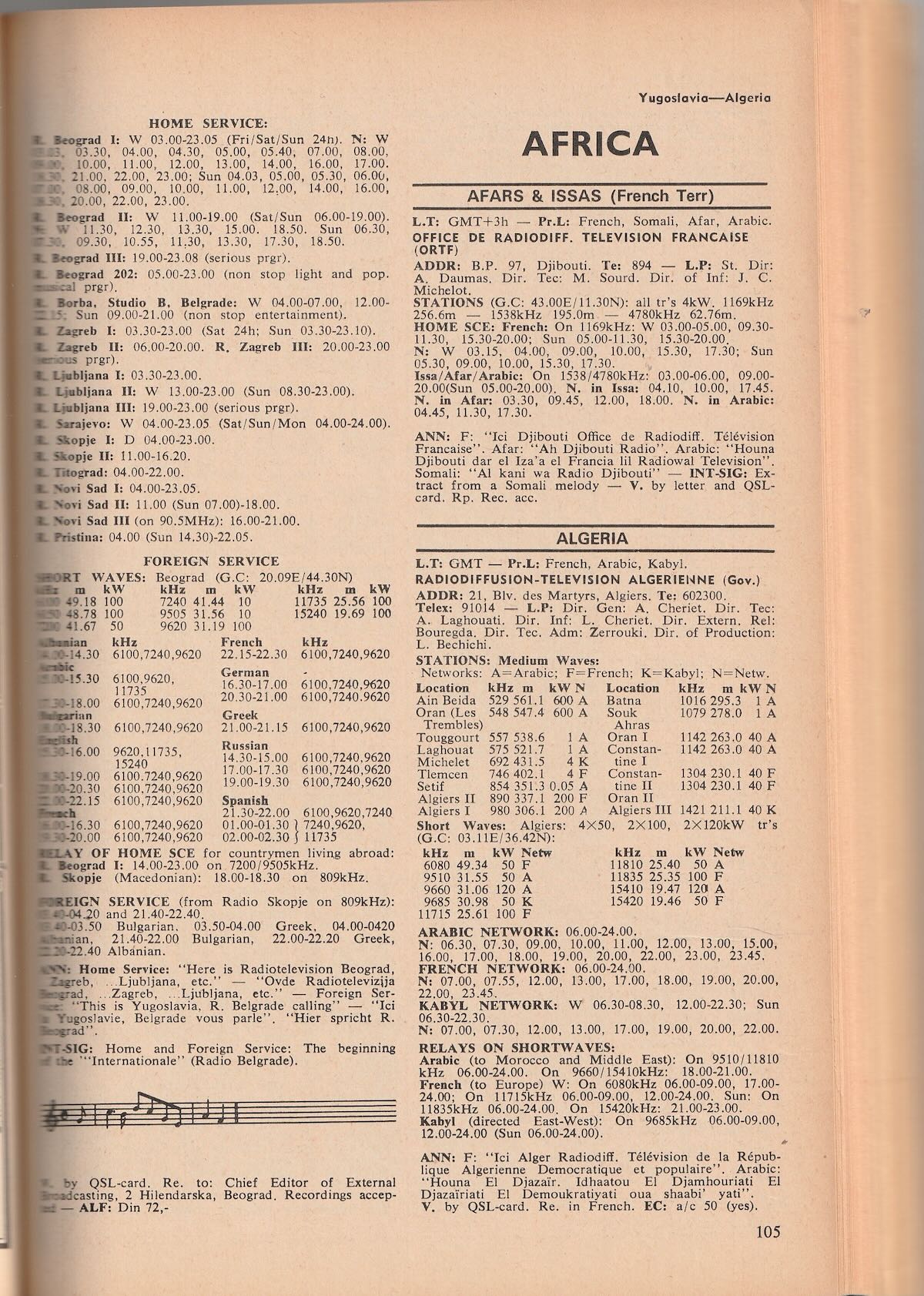
Radio Belgrade

RAI, Rome

ORTF, Paris

IBRA Radio via Radio Trans Europe in Portugal

Radio Sofia Bulgaria

Austrian Radio

Radio Prague

Radio Denmark

Radio Luxembourg

Vatican Radio

Radio Sweden

Trans World Radio Monte Carlo

Radio Kiev

Radio Free Europe

Radio Nordsee International

Mexico on Shortwave – Then and Now

by Dan Greenall

Back in the early 1970’s, a wide variety of Mexican stations could be heard on shortwave as evidenced by the loggings columns in the SPEEDX club’s monthly bulletins. Examples from this time period can be found here:

https://www.worldradiohistory.com/Speedx.htm

As well, the late Dr. Richard E. Wood wrote about what was available to be heard from Mexico in the 1971 Communications Handbook on page 18. You can read this here:

A brief recording of La RH, Radio Tricolor (in Spanish) on 11880 kHz from Mexico City can be found here:

The official international broadcaster, Radio Mexico, was known to issue colorful station pennants like the one pictured. Click here to listen to their ID’s in Spanish (though they did use some English) by a female and male announcer, likely on 21705 kHz (one of the many frequencies they used).

Currently, the only station broadcasting from Mexico on shortwave is Radio Educacion, XEPPM, from Mexico City on 6185 kHz. This recording was made on July 10, 2025 using a remote SDR close to the transmitter to ensure the best overall quality. The QSL attached is one received by my (then) 12 year old son in 1994.